P46 (P.Mich. inv. 6238): Galatians 3:2-29 (fols. 83r-83v)
Introduction
P46 is a papyrus codex of the letters of Paul copied in Egypt around 200, the oldest surviving collection of Paul's letters. 86 of its 104 leaves survive: 56 in the Chester Beatty Library, Dublin (Biblical Papyrus II, published by Frederic Kenyon in 1934-1937) and 30 in the University of Michigan Library, Ann Arbor (P.Mich. inv. 6238, published by Henry Sanders in 1935). The letters run in the order Romans, Hebrews, 1 and 2 Corinthians, Ephesians, Galatians, Philippians, Colossians and 1 Thessalonians; the first seven leaves (Romans 1:1-5:17) and the end of the book are lost. Hebrews standing after Romans, and the doxology of Romans (16:25-27) standing after 15:33, are among its best-known features.
Each section below is one page side: the holding library's photograph, the NTVMR diplomatic transcription line by line, and the King James Version of every verse that has text on the page. The lower lines of many leaves are lost; the transcribers' restorations are in square brackets.
This entry covers fols. 83r-83v (Galatians 3:2-29).
How was this verified? (Provenance)
Where on the image
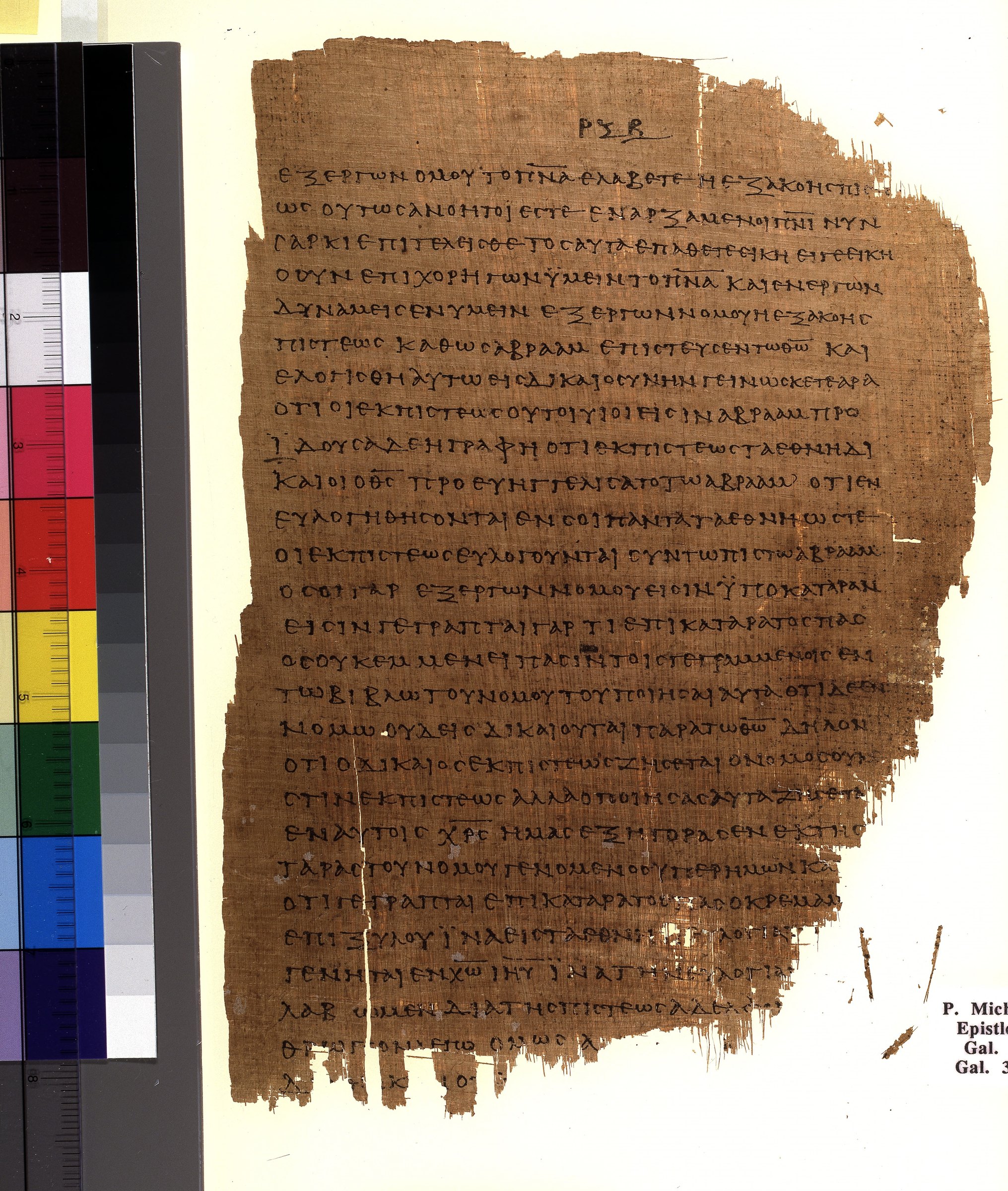
University of Michigan Library photograph 10046x6238_162JP2_UMich.jpg (https://ntmss.info/images/webfriendly/10046/10046x6238_162JP2_UMich.jpg), linked to NTVMR page 1470 (folio 83r) in NTVMR's page index. 3:2 begins on the previous page. Checked on the image: the scribe's page number ρξβ (162) at the head of the page, continuing the sequence of the neighbouring pages; the first line reads ‹εξ εργων νομου το π̅ν̅α̅ ελαβετε η εξ ακοης πι...›, as in the transcription.
3:2 εξ εργων ομου το π̅ν̅α̅ ελαβετε η εξ ακοης πιστ̣ε̣
ως 3 ουτως ανοητοι εστε εναρξαμενοι π̅ν̅ι̅ νυν
σαρκι επιτελεισθε 4 τοσαυτα επαθετε εικη ει γε εικη
5 ο ουν επιχορηγων υμειν το π̅ν̅α̅ και ενεργων
δυναμεις εν υμειν εξ εργων νομου η εξ ακοης
πιστεως 6 καθως αβρααμ επιστευσεν τω θ̅ω̅ και
ελογισθη αυτω εις δικαιοσυνην 7 γεινωσκετε αρα
οτι οι εκ πιστεως ουτοι υιοι εισιν αβρααμ 8 προ
ιδουσα δε η γραφη οτι εκ πιστεως τα εθνη δι
καιοι ο θ̅ς̅ προευηγγελισατο τω αβρααμ οτι εν
ευλογηθησονται εν σοι παντα τα εθνη 9 ωστε
οι εκ πιστεως ευλογουνται συν τω πιστω αβρααμ
10 οσοι γαρ εξ εργων νομου εισιν υπο καταραν
εισιν γεγραπται γαρ τι επικαταρατος πας
ος ουκ εμμενει πασιν τοις γεγραμμενοις εν
τω βιβλω του νομου του ποιησαι αυτα 11 οτι δε εν
νομω ουδεις δικαιουται παρα τω θ̅ω̅ δηλον
οτι ο δικαιος εκ πιστεως ζησεται 12 ο νομος ουκ̣ ε̣
στιν εκ πιστεως αλλα ο ποιησας αυτα ζησετα[ι]
εν αυτοις 13 χ̅ρ̅ς̅ ημας εξηγορασεν εκ της [κα]
ταρας του νομου γενομενος υπερ ημων κατ̣[αρα]
οτι γεγραπται επικαταρατος πας ο κρεμαμ[ενος]
επι ξυλου 14 ινα εις τα εθνη η ευλογια τ[ου αβρααμ]
γενηται εν χ̅ω̅ ι̅η̅υ̅ ινα την ευλογιαν̣ [του π̅ν̅ς̅]
λαβωμεν δια της πιστεως 15 αδελφ̣ο̣ι [κατα αν]
θρωπ̣ον λ̣εγω ομως α[νθρωπου] κ̣[εκυρωμενην]
δ[ια]θ̣η̣κ[η]ν̣ ου̣δ̣[εις αθετει η επιδιατασσεται]
3:2This only would I learn of you, Received ye the Spirit by the works of the law, or by the hearing of faith? 3Are ye so foolish? having begun in the Spirit, are ye now made perfect by the flesh? 4Have ye suffered so many things in vain? if it be yet in vain. 5He therefore that ministereth to you the Spirit, and worketh miracles among you, doeth he it by the works of the law, or by the hearing of faith? 6Even as Abraham believed God, and it was accounted to him for righteousness. 7Know ye therefore that they which are of faith, the same are the children of Abraham. 8And the scripture, foreseeing that God would justify the heathen through faith, preached before the gospel unto Abraham, saying, In thee shall all nations be blessed. 9So then they which be of faith are blessed with faithful Abraham. 10For as many as are of the works of the law are under the curse: for it is written, Cursed is every one that continueth not in all things which are written in the book of the law to do them. 11But that no man is justified by the law in the sight of God, it is evident: for, The just shall live by faith. 12And the law is not of faith: but, The man that doeth them shall live in them. 13Christ hath redeemed us from the curse of the law, being made a curse for us: for it is written, Cursed is every one that hangeth on a tree: 14That the blessing of Abraham might come on the Gentiles through Jesus Christ; that we might receive the promise of the Spirit through faith. 15Brethren, I speak after the manner of men; Though it be but a man’s covenant, yet if it be confirmed, no man disannulleth, or addeth thereto.
Where on the image
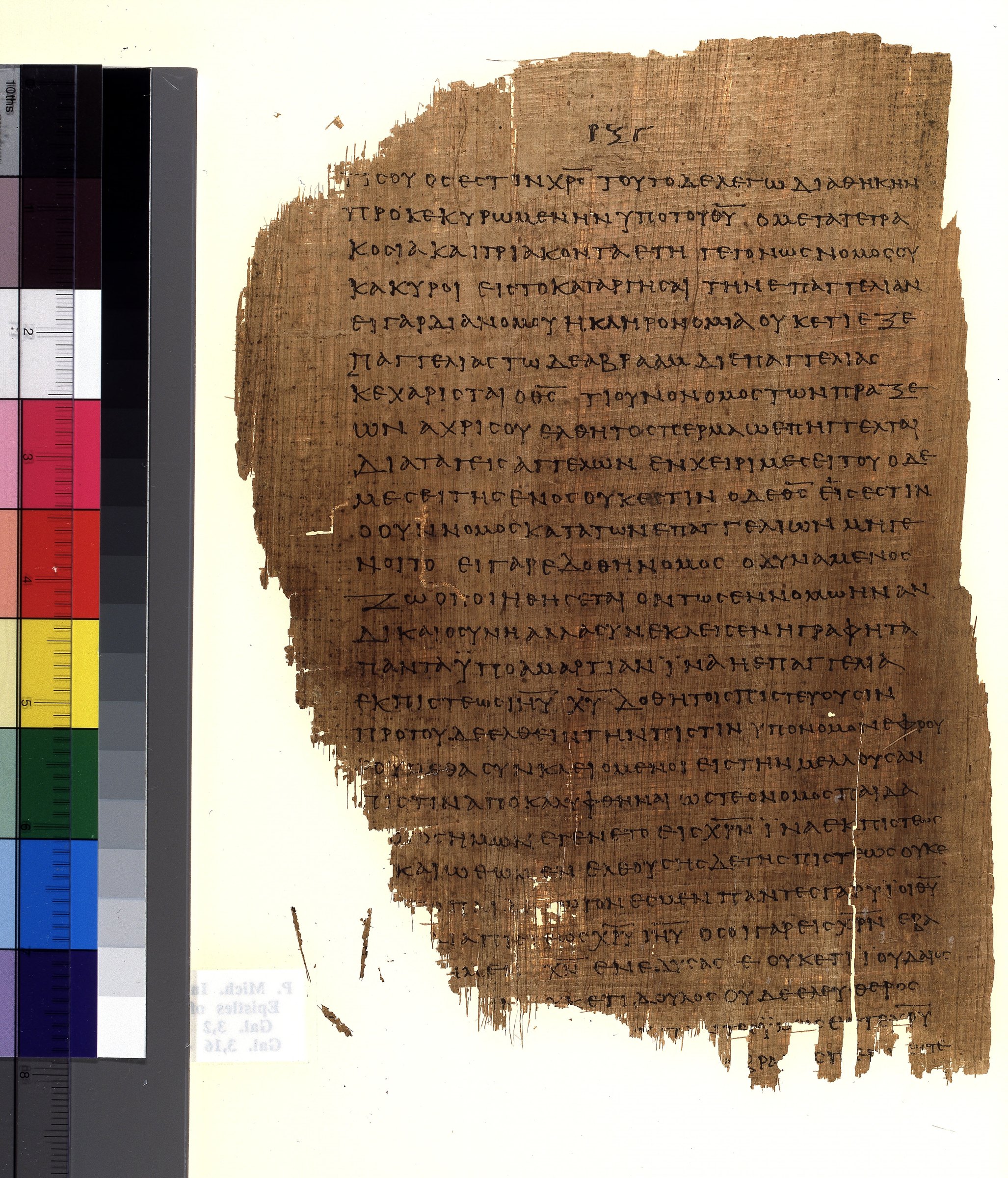
University of Michigan Library photograph 10046x6238_163JP2_UMich.jpg (https://ntmss.info/images/webfriendly/10046/10046x6238_163JP2_UMich.jpg), linked to NTVMR page 1480 (folio 83v) in NTVMR's page index. 3:16 begins on the previous page; 3:29 continues on the next page. Checked on the image: the scribe's page number ρξγ (163) at the head of the page, continuing the sequence of the neighbouring pages; the first line reads ‹...ος εστιν χ̅ρ̅ς̅ τουτο δε λεγω διαθηκην›, as in the transcription.
3:16 τι σου ος εστιν χ̅ρ̅ς̅ 17 τουτο δε λεγω διαθηκην
προκεκυρωμενην υπο του θ̅υ̅ ο μετα τετρα
κοσια και τριακοντα ετη γεγονως νομος ου
κ ακυροι εις το καταργησαι την επαγγελιαν
18 ει γαρ δια νομου η κληρονομια ουκετι εξ ε
παγγελιας τω δε αβρααμ δι επαγγελιας
κεχαρισται ο θ̅ς̅ 19 τι ουν ο νομος των πραξε
ων αχρις ου ελθη το σπερμα ω επηγγελται
διαταγεις αγγελων εν χειρι μεσειτου 20 ο δε
μεσειτης ενος ουκ εστιν ο δε θ̅ς̅ εις εστιν
21 ο ουν νομος κατα των επαγγελιων μη γε
νοιτο ει γαρ εδοθη νομος ο δυναμενος
ζωοποιηθησεται οντως εν νομω ην αν
δικαιοσυνη 22 αλλα συνεκλεισεν η γραφη τα
παντα υπο αμαρτιαν ινα η επαγγελια
εκ πιστεως ι̅η̅υ̅ χ̅υ̅ δοθη τοις πιστευουσιν
23 προ του δε ελθειν την πιστιν υπο νομον εφρου
ρ̣ουμεθα συνκλειομενοι εις την μελλουσαν
πιστιν αποκαλυφθηναι 24 ωστε ο νομος παιδα
[γ]ω̣γος ημων εγενετο εις χ̅ρ̅ν̅ ινα εκ πιστεως
[δι]καιωθωμεν 25 ελθουσης δε της πιστεως ουκε
[τι υ]π̣ο παιδαγ̣ωγον εσμεν 26 παντες γαρ υιοι θ̅υ̅
[εστε] δ̣ια πιστεως χ̅ρ̅υ̅ ι̅η̅υ̅ 27 οσοι γαρ εις χ̅ρ̅ν̅ εβα
[πτισθ]η̣μεν χ̅ν̅ ενεδυσασθ̣ε 28 ουκετι ιουδαιος
[ουδε ελλ]η̣ν̣ [ο]υκετι δουλος ουδε ελευθερος
[ουκ ενι αρσεν και θηλ]υ̣ π̣α̣ν̣τες υμε̣ι̣ς εσ̣τε χ̣̣̅ρ̅υ̅
[ι̅η̅υ̅] 29 [ει δε υμεις χ̅ρ̅υ̅ αρα του] α̣βρα[αμ] σπερ̣μ̣[α] εστε
3:16Now to Abraham and his seed were the promises made. He saith not, And to seeds, as of many; but as of one, And to thy seed, which is Christ. 17And this I say, that the covenant, that was confirmed before of God in Christ, the law, which was four hundred and thirty years after, cannot disannul, that it should make the promise of none effect. 18For if the inheritance be of the law, it is no more of promise: but God gave it to Abraham by promise. 19Wherefore then serveth the law? It was added because of transgressions, till the seed should come to whom the promise was made; and it was ordained by angels in the hand of a mediator. 20Now a mediator is not a mediator of one, but God is one. 21Is the law then against the promises of God? God forbid: for if there had been a law given which could have given life, verily righteousness should have been by the law. 22But the scripture hath concluded all under sin, that the promise by faith of Jesus Christ might be given to them that believe. 23But before faith came, we were kept under the law, shut up unto the faith which should afterwards be revealed. 24Wherefore the law was our schoolmaster to bring us unto Christ, that we might be justified by faith. 25But after that faith is come, we are no longer under a schoolmaster. 26For ye are all the children of God by faith in Christ Jesus. 27For as many of you as have been baptized into Christ have put on Christ. 28There is neither Jew nor Greek, there is neither bond nor free, there is neither male nor female: for ye are all one in Christ Jesus. 29And if ye be Christ’s, then are ye Abraham’s seed, and heirs according to the promise.
Notes
- Greek: the NTVMR diplomatic transcription, line by line as on the papyrus. Square brackets enclose letters that are lost or illegible and were supplied by the transcribers; a dot under a letter marks it as uncertain; [...] marks a gap. Nomina sacra and numerals keep the scribe's overline. Spelling is the scribe's (no accents or breathings). Words broken at a line end stay broken as on the papyrus. Corrections are not shown: the text is the first hand.
- English: the King James Version (1611), whole verses, for every verse that has text on the page. A verse that begins on one page and ends on the next is given in full on both. The KJV translates a later form of the Greek text, so its wording does not always match the papyrus; material differences (such as verses the papyrus does not have) are noted in the section.
Cite
Sources
- Source: P46 (P.Mich. inv. 6238, University of Michigan Library): photographs as published in the INTF New Testament Virtual Manuscript Room; Greek from the INTF NTVMR transcription of P46; English from the King James Version (holding institution)
- Critical edition: INTF NTVMR diplomatic transcription (CC BY 4.0)
← previous · → next · v cycle view · l back to library