P46 (P.Mich. inv. 6238): Galatians 4:2-5:1 (fols. 84r-84v)
Introduction
P46 is a papyrus codex of the letters of Paul copied in Egypt around 200, the oldest surviving collection of Paul's letters. 86 of its 104 leaves survive: 56 in the Chester Beatty Library, Dublin (Biblical Papyrus II, published by Frederic Kenyon in 1934-1937) and 30 in the University of Michigan Library, Ann Arbor (P.Mich. inv. 6238, published by Henry Sanders in 1935). The letters run in the order Romans, Hebrews, 1 and 2 Corinthians, Ephesians, Galatians, Philippians, Colossians and 1 Thessalonians; the first seven leaves (Romans 1:1-5:17) and the end of the book are lost. Hebrews standing after Romans, and the doxology of Romans (16:25-27) standing after 15:33, are among its best-known features.
Each section below is one page side: the holding library's photograph, the NTVMR diplomatic transcription line by line, and the King James Version of every verse that has text on the page. The lower lines of many leaves are lost; the transcribers' restorations are in square brackets.
This entry covers fols. 84r-84v (Galatians 4:2-5:1).
How was this verified? (Provenance)
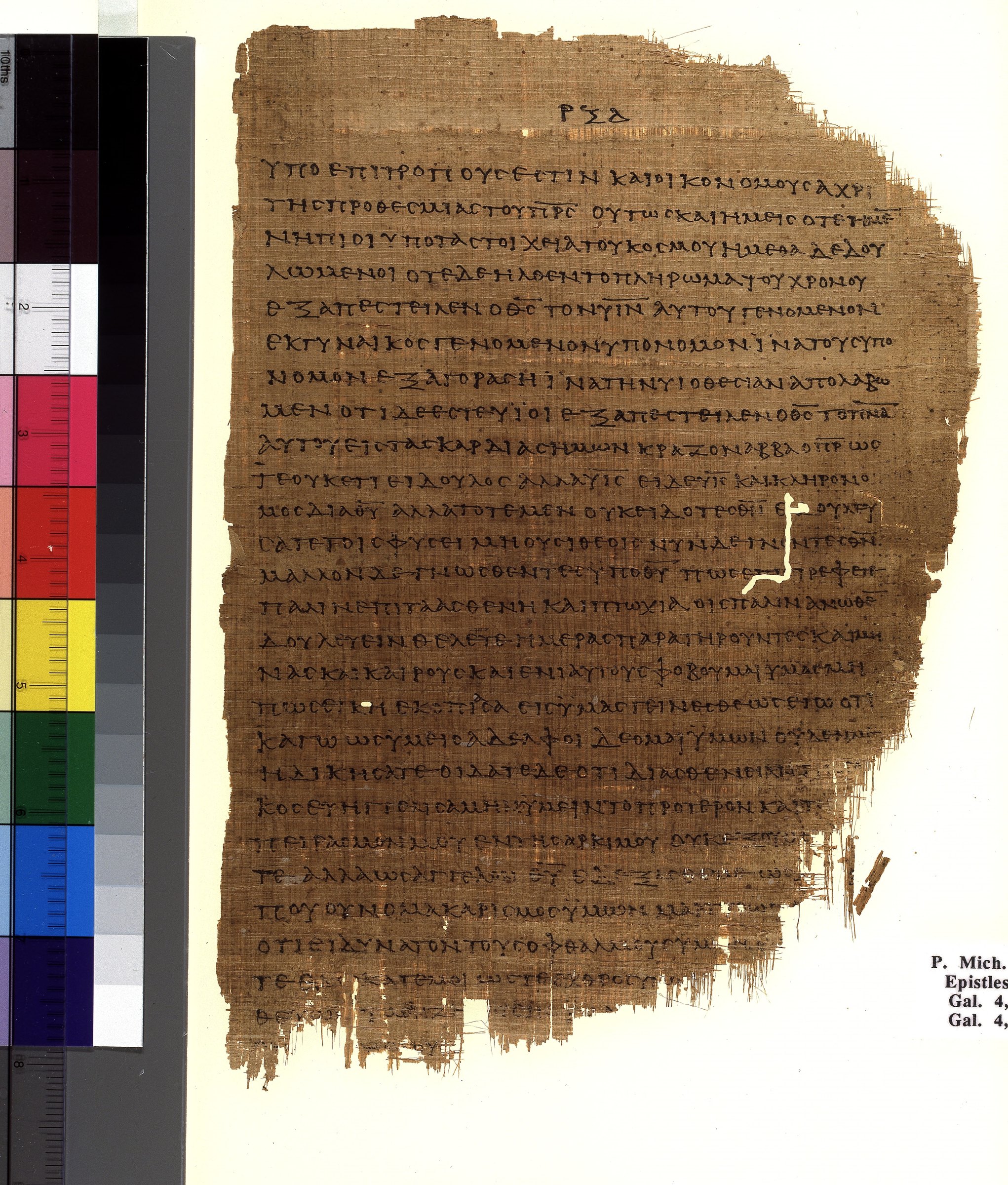
Where on the image
University of Michigan Library photograph 10046x6238_164JP2_UMich.jpg (https://ntmss.info/images/webfriendly/10046/10046x6238_164JP2_UMich.jpg), linked to NTVMR page 1490 (folio 84r) in NTVMR's page index. 4:2 begins on the previous page. Checked on the image: the scribe's page number ρξδ (164) at the head of the page, continuing the sequence of the neighbouring pages; the first line reads ‹υπο επιτροπους εστιν και οικονομους αχρι›, as in the transcription.
4:2 υπο επιτροπους εστιν και οικονομους αχρι
της προθεσμιας του π̅ρ̅ς̅ 3 ουτως και ημεις οτε ημεν
νηπιοι υπο τα στοιχεια του κοσμου ημεθα δεδου
λωμενοι 4 οτε δε ηλθεν το πληρωμα του χρονου
εξαπεστειλεν ο θ̅ς̅ τον υ̅ι̅ν̅ αυτου γενομενον
εκ γυναικος γενομενον υπο νομον 5 ινα τους υπο
νομον εξαγοραση ινα την υιοθεσιαν απολαβω
μεν 6 οτι δε εστε υιοι εξαπεστειλεν ο θ̅ς̅ το π̅ν̅α̅
αυτου εις τας καρδιας ημων κραζον αββα ο π̅ρ̅ 7 ωσ
τε ουκετι ει δουλος αλλα υ̅ι̅ς̅ ει δε υ̅ι̅ς̅ και κληρονο
μος δια θ̅υ̅ 8 αλλα τοτε μεν ουκ ειδοτες θ̅ν̅ εδ̣ουλευ
σατε τοις φυσει μη ουσι θεοις 9 νυν δε γνο̣ντες θ̅ν̅
μαλλον δε γνωσθεντες υπο θ̅υ̅ πως επισ̣τρεφετε
παλιν επι τα ασθενη και πτωχια οις παλιν ανωθεν
δουλευειν θελετε 10 ημερας παρατηρουντες και μη
νας και καιρους και ενιαυτους 11 φοβουμαι υμας μη
πως εικη εκοπισα εις υμας 12 γεινεσθε ως εγω οτι
καγω ως υμεις αδελφοι δεομαι υμων ουδεν με
ηδικησατε 13 οιδατε δε οτι δι ασθενειαν τη̣ς̣ σ̣α̣[ρ]
κος ευηγγελισαμην υμειν το προτερον 14 και το̣[ν]
πειρασμον μου εν τη σαρκι μου ουκ εξουθ̣εν̣[ησα]
τε αλλα ως αγγελον θ̅υ̅ εδεξασθε με ως χ̣̣̅[ρ̅ν̅ ι̅η̅ν̅]
15 που ουν ο μακαρισμος υμων μαρτυ̣ρ̣ω γ̣α̣[ρ υμιν]
οτι ει δυνατον τους οφθαλμους υμων ε[ξορυξα]
τε εδω̣κατε μοι 16 ωστε εχθρος υμ̣ω̣[ν γεγονα αλη]
θευων̣ υ̣μεν 17 ζη̣[λ]ο̣υ̣σιν̣ υ̣μ̣α̣[ς ου καλως αλλα εκκλει]
σ̣α̣ι̣ [υμα]ς̣ θ̣ε̣λ̣ουσ̣[ιν] [...]
4:2But is under tutors and governors until the time appointed of the father. 3Even so we, when we were children, were in bondage under the elements of the world: 4But when the fulness of the time was come, God sent forth his Son, made of a woman, made under the law, 5To redeem them that were under the law, that we might receive the adoption of sons. 6And because ye are sons, God hath sent forth the Spirit of his Son into your hearts, crying, Abba, Father. 7Wherefore thou art no more a servant, but a son; and if a son, then an heir of God through Christ. 8Howbeit then, when ye knew not God, ye did service unto them which by nature are no gods. 9But now, after that ye have known God, or rather are known of God, how turn ye again to the weak and beggarly elements, whereunto ye desire again to be in bondage? 10Ye observe days, and months, and times, and years. 11I am afraid of you, lest I have bestowed upon you labour in vain. 12Brethren, I beseech you, be as I am; for I am as ye are: ye have not injured me at all. 13Ye know how through infirmity of the flesh I preached the gospel unto you at the first. 14And my temptation which was in my flesh ye despised not, nor rejected; but received me as an angel of God, even as Christ Jesus. 15Where is then the blessedness ye spake of? for I bear you record, that, if it had been possible, ye would have plucked out your own eyes, and have given them to me. 16Am I therefore become your enemy, because I tell you the truth? 17They zealously affect you, but not well; yea, they would exclude you, that ye might affect them.
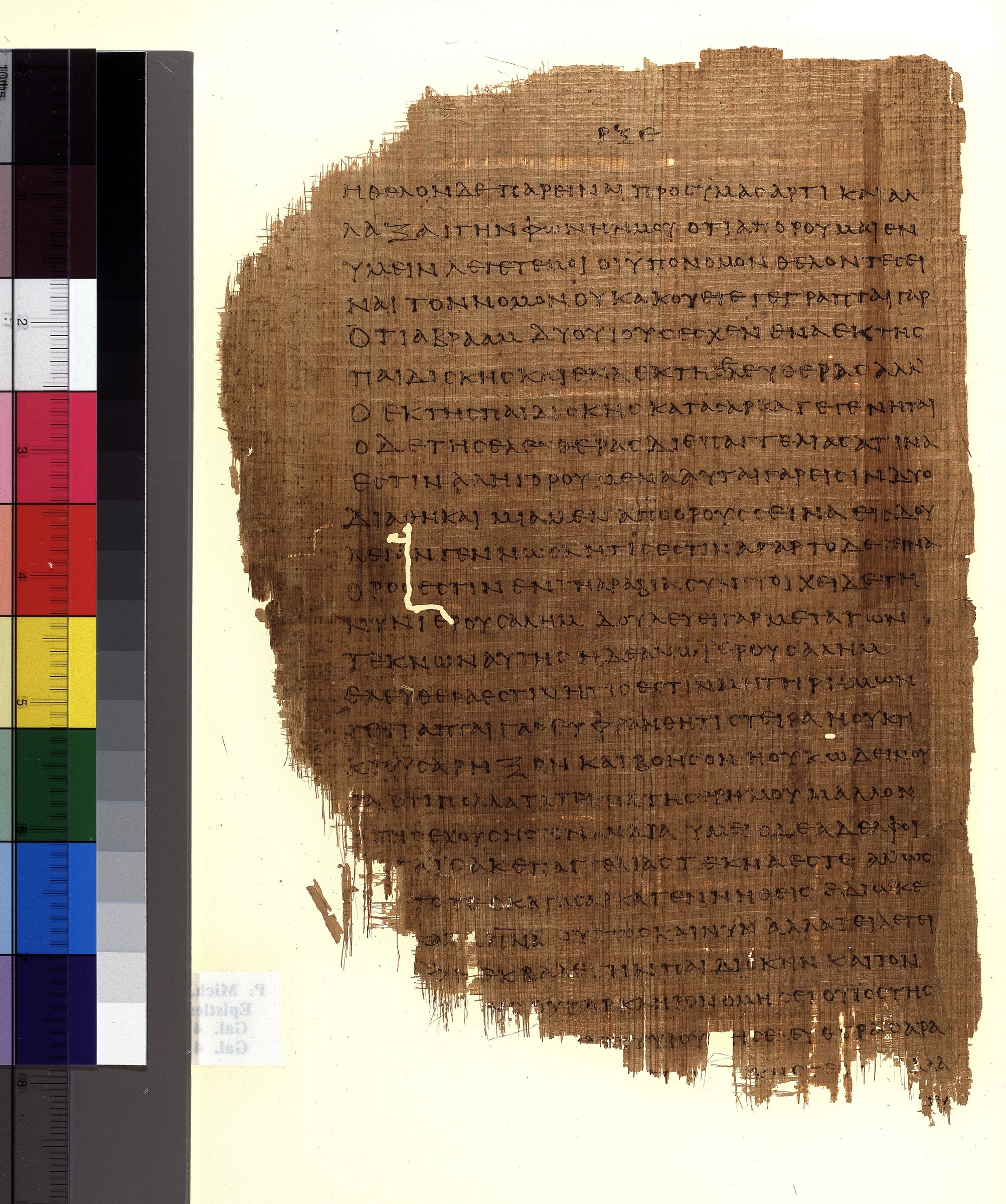
Where on the image
University of Michigan Library photograph 10046x6238_165JP2_UMich.jpg (https://ntmss.info/images/webfriendly/10046/10046x6238_165JP2_UMich.jpg), linked to NTVMR page 1500 (folio 84v) in NTVMR's page index. 5:1 continues on the next page. Checked on the image: the scribe's page number ρξε (165) at the head of the page, continuing the sequence of the neighbouring pages; the first line reads ‹ηθελον δε παρειναι προς υμας αρτι και αλ...›, as in the transcription.
4:20 ηθελον δε παρειναι προς υμας αρτι και αλ
λαξαι την φωνην μου οτι απορουμαι εν
υμειν 21 λεγετε μοι οι υπο νομον θελοντες ει
ναι τον νομον ουκ ακουετε 22 γεγραπται γαρ
οτι αβρααμ δυο υιους εσχεν ενα εκ της
παιδισκης και ενα εκ της λευθερας 23 αλλ
ο εκ της παιδισκης κατα σαρκα γεγενηται
ο δε της ελευθερας δι επαγγελιας 24 ατινα
εστιν αληγορουμενα αυται γαρ εισιν δυο
διαθηκαι μια μεν απο ορους σεινα εις δου
λειαν γεννωσα ητις εστιν αγαρ 25 το δε σεινα
ορος̣ εστιν εν τη αραβια συνστοιχει δε τη
νυν ιερουσαλημ δουλευει γαρ μετα των
τεκνων αυτης 26 η δε ανω ιερουσαλημ
ελευθερα εστιν ητις εστιν μητηρ ημων
27 γεγραπται γαρ ευφρανθητι στειρα η ουκ τι
κτουσα ρηξον και βοησον η ουκ ωδεινου
σα οτι πολλα τα τεκνα της ερημου μαλλον
η̣ της εχουσης τον ανδρα 28 υμεις δε αδελφοι
[κ]α̣τ̣α ισακ επαγγελιας τεκνα εστε 29 αλ ωσ
[π]ε̣ρ̣ τοτε ο κατα σαρκα γεννηθεις εδιωκε
[τον] κατα π̅ν̅α̅ ουτως και νυν 30 αλλα τει λεγει
[η γρα]φ̣η̣ εκβαλε την παιδισκην και τον
[υιον αυτ]ης ου γαρ κληρονομησει ο υιος της
[παιδισκης μετ]α̣ του υιου [τ]ης ελευθερας 31 αρα
[αδελφοι ουκ εσμεν] π̣[αιδι]σ̣κης τεκ[να] α̣λλα
[της ελευθεριας] 5:1 [τη ελευθερια ημας χ̅ρ̅ς̅ ηλ]ευ
[θερωσεν]
4:20I desire to be present with you now, and to change my voice; for I stand in doubt of you. 21Tell me, ye that desire to be under the law, do ye not hear the law? 22For it is written, that Abraham had two sons, the one by a bondmaid, the other by a freewoman. 23But he who was of the bondwoman was born after the flesh; but he of the freewoman was by promise. 24Which things are an allegory: for these are the two covenants; the one from the mount Sinai, which gendereth to bondage, which is Agar. 25For this Agar is mount Sinai in Arabia, and answereth to Jerusalem which now is, and is in bondage with her children. 26But Jerusalem which is above is free, which is the mother of us all. 27For it is written, Rejoice, thou barren that bearest not; break forth and cry, thou that travailest not: for the desolate hath many more children than she which hath an husband. 28Now we, brethren, as Isaac was, are the children of promise. 29But as then he that was born after the flesh persecuted him that was born after the Spirit, even so it is now. 30Nevertheless what saith the scripture? Cast out the bondwoman and her son: for the son of the bondwoman shall not be heir with the son of the freewoman. 31So then, brethren, we are not children of the bondwoman, but of the free. 5:1Stand fast therefore in the liberty wherewith Christ hath made us free, and be not entangled again with the yoke of bondage.
Notes
- Greek: the NTVMR diplomatic transcription, line by line as on the papyrus. Square brackets enclose letters that are lost or illegible and were supplied by the transcribers; a dot under a letter marks it as uncertain; [...] marks a gap. Nomina sacra and numerals keep the scribe's overline. Spelling is the scribe's (no accents or breathings). Words broken at a line end stay broken as on the papyrus. Corrections are not shown: the text is the first hand.
- English: the King James Version (1611), whole verses, for every verse that has text on the page. A verse that begins on one page and ends on the next is given in full on both. The KJV translates a later form of the Greek text, so its wording does not always match the papyrus; material differences (such as verses the papyrus does not have) are noted in the section.
Cite
Sources
- Source: P46 (P.Mich. inv. 6238, University of Michigan Library): photographs as published in the INTF New Testament Virtual Manuscript Room; Greek from the INTF NTVMR transcription of P46; English from the King James Version (holding institution)
- Critical edition: INTF NTVMR diplomatic transcription (CC BY 4.0)
← previous · → next · v cycle view · l back to library