P46 (P.Mich. inv. 6238): Hebrews 3:3-4:3 (fols. 23v-24r)
Introduction
P46 is a papyrus codex of the letters of Paul copied in Egypt around 200, the oldest surviving collection of Paul's letters. 86 of its 104 leaves survive: 56 in the Chester Beatty Library, Dublin (Biblical Papyrus II, published by Frederic Kenyon in 1934-1937) and 30 in the University of Michigan Library, Ann Arbor (P.Mich. inv. 6238, published by Henry Sanders in 1935). The letters run in the order Romans, Hebrews, 1 and 2 Corinthians, Ephesians, Galatians, Philippians, Colossians and 1 Thessalonians; the first seven leaves (Romans 1:1-5:17) and the end of the book are lost. Hebrews standing after Romans, and the doxology of Romans (16:25-27) standing after 15:33, are among its best-known features.
Each section below is one page side: the holding library's photograph, the NTVMR diplomatic transcription line by line, and the King James Version of every verse that has text on the page. The lower lines of many leaves are lost; the transcribers' restorations are in square brackets.
This entry covers fols. 23v-24r (Hebrews 3:3-4:3).
How was this verified? (Provenance)
Where on the image
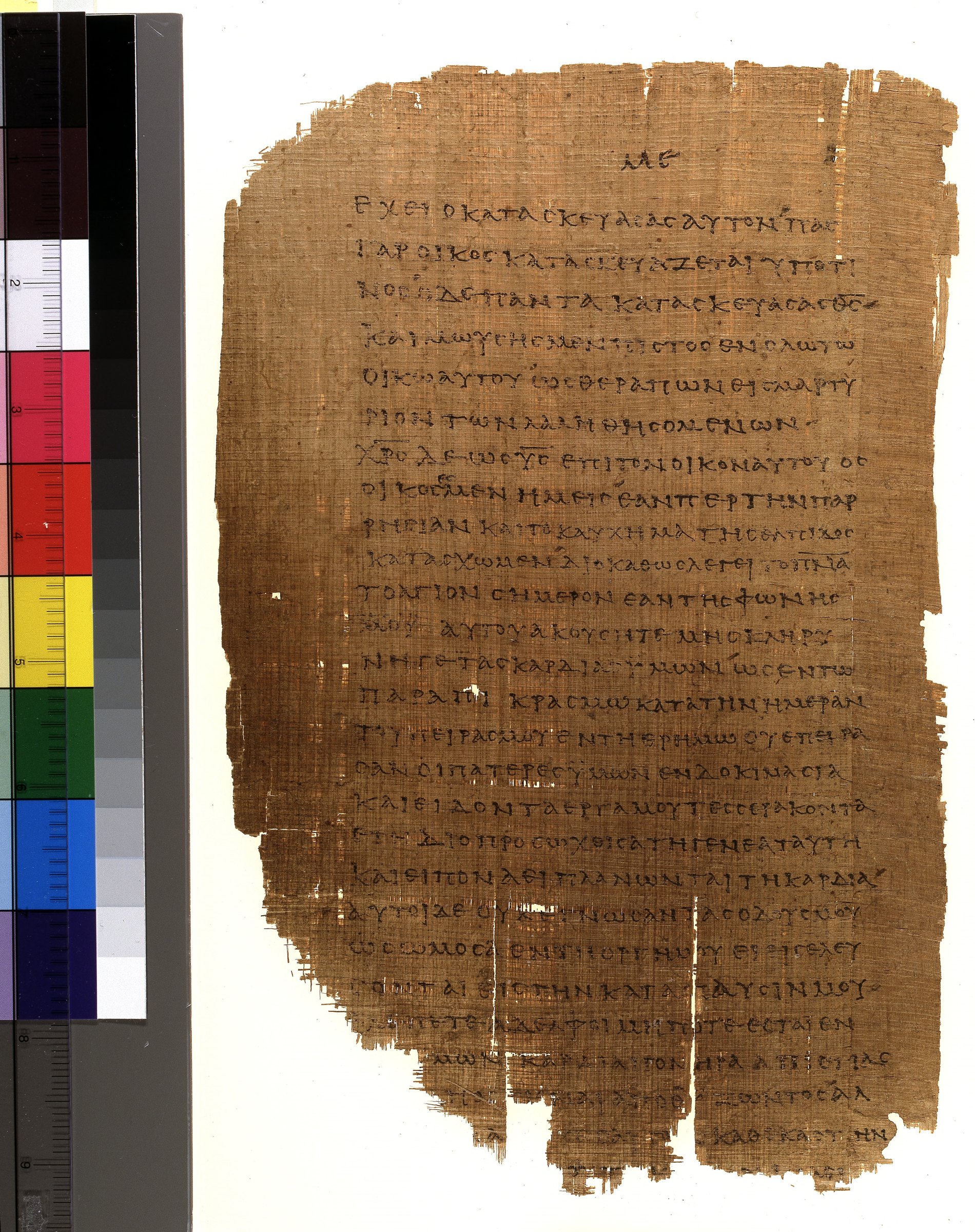
University of Michigan Library photograph 10046x6238_45JP2_UMich.jpg (https://ntmss.info/images/webfriendly/10046/10046x6238_45JP2_UMich.jpg), linked to NTVMR page 280 (folio 23v) in NTVMR's page index. 3:3 begins on the previous page; 3:13 continues on the next page. Checked on the image: the scribe's page number με (45) at the head of the page, matching NTVMR folio 23v.
3:3 εχει ο κατασκευασας αυτον 4 πας
γαρ οικος κατασκευαζεται υπο τι
νος ο δε παντα κατασκευασας θ̅ς̅
5 και μωυσης μεν πιστος εν ολω τω
οικω αυτου ως θεραπων εις μαρτυ
ριον των λαληθησομενων
6 χ̅ρ̅ς̅ δε ως υ̅ς̅ επι τον οικον αυτου ος
οικος μεν ημεις εανπερ την παρ
ρησιαν και το καυχημα της ελπιδος
κατασχωμεν 7 διο καθως λεγει το π̅ν̅α̅
το αγιον σημερον εαν της φωνης
μου αυτου ακουσητε 8 μη σκληρυ
νητ̣ε τας καρδιας υμων ως εν τω
παραπικρασμω κατα την ημεραν
του πειρασμου εν τη ερημω 9 ου επειρα
σαν οι πατερες υμων εν δοκιμασια
και ειδον τα εργα μου 10 τεσσερακοντα
ετη διο προσωχθισα τη γενεα ταυτη
και ειπον αει πλανωνται τη καρδια
αυτοι δε ουκ εγνωσαν τας οδους μου
11 ως ωμοσα εν τη οργη μου ει εισελευ
σονται εις την καταπαυσιν μου
12 β̣λεπετε αδελφοι μηποτε εσται εν
[τινι] υ̣μων καρδια πονηρα απιστιας
[εν τω] α̣ποστ̣ηναι απο θ̅υ̣̣̅ ζωντος 13 αλ
[λα παρα]κ̣α[λε]ι̣τ̣ε ε̣αυ̣το[υ]ς καθ εκαστην
[ημεραν αχρις] ου τ[ο σ]η[μερο]ν̣ κ̣α̣λει
[ται]
3:3For this man was counted worthy of more glory than Moses, in asmuch as he who hath builded the house hath more honour than the house. 4For every house is builded by some man; but he that built all things is God. 5And Moses verily was faithful in all his house, as a servant, for a testimony of those things which were to be spoken after; 6But Christ as a son over his own house; whose house are we, if we hold fast the confidence and the rejoicing of the hope firm unto the end. 7Wherefore (as the Holy Ghost saith, To day if ye will hear his voice, 8Harden not your hearts, as in the provocation, in the day of temptation in the wilderness: 9When your fathers tempted me, proved me, and saw my works forty years. 10Wherefore I was grieved with that generation, and said, They do alway err in their heart; and they have not known my ways. 11So I sware in my wrath, They shall not enter into my rest.) 12Take heed, brethren, lest there be in any of you an evil heart of unbelief, in departing from the living God. 13But exhort one another daily, while it is called To day; lest any of you be hardened through the deceitfulness of sin.
Where on the image
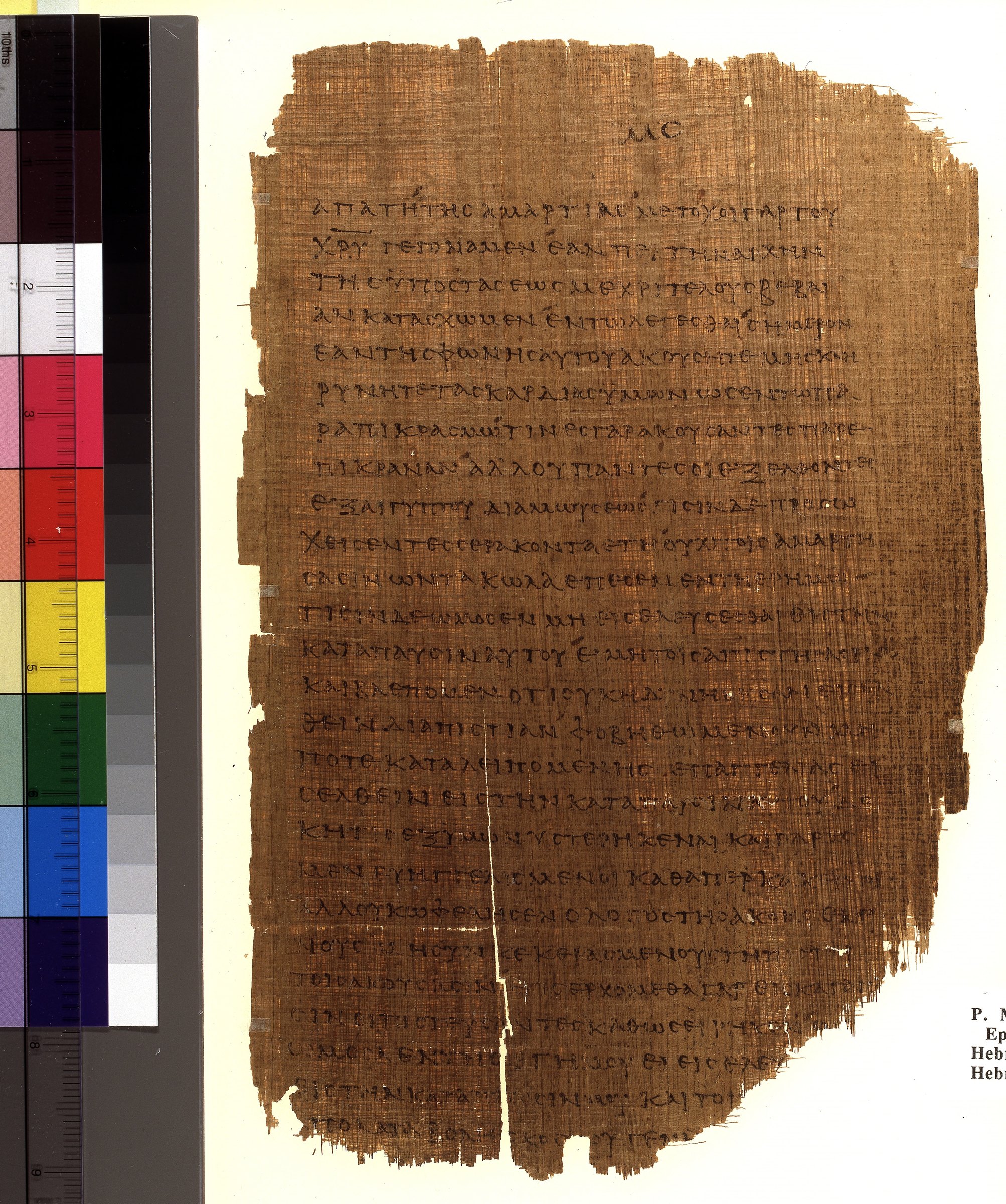
University of Michigan Library photograph 10046x6238_46JP2_UMich.jpg (https://ntmss.info/images/webfriendly/10046/10046x6238_46JP2_UMich.jpg), linked to NTVMR page 290 (folio 24r) in NTVMR's page index. 3:13 begins on the previous page. Checked on the image: the scribe's page number μς (46) at the head of the page, matching NTVMR folio 24r.
3:13 απατη της αμαρτιας 14 μετοχοι γαρ του
χ̅ρ̅υ̅ γεγοναμεν εανπερ την αρχην
της υποστασεως μεχρι τελους βεβαι
αν κατασχωμεν 15 εν τω λεγεσθαι σημερον
εαν της φωνης αυτου ακουσητε μη σκλη
ρυνητε τας καρδιας υμων ως εν τω πα
ραπικρασμω 16 τινες γαρ ακουσαντες παρε
πικραναν αλλ ου παντες οι εξελθοντες
εξ αιγυπτου δια μωυσεως 17 τισιν δε προσω
χθισεν τεσσερακοντα ετη ουχι τοις αμαρτη
σασιν ων τα κωλα επεσεν εν τη ερημω
18 τισιν δε ωμοσεν μη εισελευσεσθαι εις την
καταπαυσιν αυτου ει̣ μη τοις απιστησασιν
19 και βλεπομεν οτι ουκ ηδυνηθησαν εισελ
θειν δι απιστιαν 4:1 φοβηθωμεν ουν μη
ποτε καταλειπομενης επαγγελιας ει
σελθειν εις την καταπαυσιν αυτου δο
κη τις εξ υμων υστερηκεναι 2 και γαρ εσ
μεν ευηγγελισμενοι καθαπερ κακεινοι
αλλ ουκ ωφελησεν ο λογος της ακοης εκει
νους μη συνκεκερασμενους τη πι̣στε̣ι
τοις ακουσασιν 3 ει̣σερχομεθα [...] εις καταπα̣[υ]
σιν οι πιστευσαντες καθως ειρηκεν ω̣ς̣
ωμοσα εν τη οργη μου ει εισελευ[σονται]
εις την καταπα̣υ̣σιν μου καιτοι [των εργων]
α̣πο καταβολης κοσ[μ]ου γενη̣[θεντων]
3:13But exhort one another daily, while it is called To day; lest any of you be hardened through the deceitfulness of sin. 14For we are made partakers of Christ, if we hold the beginning of our confidence stedfast unto the end; 15While it is said, To day if ye will hear his voice, harden not your hearts, as in the provocation. 16For some, when they had heard, did provoke: howbeit not all that came out of Egypt by Moses. 17But with whom was he grieved forty years? was it not with them that had sinned, whose carcases fell in the wilderness? 18And to whom sware he that they should not enter into his rest, but to them that believed not? 19So we see that they could not enter in because of unbelief. 4:1Let us therefore fear, lest, a promise being left us of entering into his rest, any of you should seem to come short of it. 2For unto us was the gospel preached, as well as unto them: but the word preached did not profit them, not being mixed with faith in them that heard it. 3For we which have believed do enter into rest, as he said, As I have sworn in my wrath, if they shall enter into my rest: although the works were finished from the foundation of the world.
Notes
- Greek: the NTVMR diplomatic transcription, line by line as on the papyrus. Square brackets enclose letters that are lost or illegible and were supplied by the transcribers; a dot under a letter marks it as uncertain; [...] marks a gap. Nomina sacra and numerals keep the scribe's overline. Spelling is the scribe's (no accents or breathings). Words broken at a line end stay broken as on the papyrus. Corrections are not shown: the text is the first hand.
- English: the King James Version (1611), whole verses, for every verse that has text on the page. A verse that begins on one page and ends on the next is given in full on both. The KJV translates a later form of the Greek text, so its wording does not always match the papyrus; material differences (such as verses the papyrus does not have) are noted in the section.
Cite
Sources
- Source: P46 (P.Mich. inv. 6238, University of Michigan Library): photographs as published in the INTF New Testament Virtual Manuscript Room; Greek from the INTF NTVMR transcription of P46; English from the King James Version (holding institution)
- Critical edition: INTF NTVMR diplomatic transcription (CC BY 4.0)
← previous · → next · v cycle view · l back to library