P46 (P.Mich. inv. 6238): Hebrews 2:3-3:3 (fols. 22v-23r)
Introduction
P46 is a papyrus codex of the letters of Paul copied in Egypt around 200, the oldest surviving collection of Paul's letters. 86 of its 104 leaves survive: 56 in the Chester Beatty Library, Dublin (Biblical Papyrus II, published by Frederic Kenyon in 1934-1937) and 30 in the University of Michigan Library, Ann Arbor (P.Mich. inv. 6238, published by Henry Sanders in 1935). The letters run in the order Romans, Hebrews, 1 and 2 Corinthians, Ephesians, Galatians, Philippians, Colossians and 1 Thessalonians; the first seven leaves (Romans 1:1-5:17) and the end of the book are lost. Hebrews standing after Romans, and the doxology of Romans (16:25-27) standing after 15:33, are among its best-known features.
Each section below is one page side: the holding library's photograph, the NTVMR diplomatic transcription line by line, and the King James Version of every verse that has text on the page. The lower lines of many leaves are lost; the transcribers' restorations are in square brackets.
This entry covers fols. 22v-23r (Hebrews 2:3-3:3).
How was this verified? (Provenance)
Where on the image
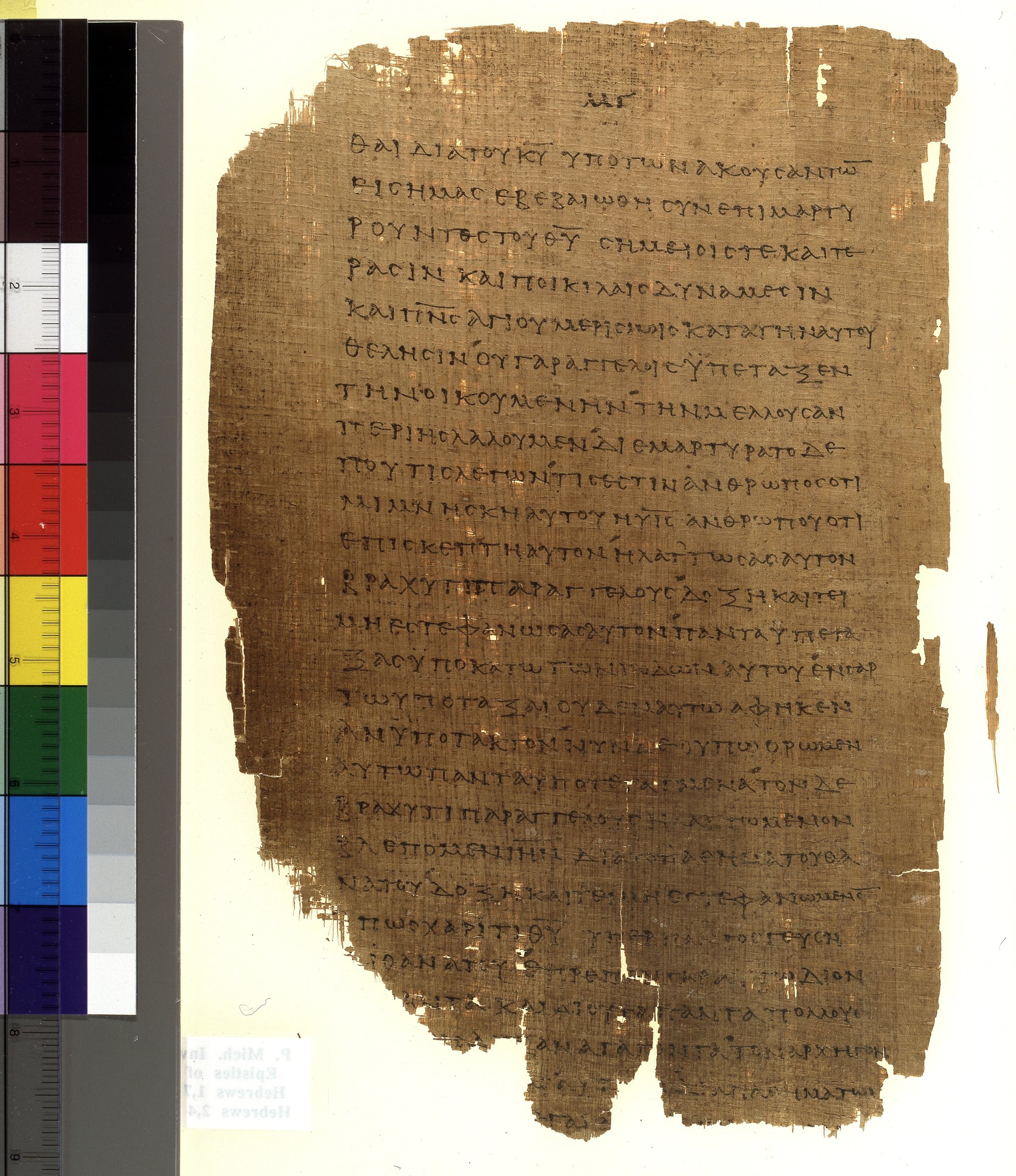
University of Michigan Library photograph 10046x6238_43JP2_UMich.jpg (https://ntmss.info/images/webfriendly/10046/10046x6238_43JP2_UMich.jpg), linked to NTVMR page 260 (folio 22v) in NTVMR's page index. 2:3 begins on the previous page; 2:11 continues on the next page. Checked on the image: the scribe's page number μγ (43) at the head of the page, matching NTVMR folio 22v; the first line reads ‹θαι δια του κ̅υ̅ υπο των ακουσαντων›, as in the transcription.
2:3 θαι δια του κ̅υ̅ υπο των ακουσαντων
εις ημας εβεβαιωθη 4 συνεπιμαρτυ
ρουντες του θ̅υ̅ σημειοις τε και τε
ρασιν και ποικιλαις δυναμεσιν
και π̅ν̅ς̅ αγιου μερισμοις κατα την αυτου
θελησιν 5 ου γαρ αγγελοις υπεταξεν
την οικουμενην την μελλουσαν
περι ης λαλουμεν 6 διεμαρτυρατο δε
που τις λεγων τις εστιν ανθρωπος οτι
μιμνησκη αυτου η υ̅ι̅ς̅ ανθρωπου οτι
επισκεπτη αυτον 7 ηλαττωσας αυτον
βραχυ τις παρ αγγελους δοξη και τει
μη εστεφανωσας αυτον 8 παντα υπετα
ξας υποκατω των ποδων αυτου εν γαρ
τω υποταξαι ουδεν αυτω αφηκεν
ανυποτακτον νυν δ̣ε ουπω ορωμεν
αυτω παντα υποτετ̣αγμενα 9 τον δε
βραχυ τι παρ αγγελους ηλατ̣τωμενον
βλεπομεν ι̅η̅ν̅ δια το παθημα του θα
νατου δοξη και τειμη εστεφανωμενον
ο̣πως χαριτι θ̅υ̅ υπερ παντος γευση
[τ]α̣ι θανατου 10 επρεπε̣ν γαρ αυτω δι ον
[τα π]αντα και δι ου τα παντα πολλους
[υιους ε]ι̣ς δ[ο]ξ̣αν αγαγοντα τον αρχηγον
[της σωτηρι]α̣ς̣ αυτ[ω]ν̣ δ̣ι̣α̣ παθ̣ηματων̣
[τελειωσαι] 11 [ο τ]ε̣ γαρ̣ α[γιαζων και οι]
2:3How shall we escape, if we neglect so great salvation; which at the first began to be spoken by the Lord, and was confirmed unto us by them that heard him; 4God also bearing them witness, both with signs and wonders, and with divers miracles, and gifts of the Holy Ghost, according to his own will? 5For unto the angels hath he not put in subjection the world to come, whereof we speak. 6But one in a certain place testified, saying, What is man, that thou art mindful of him? or the son of man, that thou visitest him? 7Thou madest him a little lower than the angels; thou crownedst him with glory and honour, and didst set him over the works of thy hands: 8Thou hast put all things in subjection under his feet. For in that he put all in subjection under him, he left nothing that is not put under him. But now we see not yet all things put under him. 9But we see Jesus, who was made a little lower than the angels for the suffering of death, crowned with glory and honour; that he by the grace of God should taste death for every man. 10For it became him, for whom are all things, and by whom are all things, in bringing many sons unto glory, to make the captain of their salvation perfect through sufferings. 11For both he that sanctifieth and they who are sanctified are all of one: for which cause he is not ashamed to call them brethren,
Where on the image
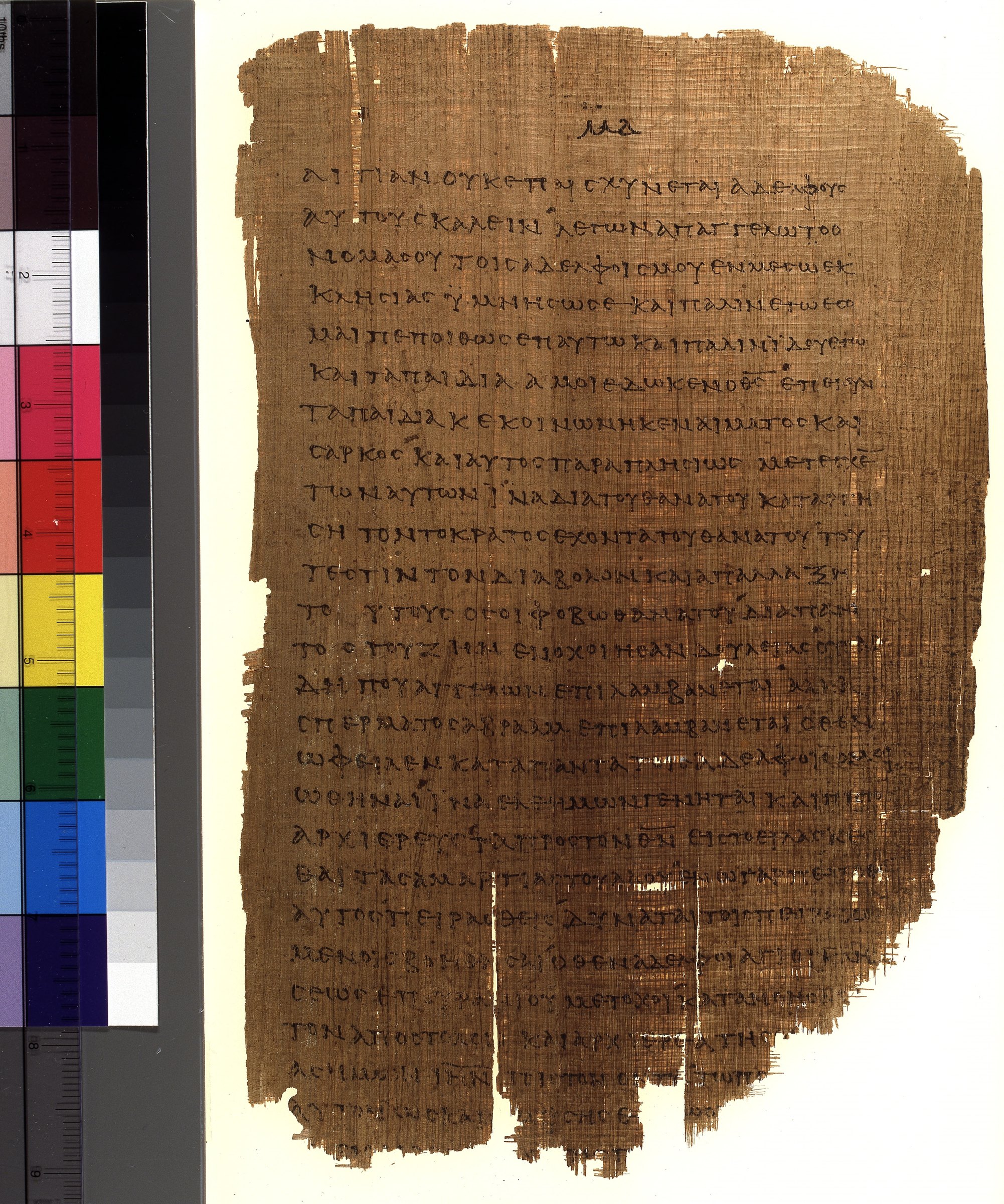
University of Michigan Library photograph 10046x6238_44JP2_UMich.jpg (https://ntmss.info/images/webfriendly/10046/10046x6238_44JP2_UMich.jpg), linked to NTVMR page 270 (folio 23r) in NTVMR's page index. 2:11 begins on the previous page; 3:3 continues on the next page. Checked on the image: the first line reads ‹αιτιαν ουκ επαισχυνεται αδελφους›, as in the transcription.
2:11 αιτιαν ουκ επαισχυνεται αδελφους
αυτους καλειν 12 λεγων απαγγελω το ο
νομα σου τοις αδελφοις μου εν μεσω εκ
κλησιας υμνησω σε 13 και παλιν εγω εσο
μαι πεποιθως επ αυτω και παλιν ιδου εγω
και τα παιδια α μοι εδωκεν ο θ̅ς̅ 14 επει ουν
τα παιδια κεκοινωνηκεν αιματος και
σαρκος και αυτος παραπλησιως μετεσχεν
των αυτων ινα δια του θανατου καταργη
ση τον το κρατος εχοντα του θανατου του
τ εστιν τον διαβολον 15 και απαλλαξη
τουτους οσοι φοβω θανατου δια παν
τος του ζην ενοχοι ησαν δουλειας 16 ου γ̣α̣ρ̣
δηπου αγγελων επιλαμβανεται αλλα
σπερματος αβρααμ επιλαμβανεται 17 οθεν
ωφειλεν κατα παντα τοις αδελφοις ομοι
ωθηναι ινα ελεημων γενηται και πιστος̣
αρχιερευς τα προς τον θ̅ν̅ εις το ειλασκεσ
θαι τας αμαρτιας του λαου 18 εν ω γαρ πεποθεν
αυτος πειρασθεις δυναται τοις πειρ̣α̣ζο
μενοις βοηθησαι 3:1 οθεν αδελφοι αγιοι κλ̣η
σεως επουρανιου μετοχοι κατανοησα̣[τε]
τον αποστολον και αρχιερεα της ο̣μ̣[ολογι]
ας ημων ι̅η̅ν̅ 2 πιστον οντα τω πο[ιησαντι]
αυτον ως και [μ]ωυσης ε[ν τ]ω ο[ικω αυτου] 3 [πλει]
[ονο]ς̣ γ̣α̣[ρ ο]υ̣[τος δοξ]η̣ς̣ π̣[αρα μωυσην ηξι]
[ωται]
2:11For both he that sanctifieth and they who are sanctified are all of one: for which cause he is not ashamed to call them brethren, 12Saying, I will declare thy name unto my brethren, in the midst of the church will I sing praise unto thee. 13And again, I will put my trust in him. And again, Behold I and the children which God hath given me. 14Forasmuch then as the children are partakers of flesh and blood, he also himself likewise took part of the same; that through death he might destroy him that had the power of death, that is, the devil; 15And deliver them who through fear of death were all their lifetime subject to bondage. 16For verily he took not on him the nature of angels; but he took on him the seed of Abraham. 17Wherefore in all things it behoved him to be made like unto his brethren, that he might be a merciful and faithful high priest in things pertaining to God, to make reconciliation for the sins of the people. 18For in that he himself hath suffered being tempted, he is able to succour them that are tempted. 3:1Wherefore, holy brethren, partakers of the heavenly calling, consider the Apostle and High Priest of our profession, Christ Jesus; 2Who was faithful to him that appointed him, as also Moses was faithful in all his house. 3For this man was counted worthy of more glory than Moses, in asmuch as he who hath builded the house hath more honour than the house.
Notes
- Greek: the NTVMR diplomatic transcription, line by line as on the papyrus. Square brackets enclose letters that are lost or illegible and were supplied by the transcribers; a dot under a letter marks it as uncertain; [...] marks a gap. Nomina sacra and numerals keep the scribe's overline. Spelling is the scribe's (no accents or breathings). Words broken at a line end stay broken as on the papyrus. Corrections are not shown: the text is the first hand.
- English: the King James Version (1611), whole verses, for every verse that has text on the page. A verse that begins on one page and ends on the next is given in full on both. The KJV translates a later form of the Greek text, so its wording does not always match the papyrus; material differences (such as verses the papyrus does not have) are noted in the section.
Cite
Sources
- Source: P46 (P.Mich. inv. 6238, University of Michigan Library): photographs as published in the INTF New Testament Virtual Manuscript Room; Greek from the INTF NTVMR transcription of P46; English from the King James Version (holding institution)
- Critical edition: INTF NTVMR diplomatic transcription (CC BY 4.0)
← previous · → next · v cycle view · l back to library