P46 (P.Mich. inv. 6238): Hebrews 4:4-5:7 (fols. 24v-25r)
Introduction
P46 is a papyrus codex of the letters of Paul copied in Egypt around 200, the oldest surviving collection of Paul's letters. 86 of its 104 leaves survive: 56 in the Chester Beatty Library, Dublin (Biblical Papyrus II, published by Frederic Kenyon in 1934-1937) and 30 in the University of Michigan Library, Ann Arbor (P.Mich. inv. 6238, published by Henry Sanders in 1935). The letters run in the order Romans, Hebrews, 1 and 2 Corinthians, Ephesians, Galatians, Philippians, Colossians and 1 Thessalonians; the first seven leaves (Romans 1:1-5:17) and the end of the book are lost. Hebrews standing after Romans, and the doxology of Romans (16:25-27) standing after 15:33, are among its best-known features.
Each section below is one page side: the holding library's photograph, the NTVMR diplomatic transcription line by line, and the King James Version of every verse that has text on the page. The lower lines of many leaves are lost; the transcribers' restorations are in square brackets.
This entry covers fols. 24v-25r (Hebrews 4:4-5:7).
How was this verified? (Provenance)
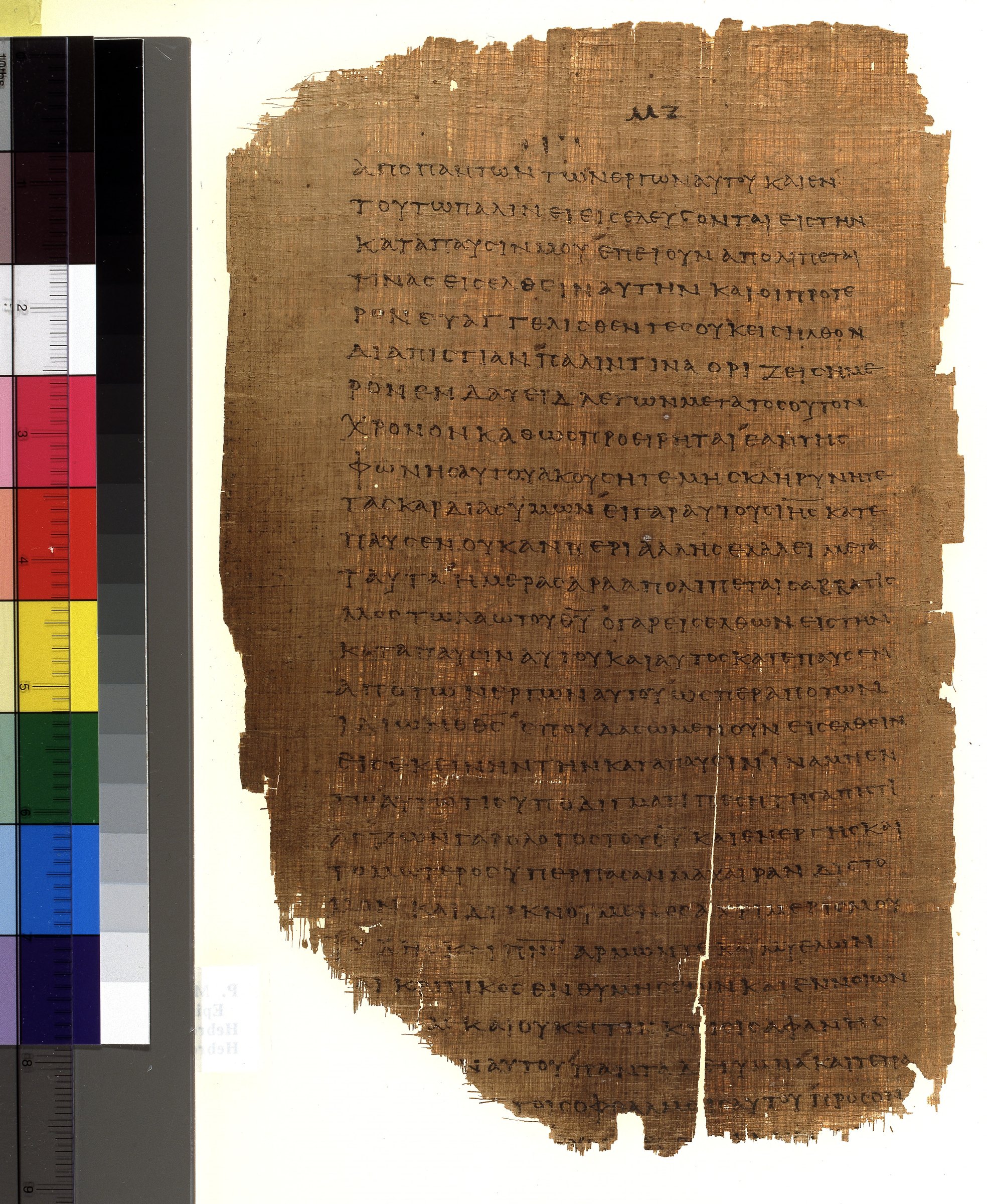
Where on the image
University of Michigan Library photograph 10046x6238_47JP2_UMich.jpg (https://ntmss.info/images/webfriendly/10046/10046x6238_47JP2_UMich.jpg), linked to NTVMR page 300 (folio 24v) in NTVMR's page index. 4:4 begins on the previous page; 4:14 continues on the next page. Checked on the image: the scribe's page number μζ (47) at the head of the page, matching NTVMR folio 24v; the first line reads ‹απο παντων των εργων αυτου και εν›, as in the transcription.
4:4 απο παντων των εργων αυτου 5 και εν
τουτω παλιν ει εισελευσονται εις την
καταπαυσιν μου 6 επει ουν απολιπεται
τινας εισελθειν αυτην και οι προτε
ρον ευαγγελισθεντες ουκ εισηλθον
δι απιστιαν 7 παλιν τινα οριζει σημε
ρον εν δαυειδ λεγων μετα τοσουτον
χρονον καθως προειρηται εαν της
φωνης αυτου ακουσητε μη σκληρυνητε
τας καρδιας υμων 8 ει γαρ αυτους ι̅η̅ς̅ κατε
παυσεν ουκ αν περι αλλης ελαλει μετα
ταυτα ημερας 9 αρα απολιπεται σαββατισ
μος τω λαω του θ̅υ̅ 10 ο γαρ εισελθων εις την
καταπαυσιν αυτου και αυτος κατεπαυσεν
απο των εργων αυτου ωσπερ απο των
ιδιων ο θ̅ς̅ 11 σπουδασωμεν ουν εισελθειν
εις εκεινην την καταπαυσιν ινα μη εν
τω αυτω τις υποδιγματι πεση της απιστι
ας 12 ζων γαρ ο λογος του θ̅υ̅ και ενεργης και
τομωτερος υπερ πασαν μαχαιραν διστο
μον και διι̣κνουμενος αχρι μερισμου
ψυχης κα̣ι π̅ν̅ς̅ αρμων τε και μυελων
[κ]αι κριτικος ενθυμησεων και εννοιων
[καρδι]ας 13 και ουκ εστιν κτισις αφανης
[ενωπιο]ν αυτου παντα δε γυμνα και τετρα
[χηλισμενα] τοις οφθαλμοις αυτου προς ον
[ημειν ο λογος] 14 ε̣χ̣ο̣ν̣[τ]ες̣ ο̣[υν] α̣ρ̣χ̣ι̣[ερεα]
4:4For he spake in a certain place of the seventh day on this wise, And God did rest the seventh day from all his works. 5And in this place again, If they shall enter into my rest. 6Seeing therefore it remaineth that some must enter there in, and they to whom it was first preached entered not in because of unbelief: 7Again, he limiteth a certain day, saying in David, To day, after so long a time; as it is said, To day if ye will hear his voice, harden not your hearts. 8For if Jesus had given them rest, then would he not afterward have spoken of another day. 9There remaineth therefore a rest to the people of God. 10For he that is entered into his rest, he also hath ceased from his own works, as God did from his. 11Let us labour therefore to enter into that rest, lest any man fall after the same example of unbelief. 12For the word of God is quick, and powerful, and sharper than any twoedged sword, piercing even to the dividing asunder of soul and spirit, and of the joints and marrow, and is a discerner of the thoughts and intents of the heart. 13Neither is there any creature that is not manifest in his sight: but all things are naked and opened unto the eyes of him with whom we have to do. 14Seeing then that we have a great high priest, that is passed into the heavens, Jesus the Son of God, let us hold fast our profession.
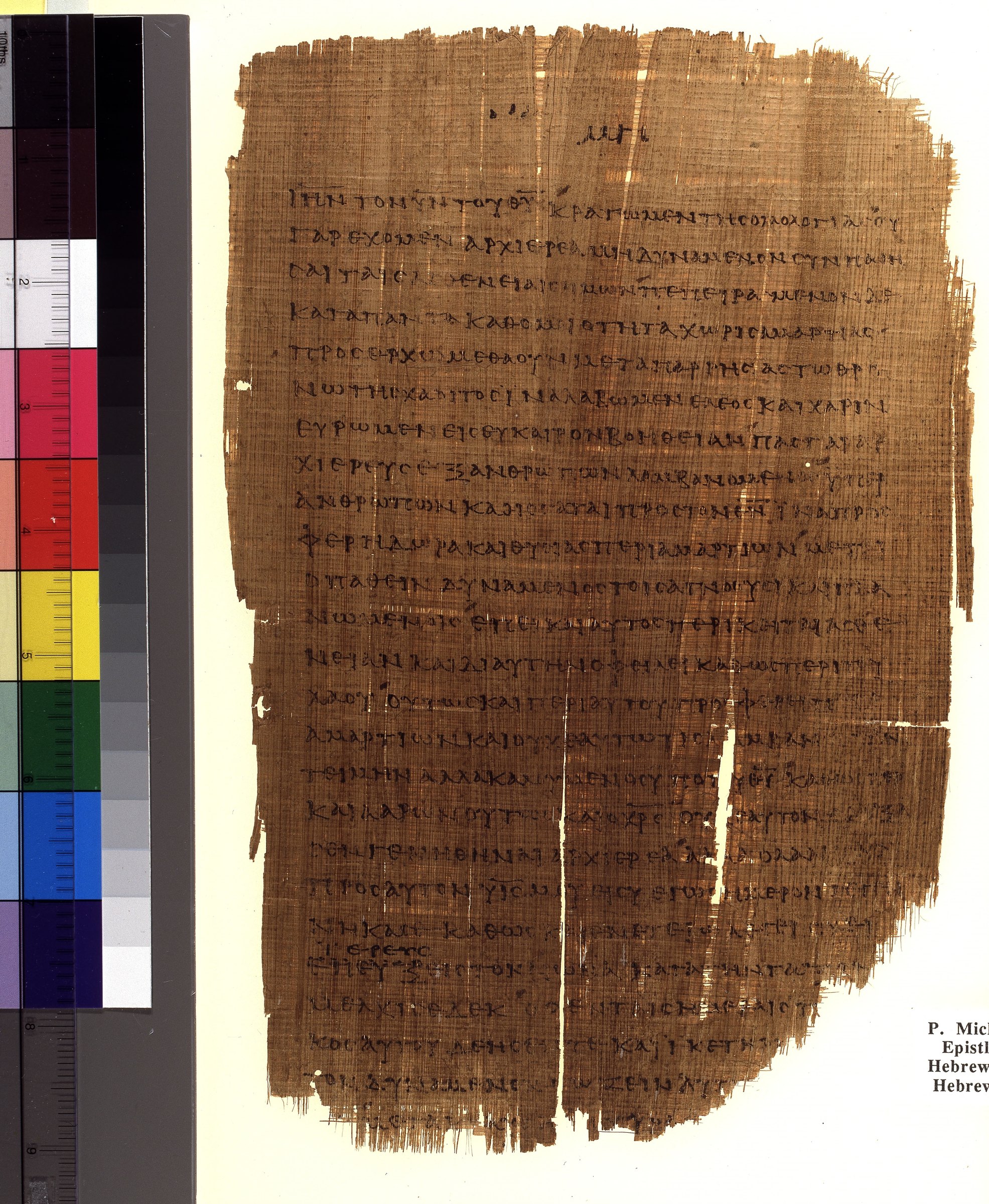
Where on the image
University of Michigan Library photograph 10046x6238_48JP2_UMich.jpg (https://ntmss.info/images/webfriendly/10046/10046x6238_48JP2_UMich.jpg), linked to NTVMR page 310 (folio 25r) in NTVMR's page index. 4:14 begins on the previous page; 5:7 continues on the next page. Checked on the image: the scribe's page number μη (48) at the head of the page, matching NTVMR folio 25r.
4:14 ι̅η̅ν̅ τον υ̅ν̅ του θ̅υ̅ κρατωμεν της ομολογιας 15 ου
γαρ εχομεν αρχιερεα μη δυναμενον συνπαθ̣η
σαι ταις ασ̣θ̣ενειαις ημων πεπειρασ̣μενον δε
κατα παντα καθ ομοιοτητα χωρις αμαρτιας
16 προσερχωμεθα ουν μετα παρρησιας τω θρο
νω της χαριτος ινα λαβωμεν ελεος και χαριν
ευρωμεν εις ευκαιρον βοηθειαν 5:1 πας γαρ αρ
χιερευς εξ ανθρωπων λαμβανομενος υπερ
ανθρωπων καθιστ̣αται προς τον θ̅ν̅ ινα προσ
φερη δωρα και θυσιας περι αμαρτιων 2 μετρ̣ι
οπαθειν δυναμενος τοις αγνοουσι και πλα
νωμενοις επει και αυτος περικειται ασθε
νειαν 3 και δι αυτην οφειλει καθως περι του
λαου ουτως και περι αυτου προσ̣φερει π[ερι]
αμαρτιων 4 και ουχ εαυτω τις λα̣μβανε̣ι̣ τ̣η̣ν
τειμην αλλα καλουμενος υπο τ[ο]υ θ̅υ̅ καθωσπερ
και ααρων 5 ουτως και ο χ̅ρ̅ς̅ ουχ̣ εαυτον εδ̣ο̣ξα
σεν γενηθηναι αρχιερεα αλλα ο λαλη̣σ̣α̣ς̣
προς αυτον υ̅ι̅ς̅ μου ει συ εγω σημερον γεγεν
νηκα σε 6 καθως και εν ετερ̣ω λεγει συ ει
επευξ εις τον αιωνα κατα την ταξι̣ν̣
μελχισεδεκ 7 ος εν ταις ημεραις τ[ης σαρ]
κος αυτου δεησεις τε και ικετηρ̣ι̣[ας προς]
τον δυναμενο̣ν σ̣ωζειν αυτο̣[ν εκ θανα]
[του] μετα κρ̣αυγ̣η̣[ς ι]σ̣χ̣υρ̣α̣[ς και δακρυων]
4:14Seeing then that we have a great high priest, that is passed into the heavens, Jesus the Son of God, let us hold fast our profession. 15For we have not an high priest which can not be touched with the feeling of our infirmities; but was in all points tempted like as we are, yet without sin. 16Let us therefore come bold ly unto the throne of grace, that we may obtain mercy, and find grace to help in time of need. 5:1For every high priest taken from among men is ordained for men in things pertaining to God, that he may offer both gifts and sacrifices for sins: 2Who can have compassion on the ignorant, and on them that are out of the way; for that he himself also is compassed with infirmity. 3And by reason here of he ought, as for the people, so also for himself, to offer for sins. 4And no man taketh this honour unto himself, but he that is called of God, as was Aaron. 5So also Christ glorified not himself to be made an high priest; but he that said unto him, Thou art my Son, to day have I begotten thee. 6As he saith also in another place, Thou art a priest for ever after the order of Melchisedec. 7Who in the days of his flesh, when he had offered up prayers and supplications with strong crying and tears unto him that was able to save him from death, and was heard in that he feared;
Notes
- Greek: the NTVMR diplomatic transcription, line by line as on the papyrus. Square brackets enclose letters that are lost or illegible and were supplied by the transcribers; a dot under a letter marks it as uncertain; [...] marks a gap. Nomina sacra and numerals keep the scribe's overline. Spelling is the scribe's (no accents or breathings). Words broken at a line end stay broken as on the papyrus. Corrections are not shown: the text is the first hand.
- English: the King James Version (1611), whole verses, for every verse that has text on the page. A verse that begins on one page and ends on the next is given in full on both. The KJV translates a later form of the Greek text, so its wording does not always match the papyrus; material differences (such as verses the papyrus does not have) are noted in the section.
Cite
Sources
- Source: P46 (P.Mich. inv. 6238, University of Michigan Library): photographs as published in the INTF New Testament Virtual Manuscript Room; Greek from the INTF NTVMR transcription of P46; English from the King James Version (holding institution)
- Critical edition: INTF NTVMR diplomatic transcription (CC BY 4.0)
← previous · → next · v cycle view · l back to library