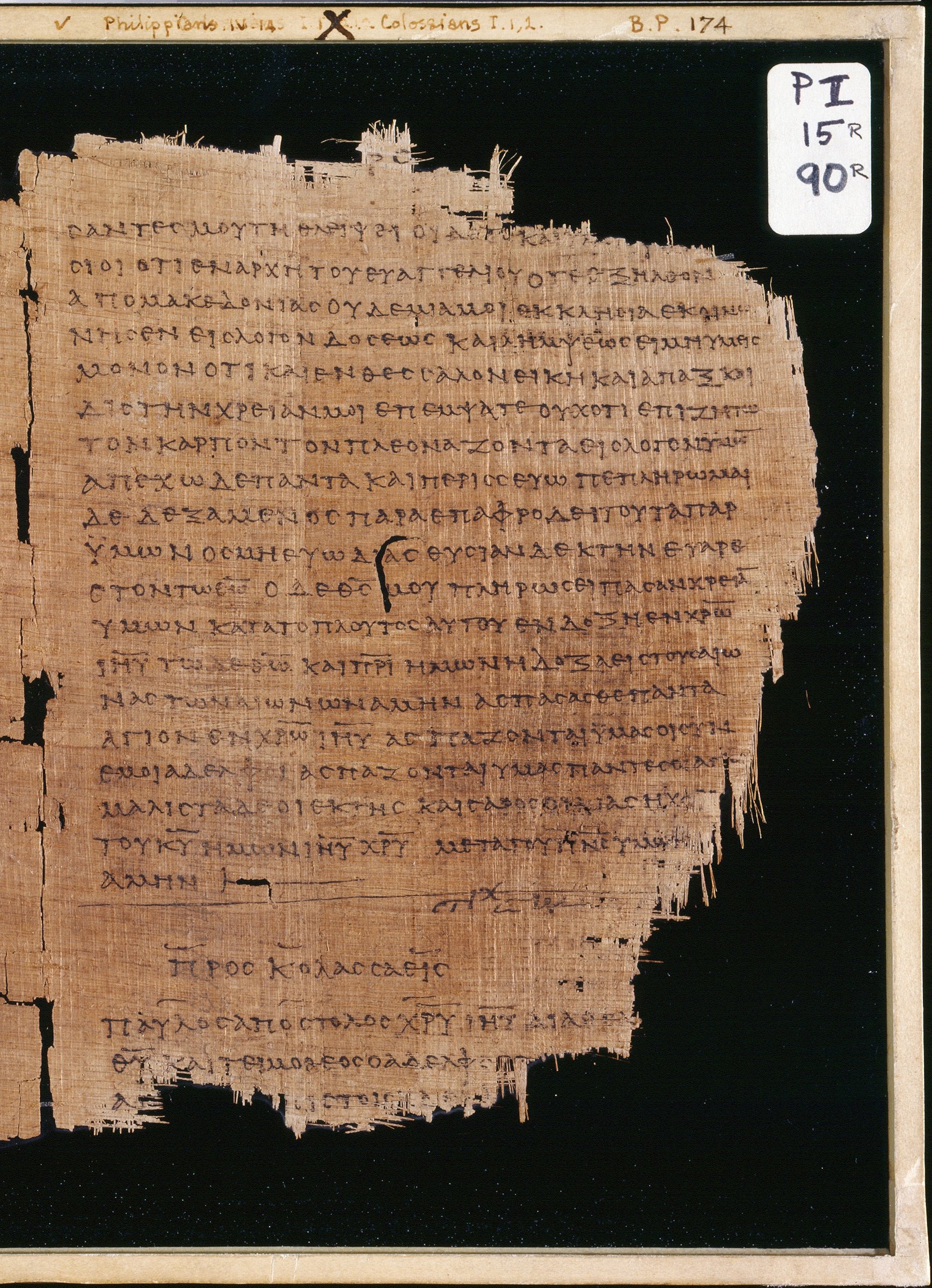
P46 (Chester Beatty II): Philippians 4:14-Colossians 1:2 (fol. 90r)
Introduction
P46 is a papyrus codex of the letters of Paul copied in Egypt around 200, the oldest surviving collection of Paul's letters. 86 of its 104 leaves survive: 56 in the Chester Beatty Library, Dublin (Biblical Papyrus II, published by Frederic Kenyon in 1934-1937) and 30 in the University of Michigan Library, Ann Arbor (P.Mich. inv. 6238, published by Henry Sanders in 1935). The letters run in the order Romans, Hebrews, 1 and 2 Corinthians, Ephesians, Galatians, Philippians, Colossians and 1 Thessalonians; the first seven leaves (Romans 1:1-5:17) and the end of the book are lost. Hebrews standing after Romans, and the doxology of Romans (16:25-27) standing after 15:33, are among its best-known features.
Each section below is one page side: the holding library's photograph, the NTVMR diplomatic transcription line by line, and the King James Version of every verse that has text on the page. The lower lines of many leaves are lost; the transcribers' restorations are in square brackets.
This entry covers fol. 90r (Philippians 4:14-Colossians 1:2).
How was this verified? (Provenance)
Where on the image
Chester Beatty Library photograph T0004435-2.jpg (https://ntmss.info/images/webfriendly/10046/T0004435-2.jpg), linked to NTVMR page 1610 (folio 90r) in NTVMR's page index. 4:14 begins on the previous page; 1:2 continues on the next page. The page also carries a book title, shown in italics in the Greek (προς κολασσαεις); the KJV has no English for it. Checked on the image: the disc on the frame reads ‹P. II ... 90R›.
4:14 σαντες μου τη θλειψει 15 οιδα̣τε̣ και υμ̣ε̣ι̣[ς] φ̣[ιλιππη]
σιοι οτι εν αρχη του ευαγγελιου οτε εξηλθον
απο μακεδονιας ουδεμια μοι εκκλησια εκοινω
νησεν εις λογον δοσεως και λημψεως ει μη υμεις
μονον 16 οτι και εν θεσσαλονεικη και απαξ και
δις την χρειαν μοι επεμψατε 17 ουχ οτι επιζητω
τον καρπον τον πλεοναζοντα εις λογον υμων
18 απεχω δε παντα και περισσευω πεπληρωμαι
δε δεξαμενος παρα επαφροδειτου τα παρ
υμων οσμη ευωδι̣ας θυσιαν δεκτην ευαρε
στον τω θ̅ω̅ 19 ο δε θ̅ς̅ μου πληρωσει πασαν χρειαν
υμων κατα το πλουτος αυτου εν δοξη εν χ̅ρ̅ω̅
ι̅η̅υ̅ 20 τω δε θ̅ω̅ και π̅ρ̅ι̅ ημων η δοξα εις τους αιω
νας των αιωνων αμην 21 ασπασασθε παντα
αγιον εν χ̅ρ̅ω̅ ι̅η̅υ̅ ασπαζονται υμας οι συν
εμοι αδελφο̣ι 22 ασπαζονται υμας παντες οι αγι̣ο̣ι̣
μαλιστα δε οι εκ της καισαρος οικ̣ιας 23 η χα̣[ρις]
του κ̅υ̅ ημων ι̅η̅υ̅ χ̅ρ̅υ̅ μετα του π̅ν̅ς̅ υμων̣
αμην
προς κολασσαεις
Colossians 1:1 παυλος αποστολος χ̅ρ̅υ̅ ι̅η̅υ̅ δια θελ[ηματος]
θ̅υ̅ κ̣αι τειμοθεος ο αδελφος̣ 2 τ̣[οις εν κολασσαις]
αγ̣[ιοις και] π̣ιστοις α̣δε̣λ̣φ̣[οις εν χ̅ρ̅ω̅ χαρις]
4:14Notwithstanding ye have well done, that ye did communicate with my affliction. 15Now ye Philippians know also, that in the beginning of the gospel, when I departed from Macedonia, no church communicated with me as concerning giving and receiving, but ye only. 16For even in Thessalonica ye sent once and again unto my necessity. 17Not because I desire a gift: but I desire fruit that may abound to your account. 18But I have all, and abound: I am full, having received of Epaphroditus the things which were sent from you, an odour of a sweet smell, a sacrifice acceptable, wellpleasing to God. 19But my God shall supply all your need according to his riches in glory by Christ Jesus. 20Now unto God and our Father be glory for ever and ever. Amen. 21Salute every saint in Christ Jesus. The brethren which are with me greet you. 22All the saints salute you, chiefly they that are of Caesar’s household. 23The grace of our Lord Jesus Christ be with you all. Amen. Colossians 1:1Paul, an apostle of Jesus Christ by the will of God, and Timotheus our brother, 2To the saints and faithful brethren in Christ which are at Colosse: Grace be unto you, and peace, from God our Father and the Lord Jesus Christ.
Notes
- Greek: the NTVMR diplomatic transcription, line by line as on the papyrus. Square brackets enclose letters that are lost or illegible and were supplied by the transcribers; a dot under a letter marks it as uncertain; [...] marks a gap. Nomina sacra and numerals keep the scribe's overline. Spelling is the scribe's (no accents or breathings). Words broken at a line end stay broken as on the papyrus. Corrections are not shown: the text is the first hand.
- English: the King James Version (1611), whole verses, for every verse that has text on the page. A verse that begins on one page and ends on the next is given in full on both. The KJV translates a later form of the Greek text, so its wording does not always match the papyrus; material differences (such as verses the papyrus does not have) are noted in the section.
Cite
Sources
- Source: P46 (Chester Beatty Biblical Papyrus II, Chester Beatty Library, Dublin): photographs as published in the INTF New Testament Virtual Manuscript Room; Greek from the INTF NTVMR transcription of P46; English from the King James Version (holding institution)
- Critical edition: INTF NTVMR diplomatic transcription (CC BY 4.0)
← previous · → next · v cycle view · l back to library