P46 (Chester Beatty II): Philippians 2:14-27 (fol. 88r)
Introduction
P46 is a papyrus codex of the letters of Paul copied in Egypt around 200, the oldest surviving collection of Paul's letters. 86 of its 104 leaves survive: 56 in the Chester Beatty Library, Dublin (Biblical Papyrus II, published by Frederic Kenyon in 1934-1937) and 30 in the University of Michigan Library, Ann Arbor (P.Mich. inv. 6238, published by Henry Sanders in 1935). The letters run in the order Romans, Hebrews, 1 and 2 Corinthians, Ephesians, Galatians, Philippians, Colossians and 1 Thessalonians; the first seven leaves (Romans 1:1-5:17) and the end of the book are lost. Hebrews standing after Romans, and the doxology of Romans (16:25-27) standing after 15:33, are among its best-known features.
Each section below is one page side: the holding library's photograph, the NTVMR diplomatic transcription line by line, and the King James Version of every verse that has text on the page. The lower lines of many leaves are lost; the transcribers' restorations are in square brackets.
This entry covers fol. 88r (Philippians 2:14-27).
How was this verified? (Provenance)
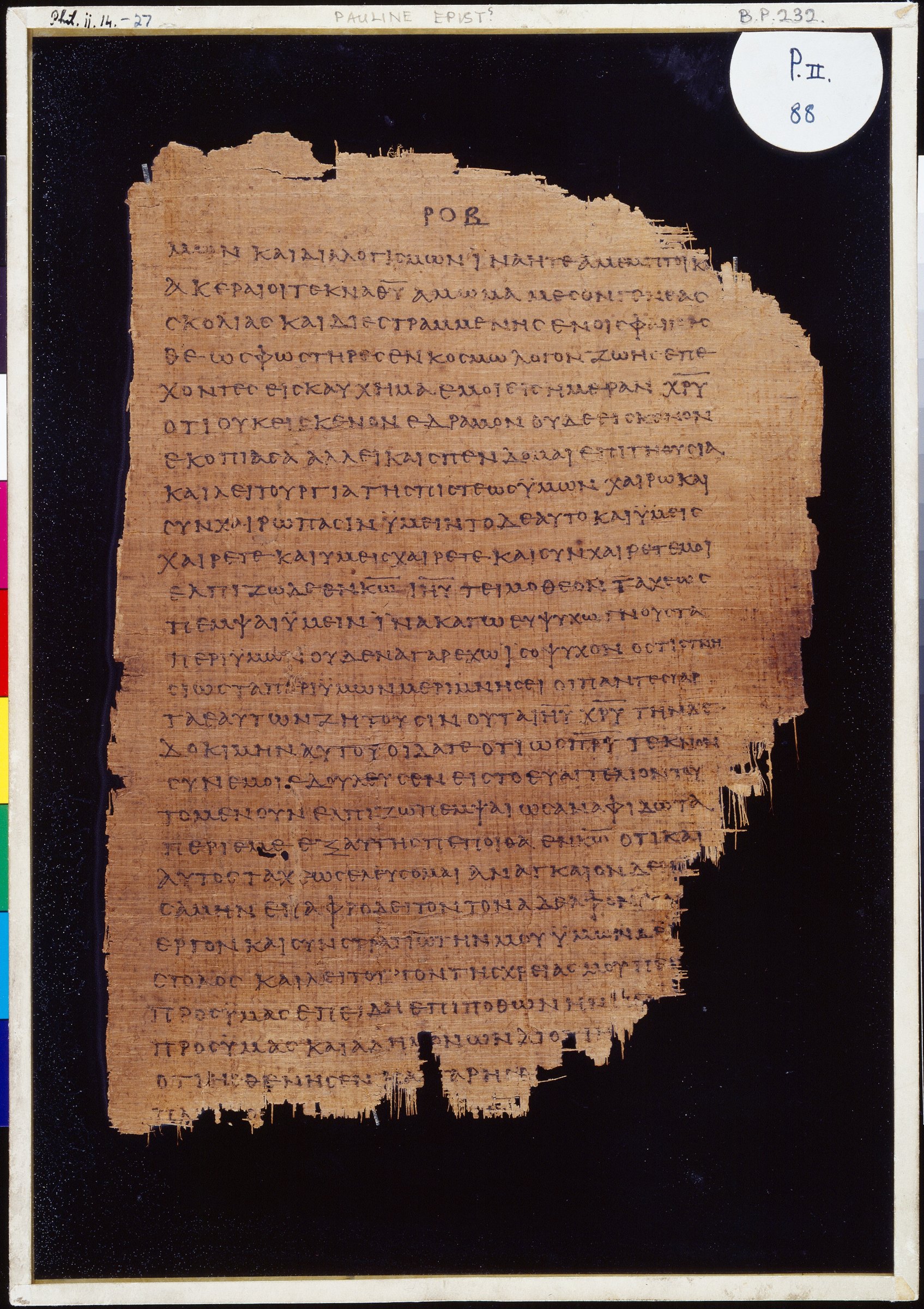
Where on the image
Chester Beatty Library photograph T0005276.jpg (https://ntmss.info/images/webfriendly/10046/T0005276.jpg), linked to NTVMR page 1570 (folio 88r) in NTVMR's page index. 2:14 begins on the previous page; 2:27 continues on the next page. Checked on the image: the scribe's page number ροβ (172) at the head of the page, continuing the sequence of the neighbouring pages; the disc on the frame reads ‹P. II 88›.
2:14 μων και διαλογισμων 15 ινα ητε αμεμπτοι κ[αι]
ακεραιοι τεκνα θ̅υ̅ αμωμα μεσον γενεας
σκολιας και διεστραμμενης εν οις φαιν̣ε̣σ
θε ως φωστηρες εν κοσμω 16 λογον ζωης επε
χοντες εις καυχημα εμοι εις ημεραν χ̅ρ̅υ̅
οτι ουκ εις κενον εδραμον ουδε εις κενον
εκοπιασα 17 αλλ ει και σπενδομαι επι τη θυσια
και λειτουργια της πιστεως υμων χαιρω και
συνχαιρω πασιν υμειν 18 το δε αυτο και υμεις
χαιρετε και υμεις χαιρετε και συνχαιρετε μοι
19 ελπιζω δε εν κ̅ω̅ ι̅η̅υ̅ τειμοθεον ταχεως
πεμψαι υμειν ινα καγω ευψυχω γνους τα
περι υμων̣ 20 ουδενα γαρ εχω ισοψυχον οστις γνη
σιως τα πε̣ρι υμων μεριμνησει 21 οι παντες γαρ
τα εαυτων ζητουσιν ου τα ι̅η̅υ̅ χ̅ρ̅υ̅ 22 την δε
δοκιμην αυτου οιδατε οτι ως π̅ρ̅ι̅ τεκνον
συν εμοι εδουλευσεν εις το ευαγγελιον 23 του
το μεν ουν ελπιζω πεμψαι ως αν αφιδω τα
περι εμε εξαυτης 24 πεποιθα εν κ̅ω̅ οτι και̣
αυτος ταχεως ελευσομαι 25 αναγκαιον δε η̣[γη]
σαμην επ̣αφροδειτον τον αδελφον κ̣α̣[ι συν]
εργον και συνστρατιωτην μου υμων δε [απο]
στολος και λειτουργον της χρειας μου πε[μψαι]
προς υμας 26 επειδη επιποθων ην π̣ε̣μ̣[ψαι]
προς υμας και αδημ̣ονων διοτ̣ι η[κουσατε]
οτι ησθενησεν 27 κ̣α[ι] γ̣αρ ησ̣θ[ενησεν παρα]
πλ[ησι]ο[ν θανατω αλ]λ̣ [ο] θ̣̣̅ς̣̣̅ [ηλεησεν αυτον]
2:14Do all things without murmurings and disputings: 15That ye may be blameless and harmless, the sons of God, without rebuke, in the midst of a crooked and perverse nation, among whom ye shine as lights in the world; 16Holding forth the word of life; that I may rejoice in the day of Christ, that I have not run in vain, neither laboured in vain. 17Yea, and if I be offered upon the sacrifice and service of your faith, I joy, and rejoice with you all. 18For the same cause also do ye joy, and rejoice with me. 19But I trust in the Lord Jesus to send Timotheus shortly unto you, that I also may be of good comfort, when I know your state. 20For I have no man likeminded, who will naturally care for your state. 21For all seek their own, not the things which are Jesus Christ’s. 22But ye know the proof of him, that, as a son with the father, he hath served with me in the gospel. 23Him therefore I hope to send presently, so soon as I shall see how it will go with me. 24But I trust in the Lord that I also myself shall come shortly. 25Yet I supposed it necessary to send to you Epaphroditus, my brother, and companion in labour, and fellowsoldier, but your messenger, and he that ministered to my wants. 26For he longed after you all, and was full of heaviness, because that ye had heard that he had been sick. 27For indeed he was sick nigh unto death: but God had mercy on him; and not on him only, but on me also, lest I should have sorrow upon sorrow.
Notes
- Greek: the NTVMR diplomatic transcription, line by line as on the papyrus. Square brackets enclose letters that are lost or illegible and were supplied by the transcribers; a dot under a letter marks it as uncertain; [...] marks a gap. Nomina sacra and numerals keep the scribe's overline. Spelling is the scribe's (no accents or breathings). Words broken at a line end stay broken as on the papyrus. Corrections are not shown: the text is the first hand.
- English: the King James Version (1611), whole verses, for every verse that has text on the page. A verse that begins on one page and ends on the next is given in full on both. The KJV translates a later form of the Greek text, so its wording does not always match the papyrus; material differences (such as verses the papyrus does not have) are noted in the section.
Cite
Sources
- Source: P46 (Chester Beatty Biblical Papyrus II, Chester Beatty Library, Dublin): photographs as published in the INTF New Testament Virtual Manuscript Room; Greek from the INTF NTVMR transcription of P46; English from the King James Version (holding institution)
- Critical edition: INTF NTVMR diplomatic transcription (CC BY 4.0)
← previous · → next · v cycle view · l back to library