P46 (Chester Beatty II): Romans 5:17-6:4 (fol. 8r)
Introduction
P46 is a papyrus codex of the letters of Paul copied in Egypt around 200, the oldest surviving collection of Paul's letters. 86 of its 104 leaves survive: 56 in the Chester Beatty Library, Dublin (Biblical Papyrus II, published by Frederic Kenyon in 1934-1937) and 30 in the University of Michigan Library, Ann Arbor (P.Mich. inv. 6238, published by Henry Sanders in 1935). The letters run in the order Romans, Hebrews, 1 and 2 Corinthians, Ephesians, Galatians, Philippians, Colossians and 1 Thessalonians; the first seven leaves (Romans 1:1-5:17) and the end of the book are lost. Hebrews standing after Romans, and the doxology of Romans (16:25-27) standing after 15:33, are among its best-known features.
Each section below is one page side: the holding library's photograph, the NTVMR diplomatic transcription line by line, and the King James Version of every verse that has text on the page. The lower lines of many leaves are lost; the transcribers' restorations are in square brackets.
This entry covers fol. 8r (Romans 5:17-6:4).
How was this verified? (Provenance)
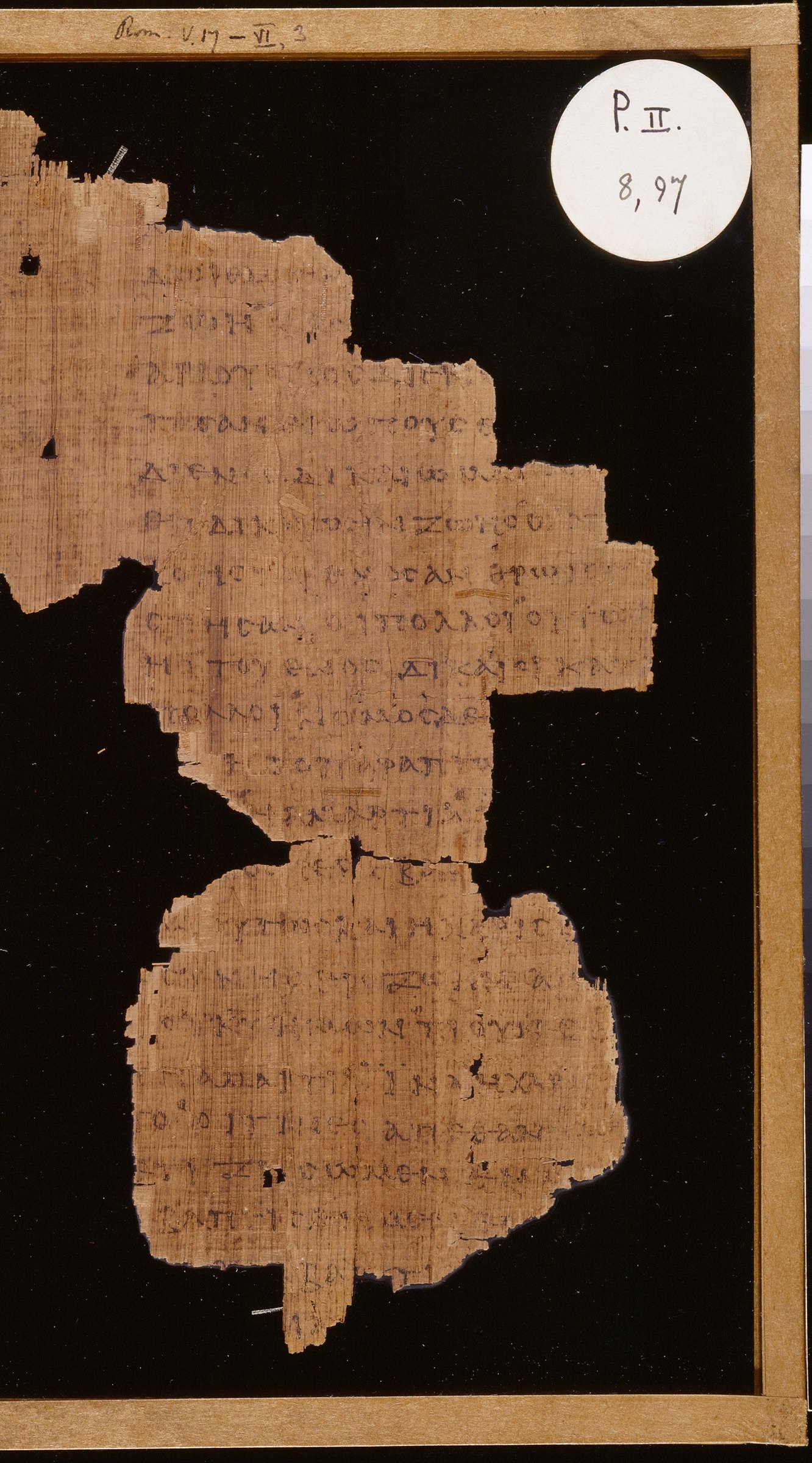
Where on the image
Chester Beatty Library photograph T0005249-2.jpg (https://ntmss.info/images/webfriendly/10046/T0005249-2.jpg), linked to NTVMR page 10 (folio 8r) in NTVMR's page index. 5:17 begins on the previous page; 6:4 continues on the next page. Checked on the image: the frame label reads ‹Rom. V.17-VI.3› and the disc ‹P. II 8,97›.
5:17 δωρ̣εα̣ς̣ τ̣η̣ς̣ [δικαιοσυνης λαμβανοντες εν]
ζωη β̣α̣σ̣[ιλευσουσιν δια του ενος ι̅η̅υ̅ χ̅ρ̅υ̅]
18 αρα ουν̣ ως δι εν̣[ος παραπτωματος εις παν]
τα̣ς ανθρ̣ωπους ε̣[ις κατακριμα ουτως και]
δι ενο̣ς̣ δικα̣ιωμα̣τ̣[ος εις παντας ανθρωπους]
εις δικα̣ι̣ωσιν ζωης 19 ωσ̣π̣[ερ γαρ δια της παρα]
κ̣ο̣ης τ̣ο̣υ̣ ενος ανθρωπο̣υ̣ [αμαρτωλοι κατε]
στ̣ησαν̣ οι πολλοι ουτως̣ [και δια της υπακο]
ης του ενος δικαιοι κατ̣α̣[σταθησονται οι]
π̣ολλοι 20 νομος δε [παρεισηλθεν ινα πλεο]
[νασ]η το παραπτω̣[μα ου δε επλεονα]
[σεν] η αμαρτια̣ [υπερεπερισσευσεν η χαρις]
21 [ινα] ω̣σ̣π̣ερ ε̣βα̣σ̣[ιλευσεν η αμαρτια εν τω θανα]
[τ]ω̣ ο̣υτως̣ και η χαρ̣ις [βασιλευση δια δικαι]
[ο]συνη̣ς ε̣ις ζωην αι̣ω̣[νιον δια ι̅η̅υ̅ χ̅ρ̅υ̅]
τ̣ου κ̅υ̣̣̅ η̣μ̣ων 6:1 τι ουν ερ̣[ουμεν επιμενωμεν]
τ̣η αμαρ̣τια ινα η χαρις̣ [πλεοναση] 2 [μη γενοι]
τ̣ο οιτινες απεθανο̣μ[εν τη αμαρτια πως]
ετι ζη̣σωμεν εν α̣[υτη] 3 [η αγνοειτε οτι οσοι]
[ε]βαπτισθ̣η̣μεν̣ ε̣ι̣[ς χ̅ρ̅ν̅ ι̅η̅ν̅ εις τον θανατον]
[αυτ]ο̣υ̣ [ε]βαπ̣τι[σθημεν] 4 [συνεταφημεν ουν]
[αυτω δ]ια [του βαπτισματος εις τον θανατον]
5:17For if by one man’s offence death reigned by one; much more they which receive abundance of grace and of the gift of righteousness shall reign in life by one, Jesus Christ.) 18Therefore as by the offence of one judgment came upon all men to condemnation; even so by the righteousness of one the free gift came upon all men unto justification of life. 19For as by one man’s disobedience many were made sinners, so by the obedience of one shall many be made righteous. 20Moreover the law entered, that the offence might abound. But where sin abounded, grace did much more abound: 21That as sin hath reigned unto death, even so might grace reign through righteousness unto eternal life by Jesus Christ our Lord. 6:1What shall we say then? Shall we continue in sin, that grace may abound? 2God forbid. How shall we, that are dead to sin, live any longer therein? 3Know ye not, that so many of us as were baptized into Jesus Christ were baptized into his death? 4Therefore we are buried with him by baptism into death: that like as Christ was raised up from the dead by the glory of the Father, even so we also should walk in newness of life.
Notes
- Greek: the NTVMR diplomatic transcription, line by line as on the papyrus. Square brackets enclose letters that are lost or illegible and were supplied by the transcribers; a dot under a letter marks it as uncertain; [...] marks a gap. Nomina sacra and numerals keep the scribe's overline. Spelling is the scribe's (no accents or breathings). Words broken at a line end stay broken as on the papyrus. Corrections are not shown: the text is the first hand.
- English: the King James Version (1611), whole verses, for every verse that has text on the page. A verse that begins on one page and ends on the next is given in full on both. The KJV translates a later form of the Greek text, so its wording does not always match the papyrus; material differences (such as verses the papyrus does not have) are noted in the section.
Cite
Sources
- Source: P46 (Chester Beatty Biblical Papyrus II, Chester Beatty Library, Dublin): photographs as published in the INTF New Testament Virtual Manuscript Room; Greek from the INTF NTVMR transcription of P46; English from the King James Version (holding institution)
- Critical edition: INTF NTVMR diplomatic transcription (CC BY 4.0)
← previous · → next · v cycle view · l back to library