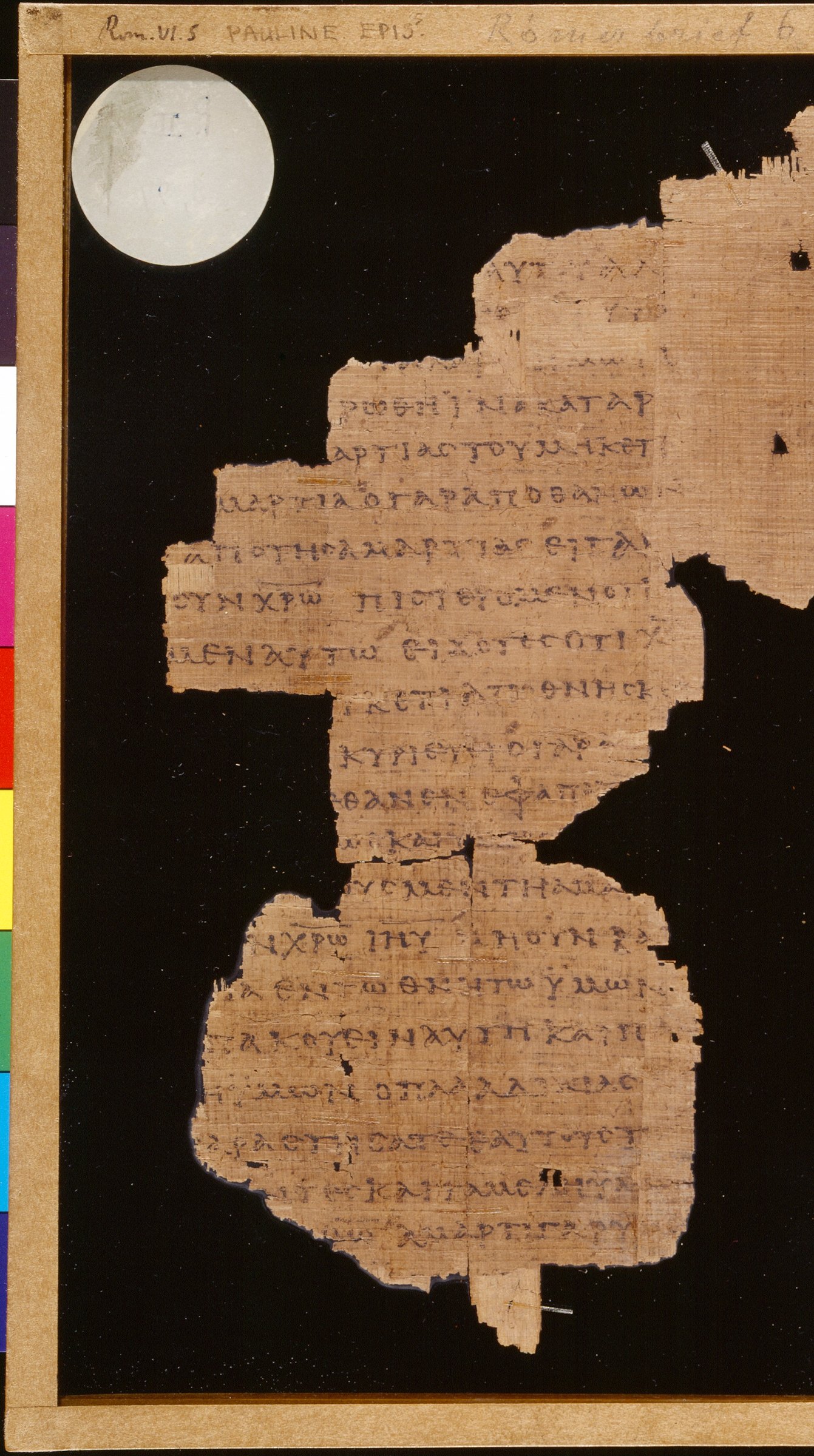
P46 (Chester Beatty II): Romans 6:5-14 (fol. 8v)
Introduction
P46 is a papyrus codex of the letters of Paul copied in Egypt around 200, the oldest surviving collection of Paul's letters. 86 of its 104 leaves survive: 56 in the Chester Beatty Library, Dublin (Biblical Papyrus II, published by Frederic Kenyon in 1934-1937) and 30 in the University of Michigan Library, Ann Arbor (P.Mich. inv. 6238, published by Henry Sanders in 1935). The letters run in the order Romans, Hebrews, 1 and 2 Corinthians, Ephesians, Galatians, Philippians, Colossians and 1 Thessalonians; the first seven leaves (Romans 1:1-5:17) and the end of the book are lost. Hebrews standing after Romans, and the doxology of Romans (16:25-27) standing after 15:33, are among its best-known features.
Each section below is one page side: the holding library's photograph, the NTVMR diplomatic transcription line by line, and the King James Version of every verse that has text on the page. The lower lines of many leaves are lost; the transcribers' restorations are in square brackets.
This entry covers fol. 8v (Romans 6:5-14).
How was this verified? (Provenance)
Where on the image
Chester Beatty Library photograph T0005250-1.jpg (https://ntmss.info/images/webfriendly/10046/T0005250-1.jpg), linked to NTVMR page 20 (folio 8v) in NTVMR's page index. 6:5 begins on the previous page; 6:14 continues on the next page. Checked on the image: the frame label reads ‹Rom. VI.5 ... Pauline Epis[tles]›.
6:5 [γεγο]
[ναμεν τω ομοιωματι του θανατου] αυτο̣υ αλ
[λα και της αναστασεως εσομ]ε̣θ[α] 6 [το]υτο
[γεινωσκοντες οτι] ο̣ π̣α̣λα̣ι̣[ος] η̣μ̣ων̣
[ανθρωπος συνεσταυ]ρωθη ινα καταρ
[γηθη το σωμα της αμ]αρτιας του μηκετι
[δουλευειν ημας τη α]μαρτια 7 ο γαρ αποθανων
[δεδικαιωται] απο της αμαρτιας 8 ει γαρ̣
[απεθανομεν] συν χ̅ρ̅ω̅ πιστευομεν οτ̣ι
[και συνζησο]μεν αυτω 9 ειδοτες οτι χ̅ς̣̣̅
[εγερθεις εκ νεκρων ο]υκετι αποθνησκε̣[ι]
[θανατος αυτου ουκετι] κυριευει 10 ο γαρ α̣[πε]
[θανεν τη αμαρτια απ]ε̣θανεν εφαπαξ̣
[ο δε ζη ζη τω θ̅ω̅] 11 [ουτ]ως και υμ̣ε̣ι̣ς̣ [λογι]
[ζεσθε εαυτους νεκρ]ο̣υς μεν τη αμαρ̣
[τια ζωντας δε τω θ̅ω̅ ε]ν χ̅ρ̅ω̅ ι̅η̅υ̅ 12 μη ουν βα
[σιλευετω η αμαρτ]ι̣α εν τω θνητω υμων
[σωματι εις το υ]πακουειν αυτη 13 και πα̣[ρ]
[ιστανετε τα μελ]η υμων οπλα αδικιας
[τη αμαρτια αλλα π]αραστησατε εαυτους τ[ω]
[θ̅ω̅ ωσει εκ νεκρων ζω]ντες και τα μελη υμω[ν]
[οπλα δικαιοσυνης τω] θ̣̣̅ω̅ 14 αμαρτι γαρ υ[μων]
6:5For if we have been planted together in the likeness of his death, we shall be also in the likeness of his resurrection: 6Knowing this, that our old man is crucified with him, that the body of sin might be destroyed, that henceforth we should not serve sin. 7For he that is dead is freed from sin. 8Now if we be dead with Christ, we believe that we shall also live with him: 9Knowing that Christ being raised from the dead dieth no more; death hath no more dominion over him. 10For in that he died, he died unto sin once: but in that he liveth, he liveth unto God. 11Likewise reckon ye also yourselves to be dead indeed unto sin, but alive unto God through Jesus Christ our Lord. 12Let not sin therefore reign in your mortal body, that ye should obey it in the lusts thereof. 13Neither yield ye your members as instruments of unrighteousness unto sin: but yield yourselves unto God, as those that are alive from the dead, and your members as instruments of righteousness unto God. 14For sin shall not have dominion over you: for ye are not under the law, but under grace.
Notes
- Greek: the NTVMR diplomatic transcription, line by line as on the papyrus. Square brackets enclose letters that are lost or illegible and were supplied by the transcribers; a dot under a letter marks it as uncertain; [...] marks a gap. Nomina sacra and numerals keep the scribe's overline. Spelling is the scribe's (no accents or breathings). Words broken at a line end stay broken as on the papyrus. Corrections are not shown: the text is the first hand.
- English: the King James Version (1611), whole verses, for every verse that has text on the page. A verse that begins on one page and ends on the next is given in full on both. The KJV translates a later form of the Greek text, so its wording does not always match the papyrus; material differences (such as verses the papyrus does not have) are noted in the section.
Cite
Sources
- Source: P46 (Chester Beatty Biblical Papyrus II, Chester Beatty Library, Dublin): photographs as published in the INTF New Testament Virtual Manuscript Room; Greek from the INTF NTVMR transcription of P46; English from the King James Version (holding institution)
- Critical edition: INTF NTVMR diplomatic transcription (CC BY 4.0)
← previous · → next · v cycle view · l back to library