P46 (Chester Beatty II): Romans 9:9-32 (fols. 12v-13r)
Introduction
P46 is a papyrus codex of the letters of Paul copied in Egypt around 200, the oldest surviving collection of Paul's letters. 86 of its 104 leaves survive: 56 in the Chester Beatty Library, Dublin (Biblical Papyrus II, published by Frederic Kenyon in 1934-1937) and 30 in the University of Michigan Library, Ann Arbor (P.Mich. inv. 6238, published by Henry Sanders in 1935). The letters run in the order Romans, Hebrews, 1 and 2 Corinthians, Ephesians, Galatians, Philippians, Colossians and 1 Thessalonians; the first seven leaves (Romans 1:1-5:17) and the end of the book are lost. Hebrews standing after Romans, and the doxology of Romans (16:25-27) standing after 15:33, are among its best-known features.
Each section below is one page side: the holding library's photograph, the NTVMR diplomatic transcription line by line, and the King James Version of every verse that has text on the page. The lower lines of many leaves are lost; the transcribers' restorations are in square brackets.
This entry covers fols. 12v-13r (Romans 9:9-32).
How was this verified? (Provenance)
Where on the image
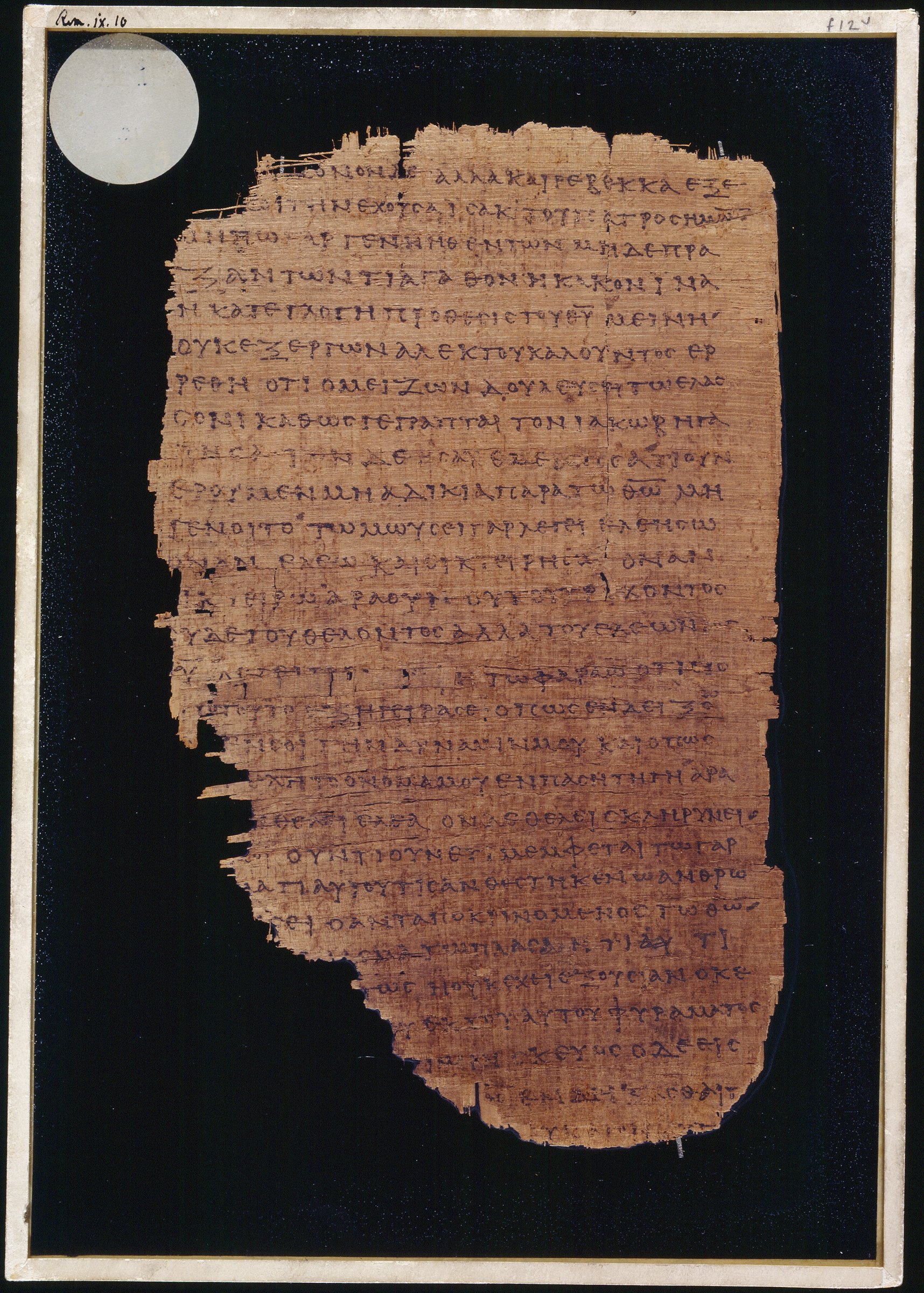
Chester Beatty Library photograph T0004421.jpg (https://ntmss.info/images/webfriendly/10046/T0004421.jpg), linked to NTVMR page 60 (folio 12v) in NTVMR's page index. 9:9 begins on the previous page; 9:22 continues on the next page. Checked on the image: the first line reads ‹[μ]ονον δε αλλα και ρεβεκκα εξ ε...›, as in the transcription.
9:9 [υιος] 10 [ο]υ̣ μ̣ονον δ̣ε αλλα και ρεβεκκα εξ ε
[νος] κ̣οιτην εχουσα ισακ του πατρος ημων
11 μηπω γαρ γεννηθεντων μηδε πρα
ξαντων τι αγαθον η κακον ινα
η κατ εγλογη προθεσις του θ̅υ̅ μεινη
12 ουκ εξ εργων αλ εκ του καλουντος ερ
ρεθη οτι ο μειζων δουλευσει τω ελασ
σονι 13 καθως γεγραπται τον ιακωβ ηγα
π̣ησα τον δε ησαυ εμεισησα 14 τι ουν
ερουμεν μη αδικια παρα τω θ̅ω̅ μη
γενοιτο 15 τω μωυσει γαρ λεγει ελεησω
ον αν ελεω και οικτειρησω ον αν
[ο]ικτ̣ειρω 16 αρα ουν ου του τρε̣χοντος
ο̣υδε του θελοντος αλλα του ελεωντ̣ος
[θ̅]υ̅ 17 λ̣εγει γ̣α̣ρ̣ η̣ [γρα]φ̣η τω φαραω οτι εις
[α]υ̣το τουτο εξηγειρα σε οπως ενδειξο
[μαι] ε̣ν σοι την δυναμιν μου και οπως
[διαγγ]ελη το ονομα μου εν παση τη γη 18 αρα
[ουν ο]ν̣ θελει ελεα ον δε θελει σκληρυνει
19 [ερεις] μ̣οι ουν τι ουν ετι μεμφεται τω γαρ
[βουλη]μ̣ατι αυτου τις ανθεστηκεν 20 ω ανθρω
[πε συ τ]ι̣ς ει ο ανταποκρινομενος τω θ̅ω̅
[μη ερει το] π̣λ̣α̣σμα τω πλασαντι αυ τι
[με εποιησας ου]τως 21 η ουκ εχει εξουσιαν ο κε
[ραμευς του πηλο]υ εκ του αυτου φυραματος
[ποιησαι ο μεν εις τ]ιμην σκευος ο δε εις
[ατιμιαν] 22 [ει δε θελων ο] θ̅ς̅ ενδειξ̣α̣σθαι τ[ην]
[οργην και γνωρισαι το δ]υνατ̣ον α̣υ̣τ[ου]
9:9For this is the word of promise, At this time will I come, and Sara shall have a son. 10And not only this; but when Rebecca also had conceived by one, even by our father Isaac; 11(For the children being not yet born, neither having done any good or evil, that the purpose of God according to election might stand, not of works, but of him that calleth;) 12It was said unto her, The elder shall serve the younger. 13As it is written, Jacob have I loved, but Esau have I hated. 14What shall we say then? Is there unrighteousness with God? God forbid. 15For he saith to Moses, I will have mercy on whom I will have mercy, and I will have compassion on whom I will have compassion. 16So then it is not of him that willeth, nor of him that runneth, but of God that sheweth mercy. 17For the scripture saith unto Pharaoh, Even for this same purpose have I raised thee up, that I might shew my power in thee, and that my name might be declared throughout all the earth. 18Therefore hath he mercy on whom he will have mercy, and whom he will he hardeneth. 19Thou wilt say then unto me, Why doth he yet find fault? For who hath resisted his will? 20Nay but, O man, who art thou that repliest against God? Shall the thing formed say to him that formed it, Why hast thou made me thus? 21Hath not the potter power over the clay, of the same lump to make one vessel unto honour, and another unto dishonour? 22What if God, willing to shew his wrath, and to make his power known, endured with much longsuffering the vessels of wrath fitted to destruction:
Where on the image
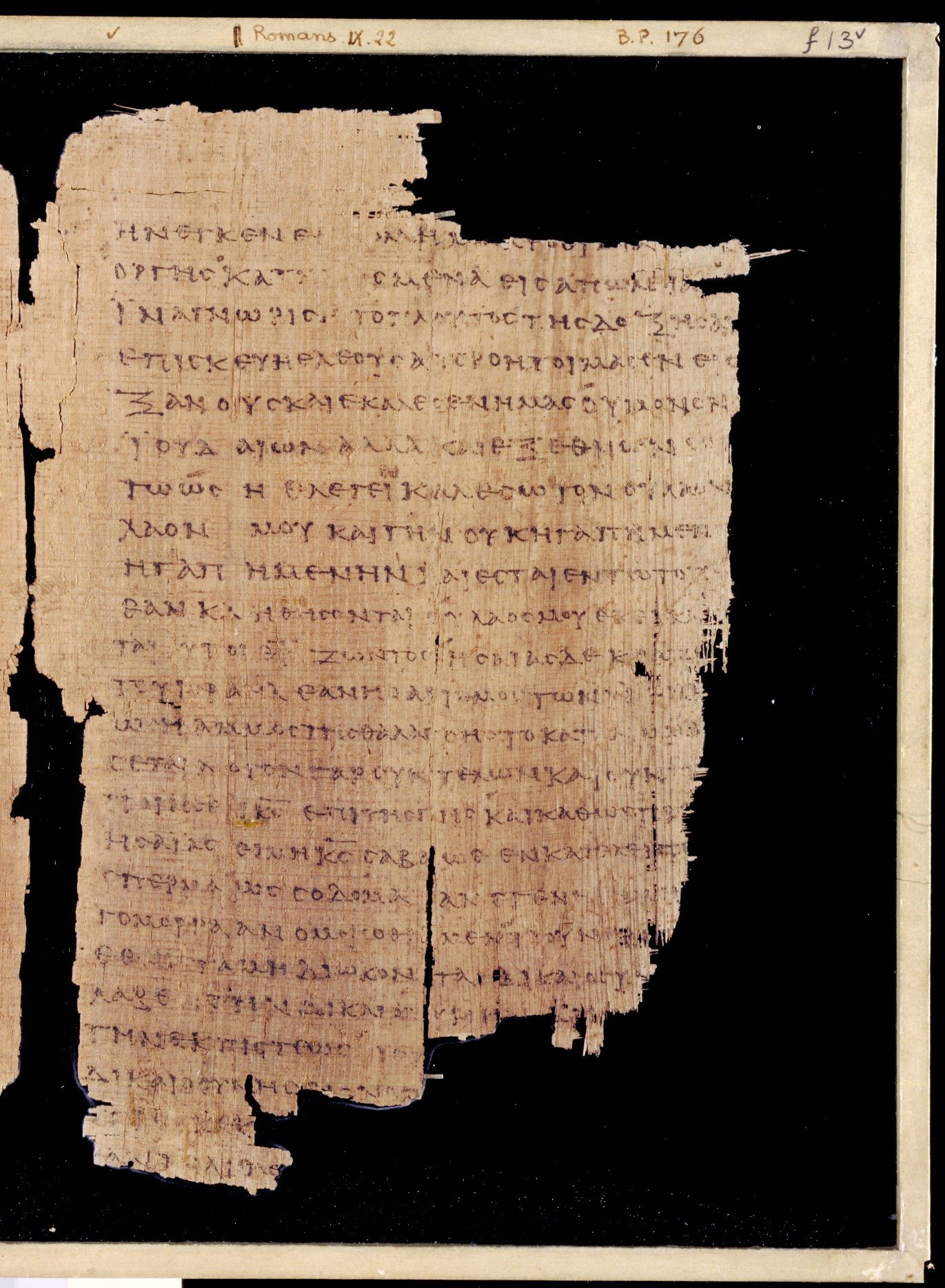
Chester Beatty Library photograph T0004433-2.jpg (https://ntmss.info/images/webfriendly/10046/T0004433-2.jpg), linked to NTVMR page 70 (folio 13r) in NTVMR's page index. 9:22 begins on the previous page. Checked on the image: the frame label reads ‹Romans IX.22 ... B.P. 176›.
9:22 ηνεγκεν εν̣ [π]ο̣λλη μ̣α̣κ̣ρ̣οθ̣υ̣μ̣ι̣α̣ [σκευη]
οργης κατη̣[ρτι]σμενα εις απωλεια[ν] 23 [και]
ινα γνωριση̣ το πλουτος της δοξης αυ̣[του]
επι σκευη ελεους α προητοιμασεν εις [δο]
ξαν 24 ους και εκαλεσεν ημας ου μονον [εξ]
ιουδαιων αλλα και εξ εθνων 25 ω̣[ς και]
τω ωσηε λεγει καλεσω τον ου λαον̣ [μου]
λαον μου και την ουκ ηγαπημεν[ην]
ηγαπημενην 26 κ̣αι εσται εν τω τοπ̣ω̣ [ου]
εαν κληθησονται ου λαος μου εκει̣ κλ[ηθησον]
ται υιοι θ̅υ̣̣̅ ζωντος 27 ησαιας δε κρ̣α̣ζε̣[ι υπερ]
του ισ̣ραη̣λ εαν η ο αρ̣ιθμος των υιων [ισραηλ]
ως η αμμος της θαλασσης το κατα̣λι̣μμα [σωθη]
σεται 28 λογον γαρ συντελων και συντ̣[εμνων]
ποιησει κ̅ς̅ επι της γης 29 και καθως προ̣[ειρηκεν]
ησαιας ει μη κ̅ς̅ σαβαωθ ενκατελειπ̣ε̣[ν ημιν]
σπερμα ως σοδομα αν εγενη[θ]η̣μ̣ε̣ν̣ [και ως]
γομορρα αν ομοιωθημεν 30 τι ουν ε̣ρ̣ο̣[υμεν οτι]
εθν̣η̣ τα μη διωκοντα δικαιοσυν̣[ην κατε]
λαβεν̣ την δικαιοσ̣υνην̣ δ̣ι̣[καιοσυνην δε]
την εκ πιστεως 31 ισρ̣[αηλ δε διωκων νομον]
δικαιοσυν̣ης ε̣ι̣ς̣ νο̣μ̣[ον ουκ εφθασεν] 32 [δια τι]
ο̣τι ο̣υ̣κ εκ [πιστεως αλλ ως εξ εργων προσεκο]
ψ̣αν τω̣ λιθ̣ω̣ [του προσκομματος]
9:22What if God, willing to shew his wrath, and to make his power known, endured with much longsuffering the vessels of wrath fitted to destruction: 23And that he might make known the riches of his glory on the vessels of mercy, which he had afore prepared unto glory, 24Even us, whom he hath called, not of the Jews only, but also of the Gentiles? 25As he saith also in Osee, I will call them my people, which were not my people; and her beloved, which was not beloved. 26And it shall come to pass, that in the place where it was said unto them, Ye are not my people; there shall they be called the children of the living God. 27Esaias also crieth concerning Israel, Though the number of the children of Israel be as the sand of the sea, a remnant shall be saved: 28For he will finish the work, and cut it short in righteousness: because a short work will the Lord make upon the earth. 29And as Esaias said before, Except the Lord of Sabaoth had left us a seed, we had been as Sodoma, and been made like unto Gomorrha. 30What shall we say then? That the Gentiles, which followed not after righteousness, have attained to righteousness, even the righteousness which is of faith. 31But Israel, which followed after the law of righteousness, hath not attained to the law of righteousness. 32Wherefore? Because they sought it not by faith, but as it were by the works of the law. For they stumbled at that stumblingstone;
Notes
- Greek: the NTVMR diplomatic transcription, line by line as on the papyrus. Square brackets enclose letters that are lost or illegible and were supplied by the transcribers; a dot under a letter marks it as uncertain; [...] marks a gap. Nomina sacra and numerals keep the scribe's overline. Spelling is the scribe's (no accents or breathings). Words broken at a line end stay broken as on the papyrus. Corrections are not shown: the text is the first hand.
- English: the King James Version (1611), whole verses, for every verse that has text on the page. A verse that begins on one page and ends on the next is given in full on both. The KJV translates a later form of the Greek text, so its wording does not always match the papyrus; material differences (such as verses the papyrus does not have) are noted in the section.
Cite
Sources
- Source: P46 (Chester Beatty Biblical Papyrus II, Chester Beatty Library, Dublin): photographs as published in the INTF New Testament Virtual Manuscript Room; Greek from the INTF NTVMR transcription of P46; English from the King James Version (holding institution)
- Critical edition: INTF NTVMR diplomatic transcription (CC BY 4.0)
← previous · → next · v cycle view · l back to library