P46 (Chester Beatty II): Romans 10:12-11:2 (fol. 14r)
Introduction
P46 is a papyrus codex of the letters of Paul copied in Egypt around 200, the oldest surviving collection of Paul's letters. 86 of its 104 leaves survive: 56 in the Chester Beatty Library, Dublin (Biblical Papyrus II, published by Frederic Kenyon in 1934-1937) and 30 in the University of Michigan Library, Ann Arbor (P.Mich. inv. 6238, published by Henry Sanders in 1935). The letters run in the order Romans, Hebrews, 1 and 2 Corinthians, Ephesians, Galatians, Philippians, Colossians and 1 Thessalonians; the first seven leaves (Romans 1:1-5:17) and the end of the book are lost. Hebrews standing after Romans, and the doxology of Romans (16:25-27) standing after 15:33, are among its best-known features.
Each section below is one page side: the holding library's photograph, the NTVMR diplomatic transcription line by line, and the King James Version of every verse that has text on the page. The lower lines of many leaves are lost; the transcribers' restorations are in square brackets.
This entry covers fol. 14r (Romans 10:12-11:2).
How was this verified? (Provenance)
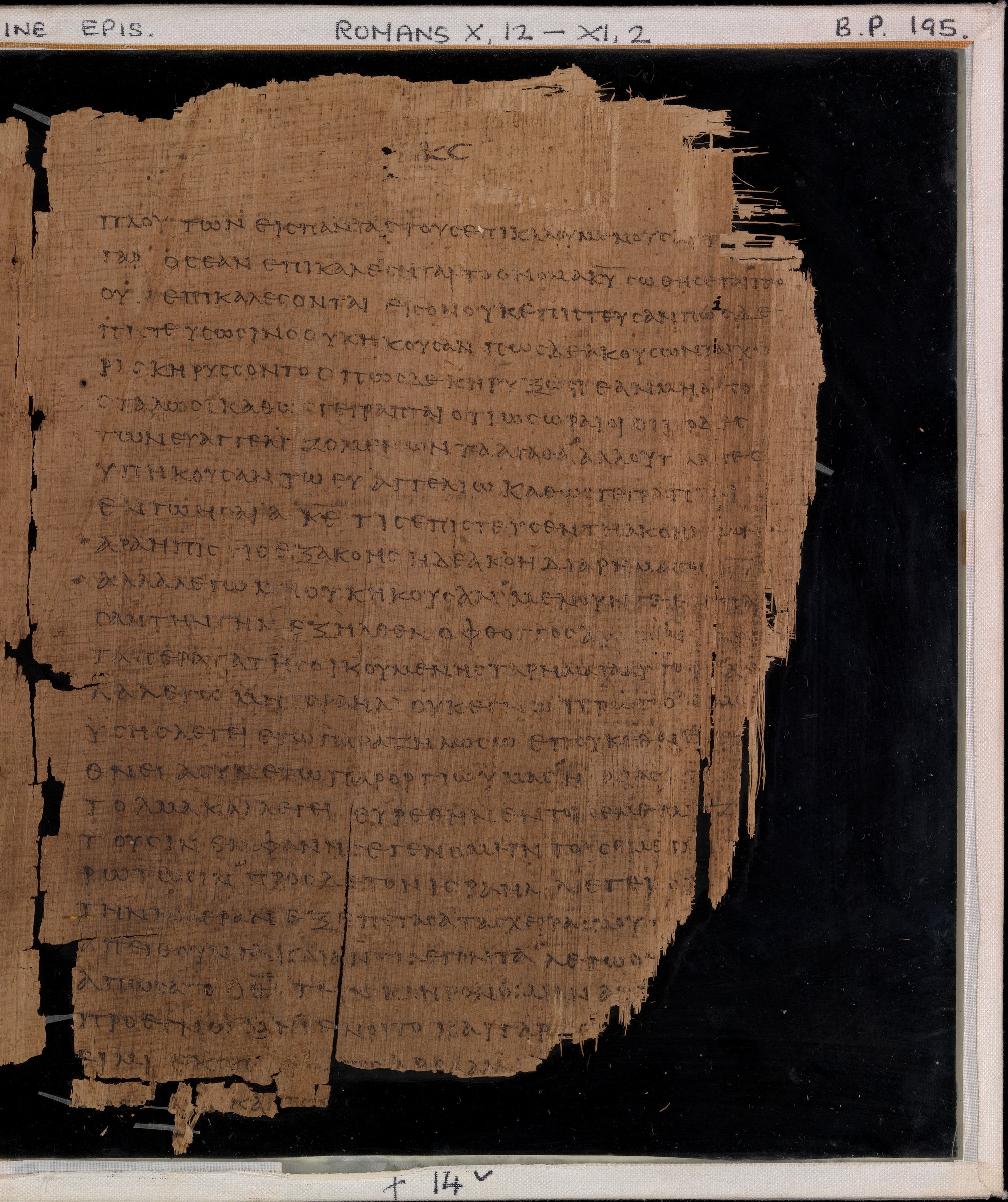
Where on the image
Chester Beatty Library photograph D0005418-2.jpg (https://ntmss.info/images/webfriendly/10046/D0005418-2.jpg), linked to NTVMR page 90 (folio 14r) in NTVMR's page index. 10:12 begins on the previous page; 11:2 continues on the next page. Checked on the image: the scribe's page number κς (26) at the head of the page, matching NTVMR folio 14r.
10:12 πλουτων εις παντας τους επικαλουμενους α̣υ̣τ[ον] 13 [πας]
γαρ ος εαν επικαλεσηται το ονομα κ̅υ̅ σωθησεται 14 πω[ς]
ουν̣ επικαλεσονται εις ον ουκ επιστευσαν πως δε
πιστευσωσιν ο ουκ ηκουσαν πως δε ακουσωνται χω̣
ρις κηρυσσοντος 15 πως δε κηρυξωσι εαν μη απ̣ο
σταλωσι καθω̣ς γεγραπται οτι ως ωραιοι οι π̣οδες
των ευαγγελιζομενων τα αγαθα 16 αλλ ου π̣αντ̣ες
υπηκουσαν τω ευαγγελιω· καθως γεγραπτ̣α̣ι
εν τω ησαια κ̅ε̅ τις επιστευσεν τη ακοη η̣μ̣ων
17 αρ̣α η πιστις εξ ακοης η δε ακοη δια ρηματος̣ χ̣̣̅ρ̣̣̅υ̣̣̅
18 αλλα λεγω μ̣η̣ ουκ ηκουσαν μενουνγε ει̣ς̣ πα
σαν την γην εξηλθεν ο φθογγος αυ[τ]ω̣ν̣ [κ]α̣ι̣ ε̣[ις]
τα περατα της οικουμενης τα ρηματα αυτω̣ν̣ 19 α[λ]
λα λεγω μη ι̣σραηλ ουκ εγνω πρωτος̣ μω
υσης λεγει εγω πα̣ραζηλωσω επ ουκ εθνε[ι] ε̣[π ε]
θνει ασυνετω παροργιω υμας 20 ησ̣αιας δ̣ε̣ [απο]
τολμα και λεγει ευρεθην εν τοις εμε μη̣ ζ[η]
τουσιν εμ̣φανης̣ εγενομην τοις εμε μ̣η̣ [επε]
ρωτωσιν 21 προς δε τον ισραηλ λεγει ολ̣[ην]
την η̣μ̣εραν εξεπετασα τας χειρας μου π̣[ρος λαον]
απειθουντα και αντιλεγοντα 11:1 λεγω ου̣[ν μη]
απωσατο ο θ̅ς̅ την κληρονομιαν αυ̣τ̣[ου ην]
προεγνω μη γ̣ενοιτο και γαρ [ι]σ̣ρ̣[αηλιτης]
ειμι εκ σ̣π̣[ε]ρμ̣α̣τος α̣β̣ρ̣α̣αμ φ̣[υλης βενι]
α̣μ̣ειν 2 ο̣[υ]κ απ̣ω̣[σατο ο θ̅ς̅ τον λαον αυτου ον]
[προε]γ[νω η ουκ οιδατε εν ηλια τι λεγει η]
10:12For there is no difference between the Jew and the Greek: for the same Lord over all is rich unto all that call upon him. 13For whosoever shall call upon the name of the Lord shall be saved. 14How then shall they call on him in whom they have not believed? and how shall they believe in him of whom they have not heard? and how shall they hear without a preacher? 15And how shall they preach, except they be sent? as it is written, How beautiful are the feet of them that preach the gospel of peace, and bring glad tidings of good things! 16But they have not all obeyed the gospel. For Esaias saith, Lord, who hath believed our report? 17So then faith cometh by hearing, and hearing by the word of God. 18But I say, Have they not heard? Yes verily, their sound went into all the earth, and their words unto the ends of the world. 19But I say, Did not Israel know? First Moses saith, I will provoke you to jealousy by them that are no people, and by a foolish nation I will anger you. 20But Esaias is very bold, and saith, I was found of them that sought me not; I was made manifest unto them that asked not after me. 21But to Israel he saith, All day long I have stretched forth my hands unto a disobedient and gainsaying people. 11:1I say then, Hath God cast away his people? God forbid. For I also am an Israelite, of the seed of Abraham, of the tribe of Benjamin. 2God hath not cast away his people which he foreknew. Wot ye not what the scripture saith of Elias? how he maketh intercession to God against Israel, saying,
Notes
- Greek: the NTVMR diplomatic transcription, line by line as on the papyrus. Square brackets enclose letters that are lost or illegible and were supplied by the transcribers; a dot under a letter marks it as uncertain; [...] marks a gap. Nomina sacra and numerals keep the scribe's overline. Spelling is the scribe's (no accents or breathings). Words broken at a line end stay broken as on the papyrus. Corrections are not shown: the text is the first hand.
- English: the King James Version (1611), whole verses, for every verse that has text on the page. A verse that begins on one page and ends on the next is given in full on both. The KJV translates a later form of the Greek text, so its wording does not always match the papyrus; material differences (such as verses the papyrus does not have) are noted in the section.
Cite
Sources
- Source: P46 (Chester Beatty Biblical Papyrus II, Chester Beatty Library, Dublin): photographs as published in the INTF New Testament Virtual Manuscript Room; Greek from the INTF NTVMR transcription of P46; English from the King James Version (holding institution)
- Critical edition: INTF NTVMR diplomatic transcription (CC BY 4.0)
← previous · → next · v cycle view · l back to library