P72 (Papyrus Bodmer VIII): 1 Peter 3:1-4:4 (pages 12-16)
Introduction
P72 is a papyrus codex copied in Egypt in the 3rd or early 4th century. It holds the oldest known copies of 1 Peter, 2 Peter and Jude. The pages are numbered by the scribe. 1-2 Peter (papyrus pages 1-36) are Papyrus Bodmer VIII, given by Martin Bodmer to Pope Paul VI in 1969 and now in the Vatican Library; Jude (pages 62-68) is Papyrus Bodmer VII, still at the Fondation Martin Bodmer, Cologny (Geneva). Both belong to the Bodmer "Miscellaneous" or "Composite" codex, which also contains the Nativity of Mary, the apocryphal correspondence of Paul with the Corinthians, the 11th Ode of Solomon, Melito's sermon On the Pascha, a hymn fragment and other texts. 1-2 Peter seem to have formed a separate booklet before being bound with the rest.
Each section below is one papyrus page: the photograph, the NTVMR diplomatic transcription of that page line by line, and the King James Version of every verse on it. The scribe's spelling is irregular (ει for ι, ε for αι, and so on) and is kept as written.
This entry covers papyrus pages 12-16 (1 Peter 3:1-4:4). The photographs are from the Vatican Library (Pap. Bodmer VIII).
How was this verified? (Provenance)
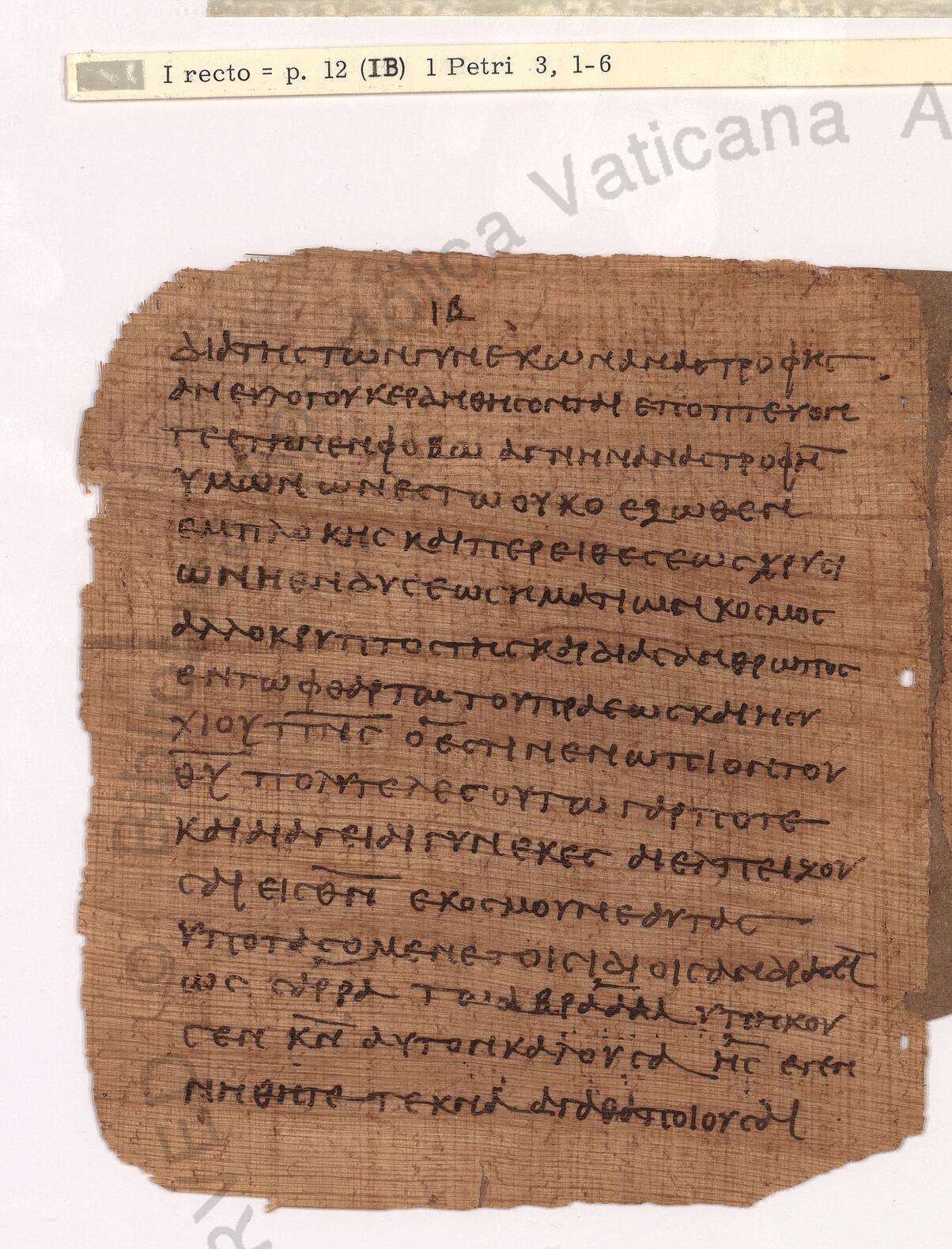
Where on the image
Vatican Library, Pap. Bodmer VIII, DigiVatLib image 2 (https://digi.vatlib.it/view/MSS_Pap.Bodmer.VIII/0002), the left-hand page of the opening, cropped at the fold. The typed label on the glass frame reads "I recto = p. 12 (IB) 1 Petri 3, 1-6". 3:1 begins on the previous page; 3:6 continues on the next page. Checked on the image: 16 lines in the transcription; the first legible line (line 1) reads ‹δια της των γυνεκων αναστροφης›, the last legible line (line 16) ‹νηθητε τεκνα αγαθαποιουσαι›; both match the page.
3:1 δια της των γυνεκων αναστροφης
ανευ λογου κερδηθησονται 2 εποπτευον
τες την εν φοβω αγνην αναστροφην
υμων 3 ων εστω ουκ ο εξωθεν
εμπλοκης και περειθεσεως χρυσι
ων η ενδυσεως ηματιων κοσμος
4 αλλ ο κρυπτος της καρδιας ανθρωπος
εν τω φθαρτω του πραεως και ησυ
χιου π̅ν̅ς̅ ο εστιν ενωπιον του
θ̅υ̅ πολυτελες 5 ουτω γαρ ποτε
και αι αγειαι γυνεκες αι ελπειζου
σαι εις θ̅ν̅ εκοσμουν εαυτας
υποτασομενε τοις ιδιοις ανδρασειν
6 ως σαρρα τω αβρααμ υπηκου
σεν κ̅ν̅ αυτον καλουσα ης εγεν
νηθητε τεκνα αγαθαποιουσαι
3:1Likewise, ye wives, be in subjection to your own husbands; that, if any obey not the word, they also may without the word be won by the conversation of the wives; 2While they behold your chaste conversation coupled with fear. 3Whose adorning let it not be that outward adorning of plaiting the hair, and of wearing of gold, or of putting on of apparel; 4But let it be the hidden man of the heart, in that which is not corruptible, even the ornament of a meek and quiet spirit, which is in the sight of God of great price. 5For after this manner in the old time the holy women also, who trusted in God, adorned themselves, being in subjection unto their own husbands: 6Even as Sara obeyed Abraham, calling him lord: whose daughters ye are, as long as ye do well, and are not afraid with any amazement.
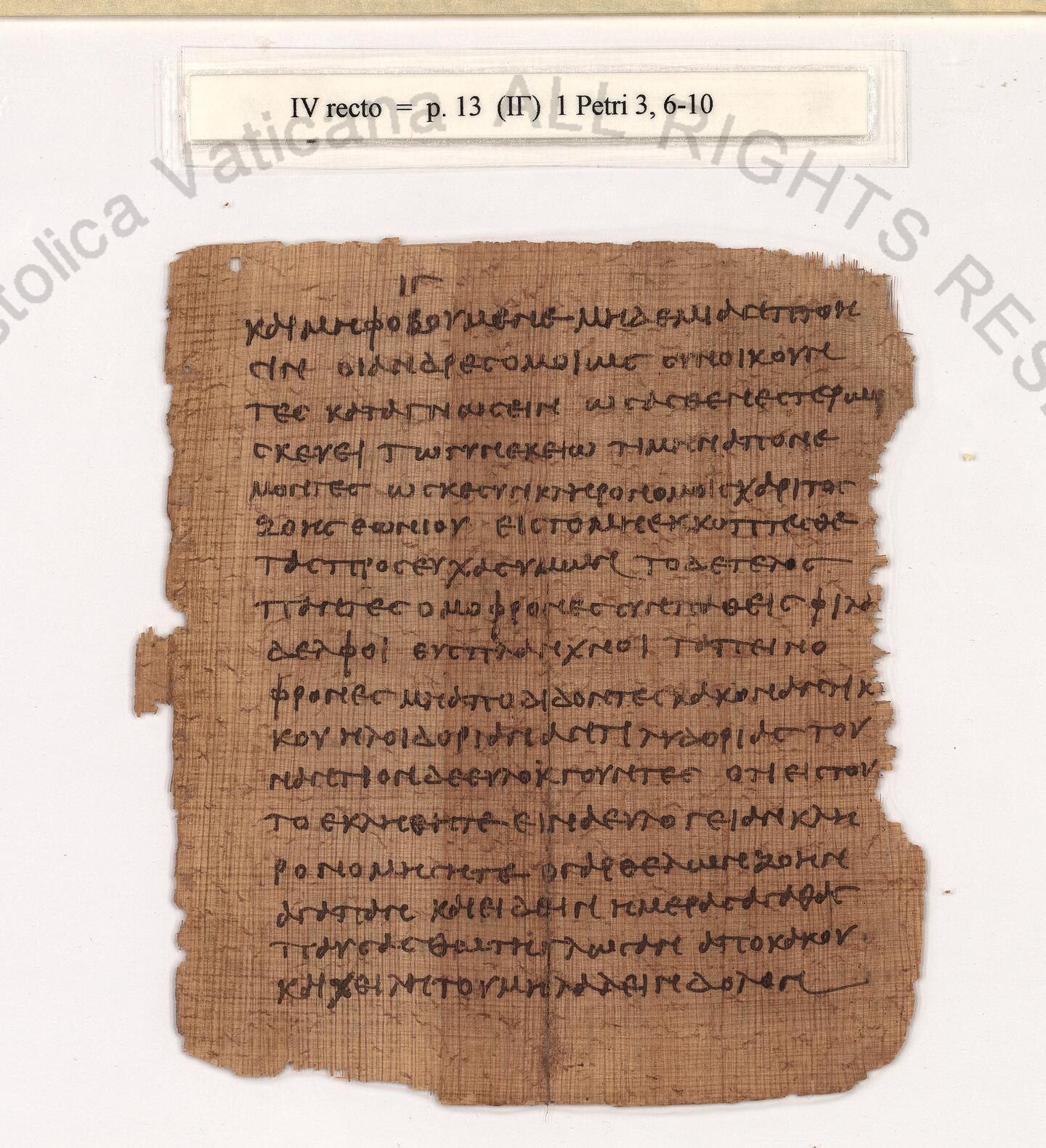
Where on the image
Vatican Library, Pap. Bodmer VIII, DigiVatLib image 7 (https://digi.vatlib.it/view/MSS_Pap.Bodmer.VIII/0007), the single leaf in the frame. The typed label on the glass frame reads "IV recto = p. 13 (IΓ) 1 Petri 3, 6-10". 3:6 begins on the previous page. Checked on the image: 17 lines in the transcription; the first legible line (line 1) reads ‹και μη φοβουμενε μηδεμιαν πτοη›, the last legible line (line 17) ‹και χειλη του μη λαλειν δολον›; both match the page.
3:6 και μη φοβουμενε μηδεμιαν πτοη
σιν 7 οι ανδρες ομοιως συνοικουν
τες κατα γνωσειν ως ασθενεστερως̣
σκευει τω γυνεκειω τιμην απονε
μοντες ως κε συνκληρονομοις χαριτος
ζοης εωνιου εις το μη εκκοπτεσθε
τας προσευχας υμων 8 το δε τελος
παντες ομοφρονες συνπαθεις φιλα
δελφοι ευσπλανχνοι ταπεινο
φρονες 9 μη αποδιδοντες κακον αντι κ[α]
κου η λοιδοριαν αντι λυδοριας του
ναντιον δε ευλοκγουντες οτι εις του
το εκληθητε εινα ευλογειαν κλη
ρονομησητε 10 ο γαρ θελων ζοην
αγαπαν και ειδειν ημερας αγαθας
παυσασθαι τη γλωσαν απο κακου
και χειλη του μη λαλειν δολον
3:6Even as Sara obeyed Abraham, calling him lord: whose daughters ye are, as long as ye do well, and are not afraid with any amazement. 7Likewise, ye husbands, dwell with them according to knowledge, giving honour unto the wife, as unto the weaker vessel, and as being heirs together of the grace of life; that your prayers be not hindered. 8Finally, be ye all of one mind, having compassion one of another, love as brethren, be pitiful, be courteous: 9Not rendering evil for evil, or railing for railing: but contrariwise blessing; knowing that ye are thereunto called, that ye should inherit a blessing. 10For he that will love life, and see good days, let him refrain his tongue from evil, and his lips that they speak no guile:
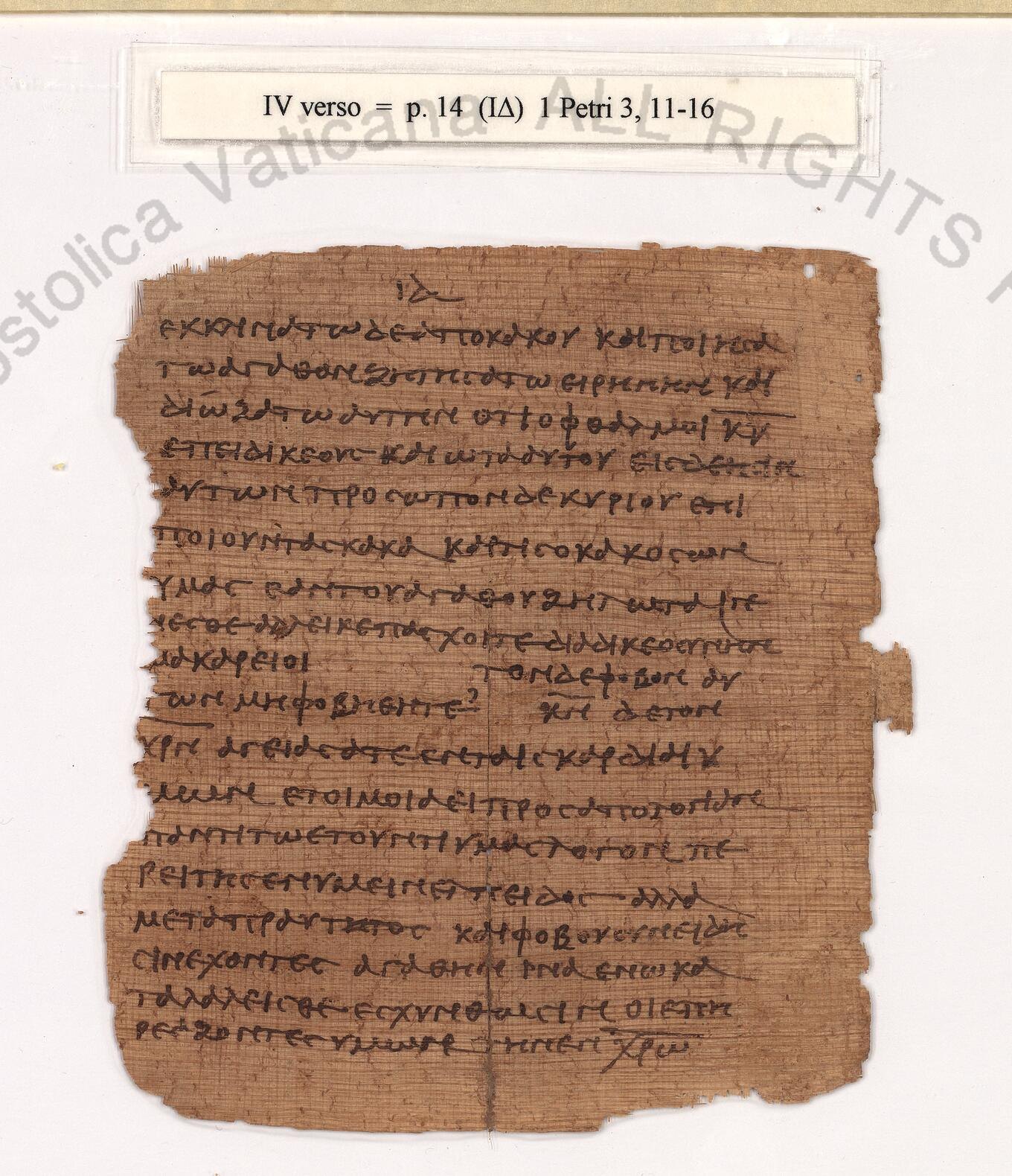
Where on the image
Vatican Library, Pap. Bodmer VIII, DigiVatLib image 8 (https://digi.vatlib.it/view/MSS_Pap.Bodmer.VIII/0008), the single leaf in the frame. The typed label on the glass frame reads "IV verso = p. 14 (IΔ) 1 Petri 3, 11-16". 3:16 continues on the next page. Checked on the image: 18 lines in the transcription; the first legible line (line 1) reads ‹εκκλινατω δε απο κακου και ποιησα›, the last legible line (line 18) ‹ρεα̣ζοντες υμων την εν χ̅ρ̅ω̅›; both match the page.
3:11 εκκλινατω δε απο κακου και ποιησα
τω αγαθον ζητησατω ειρηνην και
διωξατω αυτην 12 οτι οφθαλμοι κ̅υ̅
επει δικεους και ωτα αυτου εις δεησιν
αυτων προσωπον δε κυριου επι
ποιουντας κακα 13 και τις ο κακοσων
υμας εαν του αγαθου ζηλωται γε
ν̣εσθε 14 αλλ ει κε πασχοιτε δια δικεοσυνην
μ̣ακαρειοι τον δε φοβον αυ
τ̣ων μη φοβηθητε 15 κ̅ν̅ δε τον
χ̅ρ̅ν̅ αγειασατε εν ταις καρδιαι υ
μ̣ων ετοιμοι αει προς απολογιαν
παντι τω ετουντι υμας λογον πε
ρει της εν υμειν ελπειδος 16 αλλα
μετα πραυτητος και φοβου συνειδη
σιν εχοντες αγαθην ινα εν ω κα
ταλαλεισθε εσχυνθωσιν οι επη
ρεα̣ζοντες υμων την εν χ̅ρ̅ω̅
3:11Let him eschew evil, and do good; let him seek peace, and ensue it. 12For the eyes of the Lord are over the righteous, and his ears are open unto their prayers: but the face of the Lord is against them that do evil. 13And who is he that will harm you, if ye be followers of that which is good? 14But and if ye suffer for righteousness’ sake, happy are ye: and be not afraid of their terror, neither be troubled; 15But sanctify the Lord God in your hearts: and be ready always to give an answer to every man that asketh you a reason of the hope that is in you with meekness and fear: 16Having a good conscience; that, whereas they speak evil of you, as of evildoers, they may be ashamed that falsely accuse your good conversation in Christ.
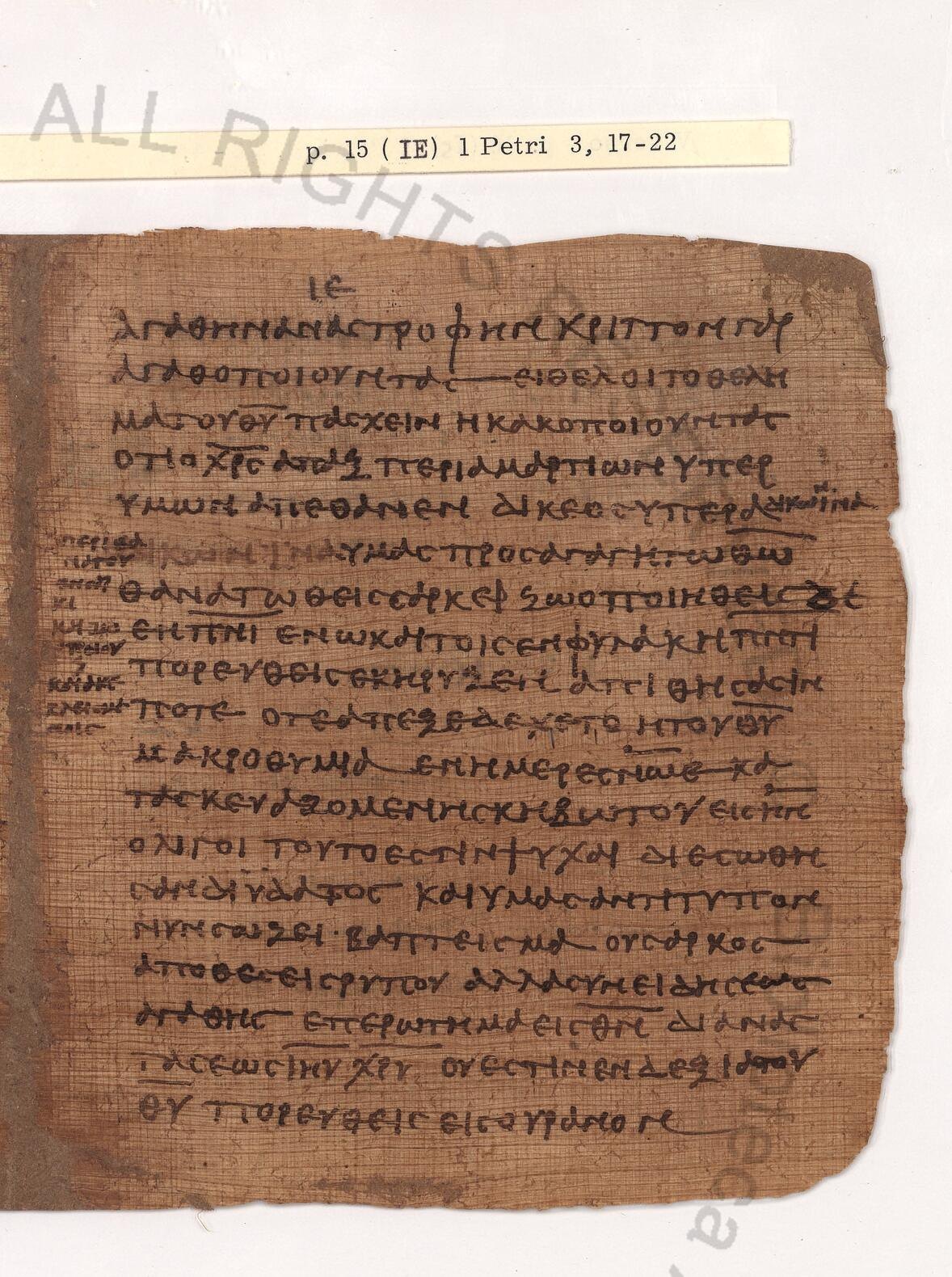
Where on the image
Vatican Library, Pap. Bodmer VIII, DigiVatLib image 9 (https://digi.vatlib.it/view/MSS_Pap.Bodmer.VIII/0009), the right-hand page of the opening, cropped at the fold. The typed label on the glass frame reads "p. 15 (IE) 1 Petri 3, 17-22". 3:16 begins on the previous page; 3:22 continues on the next page. Checked on the image: 19 lines in the transcription; the first legible line (line 1) reads ‹αγαθην αναστροφην κριττον γαρ›, the last legible line (line 19) ‹θ̅υ̅ πορευθεις εις ουρανον›; both match the page.
3:16 αγαθην αναστροφην 17 κριττον γαρ
αγαθοποιουντας ει θελοι το θελη
μα του θ̅υ̅ πασχειν η κακοποιουντας
18 οτι ο χ̅ρ̅ς̅ απαξ περι αμαρτιων υπερ
υμων απεθανεν δικεος υπερ α
δικων ινα υμας προσαγαγη τω θ̅ω̅
θανατωθεις σαρκει ζωοποιηθεις
εν π̅ν̅ι̅ 19 εν ω και τοις εν φυλακη π̅ν̅τ̅ι̅
πορευθεις εκηρυξεν 20 απιθησασιν
ποτε οτε απεξεδεχετο η του θ̅υ̅
μακροθυμια εν ημερες νωε κα
τασκευαζομενης κηβωτου εις ην
ολιγοι τουτο εστιν ψυχαι διεσωθη
σαν δι υδατος 21 και υμας αντιτυπον
νυν σωζει βαπτεισμα ου σαρκος
αποθεσεις ρυπου αλλα συνειδησεως
αγαθης επερωτημα εις θ̅ν̅ δι ανασ
τασεως ι̅η̅υ̅ χ̅ρ̅υ̅ 22 ου εστιν εν δεξια του
θ̅υ̅ πορευθεις εις ουρανον
3:16Having a good conscience; that, whereas they speak evil of you, as of evildoers, they may be ashamed that falsely accuse your good conversation in Christ. 17For it is better, if the will of God be so, that ye suffer for well doing, than for evil doing. 18For Christ also hath once suffered for sins, the just for the unjust, that he might bring us to God, being put to death in the flesh, but quickened by the Spirit: 19By which also he went and preached unto the spirits in prison; 20Which sometime were disobedient, when once the longsuffering of God waited in the days of Noah, while the ark was a preparing, wherein few, that is, eight souls were saved by water. 21The like figure whereunto even baptism doth also now save us (not the putting away of the filth of the flesh, but the answer of a good conscience toward God,) by the resurrection of Jesus Christ: 22Who is gone into heaven, and is on the right hand of God; angels and authorities and powers being made subject unto him.
Where on the image
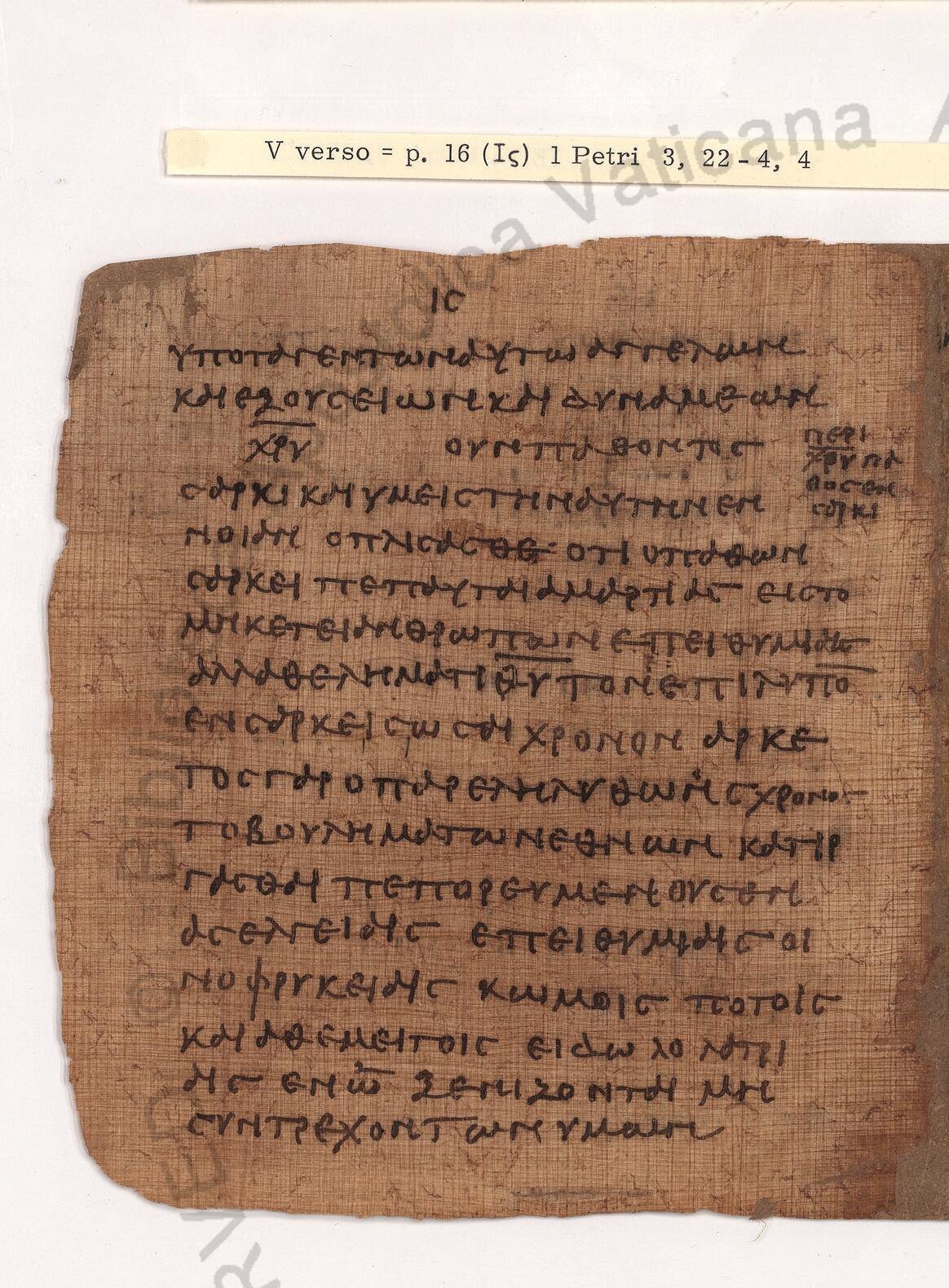
Vatican Library, Pap. Bodmer VIII, DigiVatLib image 10 (https://digi.vatlib.it/view/MSS_Pap.Bodmer.VIII/0010), the left-hand page of the opening, cropped at the fold. The typed label on the glass frame reads "V verso = p. 16 (Iς) 1 Petri 3, 22-4, 4". 3:22 begins on the previous page; 4:4 continues on the next page. Checked on the image: 17 lines in the transcription; the first legible line (line 1) reads ‹υποταγεντων αυτω αγγελων›, the last legible line (line 17) ‹συντρεχοντων υμων›; both match the page.
3:22 υποταγεντων αυτω αγγελων
και εξουσειων και δυναμεων
4:1 χ̅ρ̅υ̅ ουν παθοντος
σαρκι και υμεις την αυτην εν
νοιαν οπλισασθε οτι ο παθων
σαρκει πεπαυται αμαρτιας 2 εις το
μηκετει ανθρωπων επειθυμιαις
αλλα θεληματι θ̅υ̅ τον επιλυπον
εν σαρκει σωσαι χρονον 3 αρκε
τος γαρ ο παρεληλυθωνς χρονος
το βουλημα των εθνων κατιρ
γασθαι πεπορευμενους εν
ασελγειαις επειθυμιαις οι
νοφρυκειαις κωμοις ποτοις
και αθεμειτοις ειδωλολατρι
αις 4 εν ω ξενιζονται μη
συντρεχοντων υμων
3:22Who is gone into heaven, and is on the right hand of God; angels and authorities and powers being made subject unto him. 4:1Forasmuch then as Christ hath suffered for us in the flesh, arm yourselves likewise with the same mind: for he that hath suffered in the flesh hath ceased from sin; 2That he no longer should live the rest of his time in the flesh to the lusts of men, but to the will of God. 3For the time past of our life may suffice us to have wrought the will of the Gentiles, when we walked in lasciviousness, lusts, excess of wine, revellings, banquetings, and abominable idolatries: 4Wherein they think it strange that ye run not with them to the same excess of riot, speaking evil of you:
Notes
- Greek: the NTVMR diplomatic transcription, line by line as on the papyrus. Square brackets enclose letters that are lost or illegible and were supplied by the transcribers; a dot under a letter marks it as uncertain; [...] marks a gap. Nomina sacra and numerals keep the scribe's overline. Spelling is the scribe's (no accents or breathings). Words broken at a line end stay broken as on the papyrus. Corrections are not shown: the text is the first hand.
- English: the King James Version (1611), whole verses, for every verse that has text on the page. A verse that begins on one page and ends on the next is given in full on both. The KJV translates a later form of the Greek text, so its wording does not always match the papyrus; material differences (such as verses the papyrus does not have) are noted in the section.
Cite
Sources
- Source: Papyrus Bodmer VIII (Vatican Library): photographs from DigiVatLib; Greek from the INTF NTVMR transcription of P72; English from the King James Version (holding institution)
- Critical edition: INTF NTVMR diplomatic transcription (CC BY 4.0)
← previous · → next · v cycle view · l back to library