P72 (Papyrus Bodmer VIII): 1 Peter 4:4-5:2 (pages 17-19)
Introduction
P72 is a papyrus codex copied in Egypt in the 3rd or early 4th century. It holds the oldest known copies of 1 Peter, 2 Peter and Jude. The pages are numbered by the scribe. 1-2 Peter (papyrus pages 1-36) are Papyrus Bodmer VIII, given by Martin Bodmer to Pope Paul VI in 1969 and now in the Vatican Library; Jude (pages 62-68) is Papyrus Bodmer VII, still at the Fondation Martin Bodmer, Cologny (Geneva). Both belong to the Bodmer "Miscellaneous" or "Composite" codex, which also contains the Nativity of Mary, the apocryphal correspondence of Paul with the Corinthians, the 11th Ode of Solomon, Melito's sermon On the Pascha, a hymn fragment and other texts. 1-2 Peter seem to have formed a separate booklet before being bound with the rest.
Each section below is one papyrus page: the photograph, the NTVMR diplomatic transcription of that page line by line, and the King James Version of every verse on it. The scribe's spelling is irregular (ει for ι, ε for αι, and so on) and is kept as written.
This entry covers papyrus pages 17-19 (1 Peter 4:4-5:2). The photographs are from the Vatican Library (Pap. Bodmer VIII).
How was this verified? (Provenance)
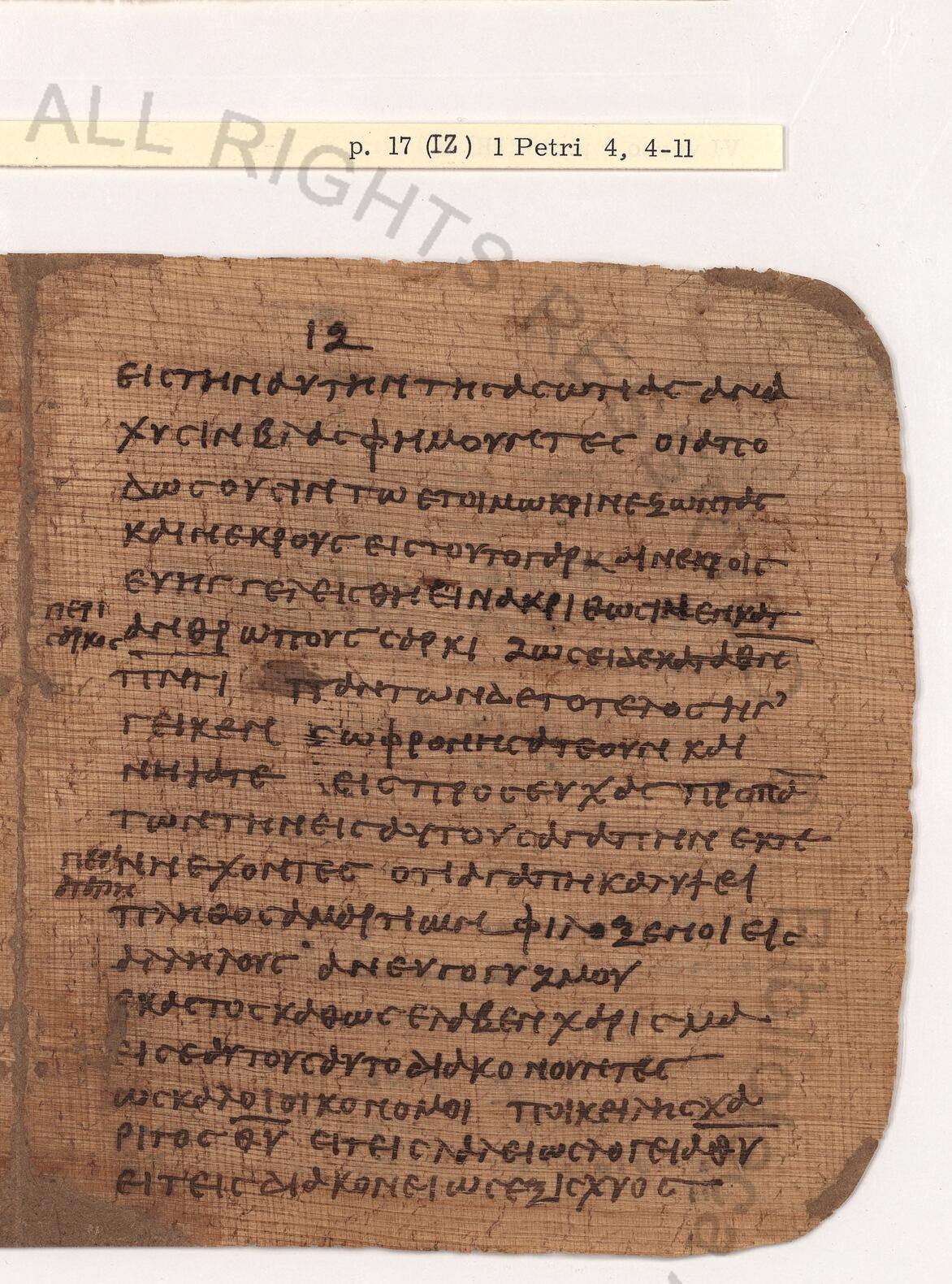
Where on the image
Vatican Library, Pap. Bodmer VIII, DigiVatLib image 11 (https://digi.vatlib.it/view/MSS_Pap.Bodmer.VIII/0011), the right-hand page of the opening, cropped at the fold. The typed label on the glass frame reads "p. 17 (IZ) 1 Petri 4, 4-11". 4:4 begins on the previous page; 4:11 continues on the next page. Checked on the image: 18 lines in the transcription; the first legible line (line 1) reads ‹εις την αυτην της ασωτιας ανα›, the last legible line (line 18) ‹ει τεις διακονει ως εξ ισχυος›; both match the page.
4:4 εις την αυτην της ασωτιας ανα
χυσιν βλασφημουντες 5 οι απο
δωσουσιν τω ετοιμω κρινε ζωντας
και νεκρους 6 εις τουτο γαρ και νεκροις
ευηγγελεισθη εινα κριθωσιν εν κατ
ανθρωπους σαρκι ζωσει δε κατα θ̅ν̅
π̅ν̅τ̅ι̅ 7 παντων δε το τελος ηγ
γεικεν σωφρονησατε ουν και
νηψατε εις προσευχας 8 προ παν
των την εις αυτους αγαπην εκτε
νη εχοντες οτι αγαπη καλυψει
πληθος αμαρτιων 9 φιλοξενοι εις
αλληλους ανευ γογυζμου
10 εκαστος καθως ελαβεν χαρισμα
εις εαυτους αυτο διακονουντες
ως καλοι οικονομοι ποικειλης χα
ριτος θ̅υ̅ 11 ει τεις λαλει ως λογεια θ̅υ̅
ει τεις διακονει ως εξ ισχυος
4:4Wherein they think it strange that ye run not with them to the same excess of riot, speaking evil of you: 5Who shall give account to him that is ready to judge the quick and the dead. 6For for this cause was the gospel preached also to them that are dead, that they might be judged according to men in the flesh, but live according to God in the spirit. 7But the end of all things is at hand: be ye therefore sober, and watch unto prayer. 8And above all things have fervent charity among yourselves: for charity shall cover the multitude of sins. 9Use hospitality one to another without grudging. 10As every man hath received the gift, even so minister the same one to another, as good stewards of the manifold grace of God. 11If any man speak, let him speak as the oracles of God; if any man minister, let him do it as of the ability which God giveth: that God in all things may be glorified through Jesus Christ, to whom be praise and dominion for ever and ever. Amen.
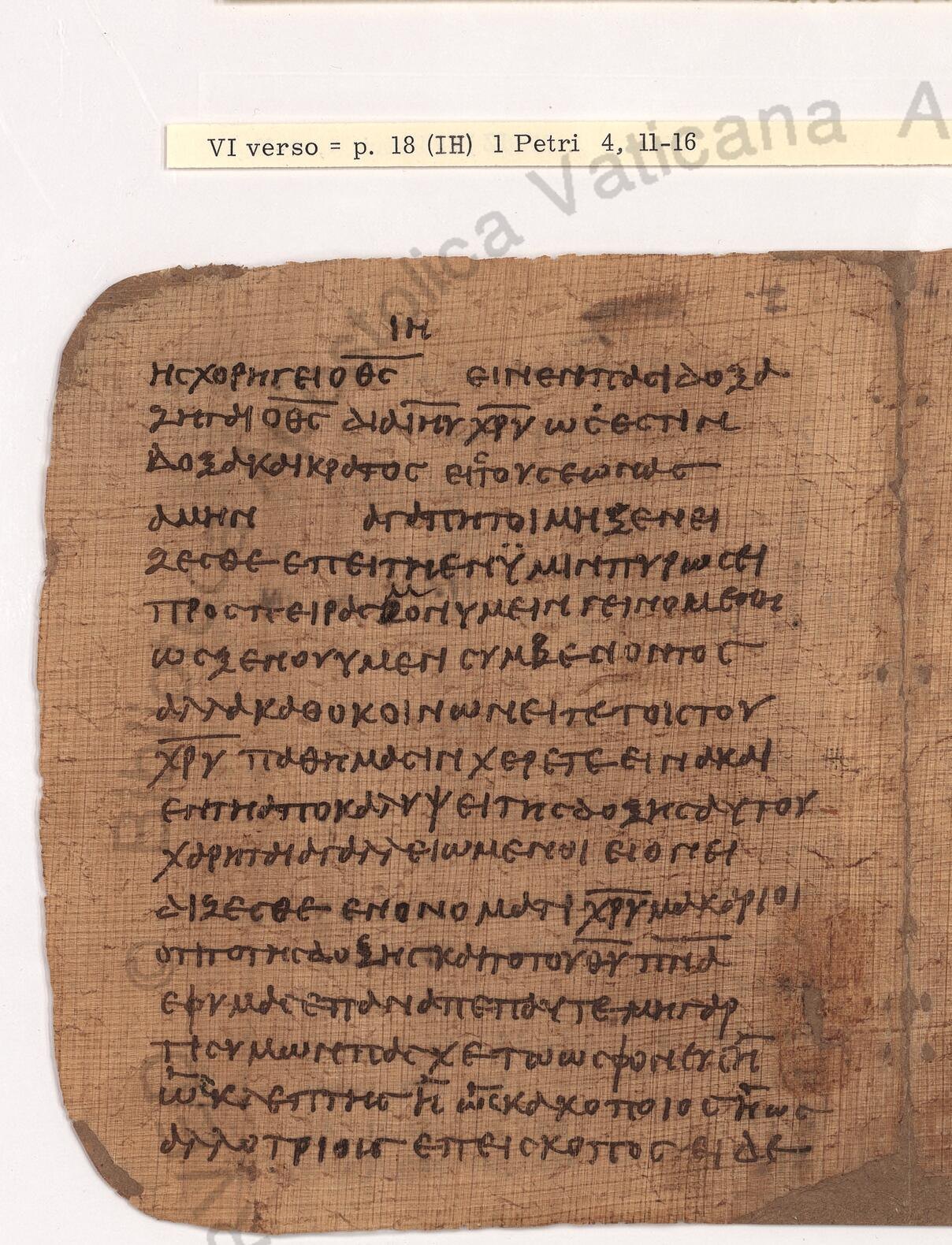
Where on the image
Vatican Library, Pap. Bodmer VIII, DigiVatLib image 12 (https://digi.vatlib.it/view/MSS_Pap.Bodmer.VIII/0012), the left-hand page of the opening, cropped at the fold. The typed label on the glass frame reads "VI verso = p. 18 (IH) 1 Petri 4, 11-16". 4:11 begins on the previous page; 4:16 continues on the next page. Checked on the image: 17 lines in the transcription; the first legible line (line 1) reads ‹ης χορηγει ο θ̅ς̅ ειν εν πασι›, the last legible line (line 17) ‹αλλοτριοις επεισκοπος ει δε›; both match the page.
4:11 ης χορηγει ο θ̅ς̅ ειν εν πασι δοξα
ζηται ο θ̅ς̅ δια ι̅η̅υ̅ χ̅ρ̅υ̅ ως εστιν
δοξα και κρατος ει τους εωνας
αμην 12 αγαπητοι μη ξενει
ζεσθε επει τη εν υμιν πυρωσει
προς πειρασζον υμειν γεινομενη
ως ξενου υμεν συμβενοντος
13 αλλα καθο κοινωνειτε τοις του
χ̅ρ̅υ̅ παθημασιν χερετε εινα και
εν τη αποκαλυψει της δοξης αυτου
χαρηται αγαλλειωμενοι 14 ει ονει
διζεσθε εν ονοματι χ̅ρ̅υ̅ μακαριοι
οτι το της δοξης και το του θ̅υ̅ π̅ν̅α̅
εφ υμας επαναπεπαυτε 15 μη γαρ
τις υμων πασχετω ως φονευς η
ω κλεπτης η ως κακοποιος η ως
αλλοτριοις επεισκοπος 16 ει δε
4:11If any man speak, let him speak as the oracles of God; if any man minister, let him do it as of the ability which God giveth: that God in all things may be glorified through Jesus Christ, to whom be praise and dominion for ever and ever. Amen. 12Beloved, think it not strange concerning the fiery trial which is to try you, as though some strange thing happened unto you: 13But rejoice, inasmuch as ye are partakers of Christ’s sufferings; that, when his glory shall be revealed, ye may be glad also with exceeding joy. 14If ye be reproached for the name of Christ, happy are ye; for the spirit of glory and of God resteth upon you: on their part he is evil spoken of, but on your part he is glorified. 15But let none of you suffer as a murderer, or as a thief, or as an evildoer, or as a busybody in other men’s matters. 16Yet if any man suffer as a Christian, let him not be ashamed; but let him glorify God on this behalf.
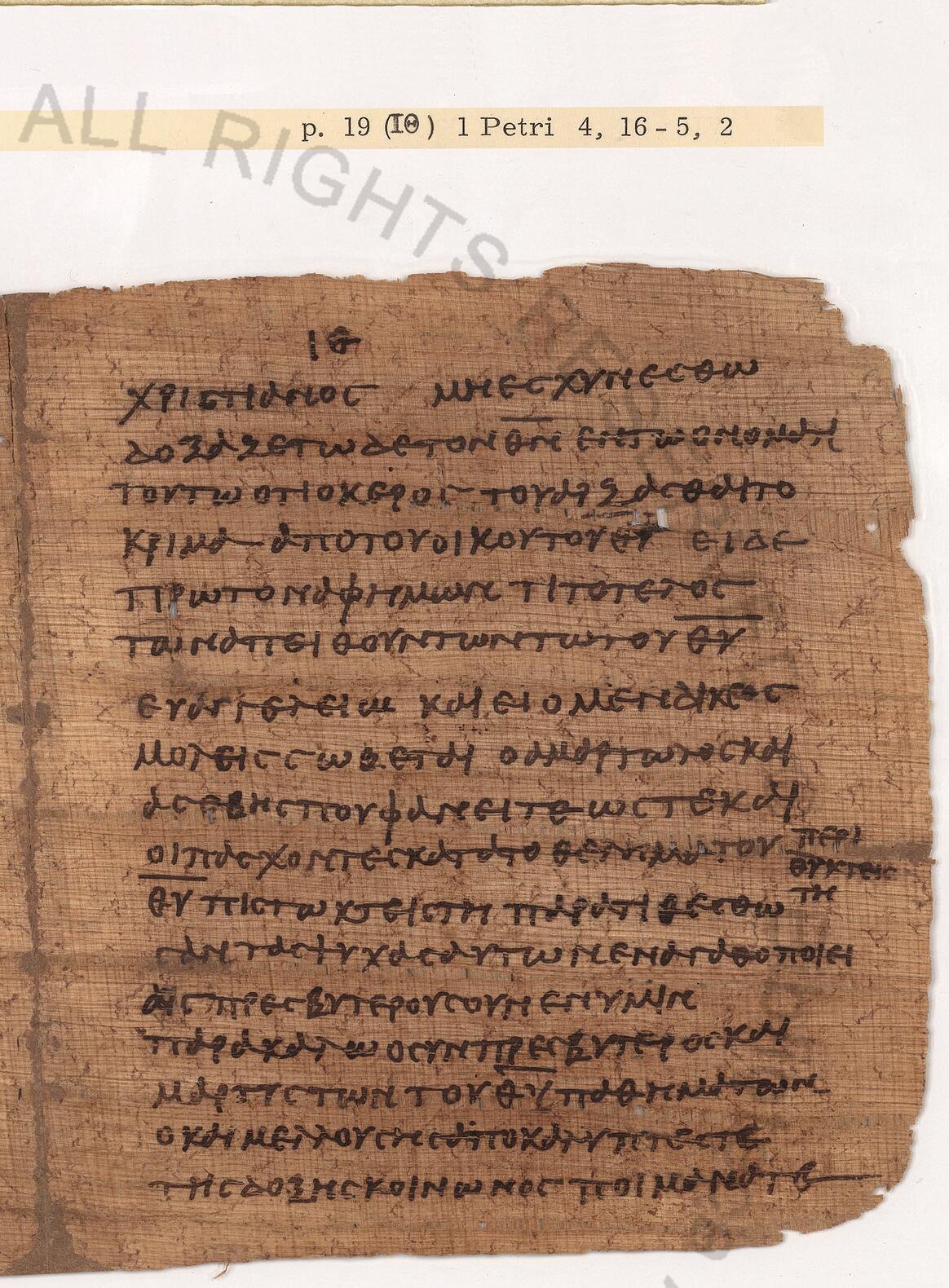
Where on the image
Vatican Library, Pap. Bodmer VIII, DigiVatLib image 13 (https://digi.vatlib.it/view/MSS_Pap.Bodmer.VIII/0013), the right-hand page of the opening, cropped at the fold. The typed label on the glass frame reads "p. 19 (IΘ) 1 Petri 4, 16-5, 2". 4:16 begins on the previous page; 5:2 continues on the next page. Checked on the image: 17 lines in the transcription; the first legible line (line 1) reads ‹χριστιανος μη εσχυνεσθω›, the last legible line (line 17) ‹της δοξης κοινωνος ποιμανατε›; both match the page.
4:16 χριστιανος μη εσχυνεσθω
δοξαζετω δε τον θ̅ν̅ εν τω ονοματι
τουτω 17 οτι ο κερος του αρξασθαι το
κριμα απο του οικου του ε̣ι̣ ει δε
πρ̣ωτον αφ ημων τι το τελος
των απειθουντων τω του θ̅υ̅
ευαγγελειω 18 και ει ο μεν δικεος
μολεις σωζεται ο αμαρτωλος και
ασεβης που φανειτε 19 ωστε και
οι πασχοντες κατα το θελημα του
θ̅υ̅ πιστω κτειστη παρατιθεσθω
σαν τας ψυχας αυτων εν αγαθοποιει
ε̣ς 5:1 πρεσβυτερους ουν εν υμιν
παρακαλω ο συνπρεσβυτερος και
μαρτυς των του θ̅υ̅ παθηματων
ο και μελλουσης αποκαλυπτεστε
της δοξης κοινωνος 2 ποιμανατε
4:16Yet if any man suffer as a Christian, let him not be ashamed; but let him glorify God on this behalf. 17For the time is come that judgment must begin at the house of God: and if it first begin at us, what shall the end be of them that obey not the gospel of God? 18And if the righteous scarcely be saved, where shall the ungodly and the sinner appear? 19Wherefore let them that suffer according to the will of God commit the keeping of their souls to him in well doing, as unto a faithful Creator. 5:1The elders which are among you I exhort, who am also an elder, and a witness of the sufferings of Christ, and also a partaker of the glory that shall be revealed: 2Feed the flock of God which is among you, taking the oversight thereof, not by constraint, but willingly; not for filthy lucre, but of a ready mind;
Notes
- Greek: the NTVMR diplomatic transcription, line by line as on the papyrus. Square brackets enclose letters that are lost or illegible and were supplied by the transcribers; a dot under a letter marks it as uncertain; [...] marks a gap. Nomina sacra and numerals keep the scribe's overline. Spelling is the scribe's (no accents or breathings). Words broken at a line end stay broken as on the papyrus. Corrections are not shown: the text is the first hand.
- English: the King James Version (1611), whole verses, for every verse that has text on the page. A verse that begins on one page and ends on the next is given in full on both. The KJV translates a later form of the Greek text, so its wording does not always match the papyrus; material differences (such as verses the papyrus does not have) are noted in the section.
Cite
Sources
- Source: Papyrus Bodmer VIII (Vatican Library): photographs from DigiVatLib; Greek from the INTF NTVMR transcription of P72; English from the King James Version (holding institution)
- Critical edition: INTF NTVMR diplomatic transcription (CC BY 4.0)
← previous · → next · v cycle view · l back to library