P72 (Papyrus Bodmer VIII): 1 Peter 2:2-3:1 (pages 7-11)
Introduction
P72 is a papyrus codex copied in Egypt in the 3rd or early 4th century. It holds the oldest known copies of 1 Peter, 2 Peter and Jude. The pages are numbered by the scribe. 1-2 Peter (papyrus pages 1-36) are Papyrus Bodmer VIII, given by Martin Bodmer to Pope Paul VI in 1969 and now in the Vatican Library; Jude (pages 62-68) is Papyrus Bodmer VII, still at the Fondation Martin Bodmer, Cologny (Geneva). Both belong to the Bodmer "Miscellaneous" or "Composite" codex, which also contains the Nativity of Mary, the apocryphal correspondence of Paul with the Corinthians, the 11th Ode of Solomon, Melito's sermon On the Pascha, a hymn fragment and other texts. 1-2 Peter seem to have formed a separate booklet before being bound with the rest.
Each section below is one papyrus page: the photograph, the NTVMR diplomatic transcription of that page line by line, and the King James Version of every verse on it. The scribe's spelling is irregular (ει for ι, ε for αι, and so on) and is kept as written.
This entry covers papyrus pages 7-11 (1 Peter 2:2-3:1). The photographs are from the Vatican Library (Pap. Bodmer VIII).
How was this verified? (Provenance)
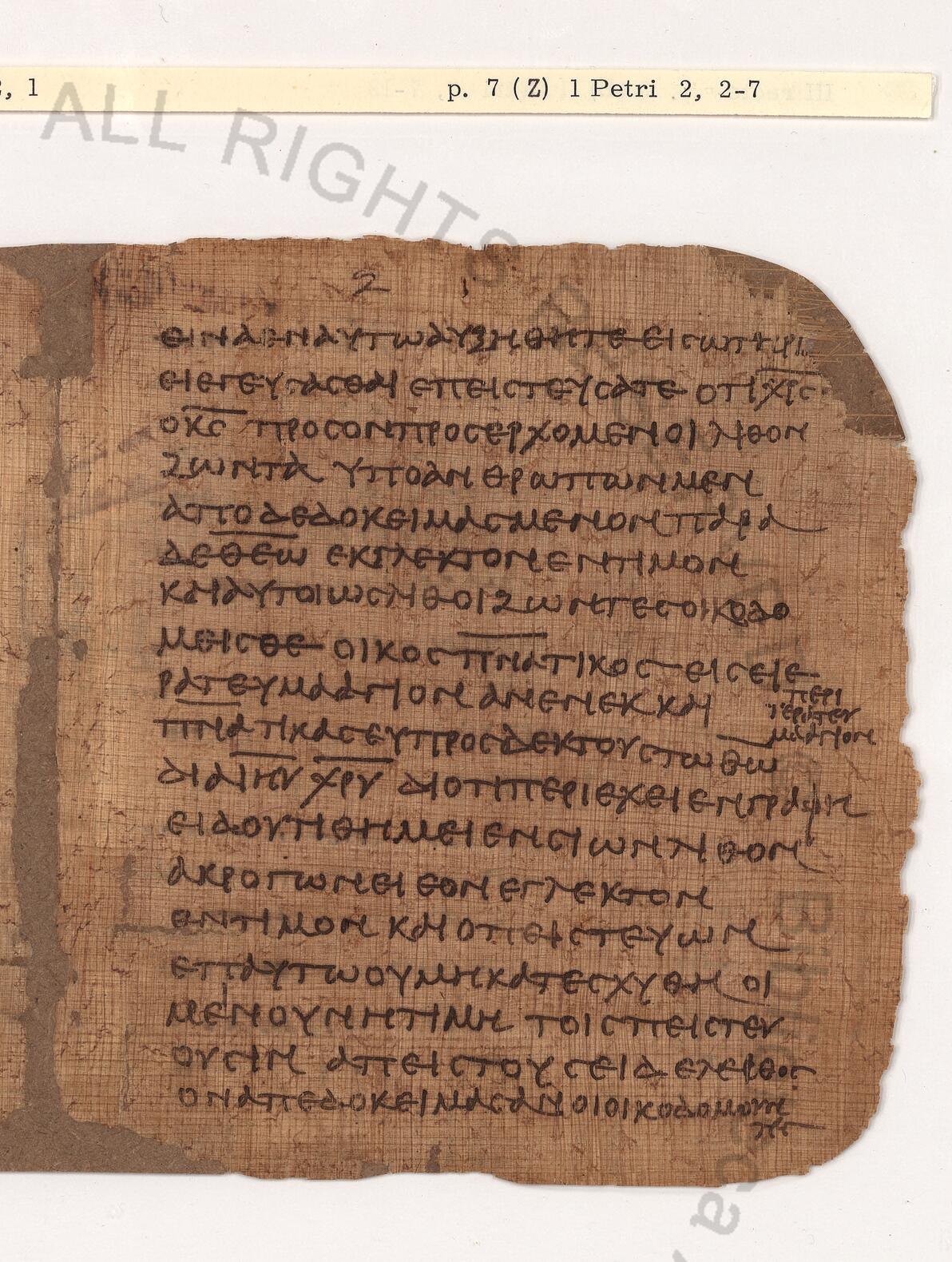
Where on the image
Vatican Library, Pap. Bodmer VIII, DigiVatLib image 6 (https://digi.vatlib.it/view/MSS_Pap.Bodmer.VIII/0006), the right-hand page of the opening, cropped at the fold. The typed label on the glass frame reads "p. 7 (Z) 1 Petri 2, 2-7". 2:2 begins on the previous page; 2:7 continues on the next page. Checked on the image: 18 lines in the transcription; the first legible line (line 1) reads ‹εινα εν αυτω αυξηθητε ει σωτηρια̣›, the last legible line (line 18) ‹ον απεδοκειμασαν οι οικοδομουντες›; both match the page.
2:2 εινα εν αυτω αυξηθητε ει σωτηρια̣[ν]
3 ει εγευσασθαι επειστευσατε οτι χ̅ρ̅ς̅
ο κ̅ς̅ 4 προς ον προσερχομενοι λιθον
ζωντα υπο ανθρωπων μεν
αποδεδοκειμασμενον παρα
δε θ̅ε̅ω̅ εκγλεκτον εντιμον
5 και αυτοι ως λιθοι ζωντες οικοδο
μεισθε οικος π̅ν̅α̅τ̅ι̅κ̅ο̅ς̅ εις ειε
ρατευμα αγιον ανενεκκαι
π̅ν̅α̅τ̅ι̅κ̅α̅ς̅ ευπροσδεκτους τω θ̅ω̅
δια ι̅η̅υ̅ χ̅ρ̅υ̅ 6 διοτι περιεχει εν γραφη
ειδου τιθημει εν σιων λιθον
ακρογωνειεον εγλεκτον
εντιμον και ο πειστευων
επ αυτω ου μη κατεσχυθη 7 οι
μεν ουν η τιμη τοις πειστευ
ουσιν απειστουσει δε λε[.]θος
ον απεδοκειμασαν οι οικοδομουντες
2:2As newborn babes, desire the sincere milk of the word, that ye may grow thereby: 3If so be ye have tasted that the Lord is gracious. 4To whom coming, as unto a living stone, disallowed indeed of men, but chosen of God, and precious, 5Ye also, as lively stones, are built up a spiritual house, an holy priesthood, to offer up spiritual sacrifices, acceptable to God by Jesus Christ. 6Wherefore also it is contained in the scripture, Behold, I lay in Sion a chief corner stone, elect, precious: and he that believeth on him shall not be confounded. 7Unto you therefore which believe he is precious: but unto them which be disobedient, the stone which the builders disallowed, the same is made the head of the corner,
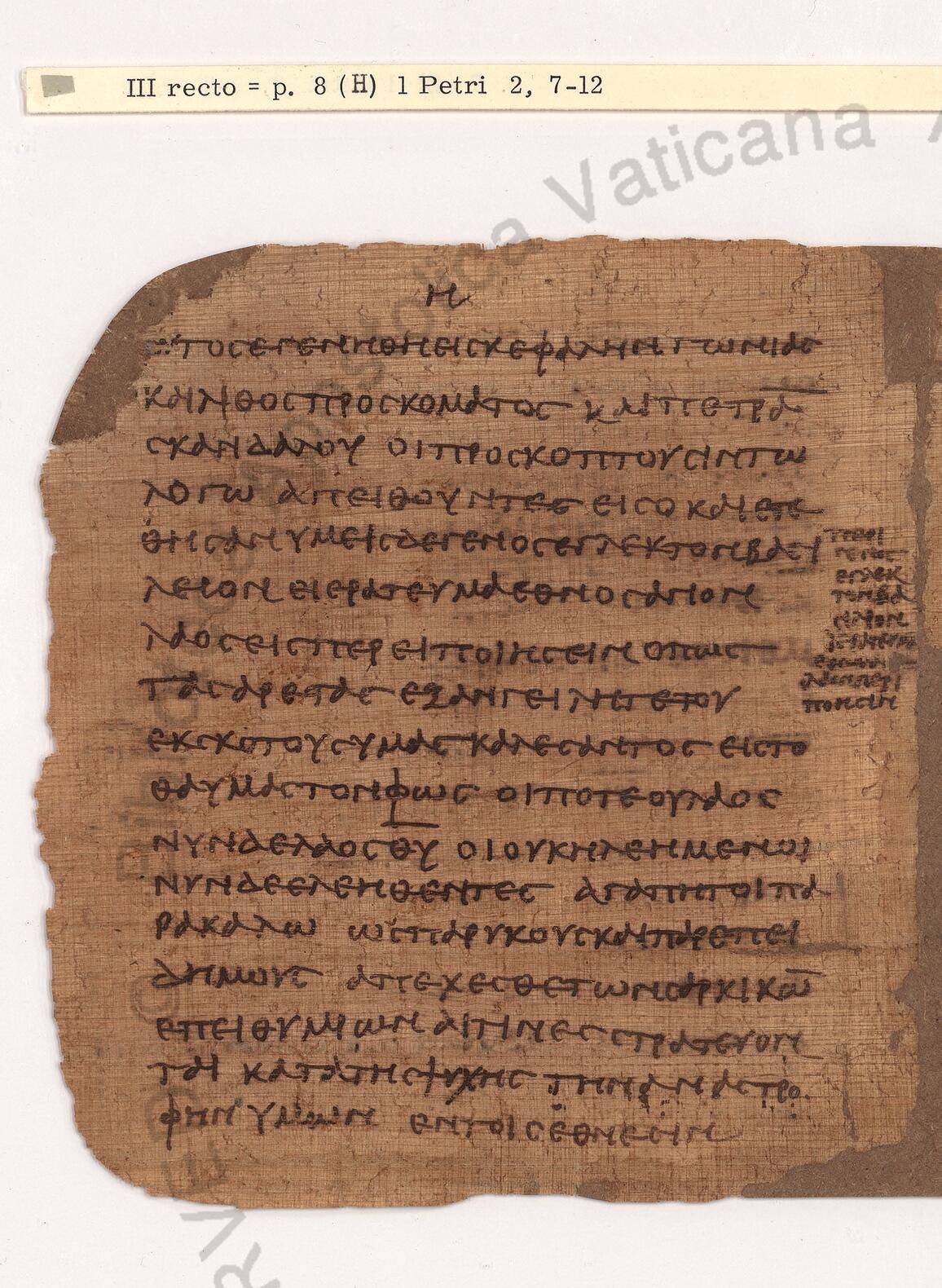
Where on the image
Vatican Library, Pap. Bodmer VIII, DigiVatLib image 5 (https://digi.vatlib.it/view/MSS_Pap.Bodmer.VIII/0005), the left-hand page of the opening, cropped at the fold. The typed label on the glass frame reads "III recto = p. 8 (H) 1 Petri 2, 7-12". 2:7 begins on the previous page; 2:12 continues on the next page. Checked on the image: 17 lines in the transcription; the first legible line (line 1) reads ‹ο̣υτος εγενηθη εις κεφαλην γωνιας›, the last legible line (line 17) ‹φην υμων εν τοις εθνεσιν›; both match the page.
2:7 ο̣υτος εγενηθη εις κεφαλην γωνιας
8 και λιθος προσκοματος και πετραν
σκανδαλου οι προσκοπτουσιν τω
λογω απειθουντες εις ο και ετε
θησαν 9 υμεις δε γενος εγλεκτον βασι
λειον ειερατευμα εθνος αγιον
λαος εις περειποιησειν οπως
τας αρετας εξανγειλητε του
εκ σκοτους υμας καλεσαντος εις το
θαυμαστον φως 10 οι ποτε ου λαος
νυν δε λαος θ̅υ̅ οι ουκ ηλεημενοι
νυν δε ελεηθεντες 11 αγαπητοι πα
ρακαλω ως παρυκους και παρεπει
δημους απεχεσθε των σαρκικων
επειθυμιων αιτινες στρατευον
ται κατα της ψυχης 12 την αναστρο
φην υμων εν τοις εθνεσιν
2:7Unto you therefore which believe he is precious: but unto them which be disobedient, the stone which the builders disallowed, the same is made the head of the corner, 8And a stone of stumbling, and a rock of offence, even to them which stumble at the word, being disobedient: whereunto also they were appointed. 9But ye are a chosen generation, a royal priesthood, an holy nation, a peculiar people; that ye should shew forth the praises of him who hath called you out of darkness into his marvellous light: 10Which in time past were not a people, but are now the people of God: which had not obtained mercy, but now have obtained mercy. 11Dearly beloved, I beseech you as strangers and pilgrims, abstain from fleshly lusts, which war against the soul; 12Having your conversation honest among the Gentiles: that, whereas they speak against you as evildoers, they may by your good works, which they shall behold, glorify God in the day of visitation.
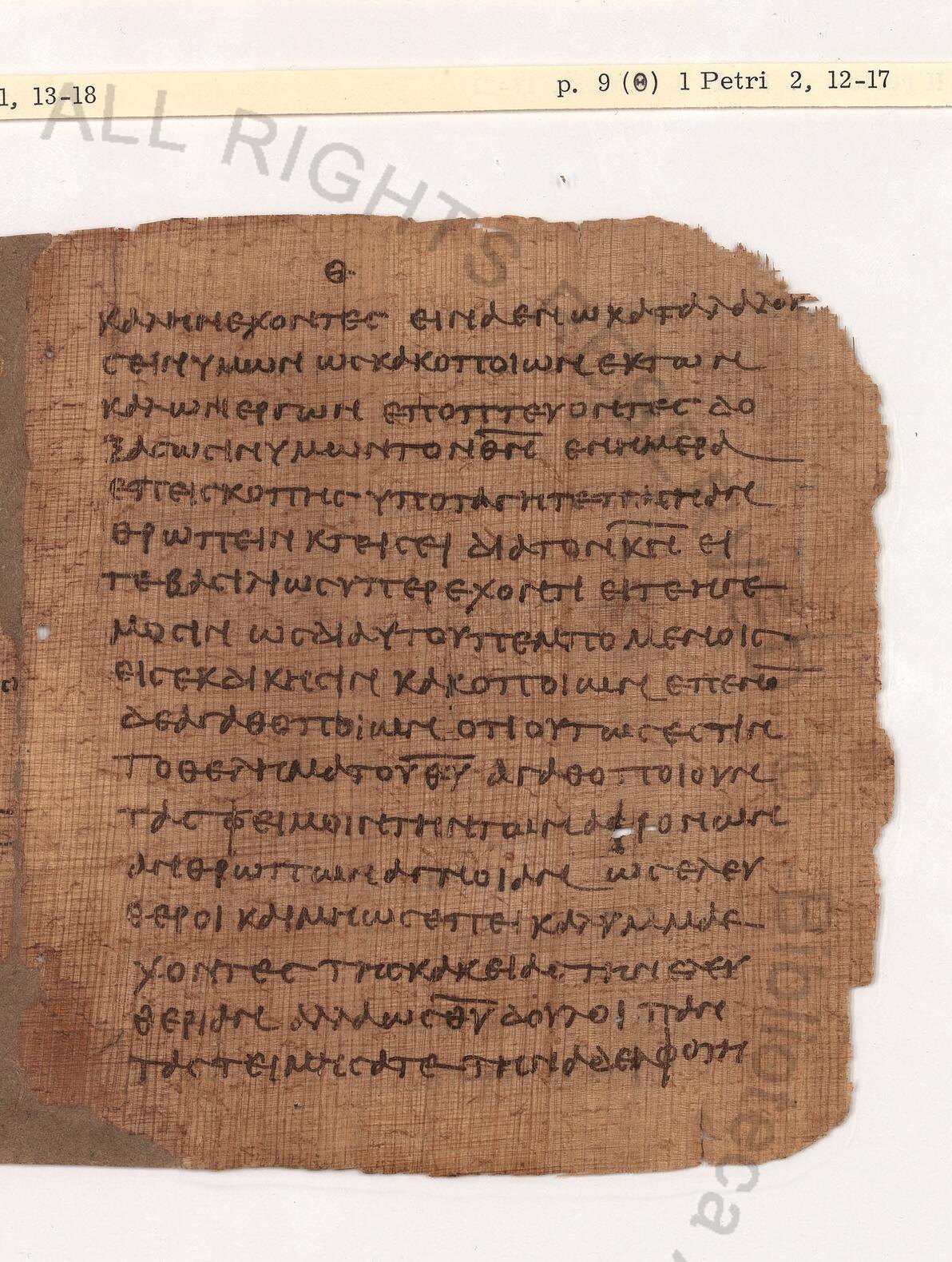
Where on the image
Vatican Library, Pap. Bodmer VIII, DigiVatLib image 4 (https://digi.vatlib.it/view/MSS_Pap.Bodmer.VIII/0004), the right-hand page of the opening, cropped at the fold. The typed label on the glass frame reads "p. 9 (Θ) 1 Petri 2, 12-17". 2:12 begins on the previous page; 2:17 continues on the next page. Checked on the image: 17 lines in the transcription; the first legible line (line 1) reads ‹καλην εχοντες εινα εν ω καταλαλου̣›, the last legible line (line 17) ‹τας τειμησατε την αδελφοτη›; both match the page.
2:12 καλην εχοντες εινα εν ω καταλαλου̣
σειν υμων ως κακοποιων εκ των
καλων εργων εποπτευοντες δο
ξασωσιν υμων τον θ̅ν̅ εν ημερα
επεισκοπης 13 υποταγητε παση αν
θρωπειν κτεισει δια τον κ̅ν̅ ει
τε βασιλι ως υπερεχοντι 14 ειτε ηγε
μοσιν ως δι αυτου πεμπομενοις
εις εκδικησιν κακοποιων επενον
δε αγαθοποιων 15 οτι ουτως εστιν
το θελημα του θ̅υ̅ αγαθοποιουν
τας φειμοιν την των αφρονων
ανθρωπων αγνοιαν 16 ως ελευ
θεροι και μη ως επεικαλυμμα ε
χοντες της κακειας την ελευ
θεριαν αλλα ως θ̅υ̅ δουλοι 17 παν
τας τειμησατε την αδελφοτη
2:12Having your conversation honest among the Gentiles: that, whereas they speak against you as evildoers, they may by your good works, which they shall behold, glorify God in the day of visitation. 13Submit yourselves to every ordinance of man for the Lord’s sake: whether it be to the king, as supreme; 14Or unto governors, as unto them that are sent by him for the punishment of evildoers, and for the praise of them that do well. 15For so is the will of God, that with well doing ye may put to silence the ignorance of foolish men: 16As free, and not using your liberty for a cloke of maliciousness, but as the servants of God. 17Honour all men. Love the brotherhood. Fear God. Honour the king.
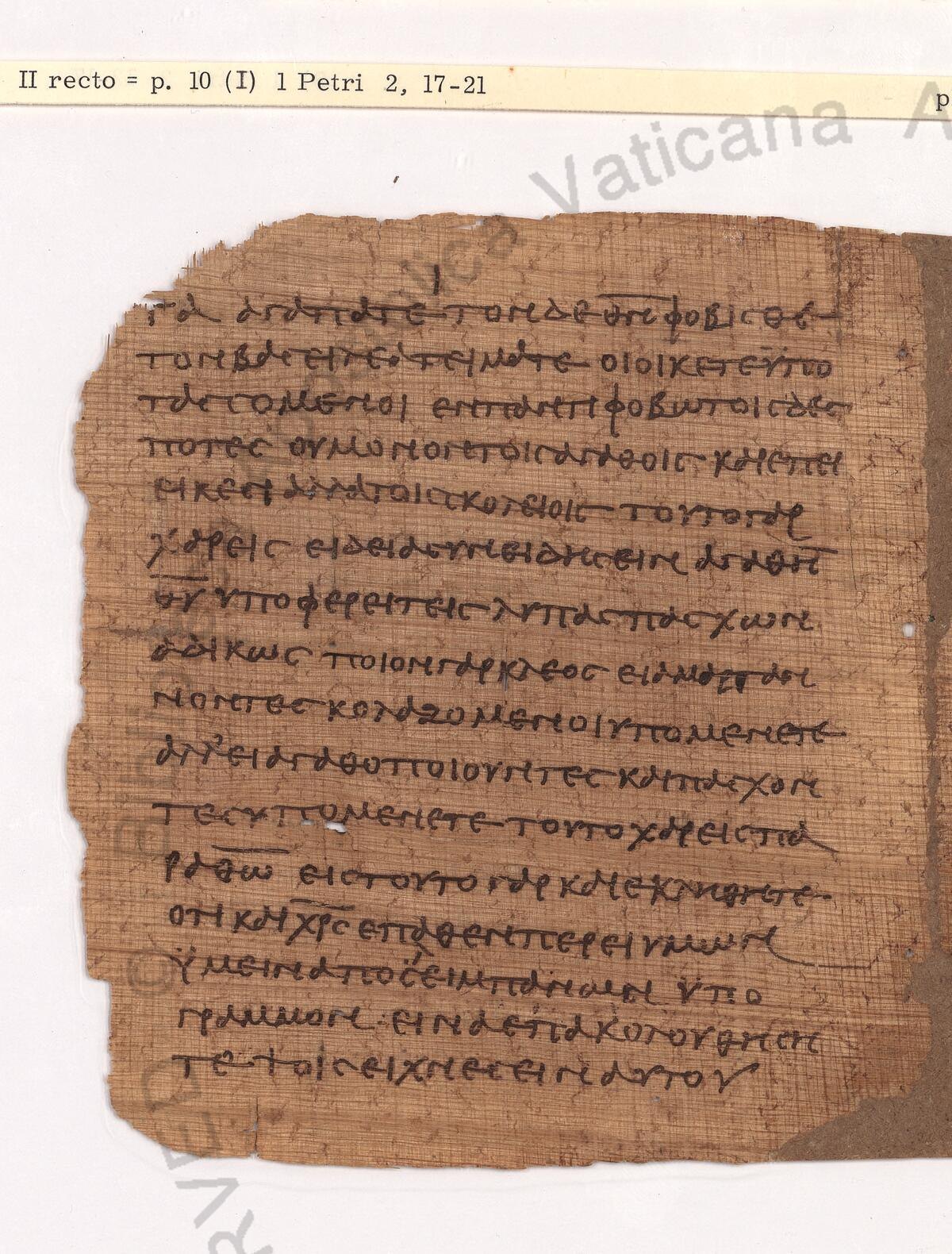
Where on the image
Vatican Library, Pap. Bodmer VIII, DigiVatLib image 3 (https://digi.vatlib.it/view/MSS_Pap.Bodmer.VIII/0003), the left-hand page of the opening, cropped at the fold. The typed label on the glass frame reads "II recto = p. 10 (I) 1 Petri 2, 17-21". 2:17 begins on the previous page. Checked on the image: 16 lines in the transcription; the first legible line (line 1) reads ‹τα αγαπατε τον δε θ̅ν̅ φοβισθε›, the last legible line (line 16) ‹τε τοις ειχνεσειν αυτου›; both match the page.
2:17 τα αγαπατε τον δε θ̅ν̅ φοβισθε
τον βασειλεα τειματε 18 οι οικετε υπο
τασσομενοι εν παντι φοβω τοις δεσ
ποτες ου μονον τοις αγαθοις και επει
εικεσι αλλα τοις σκολειοις 19 τουτο γαρ
χαρεις ει δεια συνειδησειν αγαθην
θ̅υ̅ υποφερει τεις λυπας πασχων
αδικως 20 ποιον γαρ κλεος ει αμαρταν
νοντες κολαζομενοι υπομενετε
αλλ ει αγαθοποιουντες και πασχον
τες υπομενετε τουτο χαρεις πα
ρα θ̅ω̅ 21 εις τουτο γαρ και εκληθητε
οτι και χ̅ρ̅ς̅ επαθεν περει υμων
υμειν αποσειμπανως υπο
γραμμον εινα επακολουθηση
τε τοις ειχνεσειν αυτου
2:17Honour all men. Love the brotherhood. Fear God. Honour the king. 18Servants, be subject to your masters with all fear; not only to the good and gentle, but also to the froward. 19For this is thankworthy, if a man for conscience toward God endure grief, suffering wrongfully. 20For what glory is it, if, when ye be buffeted for your faults, ye shall take it patiently? but if, when ye do well, and suffer for it, ye take it patiently, this is acceptable with God. 21For even hereunto were ye called: because Christ also suffered for us, leaving us an example, that ye should follow his steps:
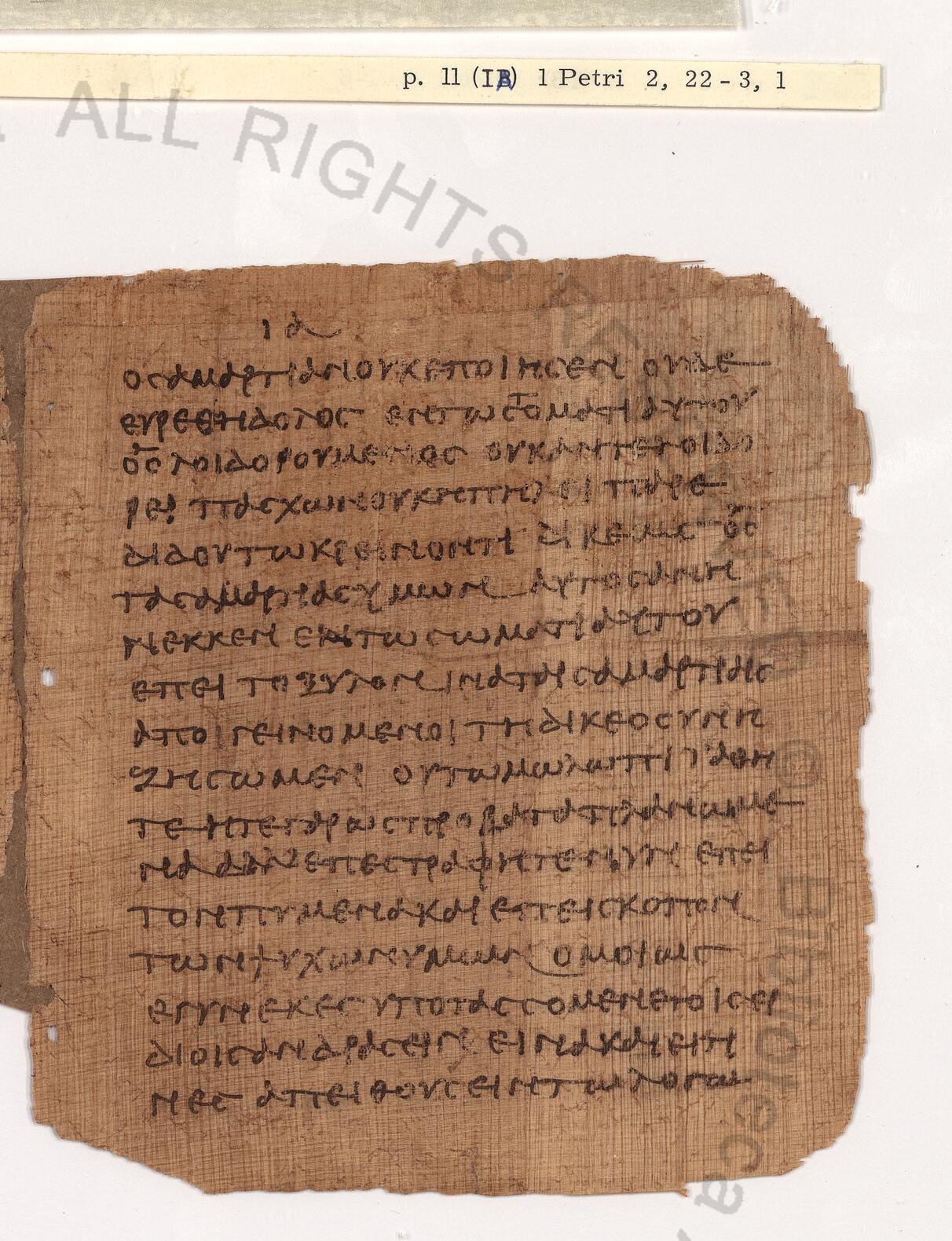
Where on the image
Vatican Library, Pap. Bodmer VIII, DigiVatLib image 1 (https://digi.vatlib.it/view/MSS_Pap.Bodmer.VIII/0001), the right-hand page of the opening, cropped at the fold. The typed label on the glass frame reads "p. 11 (IA) 1 Petri 2, 22-3, 1". 3:1 continues on the next page. Checked on the image: 17 lines in the transcription; the first legible line (line 1) reads ‹ος αμαρτιαν ουκ εποιησεν ουδε›, the last legible line (line 17) ‹νες απειθουσειν τω λογω›; both match the page.
2:22 ος αμαρτιαν ουκ εποιησεν ουδε
ευρεθη δολος εν τω σοματι αυτου
23 ος λοιδορουμενος ουκ αντελοιδο
ρει πασχων ουκ ηπηλει παρε
διδου τω κρεινοντι δικεως 24 ος
τας αμαρτιας υμων αυτος ανη
νεκκεν εις̣ τω σωματι αυτου
επει το ξυλον ινα ταις αμαρτιαις
αποιγεινομενοι τη δικεοσυνη
ζησωμεν ου τω μωλωπι ιαθη
τε 25 ητε γαρ ως προβατα πλανωμε
να αλλ επεστραφητε νυν επει
τον πυμενα και επεισκοπον
των ψυχων υμων 3:1 ομοιως
ε γυνεκες υποτασσομενε τοις ει
διοις ανδρασειν εινα και ει τι
νες απειθουσειν τω λογω
2:22Who did no sin, neither was guile found in his mouth: 23Who, when he was reviled, reviled not again; when he suffered, he threatened not; but committed himself to him that judgeth righteously: 24Who his own self bare our sins in his own body on the tree, that we, being dead to sins, should live unto righteousness: by whose stripes ye were healed. 25For ye were as sheep going astray; but are now returned unto the Shepherd and Bishop of your souls. 3:1Likewise, ye wives, be in subjection to your own husbands; that, if any obey not the word, they also may without the word be won by the conversation of the wives;
Notes
- Greek: the NTVMR diplomatic transcription, line by line as on the papyrus. Square brackets enclose letters that are lost or illegible and were supplied by the transcribers; a dot under a letter marks it as uncertain; [...] marks a gap. Nomina sacra and numerals keep the scribe's overline. Spelling is the scribe's (no accents or breathings). Words broken at a line end stay broken as on the papyrus. Corrections are not shown: the text is the first hand.
- English: the King James Version (1611), whole verses, for every verse that has text on the page. A verse that begins on one page and ends on the next is given in full on both. The KJV translates a later form of the Greek text, so its wording does not always match the papyrus; material differences (such as verses the papyrus does not have) are noted in the section.
Cite
Sources
- Source: Papyrus Bodmer VIII (Vatican Library): photographs from DigiVatLib; Greek from the INTF NTVMR transcription of P72; English from the King James Version (holding institution)
- Critical edition: INTF NTVMR diplomatic transcription (CC BY 4.0)
← previous · → next · v cycle view · l back to library