Plato, Critias 106a-106c: Timaeus ends his discourse with a prayer and hands over to Critias
Introduction
Stephanus page 106 of Plato's Critias (106a-106c): Timaeus ends his discourse with a prayer and hands over to Critias.
The Critias is Plato's full account of Atlantis and of the Athens that fought it: the land and city of ancient Athens (109b-112e), then the island of Atlantis, Poseidon's kingdom beyond the Pillars of Heracles, its royal city, plain, army and laws (113b-120d), and the moral decline of its kings (120e-121c). Plato left the dialogue unfinished; it stops in mid-sentence as Zeus begins to speak, and the manuscript shown here stops at the same words.
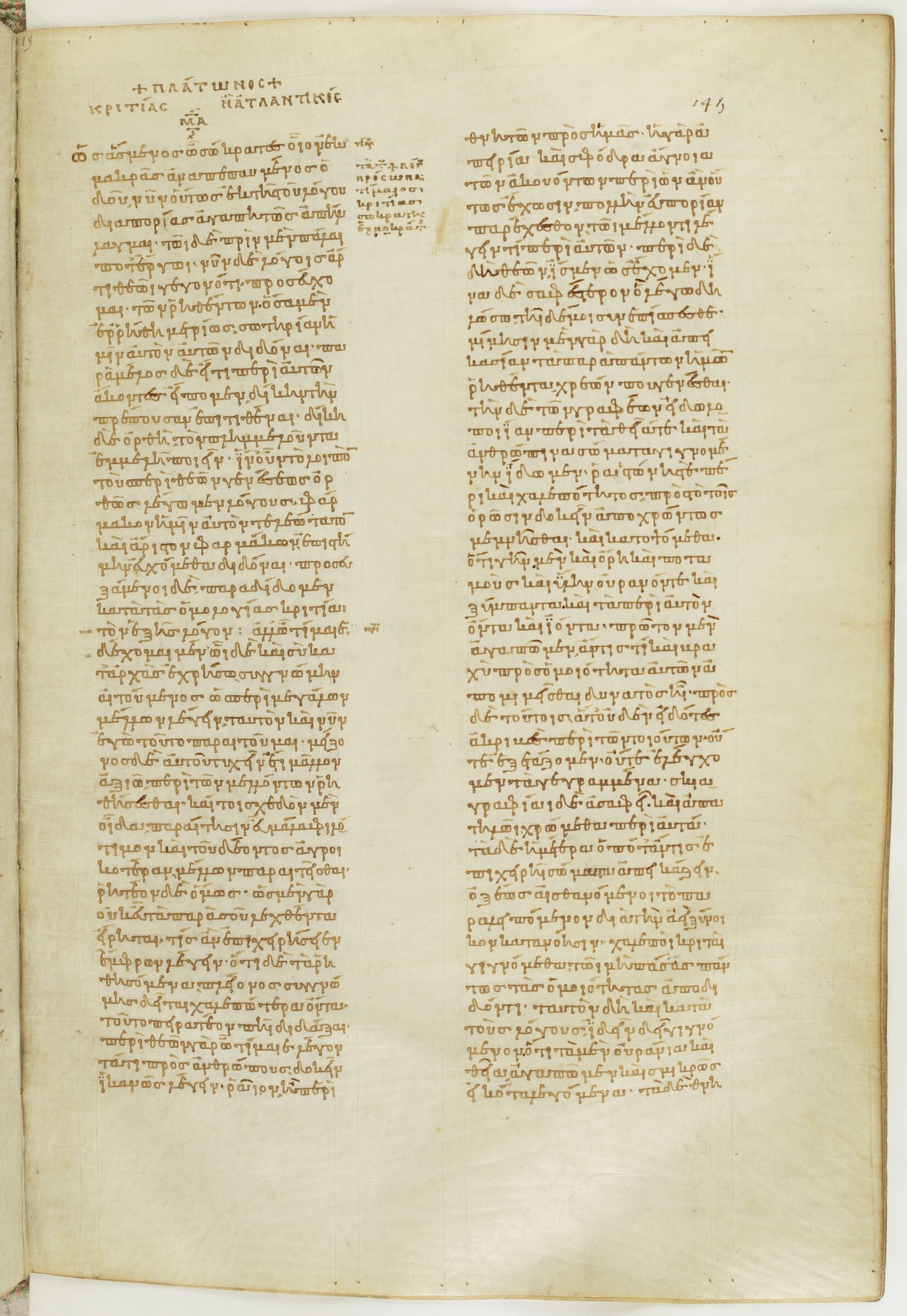
The manuscript is Paris, Bibliothèque nationale de France, grec 1807, known to editors as Plato A. It was copied in Constantinople around 850-875 by the scribe of the so-called philosophical collection, and is the oldest surviving medieval manuscript of the Timaeus and Critias (tetralogies VIII-IX: Clitophon, Republic, Timaeus, Critias, Minos, Laws, Epinomis, Letters). Each page has two columns of 44 lines. The Timaeus fills fol. 114r-144v and the Critias fol. 145r-151r.
On the manuscript this page of text runs over fol. 145r col. a. Each section below is linked to the folio side(s) that carry it. The mapping comes from reading the first words of every column on the images and finding them in Burnet's text: fol. 145r col. a begins ‹ὡς ἅσμενος, ὦ Σώκρατες, οἷον ἐκ› (Crit. 106a).
The Greek is John Burnet's critical text (Oxford, 1902), not a transcription of this manuscript; the scribe's spelling, accents and occasional readings differ from it. The English is R. G. Bury's Loeb translation (1929).
How was this verified? (Provenance)
Where on the image
Crit. 106a stands in Paris gr. 1807, fol. 145r col. a. Checked on the image (column openings read on the BnF photographs and found in Burnet's text, quoted in Burnet's spelling): fol. 145r col. a begins ‹ὡς ἅσμενος, ὦ Σώκρατες, οἷον ἐκ› (Crit. 106a).
ΤΙ. ὡς ἅσμενος, ὦ Σώκρατες, οἷον ἐκ μακρᾶς ἀναπεπαυμένος ὁδοῦ, νῦν οὕτως ἐκ τῆς τοῦ λόγου διαπορείας ἀγαπητῶς ἀπήλλαγμαι. τῷ δὲ πρὶν μὲν πάλαι ποτʼ ἔργῳ, νῦν δὲ λόγοις ἄρτι θεῷ γεγονότι προσεύχομαι, τῶν ῥηθέντων ὅσα μὲν ἐρρήθη μετρίως, σωτηρίαν ἡμῖν αὐτὸν αὐτῶν
Tim. How gladly do I now welcome my release, Socrates, from my protracted discourse, even as a traveller who takes his rest after a long journey! And I make my prayer to that God who has recently been created by our speech (although in reality created of old), that he will grant to us the conservation of all our sayings that have been rightly said,
Where on the image
Crit. 106b stands in Paris gr. 1807, fol. 145r col. a. Checked on the image (column openings read on the BnF photographs and found in Burnet's text, quoted in Burnet's spelling): fol. 145r col. a begins ‹ὡς ἅσμενος, ὦ Σώκρατες, οἷον ἐκ› (Crit. 106a).
διδόναι, παρὰ μέλος δὲ εἴ τι περὶ αὐτῶν ἄκοντες εἴπομεν, δίκην τὴν πρέπουσαν ἐπιτιθέναι. δίκη δὲ ὀρθὴ τὸν πλημμελοῦντα ἐμμελῆ ποιεῖν· ἵνʼ οὖν τὸ λοιπὸν τοὺς περὶ θεῶν γενέσεως ὀρθῶς λέγωμεν λόγους, φάρμακον ἡμῖν αὐτὸν τελεώτατον καὶ ἄριστον φαρμάκων ἐπιστήμην εὐχόμεθα διδόναι, προσευξάμενοι δὲ παραδίδομεν κατὰ τὰς ὁμολογίας Κριτίᾳ τὸν ἑξῆς λόγον.
ΚΡΙ. ἀλλʼ, ὦ Τίμαιε, δέχομαι μέν, ᾧ δὲ καὶ σὺ κατʼ
and, if unwittingly we have spoken aught discordantly, that he will impose the fitting penalty. And the correct penalty is to bring into tune him that is out of tune. In order, then, that for the future we may declare the story of the birth of the gods aright, we pray that he will grant to us that medicine which of all medicines is the most perfect and most good, even knowledge; and having made our prayer, we deliver over to Critias, in accordance with our compact, the task of speaking next in order.
Crit. And I accept the task, Timaeus; but the request which you yourself made at the beginning,
Where on the image
Crit. 106c stands in Paris gr. 1807, fol. 145r col. a. Checked on the image (column openings read on the BnF photographs and found in Burnet's text, quoted in Burnet's spelling): fol. 145r col. a begins ‹ὡς ἅσμενος, ὦ Σώκρατες, οἷον ἐκ› (Crit. 106a).
ἀρχὰς ἐχρήσω, συγγνώμην αἰτούμενος ὡς περὶ μεγάλων μέλλων λέγειν, ταὐτὸν καὶ νῦν ἐγὼ τοῦτο παραιτοῦμαι,
when you asked for indulgence on the ground of the magnitude of the theme you were about to expound, that same request I also make now on my own behalf, and I claim indeed to be granted a still larger measure of indulgence
Notes
- Greek: John Burnet, Platonis Opera IV (Oxford, 1902), via Perseus canonical-greekLit; Burnet's text is a critical edition, so its wording can differ from the manuscript shown.
- English: R. G. Bury, Plato IX (Loeb Classical Library, 1929), via Perseus. Bury's footnotes are not reproduced. Quotation marks stand where Perseus marks quoted speech.
- Stephanus sections (a-e) are those of the 1578 Stephanus edition as given by Burnet and Bury; Bury's section breaks can fall a few words away from Burnet's because English word order differs.
Cite
Sources
- Source: Paris, BnF grec 1807 (Plato A, c. 850-875) fol. 145r via BnF IIIF + Burnet's Greek (Perseus) + R. G. Bury's English (Loeb 1929, Perseus) (holding institution)
- Critical edition: Burnet, Platonis Opera IV (1902), via Perseus
← previous · → next · v cycle view · l back to library