Plato, Critias 107a-107e: Critias asks for indulgence: talk about mortals is judged more strictly than talk about gods
Introduction
Stephanus page 107 of Plato's Critias (107a-107e): Critias asks for indulgence: talk about mortals is judged more strictly than talk about gods.
The Critias is Plato's full account of Atlantis and of the Athens that fought it: the land and city of ancient Athens (109b-112e), then the island of Atlantis, Poseidon's kingdom beyond the Pillars of Heracles, its royal city, plain, army and laws (113b-120d), and the moral decline of its kings (120e-121c). Plato left the dialogue unfinished; it stops in mid-sentence as Zeus begins to speak, and the manuscript shown here stops at the same words.
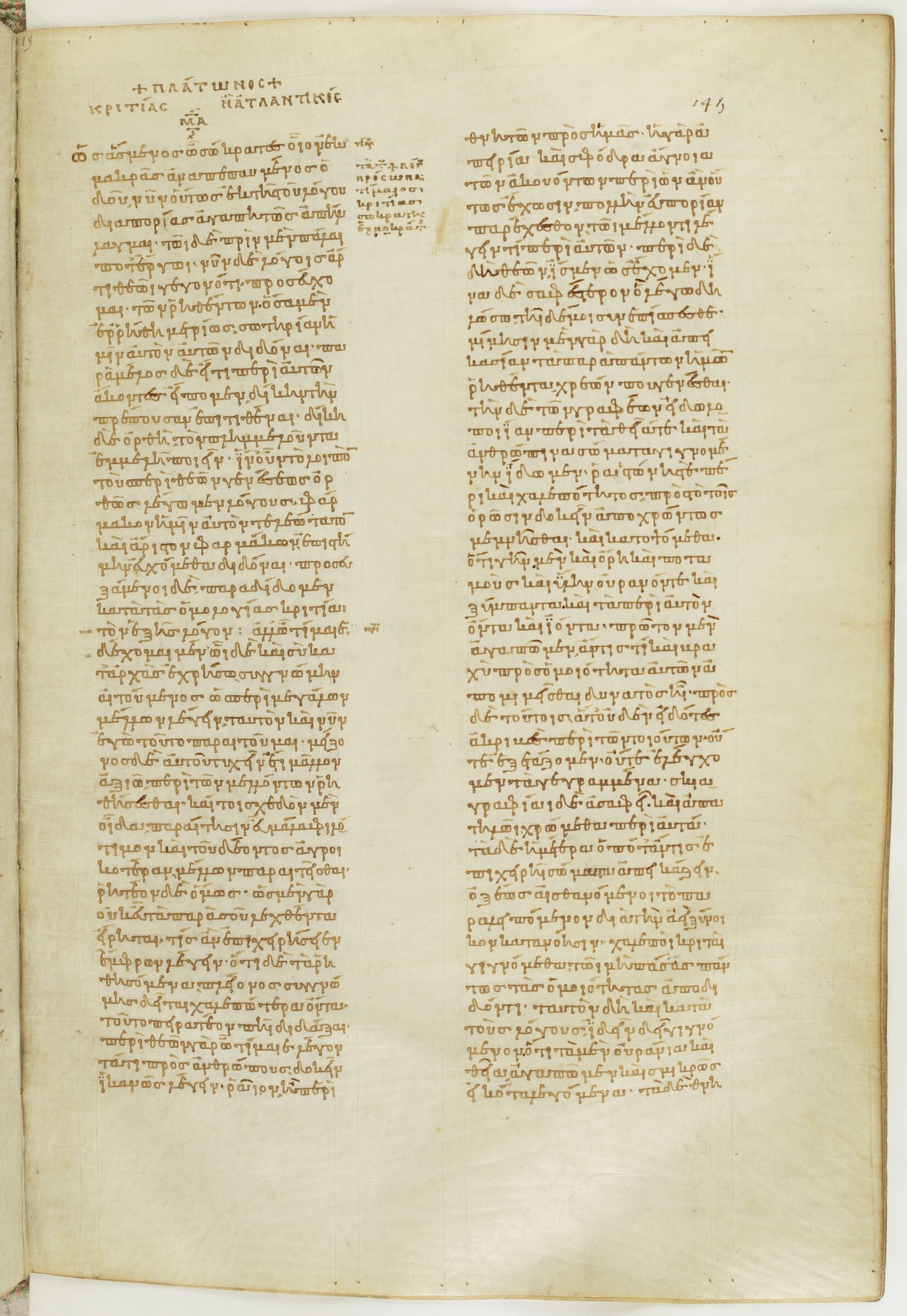
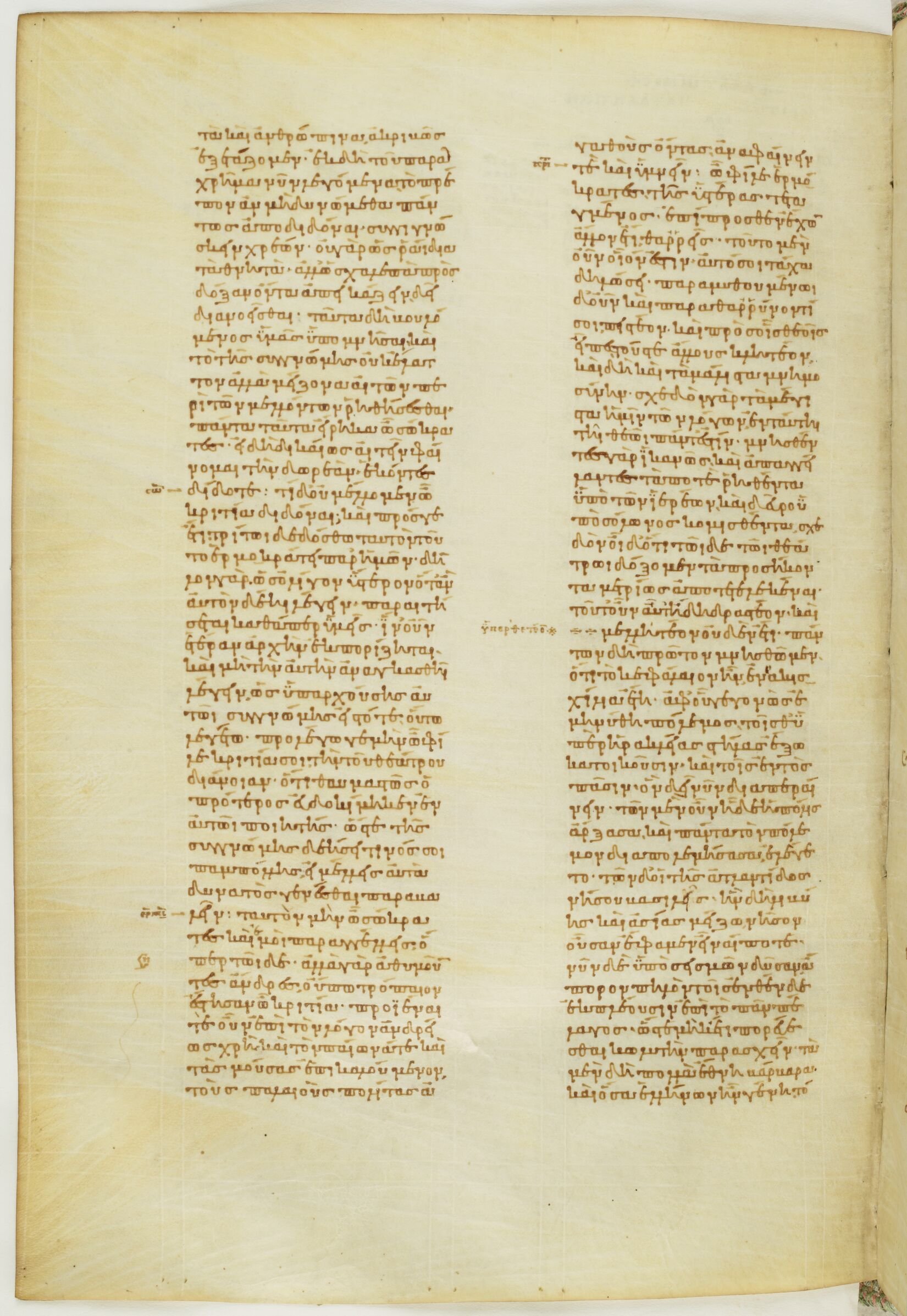
The manuscript is Paris, Bibliothèque nationale de France, grec 1807, known to editors as Plato A. It was copied in Constantinople around 850-875 by the scribe of the so-called philosophical collection, and is the oldest surviving medieval manuscript of the Timaeus and Critias (tetralogies VIII-IX: Clitophon, Republic, Timaeus, Critias, Minos, Laws, Epinomis, Letters). Each page has two columns of 44 lines. The Timaeus fills fol. 114r-144v and the Critias fol. 145r-151r.
On the manuscript this page of text runs over fol. 145r col. a to fol. 145v col. a. Each section below is linked to the folio side(s) that carry it. The mapping comes from reading the first words of every column on the images and finding them in Burnet's text: fol. 145r col. a begins ‹ὡς ἅσμενος, ὦ Σώκρατες, οἷον ἐκ› (Crit. 106a); fol. 145r col. b begins ‹θνητῶν πρὸς ἡμᾶς. ἡ γὰρ ἀπειρία› (Crit. 107b); fol. 145v col. a begins ‹-τὰ καὶ ἀνθρώπινα ἀκριβῶς ἐξετάζομεν. ἐκ› (Crit. 107d).
The Greek is John Burnet's critical text (Oxford, 1902), not a transcription of this manuscript; the scribe's spelling, accents and occasional readings differ from it. The English is R. G. Bury's Loeb translation (1929).
How was this verified? (Provenance)
Where on the image
Crit. 107a stands in Paris gr. 1807, fol. 145r col. a. Checked on the image (column openings read on the BnF photographs and found in Burnet's text, quoted in Burnet's spelling): fol. 145r col. a begins ‹ὡς ἅσμενος, ὦ Σώκρατες, οἷον ἐκ› (Crit. 106a).
μειζόνως δὲ αὐτοῦ τυχεῖν ἔτι μᾶλλον ἀξιῶ περὶ τῶν μελλόντων ῥηθήσεσθαι.
καίτοι σχεδὸν μὲν οἶδα παραίτησιν εὖ μάλα φιλότιμον καὶ τοῦ δέοντος ἀγροικοτέραν μέλλων παραιτεῖσθαι, ῥητέον δὲ ὅμως. ὡς μὲν γὰρ οὐκ εὖ τὰ παρὰ σοῦ λεχθέντα εἴρηται, τίς ἂν ἐπιχειρήσειεν ἔμφρων λέγειν; ὅτι δὲ τὰ ῥηθησόμενα πλείονος συγγνώμης δεῖται χαλεπώτερα ὄντα, τοῦτο πειρατέον πῃ διδάξαι. περὶ θεῶν γάρ, ὦ Τίμαιε, λέγοντά τι πρὸς ἀνθρώπους δοκεῖν ἱκανῶς
in respect of the discourse I am about to deliver.
I am sufficiently aware that the request I am about to make is decidedly presumptuous and less civil than is proper, but none the less it must be uttered. For as regards the exposition you gave, what man in his senses would attempt to deny its excellence? But what I must somehow endeavor to show is that the discourse now to be delivered calls for greater indulgence because of its greater difficulty. For it is easier, Timaeus, to appear to speak satisfactorily to men about the gods,
Where on the image
Crit. 107b stands in Paris gr. 1807, fol. 145r col. a to fol. 145r col. b. Checked on the image (column openings read on the BnF photographs and found in Burnet's text, quoted in Burnet's spelling): fol. 145r col. a begins ‹ὡς ἅσμενος, ὦ Σώκρατες, οἷον ἐκ› (Crit. 106a); fol. 145r col. b begins ‹θνητῶν πρὸς ἡμᾶς. ἡ γὰρ ἀπειρία› (Crit. 107b).
λέγειν ῥᾷον ἢ περὶ θνητῶν πρὸς ἡμᾶς. ἡ γὰρ ἀπειρία καὶ σφόδρα ἄγνοια τῶν ἀκουόντων περὶ ὧν ἂν οὕτως ἔχωσιν πολλὴν εὐπορίαν παρέχεσθον τῷ μέλλοντι λέγειν τι περὶ αὐτῶν· περὶ δὲ δὴ θεῶν ἴσμεν ὡς ἔχομεν. ἵνα δὲ σαφέστερον ὃ λέγω δηλώσω, τῇδέ μοι συνεπίσπεσθε. μίμησιν μὲν γὰρ δὴ καὶ ἀπεικασίαν τὰ παρὰ πάντων ἡμῶν ῥηθέντα χρεών που γενέσθαι· τὴν δὲ τῶν γραφέων εἰδωλοποιίαν περὶ τὰ θεῖά τε καὶ τὰ ἀνθρώπινα σώματα γιγνομένην
than to us about mortals. For when the listeners are in a state of inexperience and complete ignorance about a matter, such a state of mind affords great opportunities to the person who is going to discourse on that matter; and we know what our state is concerning knowledge of the gods. But in order that I may explain my meaning more clearly, pray follow me further. The accounts given by us all must be, of course, of the nature of imitations and representations; and if we look at the portraiture of divine and of human bodies as executed by painters,
Where on the image
Crit. 107c stands in Paris gr. 1807, fol. 145r col. b. Checked on the image (column openings read on the BnF photographs and found in Burnet's text, quoted in Burnet's spelling): fol. 145r col. b begins ‹θνητῶν πρὸς ἡμᾶς. ἡ γὰρ ἀπειρία› (Crit. 107b).
ἴδωμεν ῥᾳστώνης τε πέρι καὶ χαλεπότητος πρὸς τὸ τοῖς ὁρῶσιν δοκεῖν ἀποχρώντως μεμιμῆσθαι, καὶ κατοψόμεθα ὅτι γῆν μὲν καὶ ὄρη καὶ ποταμοὺς καὶ ὕλην οὐρανόν τε σύμπαντα καὶ τὰ περὶ αὐτὸν ὄντα καὶ ἰόντα πρῶτον μὲν ἀγαπῶμεν ἄν τίς τι καὶ βραχὺ πρὸς ὁμοιότητα αὐτῶν ἀπομιμεῖσθαι δυνατὸς ᾖ, πρὸς δὲ τούτοις, ἅτε οὐδὲν εἰδότες ἀκριβὲς περὶ τῶν τοιούτων, οὔτε ἐξετάζομεν οὔτε ἐλέγχομεν τὰ γεγραμμένα,
in respect of the ease or difficulty with which they succeed in imitating their subjects in the opinion of onlookers, we shall notice in the first place that as regards the earth and mountains and rivers and woods and the whole of heaven, with the things that exist and move therein, we are content if a man is able to represent them with even a small degree of likeness; and further, that, inasmuch as we have no exact knowledge about such objects, we do not examine closely or criticize the paintings, but tolerate, in such cases, an inexact
Where on the image
Crit. 107d stands in Paris gr. 1807, fol. 145r col. b to fol. 145v col. a. Checked on the image (column openings read on the BnF photographs and found in Burnet's text, quoted in Burnet's spelling): fol. 145r col. b begins ‹θνητῶν πρὸς ἡμᾶς. ἡ γὰρ ἀπειρία› (Crit. 107b); fol. 145v col. a begins ‹-τὰ καὶ ἀνθρώπινα ἀκριβῶς ἐξετάζομεν. ἐκ› (Crit. 107d).
σκιαγραφίᾳ δὲ ἀσαφεῖ καὶ ἀπατηλῷ χρώμεθα περὶ αὐτά· τὰ δὲ ἡμέτερα ὁπόταν τις ἐπιχειρῇ σώματα ἀπεικάζειν, ὀξέως αἰσθανόμενοι τὸ παραλειπόμενον διὰ τὴν ἀεὶ σύνοικον κατανόησιν χαλεποὶ κριταὶ γιγνόμεθα τῷ μὴ πάσας πάντως τὰς ὁμοιότητας ἀποδιδόντι. ταὐτὸν δὴ καὶ κατὰ τοὺς λόγους ἰδεῖν δεῖ γιγνόμενον, ὅτι τὰ μὲν οὐράνια καὶ θεῖα ἀγαπῶμεν καὶ σμικρῶς εἰκότα λεγόμενα, τὰ δὲ θνητὰ καὶ ἀνθρώπινα ἀκριβῶς ἐξετάζομεν. ἐκ δὴ τοῦ παραχρῆμα
and deceptive sketch. On the other hand, whenever a painter tries to render a likeness of our own bodies, we quickly perceive what is defective because of our constant familiar acquaintance with them, and become severe critics of him who fails to bring out to the full all the points of similarity. And precisely the same thing happens, as we should notice, in the case of discourses: in respect of what is celestial and divine we are satisfied if the account pocesses even a small degree of likelihood, but we examine with precision
Where on the image
Crit. 107e stands in Paris gr. 1807, fol. 145v col. a. Checked on the image (column openings read on the BnF photographs and found in Burnet's text, quoted in Burnet's spelling): fol. 145v col. a begins ‹-τὰ καὶ ἀνθρώπινα ἀκριβῶς ἐξετάζομεν. ἐκ› (Crit. 107d).
νῦν λεγόμενα, τὸ πρέπον ἂν μὴ δυνώμεθα πάντως ἀποδιδόναι, συγγιγνώσκειν χρεών· οὐ γὰρ ὡς ῥᾴδια τὰ θνητὰ ἀλλʼ ὡς χαλεπὰ πρὸς δόξαν ὄντα ἀπεικάζειν δεῖ διανοεῖσθαι.
what is mortal and human. To an account given now on the spur of the moment indulgence must be granted, should we fail to make it a wholly fitting representation; for one must conceive of mortal objects as being difficult, and not easy, to represent satisfactorily.
It is because I wish to remind you of these facts,
Notes
- Greek: John Burnet, Platonis Opera IV (Oxford, 1902), via Perseus canonical-greekLit; Burnet's text is a critical edition, so its wording can differ from the manuscript shown.
- English: R. G. Bury, Plato IX (Loeb Classical Library, 1929), via Perseus. Bury's footnotes are not reproduced. Quotation marks stand where Perseus marks quoted speech.
- Stephanus sections (a-e) are those of the 1578 Stephanus edition as given by Burnet and Bury; Bury's section breaks can fall a few words away from Burnet's because English word order differs.
Cite
Sources
- Source: Paris, BnF grec 1807 (Plato A, c. 850-875) fol. 145r-145v via BnF IIIF + Burnet's Greek (Perseus) + R. G. Bury's English (Loeb 1929, Perseus) (holding institution)
- Critical edition: Burnet, Platonis Opera IV (1902), via Perseus
← previous · → next · v cycle view · l back to library