Plato, Critias 121a-121c: the kings' decline; Zeus calls the gods together (the dialogue breaks off)
Introduction
Stephanus page 121 of Plato's Critias (121a-121c): the kings' decline; Zeus calls the gods together (the dialogue breaks off).
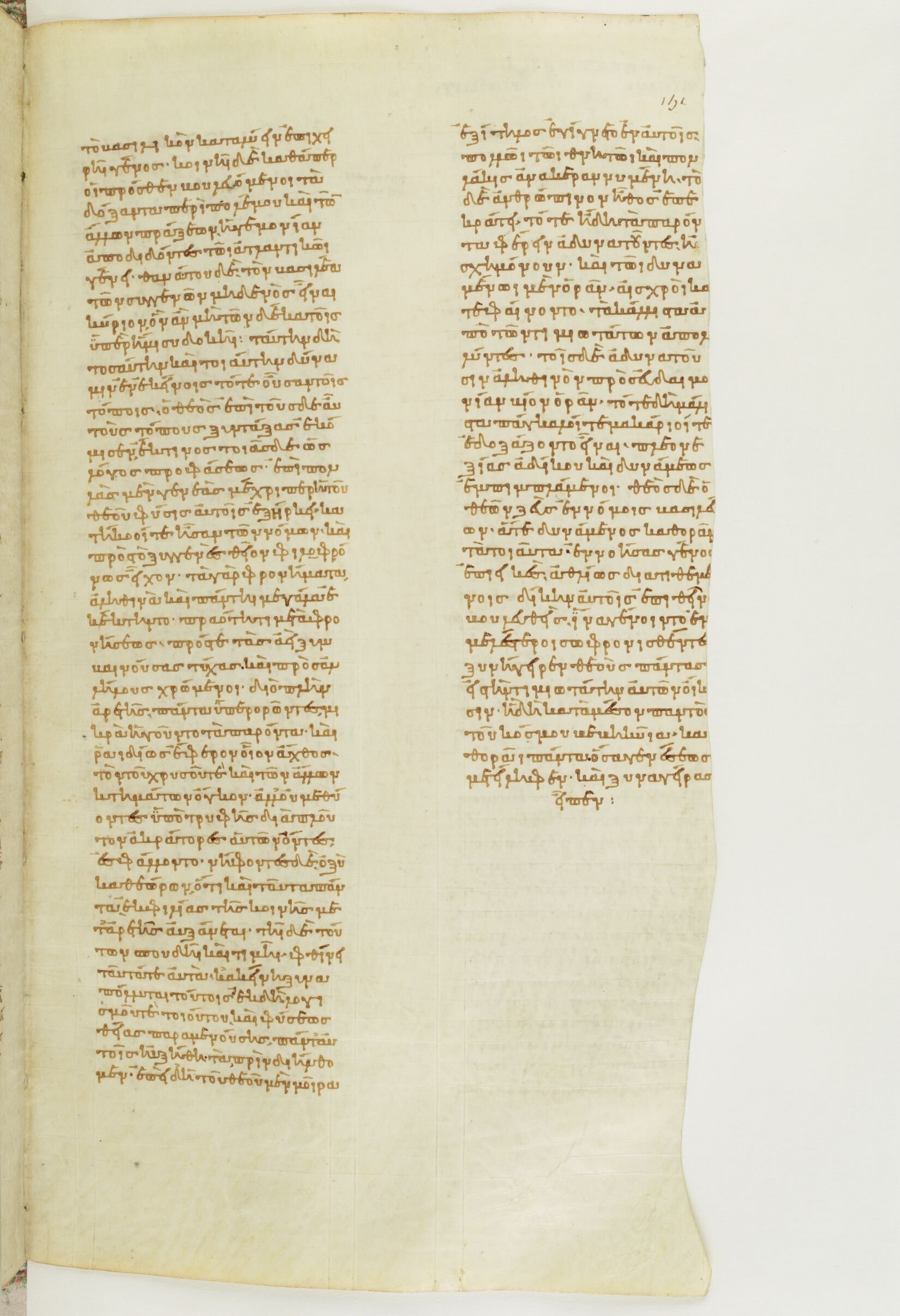
The Critias is Plato's full account of Atlantis and of the Athens that fought it: the land and city of ancient Athens (109b-112e), then the island of Atlantis, Poseidon's kingdom beyond the Pillars of Heracles, its royal city, plain, army and laws (113b-120d), and the moral decline of its kings (120e-121c). Plato left the dialogue unfinished; it stops in mid-sentence as Zeus begins to speak, and the manuscript shown here stops at the same words.
The manuscript is Paris, Bibliothèque nationale de France, grec 1807, known to editors as Plato A. It was copied in Constantinople around 850-875 by the scribe of the so-called philosophical collection, and is the oldest surviving medieval manuscript of the Timaeus and Critias (tetralogies VIII-IX: Clitophon, Republic, Timaeus, Critias, Minos, Laws, Epinomis, Letters). Each page has two columns of 44 lines. The Timaeus fills fol. 114r-144v and the Critias fol. 145r-151r.
On the manuscript this page of text runs over fol. 151r col. a to fol. 151r col. b. Each section below is linked to the folio side(s) that carry it. The mapping comes from reading the first words of every column on the images and finding them in Burnet's text: fol. 151r col. a begins ‹τὸ βασιλικὸν καταλύειν ἐπιχειρῇ γένος, κοινῇ› (Crit. 120c); fol. 151r col. b begins ‹ἐξίτηλος ἐγίγνετο ἐν αὐτοῖς πολλῷ τῷ› (Crit. 121a).
The Greek is John Burnet's critical text (Oxford, 1902), not a transcription of this manuscript; the scribe's spelling, accents and occasional readings differ from it. The English is R. G. Bury's Loeb translation (1929).
How was this verified? (Provenance)
Where on the image
Crit. 121a stands in Paris gr. 1807, fol. 151r col. a to fol. 151r col. b. Checked on the image (column openings read on the BnF photographs and found in Burnet's text, quoted in Burnet's spelling): fol. 151r col. a begins ‹τὸ βασιλικὸν καταλύειν ἐπιχειρῇ γένος, κοινῇ› (Crit. 120c); fol. 151r col. b begins ‹ἐξίτηλος ἐγίγνετο ἐν αὐτοῖς πολλῷ τῷ› (Crit. 121a).
τὰ παρόντα καὶ ῥᾳδίως ἔφερον οἷον ἄχθος τὸν τοῦ χρυσοῦ τε καὶ τῶν ἄλλων κτημάτων ὄγκον, ἀλλʼ οὐ μεθύοντες ὑπὸ τρυφῆς διὰ πλοῦτον ἀκράτορες αὑτῶν ὄντες ἐσφάλλοντο, νήφοντες δὲ ὀξὺ καθεώρων ὅτι καὶ ταῦτα πάντα ἐκ φιλίας τῆς κοινῆς μετʼ ἀρετῆς αὐξάνεται, τῇ δὲ τούτων σπουδῇ καὶ τιμῇ φθίνει ταῦτά τε αὐτὰ κἀκείνη συναπόλλυται τούτοις. ἐκ δὴ λογισμοῦ τε τοιούτου καὶ φύσεως θείας παραμενούσης πάντʼ αὐτοῖς ηὐξήθη ἃ πρὶν διήλθομεν. ἐπεὶ δʼ ἡ τοῦ θεοῦ μὲν μοῖρα ἐξίτηλος ἐγίγνετο ἐν αὐτοῖς πολλῷ τῷ θνητῷ καὶ
the burden, as it were, of the vast volume of their gold and other goods; and thus their wealth did not make them drunk with pride so that they lost control of themselves and went to ruin; rather, in their soberness of mind they clearly saw that all these good things are increased by general amity combined with virtue, whereas the eager pursuit and worship of these goods not only causes the goods themselves to diminish but makes virtue also to perish with them. As a result, then, of such reasoning and of the continuance of their divine nature all their wealth had grown to such a greatness as we previously described. But when the portion of divinity within them was now becoming faint and weak through being ofttimes blended with a large measure of mortality,
Where on the image
Crit. 121b stands in Paris gr. 1807, fol. 151r col. b. Checked on the image (column openings read on the BnF photographs and found in Burnet's text, quoted in Burnet's spelling): fol. 151r col. b begins ‹ἐξίτηλος ἐγίγνετο ἐν αὐτοῖς πολλῷ τῷ› (Crit. 121a).
πολλάκις ἀνακεραννυμένη, τὸ δὲ ἀνθρώπινον ἦθος ἐπεκράτει, τότε ἤδη τὰ παρόντα φέρειν ἀδυνατοῦντες ἠσχημόνουν, καὶ τῷ δυναμένῳ μὲν ὁρᾶν αἰσχροὶ κατεφαίνοντο, τὰ κάλλιστα ἀπὸ τῶν τιμιωτάτων ἀπολλύντες, τοῖς δὲ ἀδυνατοῦσιν ἀληθινὸν πρὸς εὐδαιμονίαν βίον ὁρᾶν τότε δὴ μάλιστα πάγκαλοι μακάριοί τε ἐδοξάζοντο εἶναι, πλεονεξίας ἀδίκου καὶ δυνάμεως ἐμπιμπλάμενοι. θεὸς δὲ ὁ θεῶν Ζεὺς ἐν νόμοις βασιλεύων, ἅτε δυνάμενος καθορᾶν τὰ τοιαῦτα, ἐννοήσας γένος ἐπιεικὲς ἀθλίως διατιθέμενον, δίκην αὐτοῖς
whereas the human temper was becoming dominant, then at length they lost their comeliness, through being unable to bear the burden of their possessions, and became ugly to look upon, in the eyes of him who has the gift of sight; for they had lost the fairest of their goods from the most precious of their parts; but in the eyes of those who have no gift of perceiving what is the truly happy life, it was then above all that they appeared to be superlatively fair and blessed, filled as they were with lawless ambition and power. And Zeus, the God of gods, who reigns by Law, inasmuch as he has the gift of perceiving such things, marked how this righteous race was in evil plight, and desired to inflict punishment upon them, to the end that when chastised they might strike a truer note.
Where on the image
Crit. 121c stands in Paris gr. 1807, fol. 151r col. b. Checked on the image (column openings read on the BnF photographs and found in Burnet's text, quoted in Burnet's spelling): fol. 151r col. b begins ‹ἐξίτηλος ἐγίγνετο ἐν αὐτοῖς πολλῷ τῷ› (Crit. 121a).
ἐπιθεῖναι βουληθείς, ἵνα γένοιντο ἐμμελέστεροι σωφρονισθέντες, συνήγειρεν θεοὺς πάντας εἰς τὴν τιμιωτάτην αὐτῶν οἴκησιν, ἣ δὴ κατὰ μέσον παντὸς τοῦ κόσμου βεβηκυῖα καθορᾷ πάντα ὅσα γενέσεως μετείληφεν, καὶ συναγείρας εἶπεν—
Wherefore he assembled together all the gods into that abode which they honor most, standing as it does at the center of all the Universe, and beholding all things that partake of generation and when he had assembled them, he spake thus:
Notes
- Greek: John Burnet, Platonis Opera IV (Oxford, 1902), via Perseus canonical-greekLit; Burnet's text is a critical edition, so its wording can differ from the manuscript shown.
- English: R. G. Bury, Plato IX (Loeb Classical Library, 1929), via Perseus. Bury's footnotes are not reproduced. Quotation marks stand where Perseus marks quoted speech.
- Stephanus sections (a-e) are those of the 1578 Stephanus edition as given by Burnet and Bury; Bury's section breaks can fall a few words away from Burnet's because English word order differs.
Cite
Sources
- Source: Paris, BnF grec 1807 (Plato A, c. 850-875) fol. 151r via BnF IIIF + Burnet's Greek (Perseus) + R. G. Bury's English (Loeb 1929, Perseus) (holding institution)
- Critical edition: Burnet, Platonis Opera IV (1902), via Perseus
← previous · → next · v cycle view · l back to library