Plato, Critias 120a-120e: the kings' oath and judgment; the laws binding the ten kings
Introduction
Stephanus page 120 of Plato's Critias (120a-120e): the kings' oath and judgment; the laws binding the ten kings.
The Critias is Plato's full account of Atlantis and of the Athens that fought it: the land and city of ancient Athens (109b-112e), then the island of Atlantis, Poseidon's kingdom beyond the Pillars of Heracles, its royal city, plain, army and laws (113b-120d), and the moral decline of its kings (120e-121c). Plato left the dialogue unfinished; it stops in mid-sentence as Zeus begins to speak, and the manuscript shown here stops at the same words.
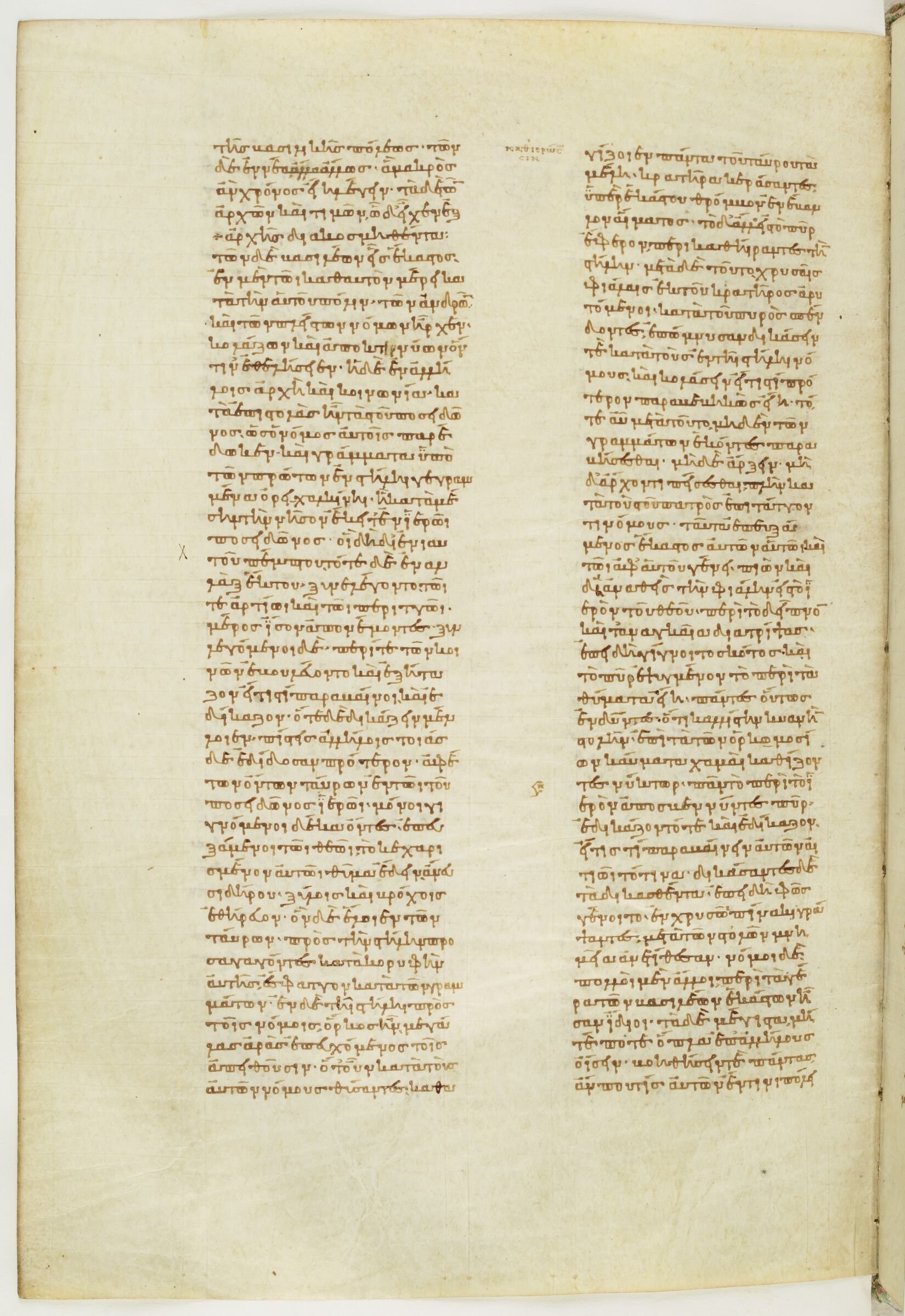
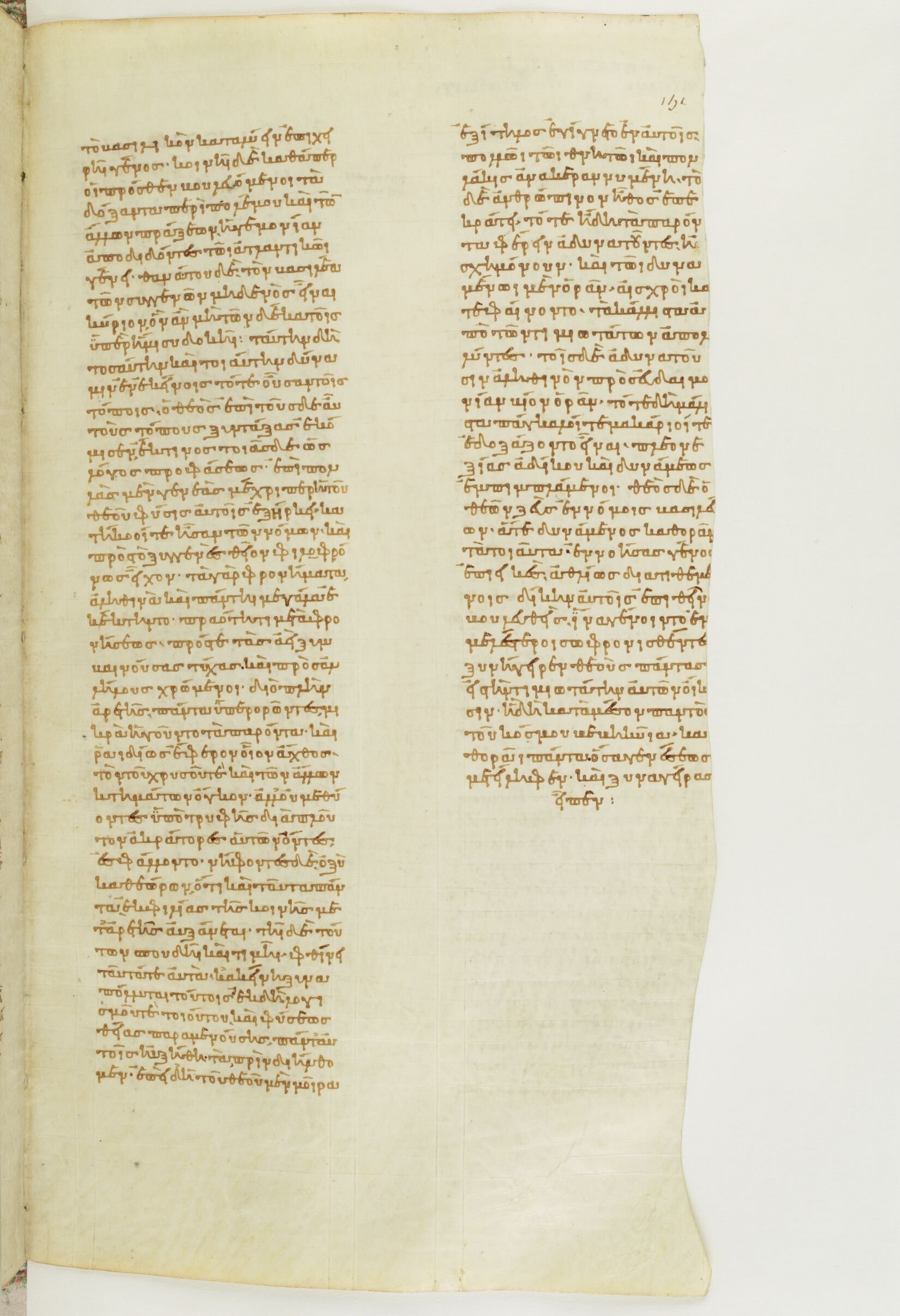
The manuscript is Paris, Bibliothèque nationale de France, grec 1807, known to editors as Plato A. It was copied in Constantinople around 850-875 by the scribe of the so-called philosophical collection, and is the oldest surviving medieval manuscript of the Timaeus and Critias (tetralogies VIII-IX: Clitophon, Republic, Timaeus, Critias, Minos, Laws, Epinomis, Letters). Each page has two columns of 44 lines. The Timaeus fills fol. 114r-144v and the Critias fol. 145r-151r.
On the manuscript this page of text runs over fol. 150v col. a to fol. 151r col. a. Each section below is linked to the folio side(s) that carry it. The mapping comes from reading the first words of every column on the images and finding them in Burnet's text: fol. 150v col. a begins ‹τῆς βασιλικῆς πόλεως, τῶν δὲ ἐννέα› (Crit. 119b); fol. 150v col. b begins ‹-γίζοιεν πάντα τοῦ ταύρου τὰ μέλη› (Crit. 120a); fol. 151r col. a begins ‹τὸ βασιλικὸν καταλύειν ἐπιχειρῇ γένος, κοινῇ› (Crit. 120c).
The Greek is John Burnet's critical text (Oxford, 1902), not a transcription of this manuscript; the scribe's spelling, accents and occasional readings differ from it. The English is R. G. Bury's Loeb translation (1929).
How was this verified? (Provenance)
Where on the image
Crit. 120a stands in Paris gr. 1807, fol. 150v col. a to fol. 150v col. b. Checked on the image (column openings read on the BnF photographs and found in Burnet's text, quoted in Burnet's spelling): fol. 150v col. a begins ‹τῆς βασιλικῆς πόλεως, τῶν δὲ ἐννέα› (Crit. 119b); fol. 150v col. b begins ‹-γίζοιεν πάντα τοῦ ταύρου τὰ μέλη› (Crit. 120a).
αὑτῶν νόμους θύσαντες καθαγίζοιεν πάντα τοῦ ταύρου τὰ μέλη, κρατῆρα κεράσαντες ὑπὲρ ἑκάστου θρόμβον ἐνέβαλλον αἵματος, τὸ δʼ ἄλλʼ εἰς τὸ πῦρ ἔφερον, περικαθήραντες τὴν στήλην· μετὰ δὲ τοῦτο χρυσαῖς φιάλαις ἐκ τοῦ κρατῆρος ἀρυτόμενοι, κατὰ τοῦ πυρὸς σπένδοντες ἐπώμνυσαν δικάσειν τε κατὰ τοὺς ἐν τῇ στήλῃ νόμους καὶ κολάσειν εἴ τίς τι πρότερον παραβεβηκὼς εἴη, τό τε αὖ μετὰ τοῦτο μηδὲν τῶν γραμμάτων ἑκόντες παραβήσεσθαι, μηδὲ ἄρξειν μηδὲ ἄρχοντι
all the limbs of the bull, they mixed a bowl of wine and poured in on behalf of each one a gout of blood, and the rest they carried to the fire, when they had first purged the pillars round about. And after this they drew out from the bowl with golden ladles, and making libation over the fire swore to give judgement according to the laws upon the pillar and to punish whosoever had committed any previous transgression; and, moreover, that henceforth they would not transgress any of the writings willingly, nor govern nor submit to any governor's edict
Where on the image
Crit. 120b stands in Paris gr. 1807, fol. 150v col. b. Checked on the image (column openings read on the BnF photographs and found in Burnet's text, quoted in Burnet's spelling): fol. 150v col. b begins ‹-γίζοιεν πάντα τοῦ ταύρου τὰ μέλη› (Crit. 120a).
πείσεσθαι πλὴν κατὰ τοὺς τοῦ πατρὸς ἐπιτάττοντι νόμους. ταῦτα ἐπευξάμενος ἕκαστος αὐτῶν αὑτῷ καὶ τῷ ἀφʼ αὑτοῦ γένει, πιὼν καὶ ἀναθεὶς τὴν φιάλην εἰς τὸ ἱερὸν τοῦ θεοῦ, περὶ τὸ δεῖπνον καὶ τἀναγκαῖα διατρίψας, ἐπειδὴ γίγνοιτο σκότος καὶ τὸ πῦρ ἐψυγμένον τὸ περὶ τὰ θύματα εἴη, πάντες οὕτως ἐνδύντες ὅτι καλλίστην κυανῆν στολήν, ἐπὶ τὰ τῶν ὁρκωμοσίων καύματα χαμαὶ καθίζοντες, νύκτωρ,
save in accordance with their father's laws. And when each of them had made this invocation both for himself and for his seed after him, he drank of the cup and offered it up as a gift in the temple of the God; and after spending the interval in supping and necessary business, when darkness came on and the sacrificial fire had died down, all the princes robed themselves in most beautiful sable vestments, and sate on the ground beside the cinders of the sacramental victims throughout the night, extinguishing all the fire that was round about the sanctuary;
Where on the image
Crit. 120c stands in Paris gr. 1807, fol. 150v col. b to fol. 151r col. a. Checked on the image (column openings read on the BnF photographs and found in Burnet's text, quoted in Burnet's spelling): fol. 150v col. b begins ‹-γίζοιεν πάντα τοῦ ταύρου τὰ μέλη› (Crit. 120a); fol. 151r col. a begins ‹τὸ βασιλικὸν καταλύειν ἐπιχειρῇ γένος, κοινῇ› (Crit. 120c).
πᾶν τὸ περὶ τὸ ἱερὸν ἀποσβεννύντες πῦρ, ἐδικάζοντό τε καὶ ἐδίκαζον εἴ τίς τι παραβαίνειν αὐτῶν αἰτιῷτό τινα· δικάσαντες δέ, τὰ δικασθέντα, ἐπειδὴ φῶς γένοιτο, ἐν χρυσῷ πίνακι γράψαντες μετὰ τῶν στολῶν μνημεῖα ἀνετίθεσαν. νόμοι δὲ πολλοὶ μὲν ἄλλοι περὶ τὰ γέρα τῶν βασιλέων ἑκάστων ἦσαν ἴδιοι, τὰ δὲ μέγιστα, μήτε ποτὲ ὅπλα ἐπʼ ἀλλήλους οἴσειν βοηθήσειν τε πάντας, ἄν πού τις αὐτῶν ἔν τινι πόλει τὸ βασιλικὸν καταλύειν ἐπιχειρῇ γένος, κοινῇ
and there they gave and received judgement, if any of them accused any of committing any transgression. And when they had given judgement, they wrote the judgements, when it was light, upon a golden tablet, and dedicated them together with their robes as memorials. And there were many other special laws concerning the peculiar rights of the several princes, whereof the most important were these: that they should never take up arms against one another, and that, should anyone attempt to overthrow in any city their royal house, they should all lend aid, taking counsel in common, like their forerunners,
Where on the image
Crit. 120d stands in Paris gr. 1807, fol. 151r col. a. Checked on the image (column openings read on the BnF photographs and found in Burnet's text, quoted in Burnet's spelling): fol. 151r col. a begins ‹τὸ βασιλικὸν καταλύειν ἐπιχειρῇ γένος, κοινῇ› (Crit. 120c).
δέ, καθάπερ οἱ πρόσθεν, βουλευόμενοι τὰ δόξαντα περὶ πολέμου καὶ τῶν ἄλλων πράξεων, ἡγεμονίαν ἀποδιδόντες τῷ Ἀτλαντικῷ γένει. θανάτου δὲ τὸν βασιλέα τῶν συγγενῶν μηδενὸς εἶναι κύριον, ὃν ἂν μὴ τῶν δέκα τοῖς ὑπὲρ ἥμισυ δοκῇ. ταύτην δὴ τοσαύτην καὶ τοιαύτην δύναμιν ἐν ἐκείνοις τότε οὖσαν τοῖς τόποις ὁ θεὸς ἐπὶ τούσδε αὖ τοὺς τόπους συντάξας ἐκόμισεν ἔκ τινος τοιᾶσδε, ὡς λόγος, προφάσεως.
concerning their policy in war and other matters, while conceding the leadership to the royal branch of Atlas; and that the king had no authority to put to death any of his brother-princes save with the consent of more than half of the ten. Such was the magnitude and character of the power which existed in those regions at that time; and this power the God set in array and brought against these regions of ours on some such pretext as the following, according to the story. For many generations,
Where on the image
Crit. 120e stands in Paris gr. 1807, fol. 151r col. a. Checked on the image (column openings read on the BnF photographs and found in Burnet's text, quoted in Burnet's spelling): fol. 151r col. a begins ‹τὸ βασιλικὸν καταλύειν ἐπιχειρῇ γένος, κοινῇ› (Crit. 120c).
ἐπὶ πολλὰς μὲν γενεάς, μέχριπερ ἡ τοῦ θεοῦ φύσις αὐτοῖς ἐξήρκει, κατήκοοί τε ἦσαν τῶν νόμων καὶ πρὸς τὸ συγγενὲς θεῖον φιλοφρόνως εἶχον·
τὰ γὰρ φρονήματα ἀληθινὰ καὶ πάντῃ μεγάλα ἐκέκτηντο, πρᾳότητι μετὰ φρονήσεως πρός τε τὰς ἀεὶ συμβαινούσας τύχας καὶ πρὸς ἀλλήλους χρώμενοι, διὸ πλὴν ἀρετῆς πάντα ὑπερορῶντες μικρὰ ἡγοῦντο
so long as the inherited nature of the God remained strong in them, they were submissive to the laws and kindly disposed to their divine kindred.
For the intents of their hearts were true and in all ways noble, and they showed gentleness joined with wisdom in dealing with the changes and chances of life and in their dealings one with another. Consequently they thought scorn of everything save virtue and lightly esteemed their rich possessions, bearing with ease
Notes
- Greek: John Burnet, Platonis Opera IV (Oxford, 1902), via Perseus canonical-greekLit; Burnet's text is a critical edition, so its wording can differ from the manuscript shown.
- English: R. G. Bury, Plato IX (Loeb Classical Library, 1929), via Perseus. Bury's footnotes are not reproduced. Quotation marks stand where Perseus marks quoted speech.
- Stephanus sections (a-e) are those of the 1578 Stephanus edition as given by Burnet and Bury; Bury's section breaks can fall a few words away from Burnet's because English word order differs.
Cite
Sources
- Source: Paris, BnF grec 1807 (Plato A, c. 850-875) fol. 150v-151r via BnF IIIF + Burnet's Greek (Perseus) + R. G. Bury's English (Loeb 1929, Perseus) (holding institution)
- Critical edition: Burnet, Platonis Opera IV (1902), via Perseus
← previous · → next · v cycle view · l back to library