Plato, Timaeus 17a-17d: Socrates counts the guests and recalls yesterday's discussion of the best city
Introduction
Stephanus page 17 of Plato's Timaeus (17a-17d): Socrates counts the guests and recalls yesterday's discussion of the best city.
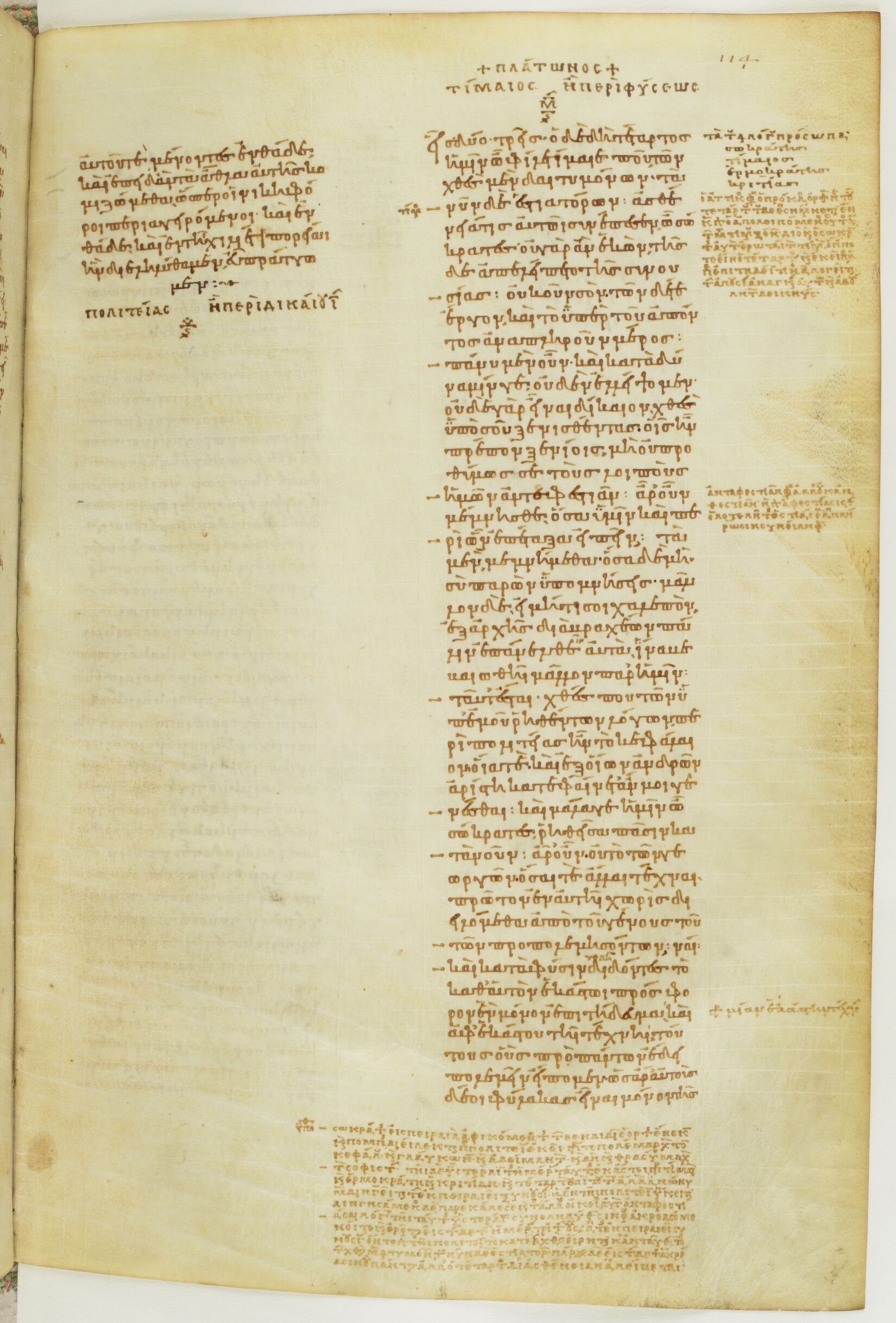
The manuscript is Paris, Bibliothèque nationale de France, grec 1807, known to editors as Plato A. It was copied in Constantinople around 850-875 by the scribe of the so-called philosophical collection, and is the oldest surviving medieval manuscript of the Timaeus and Critias (tetralogies VIII-IX: Clitophon, Republic, Timaeus, Critias, Minos, Laws, Epinomis, Letters). Each page has two columns of 44 lines. The Timaeus fills fol. 114r-144v and the Critias fol. 145r-151r.
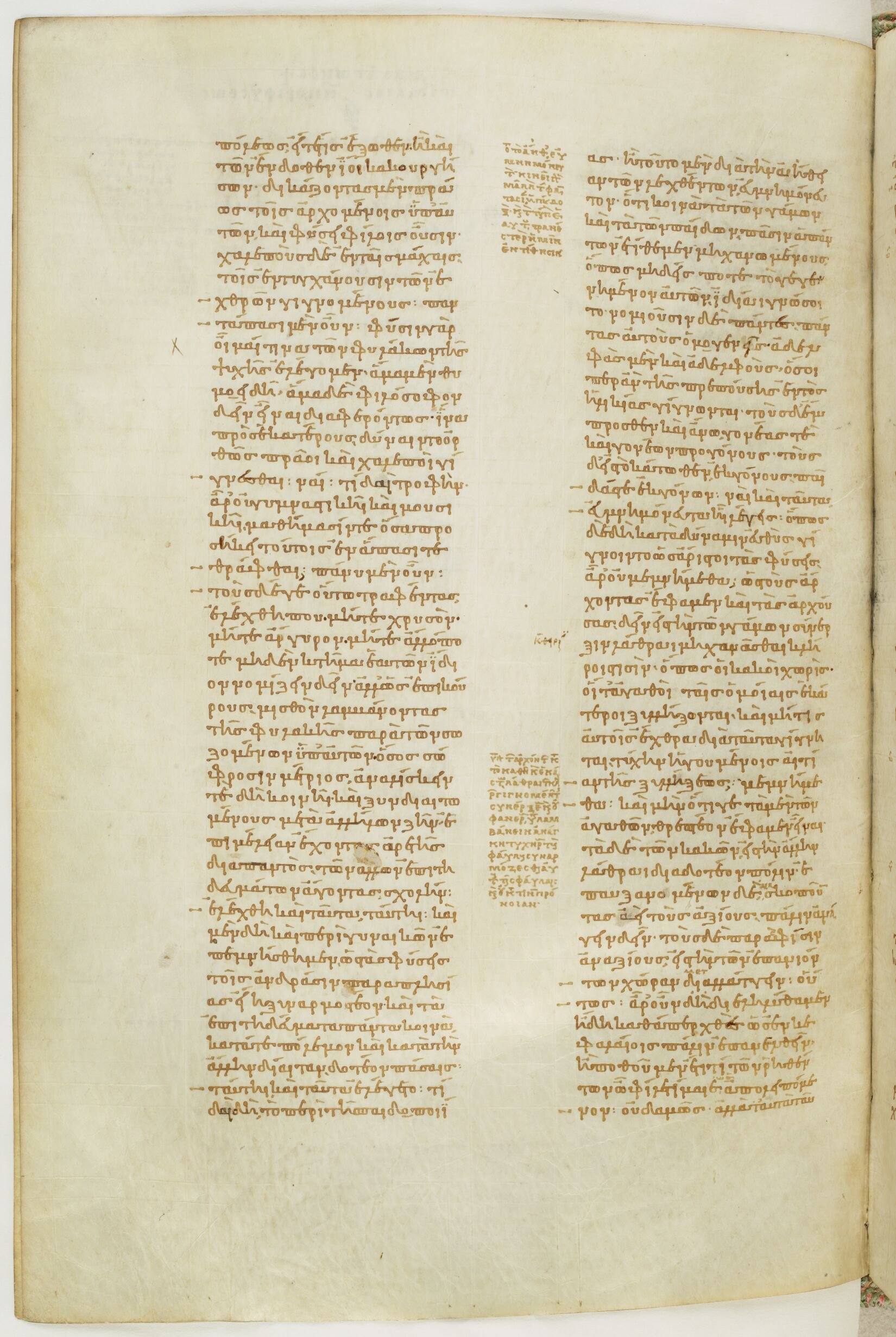
On the manuscript this page of text runs over fol. 114r col. b to fol. 114v col. a. Each section below is linked to the folio side(s) that carry it. The mapping comes from reading the first words of every column on the images and finding them in Burnet's text: fol. 114r col. b begins ‹εἷς, δύο, τρεῖς· ὁ δὲ δὴ› (Tim. 17a); fol. 114v col. a begins ‹πόλεως, εἴτε τις ἔξωθεν ἢ καὶ› (Tim. 17d).
The Greek is John Burnet's critical text (Oxford, 1902), not a transcription of this manuscript; the scribe's spelling, accents and occasional readings differ from it. The English is R. G. Bury's Loeb translation (1929).
How was this verified? (Provenance)
Where on the image
Tim. 17a stands in Paris gr. 1807, fol. 114r col. b. Checked on the image (column openings read on the BnF photographs and found in Burnet's text, quoted in Burnet's spelling): fol. 114r col. b begins ‹εἷς, δύο, τρεῖς· ὁ δὲ δὴ› (Tim. 17a). English: Timaeus' reply πάνυ μὲν οὖν ... ἀνταφεστιᾶν stands wholly in 17b in the Greek; Bury's 17b milestone falls inside it, so his English of the reply (Undoubtedly ... cordially in return.) is given whole with 17b.
ΣΩ. εἷς, δύο, τρεῖς· ὁ δὲ δὴ τέταρτος ἡμῖν, ὦ φίλε Τίμαιε, ποῦ τῶν χθὲς μὲν δαιτυμόνων, τὰ νῦν δὲ ἑστιατόρων;
ΤΙ. ἀσθένειά τις αὐτῷ συνέπεσεν, ὦ Σώκρατες· οὐ γὰρ ἂν ἑκὼν τῆσδε ἀπελείπετο τῆς συνουσίας.
ΣΩ. οὐκοῦν σὸν τῶνδέ τε ἔργον καὶ τὸ ὑπὲρ τοῦ ἀπόντος ἀναπληροῦν μέρος;
Soc. One, two, three,—but where, my dear Timaeus, is the fourth of our guests of yesterday, our hosts of today?
Tim. Some sickness has befallen him, Socrates; for he would never have stayed away from our gathering of his own free will.
Soc. Then the task of filling the place of the absent one falls upon you and our friends here, does it not?
Where on the image
Tim. 17b stands in Paris gr. 1807, fol. 114r col. b. Checked on the image (column openings read on the BnF photographs and found in Burnet's text, quoted in Burnet's spelling): fol. 114r col. b begins ‹εἷς, δύο, τρεῖς· ὁ δὲ δὴ› (Tim. 17a). English: Timaeus' reply πάνυ μὲν οὖν ... ἀνταφεστιᾶν stands wholly in 17b in the Greek; Bury's 17b milestone falls inside it, so his English of the reply (Undoubtedly ... cordially in return.) is given whole with 17b.
ΤΙ. πάνυ μὲν οὖν, καὶ κατὰ δύναμίν γε οὐδὲν ἐλλείψομεν· οὐδὲ γὰρ ἂν εἴη δίκαιον, χθὲς ὑπὸ σοῦ ξενισθέντας οἷς ἦν πρέπον ξενίοις, μὴ οὐ προθύμως σὲ τοὺς λοιποὺς ἡμῶν ἀνταφεστιᾶν.
ΣΩ. ἆρʼ οὖν μέμνησθε ὅσα ὑμῖν καὶ περὶ ὧν ἐπέταξα εἰπεῖν;
ΤΙ. τὰ μὲν μεμνήμεθα, ὅσα δὲ μή, σὺ παρὼν ὑπομνήσεις· μᾶλλον δέ, εἰ μή τί σοι χαλεπόν, ἐξ ἀρχῆς διὰ βραχέων πάλιν ἐπάνελθε αὐτά, ἵνα βεβαιωθῇ μᾶλλον παρʼ ἡμῖν.
Tim. Undoubtedly, and we shall do our best not to come short; for indeed it would not be at all right, after the splendid hospitality we received from you yesterday, if we—that is, those who are left of us—failed to entertain you cordially in return.
Soc. Well, then, do you remember the extent and character of the subjects which I proposed for your discussion?
Tim. In part we do remember them; and of what we have forgotten you are present to remind us. Or rather, if it is not a trouble, recount them again briefly from the beginning, so as to fix them more firmly in our minds.
Where on the image
Tim. 17c stands in Paris gr. 1807, fol. 114r col. b. Checked on the image (column openings read on the BnF photographs and found in Burnet's text, quoted in Burnet's spelling): fol. 114r col. b begins ‹εἷς, δύο, τρεῖς· ὁ δὲ δὴ› (Tim. 17a).
ΣΩ. ταῦτʼ ἔσται. χθές που τῶν ὑπʼ ἐμοῦ ῥηθέντων λόγων περὶ πολιτείας ἦν τὸ κεφάλαιον οἵα τε καὶ ἐξ οἵων ἀνδρῶν ἀρίστη κατεφαίνετʼ ἄν μοι γενέσθαι.
ΤΙ. καὶ μάλα γε ἡμῖν, ὦ Σώκρατες, ῥηθεῖσα πᾶσιν κατὰ νοῦν.
ΣΩ. ἆρʼ οὖν οὐ τὸ τῶν γεωργῶν ὅσαι τε ἄλλαι τέχναι πρῶτον ἐν αὐτῇ χωρὶς διειλόμεθα ἀπὸ τοῦ γένους τοῦ τῶν προπολεμησόντων;
ΤΙ. ναί.
ΣΩ. καὶ κατὰ φύσιν δὴ δόντες τὸ καθʼ αὑτὸν ἑκάστῳ
Soc. It shall be done. The main part of the discourse I delivered yesterday was concerned with the kind of constitution which seemed to me likely to prove the best, and the character of its citizens.
Tim. And in truth, Socrates, the polity you described was highly approved by us all.
Soc. Did we not begin by dividing off the class of land-workers in it, and all other crafts, from the class of its defenders?
Tim. Yes.
Soc. And when, in accordance with Nature, we had assigned to each citizen
Where on the image
Tim. 17d stands in Paris gr. 1807, fol. 114r col. b to fol. 114v col. a. Checked on the image (column openings read on the BnF photographs and found in Burnet's text, quoted in Burnet's spelling): fol. 114r col. b begins ‹εἷς, δύο, τρεῖς· ὁ δὲ δὴ› (Tim. 17a); fol. 114v col. a begins ‹πόλεως, εἴτε τις ἔξωθεν ἢ καὶ› (Tim. 17d).
πρόσφορον ἓν μόνον ἐπιτήδευμα, μίαν ἑκάστῳ τέχνην, τούτους οὓς πρὸ πάντων ἔδει πολεμεῖν, εἴπομεν ὡς ἄρʼ αὐτοὺς δέοι φύλακας εἶναι μόνον τῆς πόλεως, εἴτε τις ἔξωθεν ἢ καὶ τῶν ἔνδοθεν ἴοι κακουργήσων, δικάζοντας μὲν πρᾴως τοῖς
his one proper and peculiar occupation, we declared that those whose duty it is to fight in defence of all must act solely as guardians of the State, in case anyone from without or any of those within should go about to molest it; and that they should judge leniently such as are under their authority and their natural friends,
Notes
- Greek: John Burnet, Platonis Opera IV (Oxford, 1902), via Perseus canonical-greekLit; Burnet's text is a critical edition, so its wording can differ from the manuscript shown.
- English: R. G. Bury, Plato IX (Loeb Classical Library, 1929), via Perseus. Bury's footnotes are not reproduced. Quotation marks stand where Perseus marks quoted speech.
- Stephanus sections (a-e) are those of the 1578 Stephanus edition as given by Burnet and Bury; Bury's section breaks can fall a few words away from Burnet's because English word order differs.
Cite
Sources
- Source: Paris, BnF grec 1807 (Plato A, c. 850-875) fol. 114r-114v via BnF IIIF + Burnet's Greek (Perseus) + R. G. Bury's English (Loeb 1929, Perseus) (holding institution)
- Critical edition: Burnet, Platonis Opera IV (1902), via Perseus
← previous · → next · v cycle view · l back to library