Plato, Timaeus 18a-18e: the recapitulation continued: guardians, women, marriages and children
Introduction
Stephanus page 18 of Plato's Timaeus (18a-18e): the recapitulation continued: guardians, women, marriages and children.
The manuscript is Paris, Bibliothèque nationale de France, grec 1807, known to editors as Plato A. It was copied in Constantinople around 850-875 by the scribe of the so-called philosophical collection, and is the oldest surviving medieval manuscript of the Timaeus and Critias (tetralogies VIII-IX: Clitophon, Republic, Timaeus, Critias, Minos, Laws, Epinomis, Letters). Each page has two columns of 44 lines. The Timaeus fills fol. 114r-144v and the Critias fol. 145r-151r.
On the manuscript this page of text runs over fol. 114v col. a to fol. 114v col. b. Each section below is linked to the folio side(s) that carry it. The mapping comes from reading the first words of every column on the images and finding them in Burnet's text: fol. 114v col. a begins ‹πόλεως, εἴτε τις ἔξωθεν ἢ καὶ› (Tim. 17d); fol. 114v col. b begins ‹ἢ τοῦτο μὲν διὰ τὴν ἀήθειαν› (Tim. 18c).
The Greek is John Burnet's critical text (Oxford, 1902), not a transcription of this manuscript; the scribe's spelling, accents and occasional readings differ from it. The English is R. G. Bury's Loeb translation (1929).
How was this verified? (Provenance)
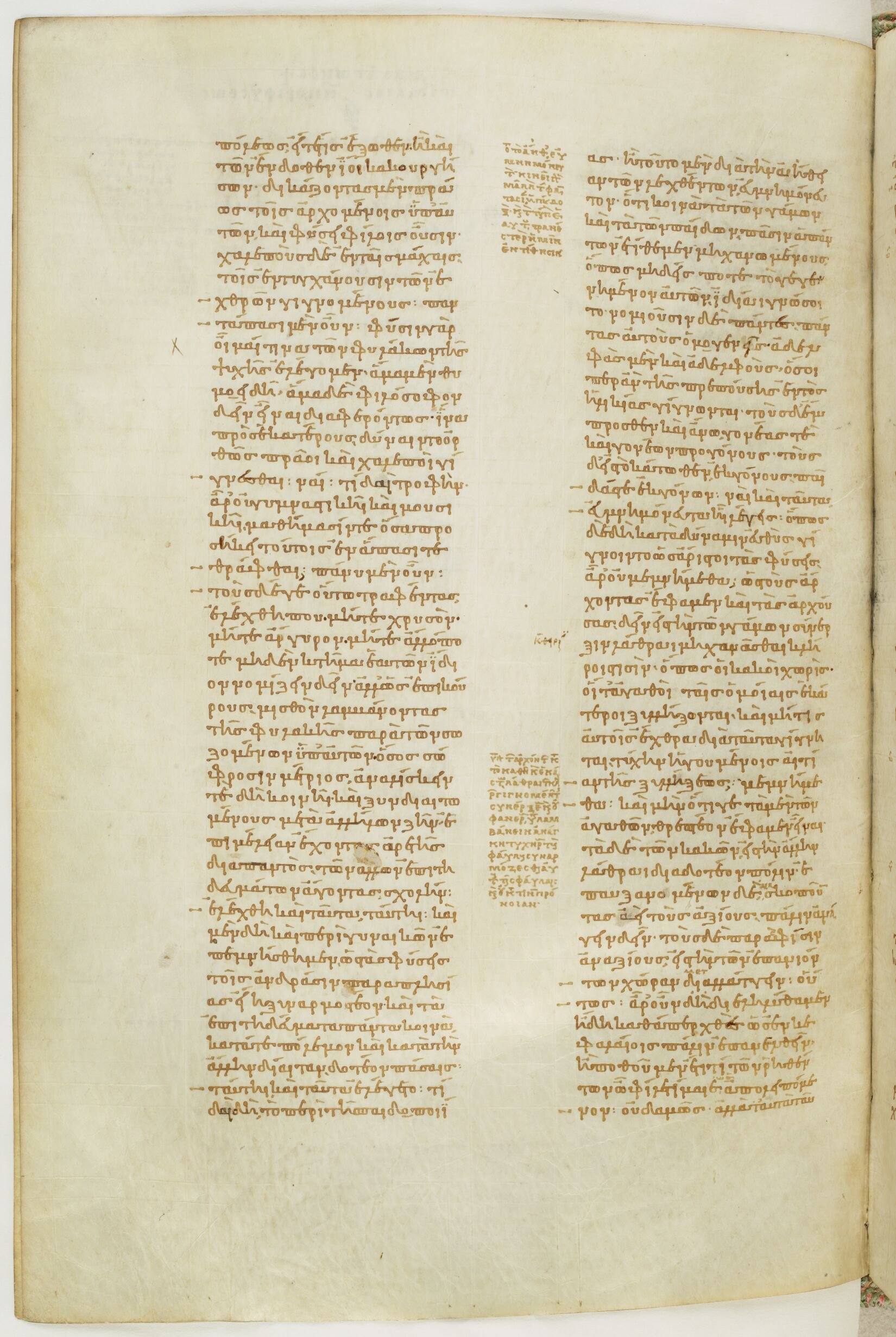
Where on the image
Tim. 18a stands in Paris gr. 1807, fol. 114v col. a. Checked on the image (column openings read on the BnF photographs and found in Burnet's text, quoted in Burnet's spelling): fol. 114v col. a begins ‹πόλεως, εἴτε τις ἔξωθεν ἢ καὶ› (Tim. 17d). English: Timaeus' reply πάνυ μὲν οὖν stands in 18b in the Greek; Bury's 18b milestone falls after it, so his English of the reply (Certainly.) is given with 18b.
ἀρχομένοις ὑπʼ αὐτῶν καὶ φύσει φίλοις οὖσιν, χαλεποὺς δὲ ἐν ταῖς μάχαις τοῖς ἐντυγχάνουσιν τῶν ἐχθρῶν γιγνομένους.
ΤΙ. παντάπασι μὲν οὖν.
ΣΩ. φύσιν γὰρ οἶμαί τινα τῶν φυλάκων τῆς ψυχῆς ἐλέγομεν ἅμα μὲν θυμοειδῆ, ἅμα δὲ φιλόσοφον δεῖν εἶναι διαφερόντως, ἵνα πρὸς ἑκατέρους δύναιντο ὀρθῶς πρᾷοι καὶ χαλεποὶ γίγνεσθαι.
ΤΙ. ναί.
ΣΩ. τί δὲ τροφήν; ἆρʼ οὐ γυμναστικῇ καὶ μουσικῇ μαθήμασίν τε ὅσα προσήκει τούτοις, ἐν ἅπασι τεθράφθαι;
but show themselves stern in battle towards all the enemies they encounter.
Tim. Very true.
Soc. For we said, as I think, that the soul of the Guardians ought to be of a nature at once spirited and philosophic in a superlative degree, so that they might be able to treat their friends rightly with leniency and their foes with sternness.
Tim. Yes.
Soc. And what of their training? Did we not say that they were trained in gymnastic, in music, and in all the studies proper for such men?
Where on the image
Tim. 18b stands in Paris gr. 1807, fol. 114v col. a. Checked on the image (column openings read on the BnF photographs and found in Burnet's text, quoted in Burnet's spelling): fol. 114v col. a begins ‹πόλεως, εἴτε τις ἔξωθεν ἢ καὶ› (Tim. 17d). English: Timaeus' reply πάνυ μὲν οὖν stands in 18b in the Greek; Bury's 18b milestone falls after it, so his English of the reply (Certainly.) is given with 18b.
ΤΙ. πάνυ μὲν οὖν.
ΣΩ. τοὺς δέ γε οὕτω τραφέντας ἐλέχθη που μήτε χρυσὸν μήτε ἄργυρον μήτε ἄλλο ποτὲ μηδὲν κτῆμα ἑαυτῶν ἴδιον νομίζειν δεῖν, ἀλλʼ ὡς ἐπικούρους μισθὸν λαμβάνοντας τῆς φυλακῆς παρὰ τῶν σῳζομένων ὑπʼ αὐτῶν, ὅσος σώφροσιν μέτριος, ἀναλίσκειν τε δὴ κοινῇ καὶ συνδιαιτωμένους μετὰ ἀλλήλων ζῆν, ἐπιμέλειαν ἔχοντας ἀρετῆς διὰ παντός, τῶν ἄλλων ἐπιτηδευμάτων ἄγοντας σχολήν.
ΤΙ. ἐλέχθη καὶ ταῦτα ταύτῃ.
Tim. Certainly.
Soc. And it was said, I believe, that the men thus trained should never regard silver or gold or anything else as their own private property; but as auxiliaries, who in return for their guard-work receive from those whom they protect such a moderate wage as suffices temperate men, they should spend their wage in common and live together in fellowship one with another, devoting themselves unceasingly to virtue, but keeping free from all other pursuits.
Tim. That too was stated as you say.
Where on the image
Tim. 18c stands in Paris gr. 1807, fol. 114v col. a to fol. 114v col. b. Checked on the image (column openings read on the BnF photographs and found in Burnet's text, quoted in Burnet's spelling): fol. 114v col. a begins ‹πόλεως, εἴτε τις ἔξωθεν ἢ καὶ› (Tim. 17d); fol. 114v col. b begins ‹ἢ τοῦτο μὲν διὰ τὴν ἀήθειαν› (Tim. 18c).
ΣΩ. καὶ μὲν δὴ καὶ περὶ γυναικῶν ἐπεμνήσθημεν, ὡς τὰς φύσεις τοῖς ἀνδράσιν παραπλησίας εἴη συναρμοστέον, καὶ τὰ ἐπιτηδεύματα πάντα κοινὰ κατά τε πόλεμον καὶ κατὰ τὴν ἄλλην δίαιταν δοτέον πάσαις.
ΤΙ. ταύτῃ καὶ ταῦτα ἐλέγετο.
ΣΩ. τί δὲ δὴ τὸ περὶ τῆς παιδοποιίας; ἢ τοῦτο μὲν διὰ τὴν ἀήθειαν τῶν λεχθέντων εὐμνημόνευτον, ὅτι κοινὰ τὰ τῶν γάμων καὶ τὰ τῶν παίδων πᾶσιν ἁπάντων ἐτίθεμεν, μηχανωμένους ὅπως μηδείς ποτε τὸ γεγενημένον αὐτῶν ἰδίᾳ γνώσοιτο,
Soc. Moreover, we went on to say about women that their natures must be attuned into accord with the men, and that the occupations assigned to them, both in war and in all other activities of life, should in every case be the same for all alike.
Tim. This matter also was stated exactly so.
Soc. And what about the matter of child-production? Or was this a thing easy to recollect because of the strangeness of our proposals? For we ordained that as regards marriages and children all should have all in common, so that no one should ever recognize his own particular offspring, but all should regard all
Where on the image
Tim. 18d stands in Paris gr. 1807, fol. 114v col. b. Checked on the image (column openings read on the BnF photographs and found in Burnet's text, quoted in Burnet's spelling): fol. 114v col. b begins ‹ἢ τοῦτο μὲν διὰ τὴν ἀήθειαν› (Tim. 18c).
νομιοῦσιν δὲ πάντες πάντας αὐτοὺς ὁμογενεῖς, ἀδελφὰς μὲν καὶ ἀδελφοὺς ὅσοιπερ ἂν τῆς πρεπούσης ἐντὸς ἡλικίας γίγνωνται, τοὺς δʼ ἔμπροσθεν καὶ ἄνωθεν γονέας τε καὶ γονέων προγόνους, τοὺς δʼ εἰς τὸ κάτωθεν ἐκγόνους παῖδάς τε ἐκγόνων;
ΤΙ. ναί, καὶ ταῦτα εὐμνημόνευτα ᾗ λέγεις.
ΣΩ. ὅπως δὲ δὴ κατὰ δύναμιν εὐθὺς γίγνοιντο ὡς ἄριστοι τὰς φύσεις, ἆρʼ οὐ μεμνήμεθα ὡς τοὺς ἄρχοντας ἔφαμεν καὶ τὰς ἀρχούσας δεῖν εἰς τὴν τῶν γάμων σύνερξιν λάθρᾳ
as their actual kinsmen—as brothers and sisters, if of a suitable age; as parents and grandparents, if more advanced in age; and as children and children’s children, if junior in age.
Tim. Yes, this also, as you say, is easy to recollect.
Soc. And in order that, to the best of our power, they might at once become as good as possible in their natural characters, do we not recollect how we said that the rulers, male and female, in dealing with marriage-unions must contrive to secure, by some secret method of allotment,
Where on the image
Tim. 18e stands in Paris gr. 1807, fol. 114v col. b. Checked on the image (column openings read on the BnF photographs and found in Burnet's text, quoted in Burnet's spelling): fol. 114v col. b begins ‹ἢ τοῦτο μὲν διὰ τὴν ἀήθειαν› (Tim. 18c).
μηχανᾶσθαι κλήροις τισὶν ὅπως οἱ κακοὶ χωρὶς οἵ τʼ ἀγαθοὶ ταῖς ὁμοίαις ἑκάτεροι συλλήξονται, καὶ μή τις αὐτοῖς ἔχθρα διὰ ταῦτα γίγνηται, τύχην ἡγουμένοις αἰτίαν τῆς συλλήξεως;
ΤΙ. μεμνήμεθα.
that the two classes of bad men and good shall each be mated by lot with women of a like nature, and that no enmity shall occur amongst them because of this, seeing that they will ascribe the allotment to chance?
Tim. We recollect.
Notes
- Greek: John Burnet, Platonis Opera IV (Oxford, 1902), via Perseus canonical-greekLit; Burnet's text is a critical edition, so its wording can differ from the manuscript shown.
- English: R. G. Bury, Plato IX (Loeb Classical Library, 1929), via Perseus. Bury's footnotes are not reproduced. Quotation marks stand where Perseus marks quoted speech.
- Stephanus sections (a-e) are those of the 1578 Stephanus edition as given by Burnet and Bury; Bury's section breaks can fall a few words away from Burnet's because English word order differs.
Cite
Sources
- Source: Paris, BnF grec 1807 (Plato A, c. 850-875) fol. 114v via BnF IIIF + Burnet's Greek (Perseus) + R. G. Bury's English (Loeb 1929, Perseus) (holding institution)
- Critical edition: Burnet, Platonis Opera IV (1902), via Perseus
← previous · → next · v cycle view · l back to library