Plato, Timaeus 92a-92c: fishes and shellfish; the world a visible god
Introduction
Stephanus page 92 of Plato's Timaeus (92a-92c): fishes and shellfish; the world a visible god.
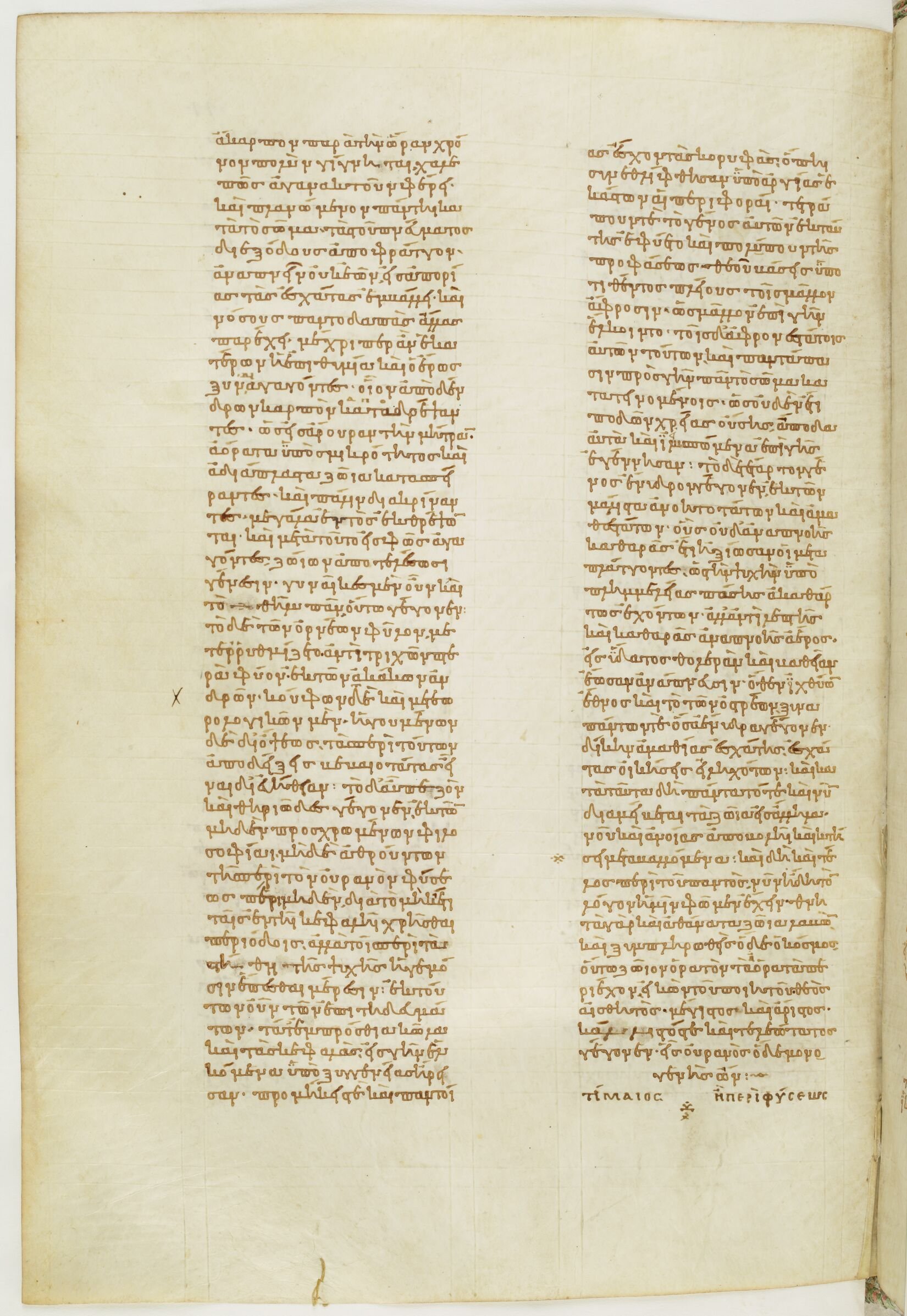
The manuscript is Paris, Bibliothèque nationale de France, grec 1807, known to editors as Plato A. It was copied in Constantinople around 850-875 by the scribe of the so-called philosophical collection, and is the oldest surviving medieval manuscript of the Timaeus and Critias (tetralogies VIII-IX: Clitophon, Republic, Timaeus, Critias, Minos, Laws, Epinomis, Letters). Each page has two columns of 44 lines. The Timaeus fills fol. 114r-144v and the Critias fol. 145r-151r.
On the manuscript this page of text runs over fol. 144v col. b. Each section below is linked to the folio side(s) that carry it. The mapping comes from reading the first words of every column on the images and finding them in Burnet's text: fol. 144v col. b begins ‹-ας ἔσχον τὰς κορυφάς, ὅπῃ συνεθλίφθησαν› (Tim. 91e).
The Greek is John Burnet's critical text (Oxford, 1902), not a transcription of this manuscript; the scribe's spelling, accents and occasional readings differ from it. The English is R. G. Bury's Loeb translation (1929).
How was this verified? (Provenance)
Where on the image
Tim. 92a stands in Paris gr. 1807, fol. 144v col. b. Checked on the image (column openings read on the BnF photographs and found in Burnet's text, quoted in Burnet's spelling): fol. 144v col. b begins ‹-ας ἔσχον τὰς κορυφάς, ὅπῃ συνεθλίφθησαν› (Tim. 91e).
κορυφάς, ὅπῃ συνεθλίφθησαν ὑπὸ ἀργίας ἑκάστων αἱ περιφοραί· τετράπουν τε τὸ γένος αὐτῶν ἐκ ταύτης ἐφύετο καὶ πολύπουν τῆς προφάσεως, θεοῦ βάσεις ὑποτιθέντος πλείους τοῖς μᾶλλον ἄφροσιν, ὡς μᾶλλον ἐπὶ γῆν ἕλκοιντο. τοῖς δʼ ἀφρονεστάτοις αὐτῶν τούτων καὶ παντάπασιν πρὸς γῆν πᾶν τὸ σῶμα κατατεινομένοις ὡς οὐδὲν ἔτι ποδῶν χρείας οὔσης, ἄποδα αὐτὰ καὶ ἰλυσπώμενα ἐπὶ γῆς ἐγέννησαν. τὸ δὲ
On this account also their race was made four-footed and many-footed, since God set more supports under the more foolish ones, so that they might be dragged down still more to the earth. And inasmuch as there was no longer any need of feet for the most foolish of these same creatures, which stretched with their whole body along the earth, the gods generated these footless and wriggling upon the earth.
Where on the image
Tim. 92b stands in Paris gr. 1807, fol. 144v col. b. Checked on the image (column openings read on the BnF photographs and found in Burnet's text, quoted in Burnet's spelling): fol. 144v col. b begins ‹-ας ἔσχον τὰς κορυφάς, ὅπῃ συνεθλίφθησαν› (Tim. 91e).
τέταρτον γένος ἔνυδρον γέγονεν ἐκ τῶν μάλιστα ἀνοητοτάτων καὶ ἀμαθεστάτων, οὓς οὐδʼ ἀναπνοῆς καθαρᾶς ἔτι ἠξίωσαν οἱ μεταπλάττοντες, ὡς τὴν ψυχὴν ὑπὸ πλημμελείας πάσης ἀκαθάρτως ἐχόντων, ἀλλʼ ἀντὶ λεπτῆς καὶ καθαρᾶς ἀναπνοῆς ἀέρος εἰς ὕδατος θολερὰν καὶ βαθεῖαν ἔωσαν ἀνάπνευσιν· ὅθεν ἰχθύων ἔθνος καὶ τὸ τῶν ὀστρέων συναπάντων τε ὅσα ἔνυδρα γέγονεν, δίκην ἀμαθίας ἐσχάτης ἐσχάτας οἰκήσεις
And the fourth kind, which lives in the water, came from the most utterly thoughtless and stupid of men, whom those that remolded them deemed no longer worthy even of pure respiration, seeing that they were unclean of soul through utter wickedness; wherefore in place of air, for refined and pure respiring, they thrust them into water, there to respire its turbid depths. Thence have come into being the tribe of fishes and of shellfish and all creatures of the waters, which have for their portion the extremest of all abodes in requital for the extremity of their witlessness. Thus, both then and now, living creatures keep passing
Where on the image
Tim. 92c stands in Paris gr. 1807, fol. 144v col. b. Checked on the image (column openings read on the BnF photographs and found in Burnet's text, quoted in Burnet's spelling): fol. 144v col. b begins ‹-ας ἔσχον τὰς κορυφάς, ὅπῃ συνεθλίφθησαν› (Tim. 91e).
εἰληχότων. καὶ κατὰ ταῦτα δὴ πάντα τότε καὶ νῦν διαμείβεται τὰ ζῷα εἰς ἄλληλα, νοῦ καὶ ἀνοίας ἀποβολῇ καὶ κτήσει μεταβαλλόμενα. καὶ δὴ καὶ τέλος περὶ τοῦ παντὸς νῦν ἤδη τὸν λόγον ἡμῖν φῶμεν ἔχειν· θνητὰ γὰρ καὶ ἀθάνατα ζῷα λαβὼν καὶ συμπληρωθεὶς ὅδε ὁ κόσμος οὕτω, ζῷον ὁρατὸν τὰ ὁρατὰ περιέχον, εἰκὼν τοῦ νοητοῦ θεὸς αἰσθητός, μέγιστος καὶ ἄριστος κάλλιστός τε καὶ τελεώτατος γέγονεν εἷς οὐρανὸς ὅδε μονογενὴς ὤν.
into one another in all these ways, as they undergo transformation by the loss or by the gain of reason and unreason. And now at length we may say that our discourse concerning the Universe has reached its termination. For this our Cosmos has received the living creatures both mortal and immortal and been thereby fulfilled; it being itself a visible Living Creature embracing the visible creatures, a perceptible God made in the image of the Intelligible, most great and good and fair and perfect in its generation—even this one Heaven sole of its kind.
Notes
- Greek: John Burnet, Platonis Opera IV (Oxford, 1902), via Perseus canonical-greekLit; Burnet's text is a critical edition, so its wording can differ from the manuscript shown.
- English: R. G. Bury, Plato IX (Loeb Classical Library, 1929), via Perseus. Bury's footnotes are not reproduced. Quotation marks stand where Perseus marks quoted speech.
- Stephanus sections (a-e) are those of the 1578 Stephanus edition as given by Burnet and Bury; Bury's section breaks can fall a few words away from Burnet's because English word order differs.
Cite
Sources
- Source: Paris, BnF grec 1807 (Plato A, c. 850-875) fol. 144v via BnF IIIF + Burnet's Greek (Perseus) + R. G. Bury's English (Loeb 1929, Perseus) (holding institution)
- Critical edition: Burnet, Platonis Opera IV (1902), via Perseus
← previous · → next · v cycle view · l back to library