Plato, Timaeus 91a-91e: the origin of women and of the animals
Introduction
Stephanus page 91 of Plato's Timaeus (91a-91e): the origin of women and of the animals.
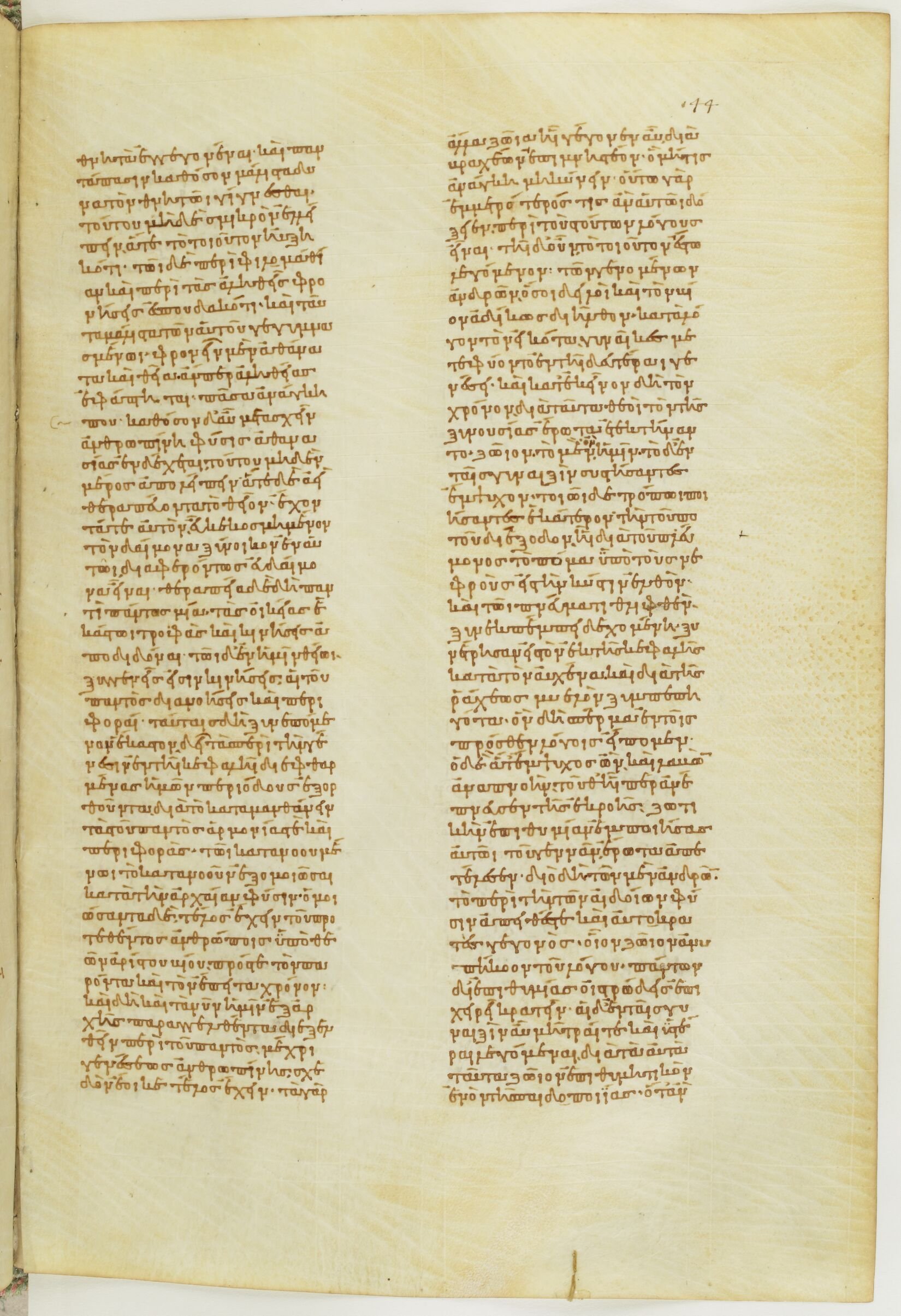
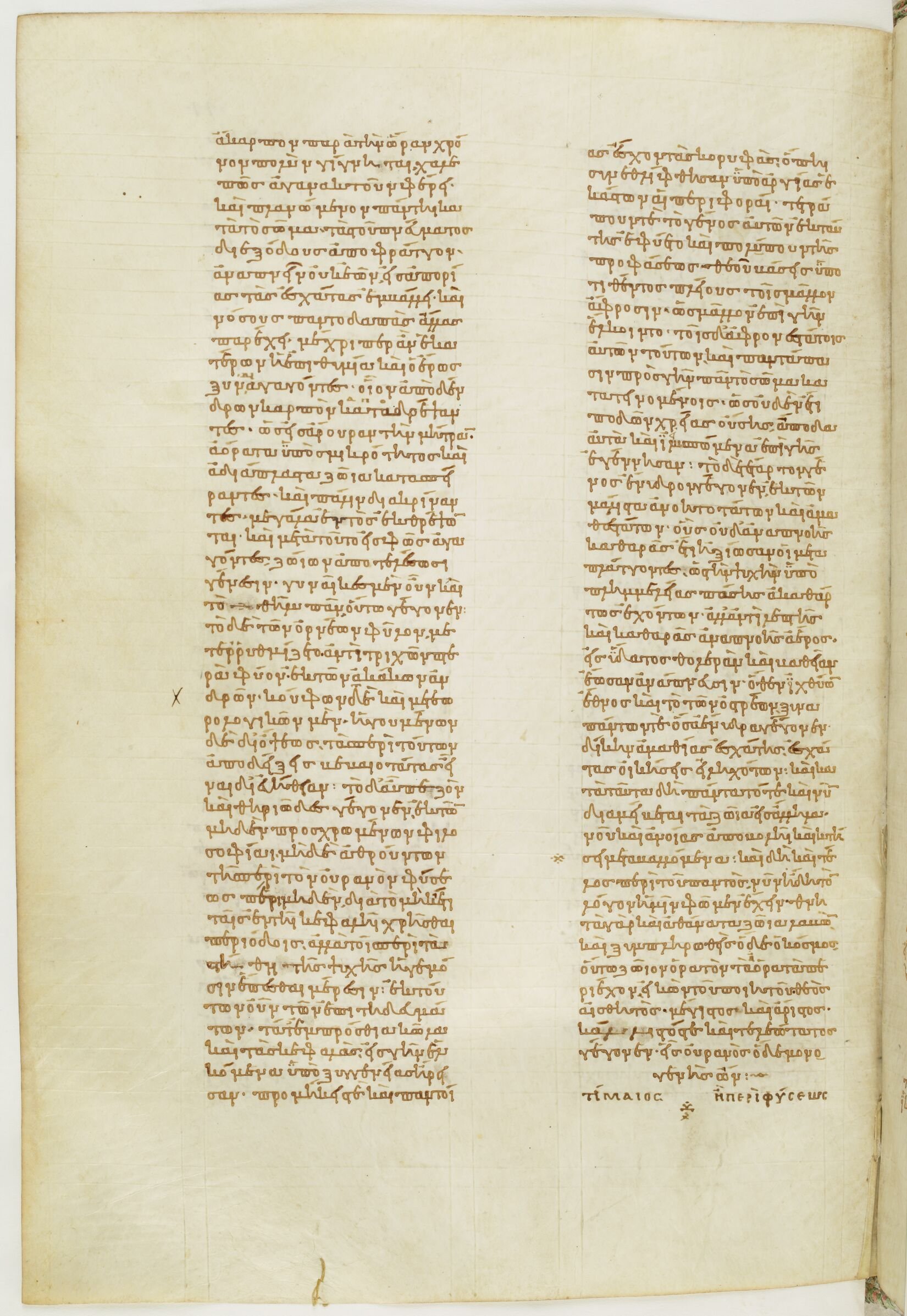
The manuscript is Paris, Bibliothèque nationale de France, grec 1807, known to editors as Plato A. It was copied in Constantinople around 850-875 by the scribe of the so-called philosophical collection, and is the oldest surviving medieval manuscript of the Timaeus and Critias (tetralogies VIII-IX: Clitophon, Republic, Timaeus, Critias, Minos, Laws, Epinomis, Letters). Each page has two columns of 44 lines. The Timaeus fills fol. 114r-144v and the Critias fol. 145r-151r.
On the manuscript this page of text runs over fol. 144r col. b to fol. 144v col. b. Each section below is linked to the folio side(s) that carry it. The mapping comes from reading the first words of every column on the images and finding them in Burnet's text: fol. 144r col. b begins ‹ἄλλα ζῷα ᾗ γέγονεν αὖ, διὰ› (Tim. 90e); fol. 144v col. a begins ‹ἄκαρπον παρὰ τὴν ὥραν χρόνον πολὺν› (Tim. 91c); fol. 144v col. b begins ‹-ας ἔσχον τὰς κορυφάς, ὅπῃ συνεθλίφθησαν› (Tim. 91e).
The Greek is John Burnet's critical text (Oxford, 1902), not a transcription of this manuscript; the scribe's spelling, accents and occasional readings differ from it. The English is R. G. Bury's Loeb translation (1929).
How was this verified? (Provenance)
Where on the image
Tim. 91a stands in Paris gr. 1807, fol. 144r col. b. Checked on the image (column openings read on the BnF photographs and found in Burnet's text, quoted in Burnet's spelling): fol. 144r col. b begins ‹ἄλλα ζῷα ᾗ γέγονεν αὖ, διὰ› (Tim. 90e).
γενέσει· καὶ κατʼ ἐκεῖνον δὴ τὸν χρόνον διὰ ταῦτα θεοὶ τὸν τῆς συνουσίας ἔρωτα ἐτεκτήναντο, ζῷον τὸ μὲν ἐν ἡμῖν, τὸ δʼ ἐν ταῖς γυναιξὶν συστήσαντες ἔμψυχον, τοιῷδε τρόπῳ ποιήσαντες ἑκάτερον. τὴν τοῦ ποτοῦ διέξοδον, ᾗ διὰ τοῦ πλεύμονος τὸ πῶμα ὑπὸ τοὺς νεφροὺς εἰς τὴν κύστιν ἐλθὸν καὶ τῷ πνεύματι θλιφθὲν συνεκπέμπει δεχομένη, συνέτρησαν εἰς τὸν ἐκ τῆς κεφαλῆς κατὰ τὸν αὐχένα καὶ διὰ τῆς ῥάχεως
at their second incarnation, into women. And it was for this reason that the gods at that time contrived the love of sexual intercourse by constructing an animate creature of one kind in us men, and of another kind in women; and they made these severally in the following fashion. From the passage of egress for the drink, where it receives and joins in discharging the fluid which has come through the lungs beneath the kidneys into the bladder and has been compressed by the air, they bored a hole into the condensed marrow which comes from the head down by the neck and along the spine
Where on the image
Tim. 91b stands in Paris gr. 1807, fol. 144r col. b. Checked on the image (column openings read on the BnF photographs and found in Burnet's text, quoted in Burnet's spelling): fol. 144r col. b begins ‹ἄλλα ζῷα ᾗ γέγονεν αὖ, διὰ› (Tim. 90e).
μυελὸν συμπεπηγότα, ὃν δὴ σπέρμα ἐν τοῖς πρόσθεν λόγοις εἴπομεν· ὁ δέ, ἅτʼ ἔμψυχος ὢν καὶ λαβὼν ἀναπνοήν, τοῦθʼ ᾗπερ ἀνέπνευσεν, τῆς ἐκροῆς ζωτικὴν ἐπιθυμίαν ἐμποιήσας αὐτῷ, τοῦ γεννᾶν ἔρωτα ἀπετέλεσεν. διὸ δὴ τῶν μὲν ἀνδρῶν τὸ περὶ τὴν τῶν αἰδοίων φύσιν ἀπειθές τε καὶ αὐτοκρατὲς γεγονός, οἷον ζῷον ἀνυπήκοον τοῦ λόγου, πάντων διʼ ἐπιθυμίας οἰστρώδεις ἐπιχειρεῖ κρατεῖν· αἱ δʼ ἐν
which marrow, in our previous account, we termed seed. And the marrow, inasmuch as it is animate and has been granted an outlet, has endowed the part where its outlet lies with a love for generating by implanting therein a lively desire for emission. Wherefore in men the nature of the genital organs is disobedient and self-willed, like a creature that is deaf to reason, and it attempts to dominate all because of its frenzied lusts.
Where on the image
Tim. 91c stands in Paris gr. 1807, fol. 144r col. b to fol. 144v col. a. Checked on the image (column openings read on the BnF photographs and found in Burnet's text, quoted in Burnet's spelling): fol. 144r col. b begins ‹ἄλλα ζῷα ᾗ γέγονεν αὖ, διὰ› (Tim. 90e); fol. 144v col. a begins ‹ἄκαρπον παρὰ τὴν ὥραν χρόνον πολὺν› (Tim. 91c).
ταῖς γυναιξὶν αὖ μῆτραί τε καὶ ὑστέραι λεγόμεναι διὰ τὰ αὐτὰ ταῦτα, ζῷον ἐπιθυμητικὸν ἐνὸν τῆς παιδοποιίας, ὅταν ἄκαρπον παρὰ τὴν ὥραν χρόνον πολὺν γίγνηται, χαλεπῶς ἀγανακτοῦν φέρει, καὶ πλανώμενον πάντῃ κατὰ τὸ σῶμα, τὰς τοῦ πνεύματος διεξόδους ἀποφράττον, ἀναπνεῖν οὐκ ἐῶν εἰς ἀπορίας τὰς ἐσχάτας ἐμβάλλει καὶ νόσους παντοδαπὰς ἄλλας παρέχει, μέχριπερ ἂν ἑκατέρων ἡ ἐπιθυμία καὶ ὁ
And in women again, owing to the same causes, whenever the matrix or womb, as it is called,—which is an indwelling creature desirous of child-bearing,—remains without fruit long beyond the due season, it is vexed and takes it ill; and by straying all ways through the body and blocking up the passages of the breath and preventing respiration it casts the body into the uttermost distress, and causes, moreover, all kinds of maladies; until the desire and love of the two sexes unite them. Then, culling as it were the fruit from trees,
Where on the image
Tim. 91d stands in Paris gr. 1807, fol. 144v col. a. Checked on the image (column openings read on the BnF photographs and found in Burnet's text, quoted in Burnet's spelling): fol. 144v col. a begins ‹ἄκαρπον παρὰ τὴν ὥραν χρόνον πολὺν› (Tim. 91c).
ἔρως συναγαγόντες, οἷον ἀπὸ δένδρων καρπὸν καταδρέψαντες, ὡς εἰς ἄρουραν τὴν μήτραν ἀόρατα ὑπὸ σμικρότητος καὶ ἀδιάπλαστα ζῷα κατασπείραντες καὶ πάλιν διακρίναντες μεγάλα ἐντὸς ἐκθρέψωνται καὶ μετὰ τοῦτο εἰς φῶς ἀγαγόντες ζῴων ἀποτελέσωσι γένεσιν. γυναῖκες μὲν οὖν καὶ τὸ θῆλυ πᾶν οὕτω γέγονεν· τὸ δὲ τῶν ὀρνέων φῦλον μετερρυθμίζετο, ἀντὶ τριχῶν πτερὰ φύον, ἐκ τῶν ἀκάκων ἀνδρῶν, κούφων δέ, καὶ μετεωρολογικῶν μέν, ἡγουμένων δὲ διʼ ὄψεως
they sow upon the womb, as upon ploughed soil, animalcules that are invisible for smallness and unshapen; and these, again, they mold into shape and nourish to a great size within the body; after which they bring them forth into the light and thus complete the generation of the living creature. In this fashion, then, women and the whole female sex have come into existence. And the tribe of birds are derived by transformation, growing feathers in place of hair, from men who are harmless but light-minded—men, too, who, being students of the worlds above, suppose in their simplicity that the most solid proofs about such matters are obtained by the sense of sight.
Where on the image
Tim. 91e stands in Paris gr. 1807, fol. 144v col. a to fol. 144v col. b. Checked on the image (column openings read on the BnF photographs and found in Burnet's text, quoted in Burnet's spelling): fol. 144v col. a begins ‹ἄκαρπον παρὰ τὴν ὥραν χρόνον πολὺν› (Tim. 91c); fol. 144v col. b begins ‹-ας ἔσχον τὰς κορυφάς, ὅπῃ συνεθλίφθησαν› (Tim. 91e).
τὰς περὶ τούτων ἀποδείξεις βεβαιοτάτας εἶναι διʼ εὐήθειαν. τὸ δʼ αὖ πεζὸν καὶ θηριῶδες γέγονεν ἐκ τῶν μηδὲν προσχρωμένων φιλοσοφίᾳ μηδὲ ἀθρούντων τῆς περὶ τὸν οὐρανὸν φύσεως πέρι μηδέν, διὰ τὸ μηκέτι ταῖς ἐν τῇ κεφαλῇ χρῆσθαι περιόδοις, ἀλλὰ τοῖς περὶ τὰ στήθη τῆς ψυχῆς ἡγεμόσιν ἕπεσθαι μέρεσιν.
ἐκ τούτων οὖν τῶν ἐπιτηδευμάτων τά τʼ ἐμπρόσθια κῶλα καὶ τὰς κεφαλὰς εἰς γῆν ἑλκόμενα ὑπὸ συγγενείας ἤρεισαν, προμήκεις τε καὶ παντοίας ἔσχον τὰς
And the wild species of animal that goes on foot is derived from those men who have paid no attention at all to philosophy nor studied at all the nature of the heavens, because they ceased to make use of the revolutions within the head and followed the lead of those parts of the soul which are in the breast.
Owing to these practices they have dragged their front limbs and their head down to the earth, and there planted them, because of their kinship therewith; and they have acquired elongated heads of every shape, according as their several revolutions have been distorted by disuse.
Notes
- Greek: John Burnet, Platonis Opera IV (Oxford, 1902), via Perseus canonical-greekLit; Burnet's text is a critical edition, so its wording can differ from the manuscript shown.
- English: R. G. Bury, Plato IX (Loeb Classical Library, 1929), via Perseus. Bury's footnotes are not reproduced. Quotation marks stand where Perseus marks quoted speech.
- Stephanus sections (a-e) are those of the 1578 Stephanus edition as given by Burnet and Bury; Bury's section breaks can fall a few words away from Burnet's because English word order differs.
Cite
Sources
- Source: Paris, BnF grec 1807 (Plato A, c. 850-875) fol. 144r-144v via BnF IIIF + Burnet's Greek (Perseus) + R. G. Bury's English (Loeb 1929, Perseus) (holding institution)
- Critical edition: Burnet, Platonis Opera IV (1902), via Perseus
← previous · → next · v cycle view · l back to library