Pyramid Texts of Unas: Utterances 273-276 (antechamber, east gable)
Introduction
The Pyramid Texts are the oldest large body of Egyptian religious writing: spells, called utterances, for the resurrection of the dead king, his protection, his meals and his ascent to the sky, cut in vertical columns of hieroglyphs on the walls of the burial apartments of late Old Kingdom pyramids. The pyramid of Unas at Saqqara, the last king of the 5th Dynasty (about 2375-2345 BCE), is the first to carry them. Its sarcophagus chamber, the passage to the antechamber, the antechamber and the corridor hold the columns of text that Sethe numbered W 1-649 (there is no W 129 or W 318). This library gives them wall by wall, in seventeen entries (227 different utterances, some of them inscribed more than once), with one gap: Utterance 271 (the end of W 492, all of W 493 and the top of W 494, on the south wall of the antechamber) is not in the Thesaurus Linguae Aegyptiae data used here, so it is not given. W 646 (corridor, east wall) has no column mark of its own in the TLA text; its words are given with W 645.
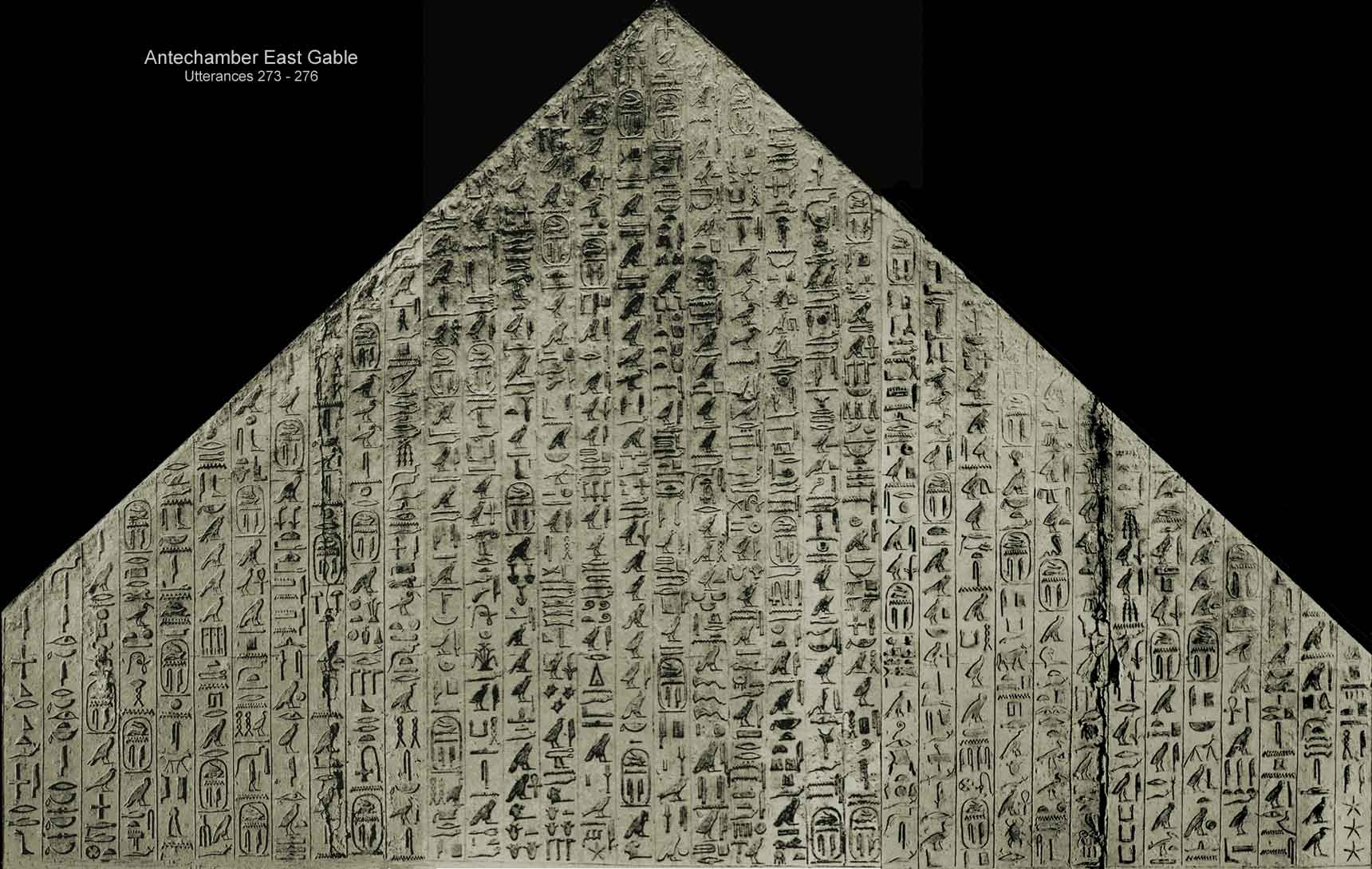
This entry is the east gable of the antechamber: 36 columns of hieroglyphs, Sethe's W 496-531, which follow each other from the right-hand (south) edge of the photograph. It holds the utterances 273-274, 275, 276.
Each section is one utterance. The Egyptian is the transliteration of the Thesaurus Linguae Aegyptiae (edition by Doris Topmann), with Sethe's Unas column number (W) before each column; a number ending in 'a' marks the offering label at the foot of a column. Signs restored by the editor are in square brackets, signs the scribe left out in angle brackets, damaged signs in half brackets. The English is Samuel A. B. Mercer's translation of 1952. Mercer translates Sethe's composite text made from all the pyramids that have an utterance, so his wording can include clauses that are not in the Unas copy, and his section numbers (134a, 134b ...) are Sethe's paragraph numbers, not column numbers; he writes 'N.' where the wall has the king's name. The photograph shows the whole wall; each section's note gives its columns counted from the edge where the text on that wall begins.
How was this verified? (Provenance)
Where on the image
Unas W 496-525: W 496-525 are columns 1-30 of the 36 columns on the photograph of the antechamber, east gable, counted from the right-hand (south) edge. Wall check (east gable): 36 columns under the gable at a regular 48 px pitch, as many as W 496-531, from the right-hand (south) corner to the left-hand (north) corner. Checked on the image: the short column in the right corner ends in stars (W 496 'gp p,t jḥy sbꜣ.pl', 'the sky is overcast, the stars are darkened'). Mercer's English renders Sethe's composite text of this utterance from all pyramids; it can contain words that are not in the Unas copy.
496gp p,t jḥy sbꜣ.pl
497nmnm pḏ,t.pl sdꜣ
498qs.pl ꜣkr.w gr r =sn gnm.w mꜣ.n =sn
499Wnjs ḫꜥ bꜣ m nṯr ꜥnḫ m jt〈j〉.pl =f wšb
500m mʾw,t.pl =f Wnjs pw nb zꜣb,wt ḫm.n
501mʾw,t =f rn =f jw šps,w Wnjs m p,t jw wsr =f m ꜣḫ,t
502mj 〈J〉tm〈,w〉 jt〈j〉 =f msi̯ sw jw msi̯.n =f sw wsr sw r =f jw kꜣ.pl
503Wnjs ḥꜣ =f jw ḥms.w,t =f ẖr rd.du =f jw nṯr.pl =f tp =f jw jꜥr,t.pl =f
504m wp,t =f jw sšm,wt Wnjs m ḥꜣ,t =f ptr.t bꜣ ꜣḫ.t nṯb =s
505jw wsr.pl Wnjs ḥr mk.t =f Wnjs pj kꜣ p,t nhd m jb =f ꜥnḫ m ḫpr〈,w〉
506n〈,j〉 nṯr nb wnm wzm.w =sn jwi̯.w mḥ ẖ,t =sn m ḥkꜣ.w m jw-nsjsj Wnjs pj
507ꜥpr jꜥb ꜣḫ.pl =f jw Wnjs ḫꜥi̯ m wr pw nb jm〈,j〉.w-s,t-ꜥ ḥmsi̯ =f sꜣ =f jr Gbb
508Wnjs pj wḏꜥ mdw =f ḥnꜥ jmn rn =f hrw pw n〈,j〉 rḫs sms,w Wnjs p nb ḥtp,t ṯꜣz ꜥqꜣ jri̯ ꜣw,t =f ḏs =f
509Wnjs pj wnm rmṯ ꜥnḫ m nṯr.pl nb jn,w.pl ḫꜣꜥ wp〈w〉,t.pl jn Jḫmꜥ-wp,t,pl-jm〈,j〉-kḥꜣ,w spḥ sn n Wnjs
510jn ḏsr-tp zꜣꜣ n =f sn ḫsf n =f sn jn ḥr〈,j〉-ṯr,wt qꜣs n =f sn jn ḫnz,w mds nb.w ḏꜣd =f sn n Wnjs
511šdi̯ =f n =f jm.t ẖ,t =sn wp〈w〉,t〈j〉 pw hꜣb.w =f r ḫsf jn Šzm,w rḫs =f sn n Wnjs fss n =f jḫ,t jm =sn m ktj,t.pl =f mšr,wt
512Wnjs pj wnm ḥkꜣ =sn j:ꜥm ꜣḫ〈,w〉 =sn jw wr.pl =sn n jš,t =f dwꜣ,t jw ḥr〈,j〉.w-jb =sn n mšr,wt =f jw šrr.pl =sn n jš,t =f ḫꜣw
513jw jꜣ〈w〉.pl =sn jꜣw,t.pl =sn n kꜣp,t.pl =f jn ꜥꜣ mḥ,t〈j〉.w p,t wd.w n =f sḏ,t r wḥꜣ.w,tpl ẖr.t =sn m ḫpš.pl n〈,j〉.w sms〈,w〉 =sn jw pẖr
514jm〈,j〉.w p,t n Wnjs šsr.t{t} n =f ktj,t.pl m rd.pl n〈,j〉.w ḥʾm,t.pl =sn jw dbn.n =f p,t.du tm.tj jw pẖr.n =f jdb.wdu Wnjs pj sḫm-wr sḫm
515m sḫm.pl Wnjs pj ꜥšm ꜥšm ꜥšm.w wr gmi̯.y =f m wꜣ,t =f wnm =f n =f sw mwmw jw mk,t Wnjs m-ḥꜣ,t
516sꜥḥ.w nb.w jm〈,j〉.w ꜣḫ,t Wnjs pj nṯr sms r sms,w jw pẖr n =f ḫꜣ.pl jw wdn n =f šn,t.pl jw rḏi̯ n =f ꜥ m sḫm-wr jn Sꜣḥ
517jt〈j〉 nṯr.pl jw wḥm.n Wnjs ḫꜥ,w m p,t j〈w〉 =f sbn m nb ꜣḫ,t jw ḥsb.n =f ṯꜣz.pl bqs,w.pl jw jṯi̯.n =f ḥꜣ,t〈j〉.pl nṯr.pl
518jw wnm.n =f dšr,t dšr,t jw ꜥm.n =f wꜣḏ,t wꜣḏ,t wšb Wnjs m zmꜣ.pl sꜣꜣ.w ḥtp =f m ꜥnḫ m ḥꜣ,t〈j〉.pl
519ḥkꜣ.w =sn jsṯ fjw Wnjs nsb =f sbš.w jm〈,j〉.w dšr,t j〈w〉 =f wꜣḫi̯ =f jw ḥkꜣ =sn m ẖ,t =f
520n nḥmm sꜥḥ.w Wnjs m-ꜥ =f jw ꜥm.n =f sjꜣ n〈,j〉 nṯr nb ꜥḥꜥ,w pj n〈,j〉 Wnjs nḥḥ ḏr〈,w〉 =f pj
521ḏ,t m sꜥḥ =f pn n〈,j〉 Mrr≡f-jrr≡f msḏḏ≡f-n-jri̯,n≡f jm〈,j〉 ḏr,w ꜣḫ,t ḏ,t r nḥḥ sk bꜣ =sn
522m ẖ,t Wnjs ꜣḫ〈,w〉 =sn ḫr Wnjs m ḥꜣ〈,w〉 ḫ,t =f r nṯr.pl qrr.t n Wnjs
523m qs.pl =sn sk bꜣ =sn ḫr Wnjs šw.w,t =sn m-ꜥ jr〈,j〉.w =sn
524jw Wnjs m nn ḫꜥi̯ ḫꜥi̯ j:mn j:mn n sḫm jri̯.w jr.wt
525m ḫbs s,t-jb Wnjs m ꜥnḫ.w m tꜣ pn ḏ,t r nḥḥ
393aTo say: The sky is overcast, the stars are darkened,
393bthe bows are agitated, the bones of the earth-gods quake.
393cThe agitations cease
394aafter they have seen N. dawning (as) a ba,
394bas a god, who lives on his fathers and feeds on his mothers.
394cN. is lord of craftiness, whose name his mother knows not.
395aThe honour of N. is in heaven, his might is in the horizon,
395blike his father, Atum, who begat him. He has begotten him mightier than he.
396aThe kas of N. are behind him, his maid-servants are under his feet,
396bhis gods are over him, his uraeus-serpents are upon his brow;
396cthe leader-serpent of N. is on his forehead, she who perceives the soul (of the enemy), (as) a diadem, a flame of fire;
396dthe might of N. is for his protection.
397aN. is the bull of heaven, who (once) suffered want and decided (lit. gave in his heart) to live on the being of every god,
397bwho ate their entrails (?) when it came (to pass) that their belly was full of magic
397cfrom the Isle of Flame.
398aN. is equipped, he who has incorporated his spirits.
398bN. dawns as the Great One, lord of those with (ready) hands.
398cHe sits, his side towards Geb (the earth).
399aIt is N. who judges with him whose name is hidden,
399b(on) this day of slaying the eldest (gods).
399cN. is lord of offerings, who knots the cord,
399dwho himself prepares his meal.
400aN. is he who eats men and lives on gods,
400blords of messengers, who distributes orders.
401aIt is "Grasper-of-the-top-knot" who is in kḥȝ.w who lassoes them for N.
401bIt is "The serpent with raised head (ḏśr-tp)" who watches them (the gods) for N., who repels them for him.
401cIt is "He who is upon the willows" who binds them for N.
402aIt is "Khonsu who slaughters the lords (gods)," in that he beheads them for N.,
402band takes out for him what is in their body.
402cHe (Khonsu?) is the messenger whom he (N.) sends forth to punish.
403aIt is Šsm.w who cuts them up for N.,
403bcooking for him a meal of them in his evening cooking-pots.
403cIt is N. who eats their magic and swallows their spirits;
404atheir Great Ones are for his morning meal,
404btheir middle-sized ones are for his evening meal,
404ctheir little ones are for his night meal,
404dtheir old men and old women are for his incense-burning (or, fire).
405aIt is "The Great Ones in the north side of heaven" who lay for him the fire
405bto the kettles containing them, with the thighs of their eldest (as fuel).
406aThe inhabitants of heaven wait on N.,
406bwhen the hearth was constructed for him with (out of) the legs of their women.
406cHe has completely encircled the two heavens; he has revolved about the two lands.
407aN. is the great mighty one, who has power over the mighty ones.
407bN. is the ‘ẖm-falcon, who surpasses the ‘ẖm-falcons--the great falcon.
407cWhom he finds on his way, he eats for himself bit by bit.
407dThe respect of N. is before (first of) all noble ones, who are in the horizon.
408aN. is a god older than the eldest.
408bThousands serve him; hundreds make offering to him.
408cA certificate as (of) a mighty, great one is given to him by Śȝḥ, father of the gods.
409aN. has dawned again in heaven; he is crowned with the Upper Egyptian crown as lord of the horizon.
409bHe has smashed the dorsal vertebra;
409che has carried off the hearts of the gods;
410ahe has eaten the red crown, he has swallowed the green one;
410bN. feeds on the lungs of the wise ones;
410che is satisfied by living on hearts as well as their magic.
411aN. is disgusted when he licks the emetics which are in the red crown,
411b(but) he is delighted when their magic is in his belly.
411'c. The dignities of N. shall not be taken from him,
411d(for) he has swallowed the intelligence of every god.
412aThe lifetime of N. is eternity, its limit is everlastingness
412bin this his dignity of "If he wishes he does, if he wishes not he does not,"
412cwho is within the boundary of the horizon for ever and ever.
413aBehold, their soul (of the gods) is in the belly of N., their spirits are with N.,
413bas his soup à la nṯr.w, cooked for N. from their bones,
413cBehold, their soul is, with N., their shadows are taken away from the hand of those to whom they belong.
414aN. is as that which dawns, which dawns, which endures, which endures.
414bThe doers of evil shall not be able to destroy
414cthe favourite place of N. among the living in this land for ever and ever.
Where on the image
Unas W 525-529: W 525-529 are columns 30-34 of the 36 columns on the photograph of the antechamber, east gable, counted from the right-hand (south) edge. Wall check (east gable): 36 columns under the gable at a regular 48 px pitch, as many as W 496-531, from the right-hand (south) corner to the left-hand (north) corner. Checked on the image: the short column in the right corner ends in stars (W 496 'gp p,t jḥy sbꜣ.pl', 'the sky is overcast, the stars are darkened'). Mercer's English renders Sethe's composite text of this utterance from all pyramids; it can contain words that are not in the Unas copy.
525ḏ〈d〉-mdw jyi̯.n Wnjs
526ḫr =ṯn bjk.pl 〈m〉 ḥw,t.pl =ṯn hru̯ m r Wnjs mꜥrq =f
527r pḥ =f n bsk n〈,j〉 jꜥn〈ꜥ〉 wn Wnjs ḫns jni̯
528Wnjs r ḏr,w ꜣḫ,t wꜣḥ.n Wnjs msd,t =f
529jm r tꜣ ḫpr Wnjs m wr jm〈,j〉 Šd,t
415aTo say: N. comes to you, ye falcons,
415bsince (?) your houses are barred off for N.,
415chis m‘rḳ-garment of ape-skin on his back.
416aN. opens the double doors (of heaven); N. goes to the boundary of the horizon;
40bN. laid down the mśd.t-garment on the ground;
416cN. became like the Great One who is in Crocodilopolis.
Where on the image
Unas W 530-531: W 530-531 are columns 35-36 of the 36 columns on the photograph of the antechamber, east gable, counted from the right-hand (south) edge. Wall check (east gable): 36 columns under the gable at a regular 48 px pitch, as many as W 496-531, from the right-hand (south) corner to the left-hand (north) corner. Checked on the image: the short column in the right corner ends in stars (W 496 'gp p,t jḥy sbꜣ.pl', 'the sky is overcast, the stars are darkened'). Mercer's English renders Sethe's composite text of this utterance from all pyramids; it can contain words that are not in the Unas copy.
530ḏ〈d〉-mdw jri̯ =k jr =k jri̯.t =k jr =k zkzk
531jm〈,j〉 qrq〈r〉,t =f jm〈,j〉-rd
417aTo say: Thy act is against thee, what thou doest is against thee,
417bO sksk-serpent, which is in his (thy) hole?, the opponent.
Notes
- Mercer's separate headings, postscripts and variants taken from other pyramids are left out.
- Letters follow the sacred-texts transcription of Mercer: ȝ stands for aleph and ‘ for ayin; letters underlined in the printed book are given as ḏ, ṯ, ẖ.
- Sethe's section numbers are kept as printed in that transcription, including a few misprints (for example '146.' for 141b in Utterance 215).
- The TLA has no hieroglyphic encoding for these texts, so only the transliteration is shown.
Cite
Sources
- Source: Pyramid of Unas, Saqqara, antechamber, east gable (photograph: L. F. Husson for A. Piankoff 1968, via Pyramid Texts Online) + TLA transliteration (ed. D. Topmann, CC BY-SA 4.0) + English of S. A. B. Mercer (1952, public domain in the US) (holding institution)
- Critical edition: Thesaurus Linguae Aegyptiae, ed. Doris Topmann (2018 data, AED-TEI)
← previous · → next · v cycle view · l back to library