Pyramid Texts of Unas: Utterances 260-272 (antechamber, south wall)
Introduction
The Pyramid Texts are the oldest large body of Egyptian religious writing: spells, called utterances, for the resurrection of the dead king, his protection, his meals and his ascent to the sky, cut in vertical columns of hieroglyphs on the walls of the burial apartments of late Old Kingdom pyramids. The pyramid of Unas at Saqqara, the last king of the 5th Dynasty (about 2375-2345 BCE), is the first to carry them. Its sarcophagus chamber, the passage to the antechamber, the antechamber and the corridor hold the columns of text that Sethe numbered W 1-649 (there is no W 129 or W 318). This library gives them wall by wall, in seventeen entries (227 different utterances, some of them inscribed more than once), with one gap: Utterance 271 (the end of W 492, all of W 493 and the top of W 494, on the south wall of the antechamber) is not in the Thesaurus Linguae Aegyptiae data used here, so it is not given. W 646 (corridor, east wall) has no column mark of its own in the TLA text; its words are given with W 645.
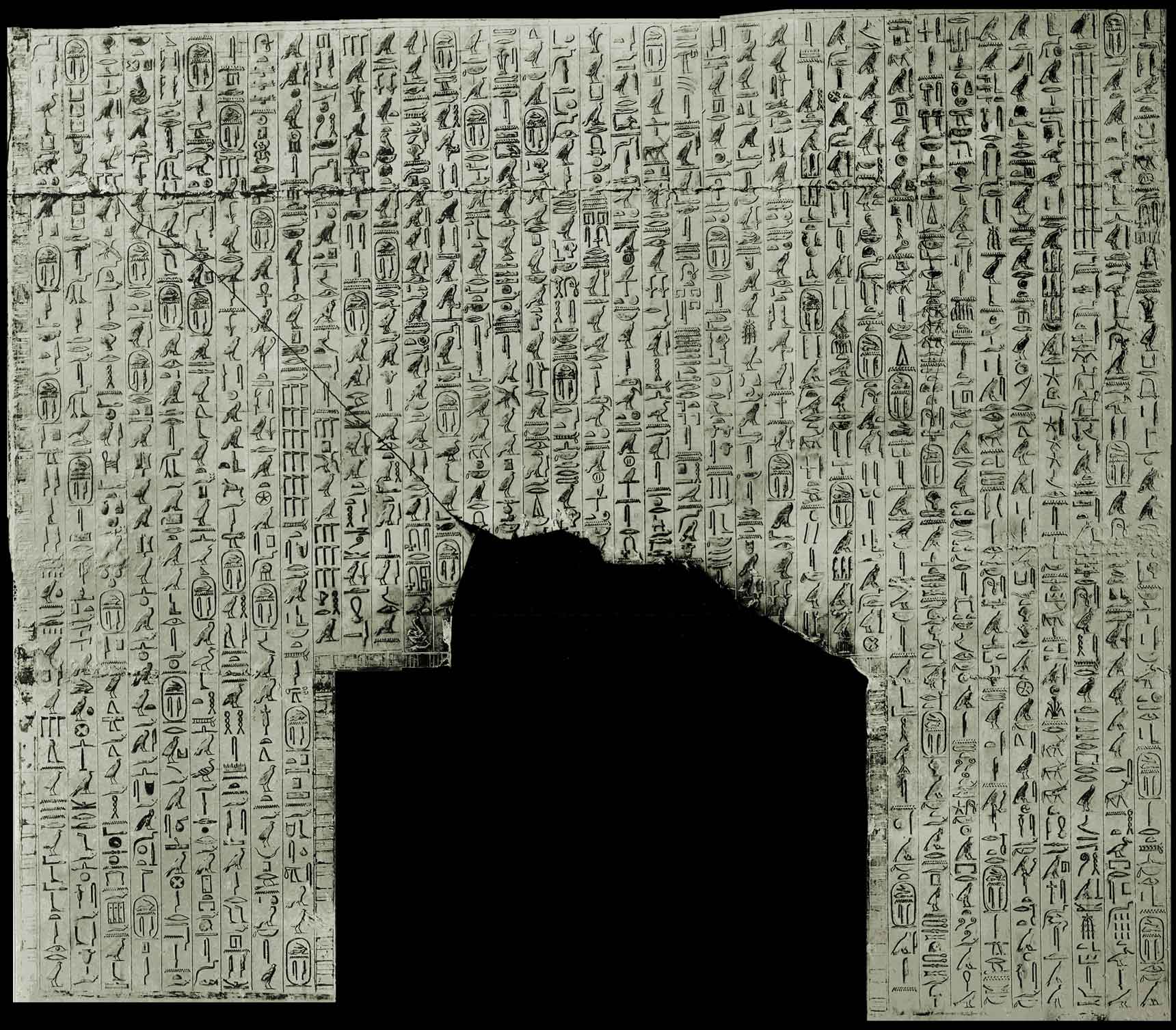
This entry is the south wall of the antechamber: 43 columns of hieroglyphs, Sethe's W 453-495, which follow each other from the right-hand (west) edge of the photograph. It holds the utterances 260, 261, 262, 263, 267, 268, 269, 270, 272. PT 260 begins on the west wall (W 452). PT 271 (the end of W 492, W 493 and the top of W 494) is not in the TLA data used here and is therefore not given; the gap is shown by the column numbers.
Each section is one utterance. The Egyptian is the transliteration of the Thesaurus Linguae Aegyptiae (edition by Doris Topmann), with Sethe's Unas column number (W) before each column; a number ending in 'a' marks the offering label at the foot of a column. Signs restored by the editor are in square brackets, signs the scribe left out in angle brackets, damaged signs in half brackets. The English is Samuel A. B. Mercer's translation of 1952. Mercer translates Sethe's composite text made from all the pyramids that have an utterance, so his wording can include clauses that are not in the Unas copy, and his section numbers (134a, 134b ...) are Sethe's paragraph numbers, not column numbers; he writes 'N.' where the wall has the king's name. The photograph shows the whole wall; each section's note gives its columns counted from the edge where the text on that wall begins.
How was this verified? (Provenance)
Where on the image
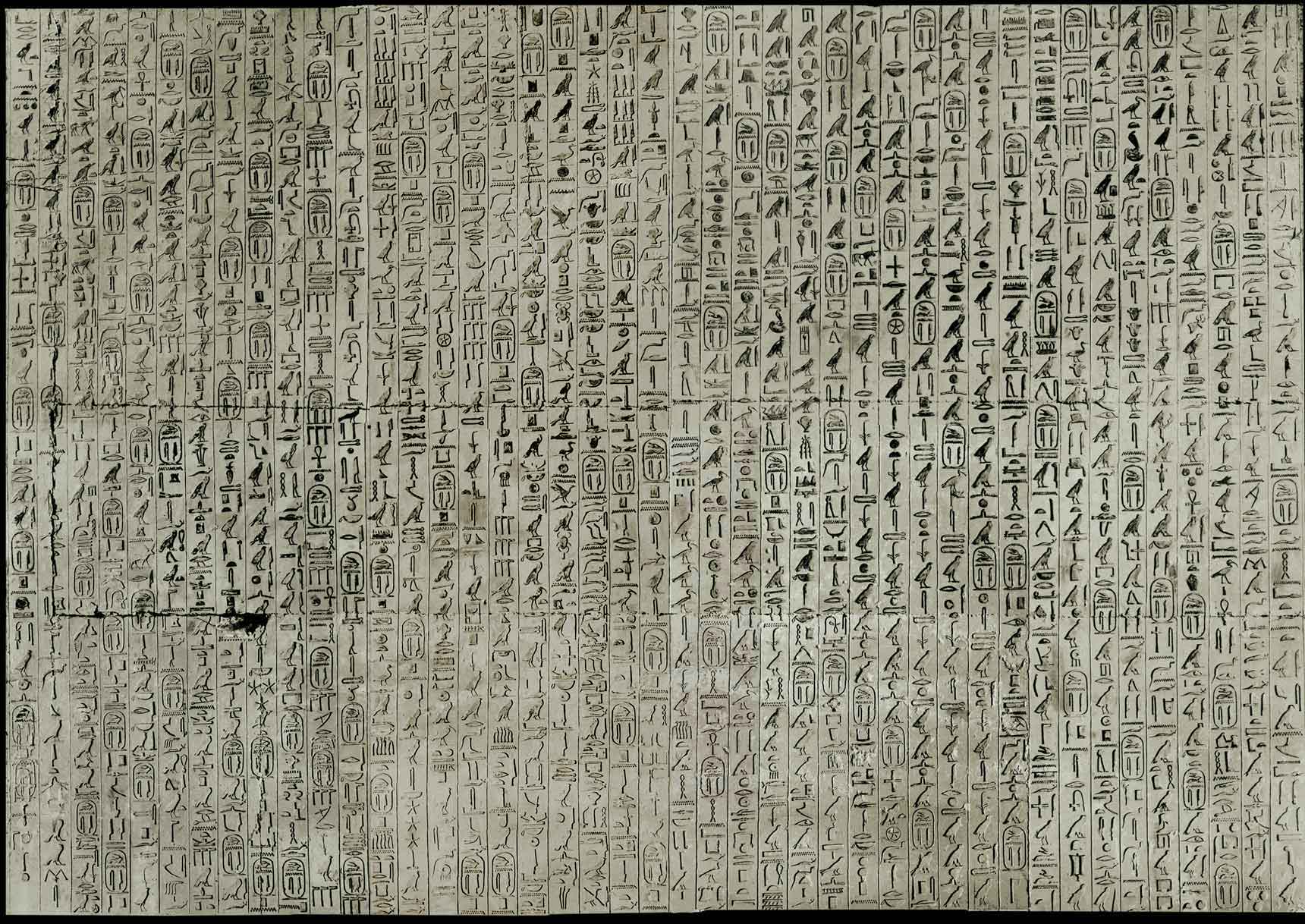
Unas W 452-460: W 452 is column 37 of the 37 columns on the photograph of the antechamber, west wall, counted from the right-hand (north) edge. W 453-460 are columns 1-8 of the 43 columns on the photograph of the antechamber, south wall, counted from the right-hand (west) edge. PT 260 begins in the last column of the antechamber west wall (W 452, the leftmost column on the west wall photograph) and continues on the south wall (W 453-460). Wall check (west wall): 37 columns counted by eye, W 416 at the right-hand (north) edge to W 452 at the left-hand (south) edge, around the doorway to the passage. Checked on the image: the second column from the right opens with the Unas cartouche (W 417 'Wnjs fꜣ,t m jtj=f Gbb'); the leftmost column shows the goose and the bull of 'j Gbb kꜣ Nw,t' (W 452, the first column of PT 260). Wall check (south wall): 43 columns counted by eye, W 453 at the right-hand (west) edge to W 495 at the left-hand (east) edge. Checked on the image: the fifth and eighth columns from the right open with the Unas cartouche (W 457 'Wnjs m jr,t=f', W 460 'Wnjs n nsr=ṯn'). Mercer's English renders Sethe's composite text of this utterance from all pyramids; it can contain words that are not in the Unas copy.
452j Gbb kꜣ Nw,t ⸢Ḥr,w⸣ pj Wnjs j〈w〉ꜥ jt〈j〉 =f Wnjs pj zy jy fd.nw n〈,j〉 fd.w jpw nṯr.pl jni̯.w mw di̯.w ꜥbꜥb,t jrr.w
453hy m ḫpš n〈,j〉 jt〈j〉.pl =sn j:mr =f mꜣꜥ-ḫr,w =f m jri̯.tn =f jw wḏꜥ.n Wnjs tfn ḥnꜥ tfn,t jw sḏm.n mꜣꜥ,tj jw Šw
454m mtr,w jw wḏ.n mꜣꜥ,tj pẖr n =f ns,t.pl Gbb ṯzi̯.y =f sw n mri̯.tn =f dmḏ ꜥ,t.pl =f jm.t štꜣ,w zmꜣ =f jm〈,j〉.w Nw,w
455rḏi̯ =f pḥ.w mdw.pl m Jwn,w sk Wnjs pri̯ m hrw pn m jr,w mꜣꜥ n〈,j〉 ꜣḫ,j ꜥnḫ j:sḏ Wnjs ꜥḥꜣ bḥn =f ẖnn,w prj Wnjs
456jr〈,j〉 Mꜣꜥ,t jnt =f s〈j〉 j〈w〉 =s ḫr =f rwi̯ n =f dnḏ.w pẖr n =f jm〈,j〉.w Nw,w ꜥnḫ jw nh,t Wnjs m jr,t =f jw mk,t Wnjs m jr,t =f jw nḫt
457Wnjs m jr,t =f jw wsr Wnjs m jr,t =f j nṯr.pl rs〈,j〉.w mḥ,t〈j〉.w jmn,t〈j〉.w jꜣb,t〈j〉.w mki̯.y Wnjs snḏ n =f ḥmsi̯.n =f m ḥtꜣ hʾ.w
458ꜣm n =ṯn ꜣḫ,t tw ḏnn,wtt mḏd =s jb.pl =ṯn jwi̯.t =sn r Wnjs m jm〈,j〉-rd mi̯.y n =f mi̯.y n =f Wnjs pj ḏsḏs n〈,j〉 jt〈j〉 =f
459nḫb n〈,j〉 mʾw,t =f b〈w〉,t Wnjs pw šꜣs m kk,w n mꜣꜣ =f sḫd.w pri̯ Wnjs m hrw pn jnt =f Mꜣꜥ,t j〈w〉 =s ḫr =f n rḏi̯.w
460Wnjs n ns〈r〉 =tn nṯr.pl
316aTo say: O Geb, bull of Nut, N. is a Horus, heir of his father.
316bN. is the goer, the comer, the fourth of these four gods,
316cwho have brought water (and) made themselves clean, who rejoice over the "power" of their fathers.
316dHe desires that he be justified by that which he has done.
317aSince Tfn and Tefnut have judged N.; since the Two Truths have heard (him);
317bsince Shu has been advocate (tongue); since the Two Truths have given verdict;
317che has encompassed the thrones of Geb, he has raised himself to that which he wished.
318a(So now that) his limbs are united, which were hidden (in the grave),
318bhe unites himself with those who are in Nun. He puts an end to his words in Heliopolis,
318cas N. goes forth on that day in the true form of an ȝḫ.
319aN. destroys battle; he punishes revolt.
319bN. goes forth (as) the protector of truth; he brings her, for she is with him.
319cThose who were furious, (now) busy themselves for him; those who are in Nun, (now) give life over to him.
320aThe refuge of N. is in his eye; the protection of N. is in his eye;
320bthe power of N. is in his eye; the strength of N. is in his eye.
321aO gods of South, North, West, East, respect N., fear him;
321bhe has sat in the ḥtȝ of the two courts.
321cThat uraeus-serpent ḏnn-wt.t might have burned you, for she attained your heart,
322ayou (they) who might have come to N. as an adversary; come to him (as a friend), come to him.
322bN. is the ḏśḏś of his father, the nḫb of his mother.
323aThe abomination of N. is to walk in darkness,
323blest he see those who are upside down.
323cN. will come forth in this day; he will bring truth with him.
323dN. will not be delivered up to your flame, O gods.
Where on the image
Unas W 460-462: W 460-462 are columns 8-10 of the 43 columns on the photograph of the antechamber, south wall, counted from the right-hand (west) edge. Wall check (south wall): 43 columns counted by eye, W 453 at the right-hand (west) edge to W 495 at the left-hand (east) edge. Checked on the image: the fifth and eighth columns from the right open with the Unas cartouche (W 457 'Wnjs m jr,t=f', W 460 'Wnjs n nsr=ṯn'). Mercer's English renders Sethe's composite text of this utterance from all pyramids; it can contain words that are not in the Unas copy.
460ḏ〈d〉-mdw Wnjs pj wjṯ jb zꜣ jb Šw ꜣwi̯.y ꜣw.t ꜣzb jꜣḫ,w Wnjs pj nsr m-tp ṯꜣw
461r ḏr,w p,t r ḏr tꜣ ḏr šwi̯.t ꜥ ḥnb,w m Wnjs šꜣs Wnjs Šw nmt =f ꜣkr sn =f n,t qmꜣ.w nṯr wn n =f jm〈,j〉.w wnwn,jt
462rmn.pl =sn ꜥḥꜥ Wnjs ḥr gs jꜣb,tj n〈,j〉 mnwḥ,wt jni̯.n =f jꜥ,t n ḥr,t Wnjs pj jri̯ wp,t nšni̯
324aTo say: N. is a heart-beat, son of the heart of Shu,
324bwide-outstretched, a blinding light.
324cIt is N. who is a flame (moving) before the wind to the ends of heaven and to the end of the earth,
324das soon as the arms of the lightning are emptied of N.
325aHe travels through Shu and strides through ȝkr;
325bhe kisses the red crown, the divinely created.
326aThose who are in the arbour (heaven?) open for him their arms.
326bN. stands on the eastern side of heaven;
326c(where) there is brought to him that which ascends to heaven.
326dN. makes a separation of the tempest.
Where on the image
Unas W 462-471: W 462-471 are columns 10-19 of the 43 columns on the photograph of the antechamber, south wall, counted from the right-hand (west) edge. Wall check (south wall): 43 columns counted by eye, W 453 at the right-hand (west) edge to W 495 at the left-hand (east) edge. Checked on the image: the fifth and eighth columns from the right open with the Unas cartouche (W 457 'Wnjs m jr,t=f', W 460 'Wnjs n nsr=ṯn'). Mercer's English renders Sethe's composite text of this utterance from all pyramids; it can contain words that are not in the Unas copy.
462ḏ〈d〉-mdw m ḫm Wnjs nṯr
463sṯ ṯw rḫ.t〈j〉 sw sṯ sw rḫ ṯw sṯ sw rḫ ṯw m ḫm Wnjs Rꜥw sṯ ṯw j:rḫ.t〈j〉 sw sṯ sw j:rḫ ṯw
464m ḫm Wnjs Rꜥw ḏd jr =k ꜥꜣ ḥtm nb tm m ḫm Wnjs Ḏḥw,tj sṯ ṯw j:rḫ.t〈j〉 sw sṯ sw j:rḫ ṯw m ḫm
465Wnjs Ḏḥw,tj ḏd jr =k ḥtp-wꜥi̯〈.w〉 m ḫm Wnjs Ḥr,w-Spd sṯ ṯw j:rḫ.t〈j〉 sw sṯ sw rḫ ṯw m ḫm Wnjs Ḥr,w-Spd
466ḏd jr =k qsn m ḫm Wnjs jm〈,j〉-dwꜣ,t sṯ ṯw j:rḫ.t〈j〉 sw sṯ sw rḫ ṯw m ḫm Wnjs jm〈,j〉-dwꜣ,t ḏd jr =k
467rs-wḏꜣ m ḫm Wnjs kꜣ-p,t sṯ ṯw j:rḫ.t〈j〉 sw sṯ sw rḫ ṯw m ḫm Wnjs kꜣ-p,t ḏd jr =k nḫḫ pn
468m Wnjs jyi̯ m Wnjs jyi̯ m =k Wnjs pri̯ n jwi̯.n js Wnjs ḏs =f jn wp,t jyi̯.t r =f swꜣ.n Wnjs ḥr pr〈,w〉 Bꜣ-〈p〉f nhi̯.n sw ꜣ,t šj wr n šzp
469hm,t =f ḥr mẖn,t wr.t n ḫsf n =f sw m ḥḏ wr.pl ḥr msq,t sḥd m =k jr =k pḥ.n Wnjs qꜣw.w p,t mꜣ.n =f ḏ〈wi̯〉,t =f
470m msk,tt jn Wnjs ẖni̯ jm =s s〈j〉ꜣ.n =f jꜥr,t m mꜥnḏ,t jn Wnjs pnq s〈j〉 mtr.n sw ḥnmm,t šdi̯.n sw šnj,t.pl
471p,t sjꜥ〈r〉 =sn Wnjs n Rꜥw
327aTo say: Disown not N., O god; for thou knowest him and he knows thee.
327bDisown not N., O god; for he knows thee.
327cTo (thee) it is said: "The transitory."
328aDisown not N., O Rē‘; for thou knowest him and he knows thee.
328bDisown not N., O Rē‘; for he knows thee.
328cTo thee it is said: "The Great (One) is altogether destroyed."
329aDisown not N., O Thot; for thou knowest him and he knows thee.
329bDisown not N., O Thot; for he knows thee.
329cTo thee it is said: "He rests, the solitary."
330aDisown not N., O Horus, the pre-eminent (pointed); for thou knowest him and he knows thee.
330bDisown not N., O Horus, the pre-eminent (pointed); for he knows thee.
330cTo thee it is said: "The unfortunate."
331aDisown not N., O thou who art in the Dȝ.t; for thou knowest him and he knows thee.
336Disown not N., O thou who art in the Dȝ.t; for he knows thee.
331cTo thee it is said: "The damaged."
332aDisown not N., O bull of heaven; for thou knowest him and he knows thee.
332bDisown not N., O bull of heaven; for he knows thee.
332cTo thee it is said: "This nḫḫ-star."
333aBehold, N. comes; behold, N. comes; behold, N. is ascended.
333bN. is not come of himself.
333cIt is a messenger who is come to him; it is a divine word which will cause him to arise.
334aN. has passed by his broad-house; the fury of the great sea has avoided him.
334bHis fare is not accepted in the great ship;
334cthe palace of the Great cannot ward him off from the way of the śḥd.w-stars.
335aBehold, therefore, N. has attained the heights of heaven.
335bHe has seen his uraeus-serpent in the boat of the evening sun; it is N. who has journeyed in it.
335cHe has recognized (his) uraeus-serpent in the boat of the morning sun, it is N. who has bailed it out.
336aThe blessed dead (?) have witnessed to him;
336bthe hail-storm of heaven has taken him away, it (lit. they cause) causes N. to approach to Rē‘.
Where on the image
Unas W 471-476: W 471-476 are columns 19-24 of the 43 columns on the photograph of the antechamber, south wall, counted from the right-hand (west) edge. Wall check (south wall): 43 columns counted by eye, W 453 at the right-hand (west) edge to W 495 at the left-hand (east) edge. Checked on the image: the fifth and eighth columns from the right open with the Unas cartouche (W 457 'Wnjs m jr,t=f', W 460 'Wnjs n nsr=ṯn'). Mercer's English renders Sethe's composite text of this utterance from all pyramids; it can contain words that are not in the Unas copy.
471ḏ〈d〉-mdw di̯ zḫn.wdu p,t n Rꜥw ḏꜣi̯ =f jm jr ꜣḫ,t di̯ zḫn.wdu p,t n Ḥr,w-ꜣḫ,tj ḏꜣi̯ Ḥr,w-ꜣḫ,tj jm ḫr Rꜥw di̯ zḫn.du p,t
472n Wnjs ḏꜣi̯ =f jm jr ꜣḫ,t ḫr Rꜥw di̯ zḫn.wdu p,t n Wnjs ḏꜣi̯ =f jm ḫr Ḥr,w-ꜣḫ,tj ḫr Rꜥw nfr.n n Wnjs ḥnꜥ kꜣ =f ꜥnḫ Wnjs ḥnꜥ kꜣ =f bꜣ =f
473ḥr =f ꜣms =f m ꜥ =f ꜥbꜣ =f m ḏr,t =f nhn ={j}f n =f zbi̯ r =sn jni̯ =sn n =f fd jpw ꜣḫ,j.pl sms.w ḫnt〈,j〉.w ḥnk,t〈j〉.w
474ꜥḥꜥ.w m gs jꜣb,t〈j〉 n〈,j〉 p,t ḏsr.w ḥr ḏꜥm.pl =sn ḏd =sn rn nfr n〈,j〉 Wnjs pn n Rꜥw sjwi̯ =sn Wnjs pn n Nḥb-kꜣ.pl nḏ ꜥq Wnjs pn
475m mḥ,t〈j〉 sḫ,t.pl-jꜣr.w ḏꜣi̯ Wnjs m mr-n〈,j〉-ḫꜣ ḏꜣi̯.t〈j〉 ḏꜣi̯.t Wnjs pn jr gs jꜣb,t〈j〉 n〈,j〉 ꜣḫ,t ḏꜣi̯.t〈j〉 ḏꜣi̯.t Wnjs pn jr gs jꜣb,t〈j〉 n〈,j〉 p,t sn,t =f
476Spd,t msṯ,wt =f dwꜣ,t
337aTo say: The two reed-floats of heaven are placed for Rē‘, that he may ferry over therewith to the horizon.
337bThe two reed-floats of heaven are placed for Harachte that Harachte may ferry over therewith to Rē‘.
337cThe two reed-floats of heaven are placed for N. that he may ferry over therewith to the horizon, to Rē‘.
337dThe two reed-floats of heaven are placed for N. that he may ferry over therewith to Harachte, to Rē‘.
338aIt is good for N. (to be) with his ka; N. lives with his ka.
338bHis bȝ-loin-cloth is on him; his Horus-weapon is on his arm; his sceptre is in his hands.
339aHe makes himself serviceable to those who have passed on.
339bThey bring to him those four spirits, the eldest, the first of the wearers of side-locks,
339cwho stand on the eastern side of the sky and lean upon their d‘m-sceptres,
340athat they may speak the good name of N. to Rē‘
340band proclaim N. to Nḥb-kȝ.w,
340cso that the entrance of N. may be greeted (or protected). The Marshes of Reeds were filled (with water),
340dso that N. might ferry over the Winding Watercourse.
341aN. will certainly ferry over to the eastern side of the horizon;
341bN. will certainly ferry over to the eastern side of heaven.
341cHis sister is Sothis; his mother is the Dwȝ.t (morning star).
Where on the image
Unas W 476-479: W 476-479 are columns 24-27 of the 43 columns on the photograph of the antechamber, south wall, counted from the right-hand (west) edge. Wall check (south wall): 43 columns counted by eye, W 453 at the right-hand (west) edge to W 495 at the left-hand (east) edge. Checked on the image: the fifth and eighth columns from the right open with the Unas cartouche (W 457 'Wnjs m jr,t=f', W 460 'Wnjs n nsr=ṯn'). Mercer's English renders Sethe's composite text of this utterance from all pyramids; it can contain words that are not in the Unas copy.
476ḏ〈d〉-mdw jb =k n =k 〈W〉sjr rd.du =k n =k 〈W〉sjr ꜥ =k n =k 〈W〉sjr jb n〈,j〉 Wnjs n =f ḏs =f rd.du =f n =f ḏs =f ꜥ =f n =f ḏs =f sqr.t〈j〉 n =f tꜣ-rd.pl r p,t pri̯ =f jm r p,t prr =f ḥr ḥtj n〈,j〉 jd,t wr.t j:pꜣ
477Wnjs pn m ꜣpd ḫnn =f m ḫprr j:pꜣ =f m ꜣpd ḫnn =f m ḫprr m ns,t šw.t jm.t wjꜣ =k Rꜥw ꜥḥꜥ j:dr ṯw J:ḫm-jw,t
478ḥmsi̯ Wnjs pn m s,t =k ẖni̯.y =kf m p,t m wjꜣ =k Rꜥw jwd Wnjs pn tꜣ m wjꜣ =k Rꜥw sṯ ṯw pri̯ =k m ꜣḫ,t sṯ sw ꜥbꜣ =f m ꜥ =f m sqdi̯ wjꜣ =k Rꜥw jꜥ =k n p,t
479ḥri̯ =k r tꜣ ḥri̯.t〈j〉 jr ḥʾm,t šnḏ,wt
364aThy heart belonged to thee, Osiris; thy legs belonged to thee, Osiris; thine arm(s) belonged to thee, Osiris.
364bThe heart of N. belongs to himself; his legs belong to himself; his arm(s) belong(s) to himself.
365aA stairway to heaven shall be laid down for him, that he may ascend to heaven thereon;
365bhe ascends on the smoke (incense) of the great censing.
366aN. flies, as a goose; he alights as a scarab;
366bhe flies as a goose; he alights as a scarab
366cupon the empty throne which is in thy boat, O Rē‘.
367aStand up, remove thyself, thou who knowest not the reed-thicket,
367bthat N. may sit in thy place and row (around) in heaven in thy boat, O Re.
368aN. pushes off from the earth in thy boat, O Rē‘;
368bso when thou goest forth from the horizon, he (N.) has his sceptre in his hand,
368cas navigator of thy boat, O Rē‘,
369Thou (N.) mountest up to heaven; thou separatest thyself from the earth, a separation from wife and office (royal-apron).
Where on the image
Unas W 479-483: W 479-483 are columns 27-31 of the 43 columns on the photograph of the antechamber, south wall, counted from the right-hand (west) edge. Wall check (south wall): 43 columns counted by eye, W 453 at the right-hand (west) edge to W 495 at the left-hand (east) edge. Checked on the image: the fifth and eighth columns from the right open with the Unas cartouche (W 457 'Wnjs m jr,t=f', W 460 'Wnjs n nsr=ṯn'). Mercer's English renders Sethe's composite text of this utterance from all pyramids; it can contain words that are not in the Unas copy.
479ḏ〈d〉-mdw jꜥi̯ sw Wnjs pn ḫꜥj Rꜥw psḏj psḏ,t wr.t qꜣi̯ nbw,t〈j〉 m-ḫnt jtr,t nḥm Wnjs pn
480pꜥ,t m ꜥ,t jm =f ḫfꜥ Wnjs pn wrr,t m-ꜥ psḏ,t.j ꜣṯi̯ sw 〈Ꜣ〉s,t snq sw Nb〈,t〉-ḥw,t šzp sw Ḥr,w r ḏbꜥ.du =f sꜥb =f Wnjs pn
481m Š-zꜣb sfḫ.w =f kꜣ n〈,j〉 Wnjs pn m Š-d〈w〉ꜣ,tj j:sk =f j〈w〉f n〈,j〉 kꜣ n〈,j〉 Wnjs pn n〈,j〉 ḏ,t =f m nw ḥr〈,j〉 rmn.du Rꜥw m ꜣḫ,t šzp.w =f psḏ tꜣ.du
482j:wn =f ḥr nṯr.pl sḫpi̯ =f kꜣ n〈,j〉 Wnjs pn n〈,j〉 ḏ,t =f r ḥw,t-ꜥꜣ.t jri̯.w n =f ꜥrr,wt.pl ṯ〈ꜣ〉zz n =f ḥmꜣṯṯ sšmi̯ Wnjs pn j:ḫm.w-sk ḏꜣi̯ =f
483r sḫ,t.pl-jꜣr.w ẖni̯ sw jm〈,j〉.w ꜣḫ,t sqdi̯ sw jm〈,j〉.w qbḥ,w mnḫ Wnjs pn mnḫ.t n zꜣ ꜥ =f ḫnti̯ Wnjs pn ḫnt.t spr kꜣ =f r =f
370aTo say: N. washes himself, Rē‘ appears, the Great Ennead sparkles;
370bthe Ombite is high as chief of the ’itr.t-palace;
371aN. puts humanity off from him as a limb;
371bN. seizes the wrr.t-crown from the hand of the Ennead.
371cIsis nurses him, Nephthys suckles him,
372aHorus takes him by his fingers (to his side),
372bhe purifies N. in the lake of the jackal,
372che makes, the ka of N. clean in the lake of the Dȝ.t.
372dHe rubs down the flesh of the ka of N. and his own
372ewith that which is near Rē‘ in the horizon, that which he (Rē‘) took,
373awhen the two lands beamed and when he bared the face of the gods.
373bHe brings the ka of N. and himself to the great palace,
373cafter offices (?) were made for him and the ḥmȝṯṯ was knotted for him.
374aN. leads the imperishable stars,
374bhe ferries over to the Marshes of Reeds,
374cthe inhabitants of the horizon row him, the inhabitants of ḳbḥ.w navigate him.
375aN. is very capable (mighty), his arms will not desert him;
375bN. is very excellent (foremost), his ka comes to him (to his aid).
Where on the image
Unas W 484-489: W 484-489 are columns 32-37 of the 43 columns on the photograph of the antechamber, south wall, counted from the right-hand (west) edge. Wall check (south wall): 43 columns counted by eye, W 453 at the right-hand (west) edge to W 495 at the left-hand (east) edge. Checked on the image: the fifth and eighth columns from the right open with the Unas cartouche (W 457 'Wnjs m jr,t=f', W 460 'Wnjs n nsr=ṯn'). Mercer's English renders Sethe's composite text of this utterance from all pyramids; it can contain words that are not in the Unas copy.
484ḏ〈d〉-mdw di̯ sḏ,t wbn sḏ,t di̯ snṯ〈r〉 ḥr sḏ,t wbn snṯ〈r〉 jyi̯ sṯ〈j〉 =k jr Wnjs snṯ〈r〉 jyi̯ sṯ〈j〉 Wnjs jr =k snṯ〈r〉 jyi̯ sṯ〈j〉 =ṯn r Wnjs nṯr.pl
485jyi̯ sṯ〈j〉 Wnjs jr =tn nṯr.pl wn Wnjs ḥnꜥ =ṯn nṯr.pl wn =ṯn ḥnꜥ Wnjs nṯr.pl ꜥnḫ Wnjs ḥnꜥ =ṯn nṯr.pl ꜥnḫ =ṯn ḥnꜥ Wnjs ntr.pl mri̯ ṯn Wnjs nṯr.pl mri̯ sw nṯr.pl
486jyi̯ pꜣq〈j〉 jyi̯ pꜣḏ pri̯ m mꜣs,t Ḥr,w jyi̯ prj.w jyi̯ prj.w jyi̯ ḥfdi̯.w jyi̯ ḥfdi̯.w jyi̯ šwj.w jyi̯ šwj.w pri̯ Wnjs ḥr mn,t.du Ꜣs,t ḥfd Wnjs pn
487ḥr mn,t.du Nb〈,t〉-ḥw,t nḏri̯.w n =f jt〈j〉 Wnjs 〈J〉tm〈,w〉 ꜥ n〈,j〉 Wnjs sjp =f Wnjs n nṯr.pl jpf sbq.jw sꜣꜣ.jw j:ḫm.w-sk mʾw,t Wnjs Jpy jmi̯ n Wnjs pn
488mnḏ =ṯ pw ḏꜣi̯ n =f sw Wnjs pn tp rʾ =f snq Wnjs jrṯ,t =ṯ jptw ḥḏ.jt sšp.t ⸢bn⸣j.t tꜣ pf j:šm Wnjs jm =f n jbi̯ Wnjs jm =f
489n ḥqr Wnjs jm =f ḏ,t
376aTo say: The fire is laid, the fire shines;
376bthe incense is laid on the fire, the incense shines.
376cThy fragrance comes to N., O Incense; the fragrance of N. comes to thee, O Incense.
377aYour fragrance comes to N., O ye gods; the fragrance of N. comes to you, O ye gods.
377bMay N. be with you, O ye gods; may you be with N., O ye gods.
377cMay N. live with you, O ye gods; may you live with N., O ye gods.
378aMay N. love you, O ye gods; love him, O ye gods.
378bThe pȝḳ-pellet (of incense) comes, the pȝḏ-pellet (of incense) comes, (they) come forth from the thigh (or lap, m3ś.t) of Horus.
379aThose who have ascended are come, those who have ascended are come; those who have climbed are come, those who have climbed are come.
379bThose who lifted themselves up like Shu are come; those who have lifted themselves up like Shu are come.
379cN. ascends on the hips of Isis; N. climbs up on the hips of Nephthys.
380aThe father of N., Atum, lays hold of the arm of N.; he assigns N.
380bto those gods, who are the nimble, the wise, the imperishable stars.
381aMother of N., ’Ipii,
381bgive to N. thy breast,
381cthat N. may pass it over his mouth (taste it),
381dand that N. may suck thy milk, which is white, light and sweet.
382aThat (yonder) land in which (where) N. goes,
382bN. will not thirst in it, N. will not hunger in it for ever.
Where on the image
Unas W 489-492: W 489-492 are columns 37-40 of the 43 columns on the photograph of the antechamber, south wall, counted from the right-hand (west) edge. Wall check (south wall): 43 columns counted by eye, W 453 at the right-hand (west) edge to W 495 at the left-hand (east) edge. Checked on the image: the fifth and eighth columns from the right open with the Unas cartouche (W 457 'Wnjs m jr,t=f', W 460 'Wnjs n nsr=ṯn'). Mercer's English renders Sethe's composite text of this utterance from all pyramids; it can contain words that are not in the Unas copy.
489ḏ〈d〉-mdw rs =k m ḥtp Ḥr≡f-ḥꜣ≡f m ḥtp Mꜣ-ḥꜣ≡f m ḥtp mẖn,tj p,t m ḥtp ⸢m⸣ẖn,tj Nw,t m ḥtp mẖn,tj nṯr.pl m ḥtp
490jyi̯.n Wnjs ḫr =k ḏꜣi̯ =k sw m 〈m〉ẖn,t tw ḏꜣꜣ.t =k nṯr.pl jm =s jyi̯.n Wnjs n gs{s} =f mj jw.t nṯr n gs =f jyi̯.n Wnjs n smꜣ =f mj jw.t nṯr n smꜣ =f
491n srḫ.w ꜥnḫ jr Wnjs n srḫ.w m〈w〉t jr Wnjs n srḫ.w z,t jr Wnjs n srḫ.w ng〈ꜣ〉 jr Wnjs j:tm =k jr =k ḏꜣi̯ Wnjs sṯp =f di̯ =f sw
492tp ḏnḥ n〈,j〉 Ḏḥw,tj swt ḏꜣi̯ =f Wnjs jr gs pf
383aTo say: Awake thou in peace, (thou) whose face is behind him in peace, (thou) who seest behind him in peace,
383bferryman of heaven in peace, ferryman of Nut in peace,
383cferryman of the gods in peace.
384aN. comes to thee,
384bthat thou mayest ferry him over in that ferry in which thou ferriest the gods over.
385aN. comes to his side as a god comes to his side,
385bhe comes to his temple as a god comes to his side,
385cN. comes to his temple as a god comes to his temple.
386aThere is no accuser of the living who is against N., there is no accuser of the dead who is against N.;
386bthere is no accuser of a goose who is against N., there is no accuser of an ox who is against N.
387aIf thou dost not ferry N. over, he will spring up
387band set himself upon the wing of Thot.
387cHe it is who will ferry N. over to yonder side.
Where on the image
Unas W 494-495: W 494-495 are columns 42-43 of the 43 columns on the photograph of the antechamber, south wall, counted from the right-hand (west) edge. Wall check (south wall): 43 columns counted by eye, W 453 at the right-hand (west) edge to W 495 at the left-hand (east) edge. Checked on the image: the fifth and eighth columns from the right open with the Unas cartouche (W 457 'Wnjs m jr,t=f', W 460 'Wnjs n nsr=ṯn'). Mercer's English renders Sethe's composite text of this utterance from all pyramids; it can contain words that are not in the Unas copy.
494ḏ〈d〉-mdw qꜣj,t-n-dmm≡s
495ꜥrr,wt n.t Nw〈,w〉 jyi̯.n Wnjs ḫr =ṯ jmi̯ j:wn.tj n =f nw Wnjs pj šrr〈,j〉 jm jw Wnjs pn tp šms,w Rꜥw n Wnjs pn tp nṯr.pl tḫtḫ
392aTo say: O Lofty-one, which is not sharpened, thou Door of Nun,
392bN. comes to thee. Cause this (door) to be opened for him.
392cN., he is small,
392d(yet) N. is chief of the Followers of Rē‘; he is not chief of the evil gods (demons).
Notes
- Mercer's separate headings, postscripts and variants taken from other pyramids are left out.
- Letters follow the sacred-texts transcription of Mercer: ȝ stands for aleph and ‘ for ayin; letters underlined in the printed book are given as ḏ, ṯ, ẖ.
- Sethe's section numbers are kept as printed in that transcription, including a few misprints (for example '146.' for 141b in Utterance 215).
- The TLA has no hieroglyphic encoding for these texts, so only the transliteration is shown.
Cite
Sources
- Source: Pyramid of Unas, Saqqara, antechamber, south wall (photograph: L. F. Husson for A. Piankoff 1968, via Pyramid Texts Online) + TLA transliteration (ed. D. Topmann, CC BY-SA 4.0) + English of S. A. B. Mercer (1952, public domain in the US) (holding institution)
- Critical edition: Thesaurus Linguae Aegyptiae, ed. Doris Topmann (2018 data, AED-TEI)
← previous · → next · v cycle view · l back to library