Pyramid Texts of Unas: Utterances 302-312 (antechamber, north wall)
Introduction
The Pyramid Texts are the oldest large body of Egyptian religious writing: spells, called utterances, for the resurrection of the dead king, his protection, his meals and his ascent to the sky, cut in vertical columns of hieroglyphs on the walls of the burial apartments of late Old Kingdom pyramids. The pyramid of Unas at Saqqara, the last king of the 5th Dynasty (about 2375-2345 BCE), is the first to carry them. Its sarcophagus chamber, the passage to the antechamber, the antechamber and the corridor hold the columns of text that Sethe numbered W 1-649 (there is no W 129 or W 318). This library gives them wall by wall, in seventeen entries (227 different utterances, some of them inscribed more than once), with one gap: Utterance 271 (the end of W 492, all of W 493 and the top of W 494, on the south wall of the antechamber) is not in the Thesaurus Linguae Aegyptiae data used here, so it is not given. W 646 (corridor, east wall) has no column mark of its own in the TLA text; its words are given with W 645.
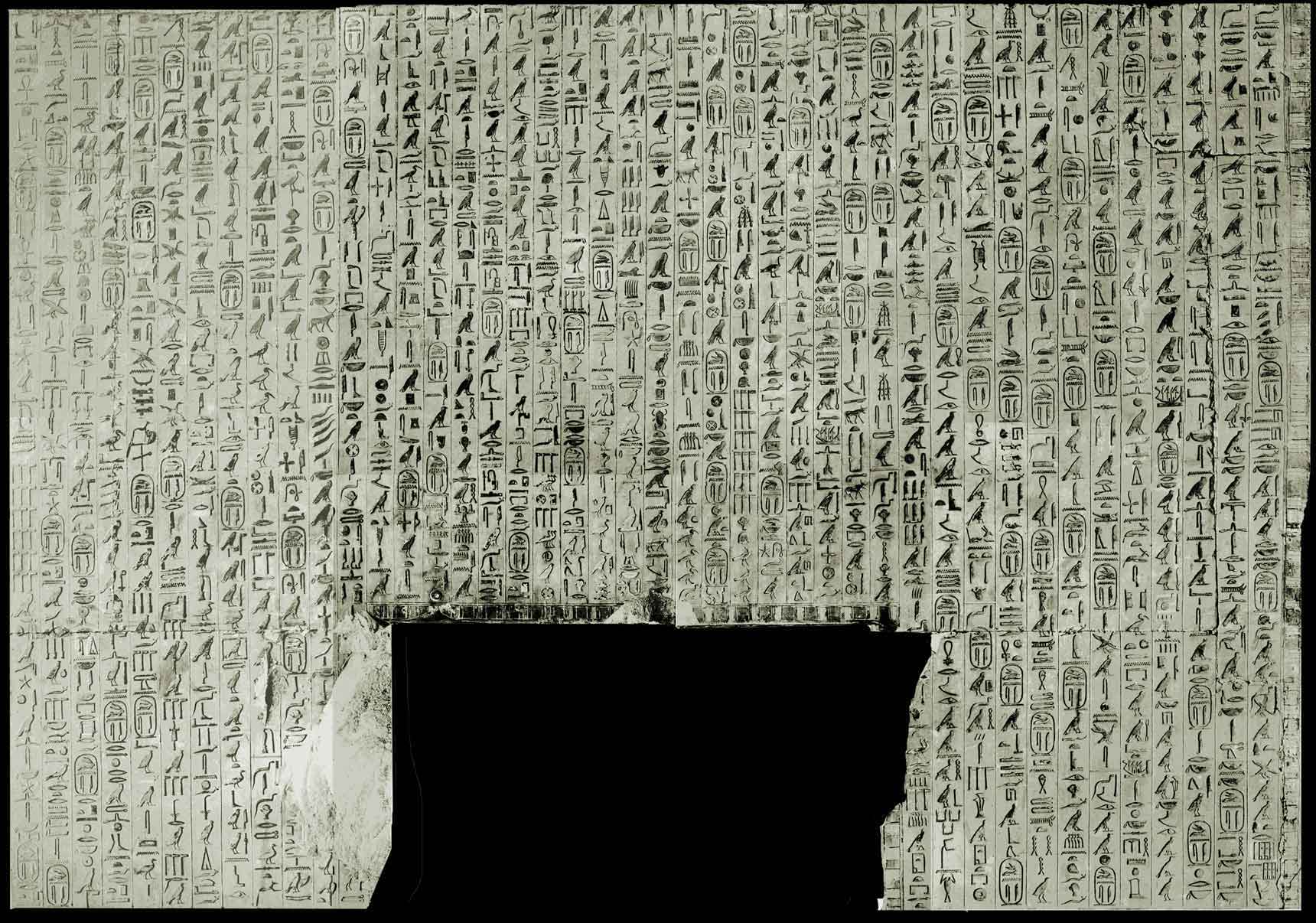
This entry is the north wall of the antechamber: 43 columns of hieroglyphs, Sethe's W 567-609, which follow each other from the left-hand (west) edge of the photograph. It holds the utterances 302, 303, 304, 305, 306, 307, 308, 309, 310, 311, 312.
Each section is one utterance. The Egyptian is the transliteration of the Thesaurus Linguae Aegyptiae (edition by Doris Topmann), with Sethe's Unas column number (W) before each column; a number ending in 'a' marks the offering label at the foot of a column. Signs restored by the editor are in square brackets, signs the scribe left out in angle brackets, damaged signs in half brackets. The English is Samuel A. B. Mercer's translation of 1952. Mercer translates Sethe's composite text made from all the pyramids that have an utterance, so his wording can include clauses that are not in the Unas copy, and his section numbers (134a, 134b ...) are Sethe's paragraph numbers, not column numbers; he writes 'N.' where the wall has the king's name. The photograph shows the whole wall; each section's note gives its columns counted from the edge where the text on that wall begins.
How was this verified? (Provenance)
Where on the image
Unas W 567-572: W 567-572 are columns 1-6 of the 43 columns on the photograph of the antechamber, north wall, counted from the left-hand (west) edge. Wall check (north wall): 43 columns counted by eye, W 567 at the left-hand (west) edge to W 609 at the right, next to the palace-facade border. Checked on the image: the leftmost column has an ankh near the top (W 567 'sbš p,t ꜥnḫ Spd,t') and the second a cartouche high up (W 568 'n ḥtm ns,t Wnjs'). Mercer's English renders Sethe's composite text of this utterance from all pyramids; it can contain words that are not in the Unas copy.
567sbš p,t ꜥnḫ Spd〈,t〉 n Wnjs js ꜥnḫ zꜣ Spd,t wꜥb.n n =f psḏ,t.du m msḫt,w j:ḫm-sk n ski̯ pr Wnjs 〈j〉r〈,j〉 p,t
568n ḥtm ns,t Wnjs 〈j〉r.t tꜣ dḫ r =sn rmṯ pꜣ.y r =sn nṯr.pl spꜣ.n Spd,t Wnjs r p,t m-ꜥb sn,w.pl =f nṯr.pl kfi̯.n Nw,t wr,t rmn.du =s n Wnjs
569qfn.n sn.du bꜣ.du ḫnt.w bꜣ.pl-Jwn,w ẖr tp hrw sḏr jri̯ =sn nn n〈,j〉 rm,wt nṯr ns,t Wnjs ḫr =k Rꜥw n rḏi̯ =f s〈j〉 n kj.j nb pri̯.y r =f Wnjs r p,t ḫr =k Rꜥw
570ḥr n〈,j〉 Wnjs m b〈j〉k.pl ḏnḥ.pl Wnjs m ꜣpd.pl ꜥn,t.pl =f m wḫꜣ.wpl Jtꜣ〈,tj〉 n mdw n〈,j〉 Wnjs r tꜣ ḫr rmṯ n ḫbn,t =f r p,t
571ḫr nṯr.pl dr.n Wnjs mdw =f ski̯.n Wnjs jr jꜥ n p,t spꜣ.n Wpi̯-wꜣ,t.pl Wnjs r p,t mm sn,w.pl =f nṯr.pl jṯi̯.n Wnjs ꜥ.w m smn
572ḥwi̯.n Wnjs ḏnḥ m ḏr,t pꜣ pꜣ rmṯ pꜣ 〈r〉 =〈f〉 Wnjs ={j} m-ꜥ =ṯn
458aTo say: Heaven is serene (?); Sothis lives, for it is N. who lives, the son of Sothis.
458bThe Two Enneads have purified themselves for him
458cas (in the form of) the mśḫtiw-hook-star, the imperishable.
458dThe house of N. in heaven will not go under, the throne of N. on earth will never be destroyed.
459aMen bury themselves (in their grave (?); the gods fly up.
449bSothis caused N. to fly to heaven among his brothers the gods.
449cNut, the great, uncovered her arms for N.
460aThe two souls who are at the head of the souls of Heliopolis, who genuflected at sun-rise,
460bpassed the night, while they did this, weeping for the god.
460cThe throne of N. is by thee, O Rē‘; he will not give it to anyone else.
461aN. ascends to heaven, to thee, O Rē‘;
461bthe face of N. is as (that of) falcons;
461cthe wings of N. are as (those of) geese;
461dhis claws are as the fangs of the god of the Ḏw.f-nome.
462aThere is not a word among men on earth against N.;
462bthere is no condemnation of him among the gods in heaven.
462cN. has removed the word against him; N. has destroyed (it) so as to mount up to heaven.
463aWp-wȝ.wt has caused N. to fly to heaven among his brothers, the gods.
463bN. moved (flapped) his arms like a śmn-goose;
463cN. flaps his wings like a kite.
463dHe flies who flies, O men; N. also flies away from you.
Where on the image
Unas W 572-575: W 572-575 are columns 6-9 of the 43 columns on the photograph of the antechamber, north wall, counted from the left-hand (west) edge. Wall check (north wall): 43 columns counted by eye, W 567 at the left-hand (west) edge to W 609 at the right, next to the palace-facade border. Checked on the image: the leftmost column has an ankh near the top (W 567 'sbš p,t ꜥnḫ Spd,t') and the second a cartouche high up (W 568 'n ḥtm ns,t Wnjs'). Mercer's English renders Sethe's composite text of this utterance from all pyramids; it can contain words that are not in the Unas copy.
572ḏ〈d〉-mdw nṯr.pl jmn,t〈j〉.w nṯr.pl jꜣb,t〈j〉.w nṯr.pl rs〈,j〉.w nṯr.pl mḥ,t〈j〉.w
573fd.w jpw zḫn.wpl wꜥb di̯.wn =ṯn n 〈W〉sjr m pri̯.t =f jr p,t ḏꜣi̯ =f jr qbḥ,w zꜣ =f Ḥr,w jr ḏbꜥ.du =f snḫ =f sw ḏi̯ =f ḫꜥi̯ =f
574m nṯr-ꜥꜣ m qbḥ,w wdi̯ sn n Wnjs ṯwt Ḥr,w zꜣ 〈W〉sjr ṯwt Wnjs nṯr sms.w zꜣ Ḥw〈,t〉-Ḥr,w ṯwt mtw,t Gbb jw wḏ.n 〈W〉sjr
575ḫꜥi̯ Wnjs m sn,nw Ḥr,w jw zš.n fd.w jpw ꜣḫ.pl jm〈,j〉.w Jwn,w jr ꜥ n〈,j〉 nṯr.du ꜥꜣ.w〈j〉 m qbḥ,w
464aTo say: Gods of the West, gods of the East, gods of the South, gods of the North--
464bthese four pure reed-floats, which ye placed for Osiris,
464cfor his ascension to heaven,
465athat he might ferry over to ḳbḥ.w, while his son Horus was at hand (at his fingers),
465b(whom) he reared and whom he caused to dawn as a great god in ḳbḥ.w,
465cplace them for N.
466aArt thou Horus, son of Osiris? Art thou, O N., the god, the eldest, son of Hathor?
466bArt thou the seed of Geb?
467aOsiris has ordained that N. dawn as a second Horus.
467bThose four souls (spirits), who are in Heliopolis, have written it
467cin the register of the two Great Gods who are in ḳbḥ.w.
Where on the image
Unas W 575-579: W 575-579 are columns 9-13 of the 43 columns on the photograph of the antechamber, north wall, counted from the left-hand (west) edge. Wall check (north wall): 43 columns counted by eye, W 567 at the left-hand (west) edge to W 609 at the right, next to the palace-facade border. Checked on the image: the leftmost column has an ankh near the top (W 567 'sbš p,t ꜥnḫ Spd,t') and the second a cartouche high up (W 568 'n ḥtm ns,t Wnjs'). Mercer's English renders Sethe's composite text of this utterance from all pyramids; it can contain words that are not in the Unas copy.
575ḏ〈d〉-mdw j:〈n〉ḏ ḥr =ṯ zꜣ,t Jnp,w
576ḥr.t ptr.w〈j〉 p,t ḥnk,t Ḏḥw,tj ḥr.t mꜥꜣꜥ.wdu mꜣq,t j:wn wꜣ,t Wnjs swꜣ Wnjs j:〈n〉ḏ ḥr =k n[j]⸢w⸣ ḥr〈,j〉 sp,t mr-n〈,j〉-ḫꜣ
577j:wn wꜣ,t n Wnjs swꜣ Wnjs j:〈n〉ḏ ḥr =k ngꜣ Rꜥw ẖr〈,j〉 fd.w ꜥb.pl ꜥb =k m jmn,t ꜥb =k m jꜣb,t ꜥb =k 〈m〉 rs,w [ꜥb] =[k] [〈m〉] [mḥ,t〈j〉] [qꜥḥ] [ꜥb] =⸢k⸣ pw jmn,t〈j〉
578n Wnjs swꜣ Wnjs ṯwt jmn,tj wꜥb pri̯.〈k〉j m bjk,t j:nḏ ḥr =ṯ sḫ,t-ḥtp j:〈n〉ḏ ḥr [s]m〈,w〉 [jm〈,j〉.w] =[ṯ] [j:〈n〉ḏ] [ḥr] [sm〈,w〉] Wnjs jm〈,j〉.w =ṯ
579ꜥꜣb wꜥb jm〈,j〉 =j
468aTo say: Greetings to thee, O daughter of Anubis, who is at the windows, of heaven,
468bthou friend of Thot, who is at the double rail (end) of the ladder.
468cOpen the way for N., that N. may pass.
469aGreetings to thee, O ostrich, who is on the shore of the Winding Watercourse.
469bOpen the way for N., that N. may pass.
470aGreetings to thee, O ox of Rē‘, with four horns,
470bthy horn in the West, thy horn in the East, thy horn in the South, thy horn in the North.
470cIncline thy western horn for N., that N. may pass.
47mArt thou a pure westerner? I come from the falcon city.
471bGreetings to thee, O Marsh of my Offerings (or, O Marsh of my Peace);
471cgreetings to the honourable ones (dead?) who are in thee. N. will honour those who are there.
471dComfortable are the pure who are in me.
Where on the image
Unas W 579-583: W 579-583 are columns 13-17 of the 43 columns on the photograph of the antechamber, north wall, counted from the left-hand (west) edge. Wall check (north wall): 43 columns counted by eye, W 567 at the left-hand (west) edge to W 609 at the right, next to the palace-facade border. Checked on the image: the leftmost column has an ankh near the top (W 567 'sbš p,t ꜥnḫ Spd,t') and the second a cartouche high up (W 568 'n ḥtm ns,t Wnjs'). Mercer's English renders Sethe's composite text of this utterance from all pyramids; it can contain words that are not in the Unas copy.
579ḏ〈d〉-mdw ṯ〈ꜣ〉z mꜣq,t jn Rꜥw ḫft 〈W〉sjr ṯ〈ꜣ〉z mꜣq,t jn Ḥr,w
580ḫft jt〈j〉 =f 〈W〉sjr m šm =f n ꜣḫ =f wꜥ =sn〈j〉 m pn gs wꜥ =sn〈j〉 m pn gs jw Wnjs jmw,t〈j〉 =sn〈j〉
581jn ṯwt js nṯr wꜥb s,t.pl pri̯ m wꜥb,t ꜥḥꜥ Wnjs j.n Ḥr,w ḥmsi̯ Wnjs j.n Stẖ šzp ꜥ =f j.n Rꜥw
582ꜣḫ jr p,t šꜣ,t jr tꜣ šzp.t rmṯ qrs =sn ḫꜣ =s m tʾ ḫꜣ =s m ḥ〈n〉q,t ḥr wdḥ,w n〈,j〉 Ḫnt〈,j〉-jmn,t〈j〉.w
583šwꜣ jwꜥ.w n-wn.t ḫr =f zš〈ꜣ,w〉 zš〈ꜣ〉 Wnjs m ḏbꜥ wr n zš〈ꜣ〉 =f js m ḏbꜥ šrr
472aTo say: The ladder is fastened by Rē‘ in the presence of Osiris;
472bthe ladder is fastened by Horus in the presence of his father Osiris,
472cas he goes to his ȝḫ (spirit).
472dOne of them is on this side, one of them is on this side, while N. is between them.
473aArt thou then a god, pure in dwellings (places)? (I am) come from a pure (place).
473bStand (here), O N., says Horus; sit (here), O N., says Set;
473cTake his arm (certificate), says Rē‘.
474aThe spirit belongs to heaven; the body belongs to the earth.
474bThat which men receive when they are buried
474care their thousand loaves of bread, their thousand mugs of beer from the offering-table of Ḫnti-’imnti.w.
475aIf the heir is poor because he has no testament,
475bthen shall N. (really, "he") write with his great finger;
475cbut he shall not write with his little finger,
Where on the image
Unas W 584-590: W 584-590 are columns 18-24 of the 43 columns on the photograph of the antechamber, north wall, counted from the left-hand (west) edge. Wall check (north wall): 43 columns counted by eye, W 567 at the left-hand (west) edge to W 609 at the right, next to the palace-facade border. Checked on the image: the leftmost column has an ankh near the top (W 567 'sbš p,t ꜥnḫ Spd,t') and the second a cartouche high up (W 568 'n ḥtm ns,t Wnjs'). Mercer's English renders Sethe's composite text of this utterance from all pyramids; it can contain words that are not in the Unas copy.
584ḏ〈d〉-mdw nfr =w〈j〉 ꜣ mꜣ,w ḥtp =wj ꜣ pt〈r〉 j.n =sn jn nṯr.pl pri̯.t r =f nṯr pn jr p,t pri̯.t r =f Wnjs r p,t
585bꜣ,w =f tp =f šꜥ,t =f r-gs,du =f ḥkꜣ,w =f tp-rd,du =f jri̯.n n =f Gbb mj-qd jri̯.y n =f jm jyi̯ n =f nṯr.pl bꜣ,pl-Pj nṯr.pl bꜣ,pl-Nḫn,w
586nṯr.pl jr〈,j〉.w p,t nṯr.pl jr〈,j〉.w tꜣ jri̯ =sn wṯz.pl n Wnjs ḥr ꜥ =sn pri̯ =k r =k Wnjs jr p,t jꜣq ḥr =s
587m rn =s pw n〈,j〉 mꜣq,t rḏi̯ p,t n Wnjs rḏi̯ n =f tꜣ j.n 〈J〉tm〈,w〉 mdwi̯ ḥr =s pw Gbb jꜣ,t.pl
588jꜣ,t =〈j〉 jꜣ,t Ḥr,w jꜣ,t Stẖ sḫ,t.pl-jꜣr,w dwꜣ =sn ṯw m rn =k pw n〈,j〉 Dwꜣ〈,w〉 Spd js ẖr〈,j〉 ksb,t.pl =f
589jn smꜣ.n =f ṯw ḏd.n jb =f m〈w〉t =k n =f mi̯ =k jr =k ṯw ḫpr.t〈j〉 r =k r =f m jmn,w n〈,j〉 smꜣ
590j:mn j:mn jmn,w wn =k Wnjs mn.tj ḫnt,j =sn ḫnt,j ꜣḫ.w ḏ,t
476aTo say: "How beautiful indeed is the sight, how pleasant indeed is the view," say they, say the gods,
476b"'the ascension of this god to heaven, the ascension of N. to heaven,
477ahis renown over him, his terror on both sides of him,
477bhis magic preceding him!"
477cGeb has done for him as was done for himself; (and)
478athe gods, the Souls of Buto come to him, (and) the gods, the Souls of Hierakonpolis, the gods who are in heaven, the gods who are on the earth;
478bthey make for thee (they serve thee as), N., supports of their arms,
479aand thou ascendest, N., to heaven, and thou climbest on it in this its name of "ladder."
479b"Let heaven be given to N.; let the earth be given to him," said Atum.
480aHe who had spoken (with Atum) about it was Geb.
480bThe regions of the kingdom, the kingdom of Horus, the kingdom of Set, (and)
480cthe Marshes of Reeds, they adore thee
480din this thy name of Dwȝ.m, as Sopdu, (who lives) under his kśb.t-trees.
481aHas he killed thee after his heart had said that thou shouldst die for him?
481bBut, behold, thou for thy part become in spite of him as the remaining bull of the wild-bulls.
481cThere remains, there remains the remaining bull,
481d(so) thou art remaining, O N., as their chief, as chief of the spirits, eternally.
Where on the image
Unas W 591-597: W 591-597 are columns 25-31 of the 43 columns on the photograph of the antechamber, north wall, counted from the left-hand (west) edge. Wall check (north wall): 43 columns counted by eye, W 567 at the left-hand (west) edge to W 609 at the right, next to the palace-facade border. Checked on the image: the leftmost column has an ankh near the top (W 567 'sbš p,t ꜥnḫ Spd,t') and the second a cartouche high up (W 568 'n ḥtm ns,t Wnjs'). Mercer's English renders Sethe's composite text of this utterance from all pyramids; it can contain words that are not in the Unas copy.
591ḏ〈d〉-mdw jwn,w〈j〉 m Wnjs nṯr jwn,w〈j〉 =k m Wnjs nṯr jwn,w〈j〉 m Wnjs Rꜥw jwn,w〈j〉 =k m Wnjs Rꜥw mʾw,t n.t Wnjs jwn,w〈t〉
592jt〈j〉 n〈,j〉 Wnjs jwn,w〈j〉 Wnjs ḏs =f jwn,w〈j〉 msi̯.y m Jwn,w sk Rꜥw ḥr-tp psḏ,t.du ḥr-tp rḫ,wt
593Nfr-tm jw,t〈j〉 sn.nw =f jwꜥ〈,w〉 jt〈j〉 =f Gbb nṯr nb wdi̯.t〈j〉 =f ꜥ =f mḏri̯ ḥr n〈,j〉 Wnjs r =k dwꜣ =f ṯw
594njs =f r =k ḥr ḏ,t Wnjs nṯr ḥr fnḏ =f nṯr n tʾ =f n pꜣq =f m-ꜥb sn.w =f nṯr.pl n hꜣb =f hꜣb.t
595n sṯp =f jb,t m-ꜥb sn.w =f n wn n =f ꜥꜣ.du msk,tt n wn n =f ꜥꜣ.du mꜥnḏ,t n wḏꜥꜥ mdw =f m jm〈,j〉 nʾ,t =f
596n wn n =f ꜥꜣ.du ḥtm,wt jyi̯.n Wnjs jr =k Wnjs pj smꜣ ty kꜣ ꜥꜣ ḥr pri̯ m Jwn,w
597jyi̯.n Wnjs r =k smꜣ ty Wnjs pj ḏrṯ msi̯ ṯw mss ṯw
482aTo say: A Heliopolitan is in N., O god; a Heliopolitan as thou (art) is in N. O god;
482ba Heliopolitan is in N., O Rē‘; a Heliopolitan as thou (art) is in N. O Rē‘.
482cThe mother of N. is a Heliopolitan; the father of N. is a Heliopolitan.
483aN. himself is a Heliopolitan, who was born in Heliopolis,
483bwhen Rē‘ ruled the Two Enneads, (when) Nefertem ruled men,
483c(as) one without an equal, the heir of his father Geb.
484aAny god who puts out his arm (menacingly),
484bwhen the face of N. turns to thee to adore thee,
484c(and) when N. calls to thee on behalf of his person, O god, on behalf of his nose, O god,
484dhe shall have no bread, he shall have no cake among his brothers, the gods;
485ahe shall send no message, he shall not cover in heat among his brothers, the gods;
485bthe double doors of the mśkt.t-boat shall not be opened for him, the double doors of the m‘nḏ.t-boat shall not be opened for him;
485chis speech shall not be judged as (that of one) in his city; the double doors of the destroyer ("Hell") shall not be open (again) for him.
486aN. comes to thee.
486bN. is the wild-bull of the highlands, the bull with the large head, which comes from Heliopolis.
486cN., wild-bull of the highlands, comes to thee.
486dHenceforth N. is he who has given birth to thee and who gives birth to thee.
Where on the image
Unas W 597-600: W 597-600 are columns 31-34 of the 43 columns on the photograph of the antechamber, north wall, counted from the left-hand (west) edge. Wall check (north wall): 43 columns counted by eye, W 567 at the left-hand (west) edge to W 609 at the right, next to the palace-facade border. Checked on the image: the leftmost column has an ankh near the top (W 567 'sbš p,t ꜥnḫ Spd,t') and the second a cartouche high up (W 568 'n ḥtm ns,t Wnjs'). Mercer's English renders Sethe's composite text of this utterance from all pyramids; it can contain words that are not in the Unas copy.
597ḏ〈d〉-mdw j:〈n〉ḏ ḥr =k Ḥr〈,w〉
598m jꜣ,t.pl ḥr,w.t j:〈n〉ḏ ḥr =k Stẖ m jꜣ,t.pl stẖ.t j:〈n〉ḏ ḥr =k Jꜣr,w m sḫ,t.pl-jꜣr.w j:〈n〉ḏ [ḥr] =[ṯ]n〈j〉 t〈w〉[t],tj-jb z〈ꜣ〉,t.du fd〈,w〉 nṯr.pl ḫnt〈,j〉.w ḥw,t-ꜥꜣ.t
599pri̯.tj-ḫrw n Wnjs ḥꜣi̯.tjj mꜣ.n n =ṯn〈j〉 Wnjs mr mꜣꜣ Ḥr,w n 〈Ꜣ〉s,t mꜣ.n n =ṯn〈j〉 Wnjs mr mꜣꜣ Nḥb,w-kꜣ.pl n Srq,t
600mꜣ.n n =ṯn〈j〉 Wnjs mj mꜣꜣ Sbk n Nj,t mꜣ.n n =ṯn〈j〉 Wnjs mr mꜣꜣ Stẖ n t〈w〉t,tj-jb
487aTo say: Greetings to thee, O Horus, in the regions of Horus;
487bgreetings to thee, O Set, in the regions of Set;
487cgreetings to thee, O ’Iȝr.w, in the Marshes of Reeds;
488agreetings to you, ye two harmonius (goddesses), daughters of the four gods, who dwell in the great palace (Heliopolis),
488bye who are come forth at the voice of N., naked.
489aN. has looked to you, as Horus looked to Isis;
489bN. has looked to you, as the Nḥb.w-kȝ.w (serpent) looked to Śrḳ.t-ḥtw;
489cN. has looked to you, as Sebek looked to Neit;
489dN. has looked to you, as Set looked to the two harmonius (goddesses).
Where on the image
Unas W 600-602: W 600-602 are columns 34-36 of the 43 columns on the photograph of the antechamber, north wall, counted from the left-hand (west) edge. Wall check (north wall): 43 columns counted by eye, W 567 at the left-hand (west) edge to W 609 at the right, next to the palace-facade border. Checked on the image: the leftmost column has an ankh near the top (W 567 'sbš p,t ꜥnḫ Spd,t') and the second a cartouche high up (W 568 'n ḥtm ns,t Wnjs'). Mercer's English renders Sethe's composite text of this utterance from all pyramids; it can contain words that are not in the Unas copy.
600ḏ〈d〉-mdw Wnjs pw ḏḥꜣ,j nṯr.pl ḥꜣ〈,j〉 ḥw,t Rꜥw
601msi̯.n Nḥ,t-nṯr.pl jm.t ḥꜣ,t wjꜣ Rꜥw ḥmsi̯ Wnjs m-bꜣḥ =f j:wn Wnjs hnw.pl =f j:sḏ Wnjs wḏ.pl =f ḫtm Wnjs mḏꜣ,t.pl =f hꜣb Wnjs
602wp〈w〉,t〈j〉.w =f j:tm.w wrḏ jri̯ Wnjs j:ḏd.t =f n Wnjs
490aTo say: N. is the ḏḥȝ.i of the gods, who is behind the house of Rē‘,
490bborn of the wish of the gods, which is in the prow of the boat of Rē‘.
490cN. sits before him;
491aN. opens his boxes; N. breaks open his edicts;
491bN. seals his rolls (of papyrus);
491cN. sends forth his messengers, the indefatigables.
491dN. does, that which he (Rē‘) says to N.
Where on the image
Unas W 602-604: W 602-604 are columns 36-38 of the 43 columns on the photograph of the antechamber, north wall, counted from the left-hand (west) edge. Wall check (north wall): 43 columns counted by eye, W 567 at the left-hand (west) edge to W 609 at the right, next to the palace-facade border. Checked on the image: the leftmost column has an ankh near the top (W 567 'sbš p,t ꜥnḫ Spd,t') and the second a cartouche high up (W 568 'n ḥtm ns,t Wnjs'). Mercer's English renders Sethe's composite text of this utterance from all pyramids; it can contain words that are not in the Unas copy.
602ḏ〈d〉-mdw šnj.w Wnjs šnj.w 〈J〉tm〈,w〉 šnṯṯ Wnjs šnṯṯ 〈J〉tm〈,w〉 ḥwi̯.w
603Wnjs ḥ〈w〉i̯ 〈J〉tm〈,w〉 ḫsbb Wnjs m wꜣ,t tn ḫsbb 〈J〉tm〈,w〉 Wnjs pw Ḥr,w jyi̯.n Wnjs m-ḫt jt〈j〉 =f jyi̯.n Wnjs m-ḫt 〈W〉sjr Ḥr≡f-m-ḫnt≡f
604Ḥr≡f-m-mḥꜣ≡f jni̯ nw n Wnjs jnt =〈j〉 n =k Wnjs zy mẖn,t jni̯ n Wnjs j:pꜣ≡s-ḫnn≡s
492aTo say: If N. should be bewitched, so will Atum be bewitched.
492bIf N. should be slandered, so will Atum be slandered.
492cIf N. should be beaten, so will Atum be beaten.
492dIf N. should be hindered on this road, so will Atum be hindered.
493aN, is Horus. N. comes after his father (in time); N. comes after Osiris.
493bO thou, whose face is before him, whose face is behind him,
494abring this (boat) to N. Which boat shall I bring to thee, O N.?
494bBring to N. that which flies up and alights.
Where on the image
Unas W 604-609: W 604-609 are columns 38-43 of the 43 columns on the photograph of the antechamber, north wall, counted from the left-hand (west) edge. Wall check (north wall): 43 columns counted by eye, W 567 at the left-hand (west) edge to W 609 at the right, next to the palace-facade border. Checked on the image: the leftmost column has an ankh near the top (W 567 'sbš p,t ꜥnḫ Spd,t') and the second a cartouche high up (W 568 'n ḥtm ns,t Wnjs'). Mercer's English renders Sethe's composite text of this utterance from all pyramids; it can contain words that are not in the Unas copy.
604ḏ〈d〉-mdw mꜣꜣ Rꜥw Wnjs
605sjꜣ Rꜥw Wnjs n〈,j〉-sw j:rḫ.w ṯw j:rḫ.k \j:rḫ/ \sw/ jr pri̯ nb =〈j〉 n ḫm =〈j〉 ḥtp-〈ḏi̯〉 \jr/ \pri̯/ \nb/ =\f/ \n/ \ḫm/ =\f/ \ḥtp/-ḏi̯ j:wn jwi̯.t jwi̯ =s ꜥꜣ.du ꜣḫ,t n pri̯,w mꜥnḏ,t j:rḫ.kw zḥ mn,w
606ḥr〈,j〉-jb ḫt,w jzkn prr.w =k jm =f hꜣi̯ =k m msk,tt j:wḏ w〈j〉 r =k \wḏ/ \Wnjs/ \r/ =\k/ j:wḏ w〈j〉 \wḏ/ \sw/ j:wḏ w〈j〉 \wḏ/ \sw/ n fd,w \ḏ〈d〉-mdw/ \zp/ \4/ \ḏd/ \n/ 4 jpw khꜣ.w ḥꜣ〈,j〉.w =k mꜣꜣ.w
607m ḥr.du mdwi̯.w m wtwt mr ḥnꜥ qsn.tj =sn ḥnꜥ ski̯ =sn jmi̯ =sn ḏꜣi̯ ꜥ =sn mḏr Wnjs jr =k jwi̯ Wnjs ḫr =k
608ḏd n =k rn =k pw n〈,j〉 ꜣgb,w-wr pri̯ m wr,t n šp Wnjs di̯ =k sw m kk,w n jdi̯ =f tm =f sḏm ḫrw =k jṯi̯ =k n =k Wnjs ḥnꜥ =k ḥnꜥ =k
609nfꜥ n =k šꜣp,t ḫsr n =k jgp j:sḏ n =k šnj,t jri̯ n =k Wnjs hnn hnn jri̯ =f n =k jꜣ jꜣ wdi̯ =k n =k Wnjs tp ḏ,t〈j〉.w mʾw,t
495aTo say: Look at N., O Rē‘; recognize N., O Rē‘.
495bHe belongs to those who know thee. He knows (that)
495cwhen his lord (Rē‘) goes forth, he should not forget the ḥtp-di,
496aso that she "who excludes whom she will exclude" may open the doors of the horizon for the going forth of the boat of the morning-sun.
496b(N.) knows the hall of the royal throne, which is in the midst of the platform of ’iskn, whence thou goest forth,
497athat thou mayest enter (step down into) the boat of the evening-sun.
497bCommend N.; commend him, commend him--to say four times one after another--to those four raging ones (winds),
497cwho are around thee (Rē‘) who see with two faces, who speak with two mouths (?),
498awho are evil with those who are unfortunate, with those who would destroy them (the winds?),
498bthat they put not out their arm, when N. turns to thee, when N. comes to thee,
499aas one who says to thee this thy name of "great flood," which proceeds from the great (one).
499bN. will not be blind when thou leavest him in darkness;
499che will not be deaf when he does not hear thy voice.
500aMayest thou take N. with thee, with thee;
500bhe who drives away the storm for thee; be who chases off the clouds for thee; he who breaks up the hail for thee.
500c, N. will do homage (upon) homage to thee; he will cause acclamation (upon) acclamation to thee.
500dMayest thou set N. over ḏt3.t.
Where on the image
Unas W 609: W 609 is column 43 of the 43 columns on the photograph of the antechamber, north wall, counted from the left-hand (west) edge. Wall check (north wall): 43 columns counted by eye, W 567 at the left-hand (west) edge to W 609 at the right, next to the palace-facade border. Checked on the image: the leftmost column has an ankh near the top (W 567 'sbš p,t ꜥnḫ Spd,t') and the second a cartouche high up (W 568 'n ḥtm ns,t Wnjs'). Mercer's English renders Sethe's composite text of this utterance from all pyramids; it can contain words that are not in the Unas copy.
609ḏ〈d〉-mdw pꜣ tʾ pꜣ ꜣ tʾ r ḥw,tj ḥw,t.pl n,t
501To say: The bread flies, the bread flies to my houses, the houses of the Lower Egyptian crown.
Notes
- Mercer's separate headings, postscripts and variants taken from other pyramids are left out.
- Letters follow the sacred-texts transcription of Mercer: ȝ stands for aleph and ‘ for ayin; letters underlined in the printed book are given as ḏ, ṯ, ẖ.
- Sethe's section numbers are kept as printed in that transcription, including a few misprints (for example '146.' for 141b in Utterance 215).
- The TLA has no hieroglyphic encoding for these texts, so only the transliteration is shown.
Cite
Sources
- Source: Pyramid of Unas, Saqqara, antechamber, north wall (photograph: L. F. Husson for A. Piankoff 1968, via Pyramid Texts Online) + TLA transliteration (ed. D. Topmann, CC BY-SA 4.0) + English of S. A. B. Mercer (1952, public domain in the US) (holding institution)
- Critical edition: Thesaurus Linguae Aegyptiae, ed. Doris Topmann (2018 data, AED-TEI)
← previous · → next · v cycle view · l back to library