Pyramid Texts of Unas: Utterances 254-258 (antechamber, west wall)
Introduction
The Pyramid Texts are the oldest large body of Egyptian religious writing: spells, called utterances, for the resurrection of the dead king, his protection, his meals and his ascent to the sky, cut in vertical columns of hieroglyphs on the walls of the burial apartments of late Old Kingdom pyramids. The pyramid of Unas at Saqqara, the last king of the 5th Dynasty (about 2375-2345 BCE), is the first to carry them. Its sarcophagus chamber, the passage to the antechamber, the antechamber and the corridor hold the columns of text that Sethe numbered W 1-649 (there is no W 129 or W 318). This library gives them wall by wall, in seventeen entries (227 different utterances, some of them inscribed more than once), with one gap: Utterance 271 (the end of W 492, all of W 493 and the top of W 494, on the south wall of the antechamber) is not in the Thesaurus Linguae Aegyptiae data used here, so it is not given. W 646 (corridor, east wall) has no column mark of its own in the TLA text; its words are given with W 645.
This entry is the west wall of the antechamber: 37 columns of hieroglyphs, Sethe's W 416-452, which follow each other from the right-hand (north) edge of the photograph. It holds the utterances 254, 255, 256, 257, 258. The leftmost column (W 452) begins PT 260, which is given in full in the entry for the south wall.
Each section is one utterance. The Egyptian is the transliteration of the Thesaurus Linguae Aegyptiae (edition by Doris Topmann), with Sethe's Unas column number (W) before each column; a number ending in 'a' marks the offering label at the foot of a column. Signs restored by the editor are in square brackets, signs the scribe left out in angle brackets, damaged signs in half brackets. The English is Samuel A. B. Mercer's translation of 1952. Mercer translates Sethe's composite text made from all the pyramids that have an utterance, so his wording can include clauses that are not in the Unas copy, and his section numbers (134a, 134b ...) are Sethe's paragraph numbers, not column numbers; he writes 'N.' where the wall has the king's name. The photograph shows the whole wall; each section's note gives its columns counted from the edge where the text on that wall begins.
How was this verified? (Provenance)
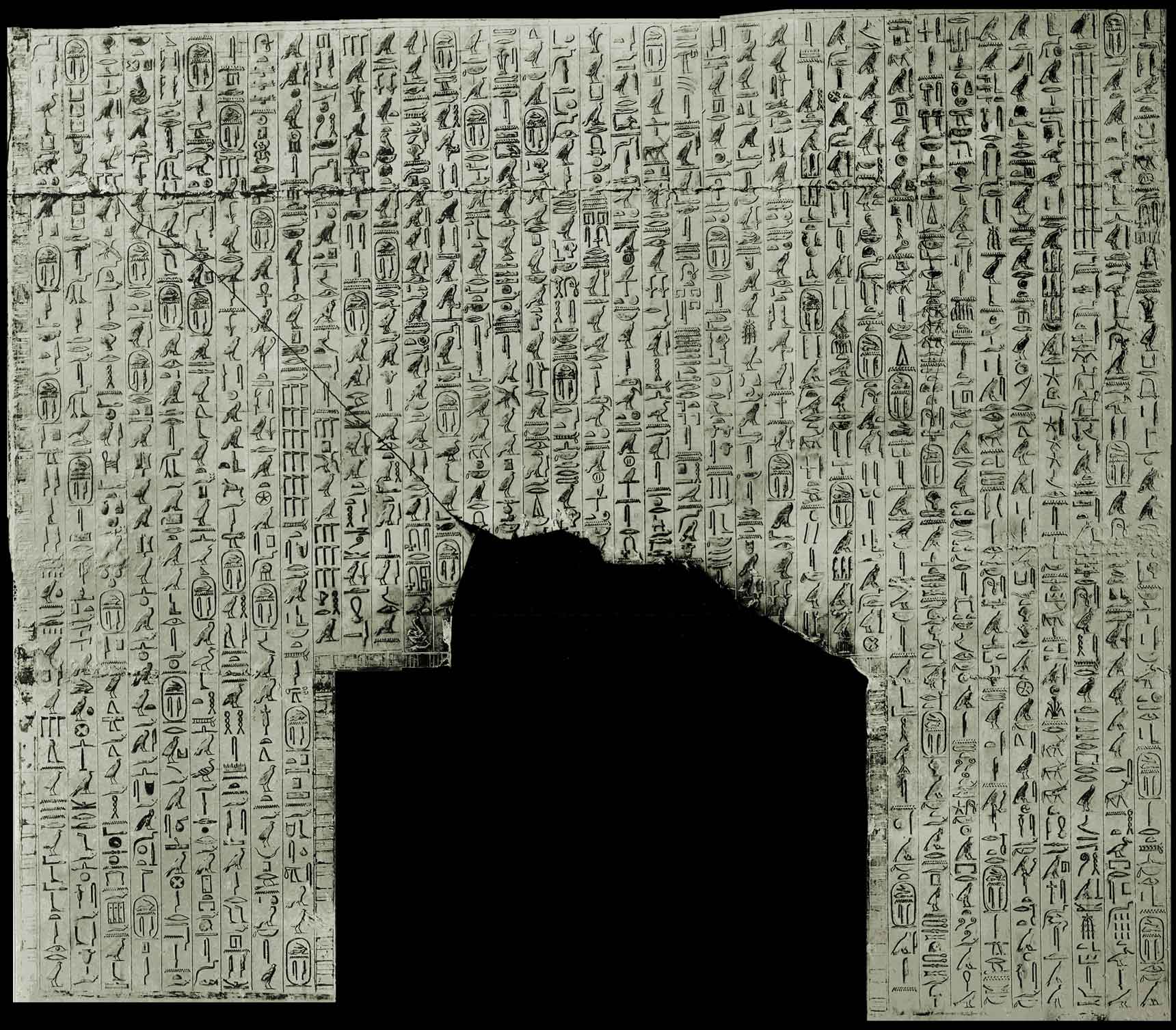
Where on the image
Unas W 416-433: W 416-433 are columns 1-18 of the 37 columns on the photograph of the antechamber, west wall, counted from the right-hand (north) edge. Wall check (west wall): 37 columns counted by eye, W 416 at the right-hand (north) edge to W 452 at the left-hand (south) edge, around the doorway to the passage. Checked on the image: the second column from the right opens with the Unas cartouche (W 417 'Wnjs fꜣ,t m jtj=f Gbb'); the leftmost column shows the goose and the bull of 'j Gbb kꜣ Nw,t' (W 452, the first column of PT 260). Mercer's English renders Sethe's composite text of this utterance from all pyramids; it can contain words that are not in the Unas copy.
416jdi̯.y wr,t n kꜣ Nḫn ns〈r〉 hh r =ṯn ḥꜣ〈,j〉.w kꜣr j nṯr-ꜥꜣ ḫmm rn =f ḫ,t ḥr s,t n nb-wꜥ〈,w〉 j nb ꜣḫ,t jri̯ s,t n Wnjs jr tm =k jri̯ s,t n Wnjs jri̯.kꜣ
417Wnjs fꜣ,t m jt〈j〉 =f Gbb tꜣ n mdwi̯.n =f Gbb n wꜣ.n =f gmi̯.y Wnjs m wꜣ,t =f wnm =f n =f sw mwmw sr ḥnʾ,t pri̯ psḏ,t〈j〉 ꜥḥꜥ wr
418mdwi̯ psḏ,t.pl tꜣ ḏnj ḏnj,t dmḏ ṯni̯〈,w〉.du zmꜣ jḫm,t.du sštꜣ wꜣ,t.pl r swꜣ.w sḥtm rwd.pl r prr.w mꜣꜥ nwḥ ḏꜣi̯ msq,t sqr
419bḏ m rʾ mr Ḥjp〈,w〉 j:nr sḫ,t.pl =k jꜣd tp-ꜥ jwn sbꜣ.pl mꜣ.n =sn jwn knz,t kꜣ n〈,j〉 p,t jꜣḫi̯ nr jḥ.pl tp mjz =f hꜣi̯ snḏ sdꜣ
420mds.w tp-ꜥ qrr n〈,j〉 p,t wpi̯.n =f tꜣ m rḫ.t.n =f hrw〈,w〉 mri̯.n =f jw.t jm j jn Wr-skꜣ,t ḥr〈,j〉-jb dwꜣ,t m =k s〈j〉 jwi̯ =s m ḫsf〈,w〉 =k Jmn,t nfr.t m ḫsf〈,w〉 =k
421m nꜣb,t.pl =s nfr.t j〈w〉 =s ḏd =s jyi̯ msi̯.n =〈j〉 wbn ꜥb =f jwn sdm kꜣ n〈,j〉 p,t ṯnj jr,w =k swꜣ m ḥtp〈,w〉 ẖnm.n =〈j〉 ṯw j.t jn Jmn,t nfr.t r Wnjs j:zj ẖni̯ =k
422r sḫ,t-ḥtp jṯi̯ =k ḥjp〈,t〉 n ḥr〈,j〉-qꜣ,t≡f j jn ḫnt〈,j〉-mnj,t≡f hb =k m tꜣ r wmt,t =k r mt,t =k r sṯt,t =k mꜣ =k Rꜥw m jnṯ,t.pl =f dwꜣ =k Rꜥw m pr.w,t =f m zꜣ wr
423jm〈,j〉 jns.pl =f nb ḥtp〈,w〉 ḏi̯ =f n =k ꜥ ={k}〈f〉 g〈j〉f,t.pl =f zni̯.t tp.pl swꜣ Wnjs ḥr =ṯn m ḥtp ṯ〈ꜣ〉z.n =f tp =f ḥr wsr,t =f jw wsr,t Wnjs ḥr mk,t =f m rn =f pw n〈,j〉 ṯ〈ꜣ〉z-tp ṯ〈ꜣ〉z =f tp
424n〈,j〉 Ḥp jm =f hrw〈,w〉 pw n〈,j〉 spḥ ng〈ꜣ〉 sk rḏi̯.n Wnjs wnm =sn m zwr =sn zwr =sn m bꜥḥ =sn jḫ mki̯.t Wnjs jm jn
425mꜣꜣ.w sw ḥkn,wtt tp ḏꜥ〈m〉 =s Tfn,t Wnjs twꜣ.t Šw ssḫ =s s,t =f m Ḏd,w
426m Ḏd,t m Ḏd,wt sꜥḥꜥ =s jꜣ,t.du m-ḫnt wr.w zk =s šj n Wnjs m sḫ,t-jꜣr,w
427smn =s ꜣḥ,t =f m sḫ,t.du-ḥtp wḏꜥ+ Wnjs +mdw m Mḥ,t-wr,t jm〈,w〉t〈j〉 ẖn〈n〉.wdu sk wsr =f
428m wsr,w jr,t Tbj nḫt =f nḫt,w jr,t Tbj jw nḏ.n sw Wnjs m-ꜥ jri̯.w nn j[r] =[f]
429nḥm.w šb〈,w〉 =f m-ꜥ =f sk sw wn nḥm.w ms,wt =f m-ꜥ =f sk s〈j〉 wn.t〈j〉 nḥm.w ṯꜣw m [fnḏ] =[f]
430sꜥḥꜥ hrw〈,w〉 =f n〈,j〉 ꜥnḫ nḫt Wnjs r =sn ḫꜥi̯ ḥr wḏb =f j:ḫr ḥꜣ,t〈j〉.pl =sn n ḏbꜥ.pl =f bsk.pl =sn n [jr〈,j〉.w] [p,t]
431dšr,w =sn n jr〈,j〉.w tꜣ jwꜥ〈,w〉〈.pl〉 =sn n šwꜣ,t pr.pl =sn n zn〈zn〉,t ꜥrr,t.pl =sn n ḥ〈ꜥ〉p〈j〉 wr nḏm jb n〈,j〉 Wnjs [zp] [2]
432Wnjs pw wꜥ〈,w〉 kꜣ n〈,j〉 p,t jw dr.n =f jri̯.w nn jr =f jw ḥtm.n =f tp〈,j〉.w+ =sn +tꜣ ḫr =f šdi̯ =f ṯzi̯ =f [nn] [rḏi̯.n] [n] =[f]
433jt〈j〉 =f Šw r-gs Stẖ
276aThe Great (Uraeus) burns incense to the bull of Nḫn.
276bThe heat of a flaming breath is against ye, who surround the chapel.
276cO Great God, whose name is unknown, an offering is on the place (i.e. in place) for the One-lord.
277aO lord of the horizon, make place for N.
277bIf thou makest not place for N., N. will put a curse on his father Geb:
277cThe earth will no more speak; Geb will no more be able to defend himself.
278aWhom N. finds on his way, him he eats for himself bit by bit.
278bThe ḥn.t-pelican announces, the pśḏ.ti-pelican comes forth; the Great One arises,
278cthe (Three) Enneads speak: A dam shall dam up the earth,
279aboth boundaries-of-the-cultivation shall be united, both riverbanks shall be joined,
279broads shall be closed against passengers,
279cstairs for those who would ascend shall be destroyed.
279dAdjust the cable, traverse the mśḳ.t, hit the ball on the meadow of Ḥȝpi.
280aO, thy fields tremble, O, ’iȝd-star, at the column of the stars,
280bwhen they see the column of Kns.t, the ox (or, bull) of heaven,
280cand how the ox-herd is terrified (overwhelmed) at him.
281aO, be afraid, tremble, ye criminals, before the tempest of heaven;
281bhe opened the earth with that which he knew, on the day he loved to come;
282aso said, he--he who is rich in arable-land, he who inhabits the Dȝt.
282bBehold, she comes to meet thee, the "Beautiful West," to meet thee,
232cwith her beautiful tresses, she says: "He comes whom I have borne,
283awhose horn shines, the varnished column, the ox (or, bull) of heaven.
283bThy figure is, exalted, pass in peace.
284aI have protected thee, says she, the "Beautiful West," to N.
284bGo, voyage to the Marsh of Offerings;
284cbring the oar to Ḥri-ḳȝ.t.f.
285aSo said he who is chief of his department (or, thigh offering). Thou decayest in the earth
285bas to thy thickness, as to thy girt, as to thy length
285c(but as spirit) thou seest Rē‘ in his bonds, thou adorest Rē‘ in-his freedom (from) his bonds,
285dthrough the great protection which is in his red robes.
286aThe lord of peace gives to thee his (with W.) arm.
286bO ye, his she-monkeys, who cut off heads,
286cmay N. pass by you in peace, (for) he has attached (again) his, head to his neck,
286d(for) the neck of N. is on his trunk, in his name of "Head-attacher,"
286e(as) he attached the head of the Apis in it (that is, in his name), the day the bull was caught with a lasso.
287aThose whom N. has made to eat (they eat of their food); (and) in their drinking,
287bthey drink of their abundance.
287cO that N. be respected there by those who see him.
288aThe ḥkn-wt.t-serpent is on her ḏ‘m-sceptre, the sister (?) of N. who holds Shu aloft.
288bShe makes his place wide in Busiris, in Mendes, in the necropolis of Heliopolis;
288cshe erects two standards before the Great Ones;
289ashe digs a pool (?) for N. in the Marsh of Reeds;
289bshe establishes his field in the two Marshes of Offerings.
289cN. judges in the Mḥ.t-wr.t-cow between the two wrestlers,
290afor his strength is the strength of the eye of Tbi (Rē‘),
290bhis might is the might of the eye of Tbi.
290cN. has freed himself from those who did this against him,
290dwho took from him his dinner,
291awhen it was there, who took his supper from him,
291bwhen it was there, who took the breath from his nose,
291cwho brought to an end the days of his life.
291dN. is mightier than they, appearing upon his shore.
292aTheir hearts fall into his fingers,
292btheir entrails to the inhabitants of heaven (birds), their blood to the inhabitants of earth (beasts),
292ctheir inheritance to the poor,
292dtheir houses to fire, their farms to high Nile (inundation).
293aLet the heart of N. be glad; let the heart of N. be glad!
293bN. is Unique, the ox (or, bull) of heaven.
293cHe has exterminated those who have done this against him, he has destroyed those who are on the earth.
294a-c. Belonging to his throne, what he will take, what he will lift up, is that which his father Shu has given him in the presence of Set.
Where on the image
Unas W 433-439: W 433-439 are columns 18-24 of the 37 columns on the photograph of the antechamber, west wall, counted from the right-hand (north) edge. Wall check (west wall): 37 columns counted by eye, W 416 at the right-hand (north) edge to W 452 at the left-hand (south) edge, around the doorway to the passage. Checked on the image: the second column from the right opens with the Unas cartouche (W 417 'Wnjs fꜣ,t m jtj=f Gbb'); the leftmost column shows the goose and the bull of 'j Gbb kꜣ Nw,t' (W 452, the first column of PT 260). Mercer's English renders Sethe's composite text of this utterance from all pyramids; it can contain words that are not in the Unas copy.
433ḏ〈d〉-mdw jdi̯ ꜣḫ,t n Ḥr〈,w〉-nḫn〈,j〉 ḫ,t n nb.w jdi̯ ꜣḫ,t n Ḥr〈,w〉-nḫn〈,j〉 nsr n〈,j〉 hh =[s] [r] =[ṯn]
434ḥꜣ〈,j〉.w kꜣr ḫfḫf,t hh =s r =ṯn wṯz.w wr,t jdi̯ ꜣḫ,t n Ḥr〈,w〉-nḫn〈,j〉 ḫ,t n nb.w [j] [ḫbḏ] [pw] ḫbḏ qd ḫbḏ jr,w
435j:dr ṯw ḥr s,t =k wꜣḥ sꜥḥ =k r tꜣ n Wnjs jr tm =k dr ṯw ḥr s,t =k [wꜣḥ] =[k] [n] =[f] [sꜥḥ] =[k] [r] [tꜣ]
436jwi̯.kꜣ Wnjs ḥr =f m wr pw nb ꜣ,t wsr m nkn.t jm =f rḏi̯.kꜣ =[f] [nsr] [n〈,j〉] [jr,t] =[f]
437pẖr =s ḥꜣ =ṯn di̯ =s nšni̯ m jri̯.w jr,wt.pl ḫfḫf〈,t〉 =s m pꜣw,t〈j〉.w 〈j〉pw zḫi̯.kꜣ =[f] [ꜥ] [Šw] [ẖr] [Nw,t]
438wdi̯.kꜣ Wnjs rmn =f m znb,t tw rmni̯.t =k jr =s ꜥḥꜥ r =f wr m-ẖnw kꜣr =f [wꜣḥ] =[f] [sꜥḥ] =[f] [jr] [tꜣ] [n]
439Wnjs jṯi̯.n =f Ḥw sḫm 〈m〉 Sjꜣ
295aTo say: The Horizon burns incense to Horus of Nḫn; provisions for the lords.
295bThe horizon burns incense to Horus of Nḫn,
295cthe heat of its flaming breath is against you who surrounded the chapel,
295dthe poison of its flaming breath is against you who wear the Great (Lower Egyptian crown).
296aThe horizon burns incense to Horus of Nḫn; provisions for the lords.
296bO the ugly, the ugly of form (speech?), the ugly of form,
297aremove thyself from thy place, lay down on the ground the dignity for N.
297bIf thou removest not thyself from thy place and layest (not) down on the ground thy dignity for N.;
297cthen will N. come, his face like the Great One, lord of the ȝ.t-helmet,
297dmighty through that in which he is, injured;
298athen will he impart heat to his eye, which will surround you,
298band will let go a tempest on those who did wrong,
298cand will let loose an inundation over the Ancients;
299athen will he strike away the arms of Shu under Nut,
299band then will N. put his arm on the wall (protection) on which thou leanest.
300aThe Great (Rē‘) stands tip in the interior of his chapel,
300band lays down to the ground his dignity for N.,
300c, after N. had taken command (Ḥw) and had laid hold of knowledge (Śiȝ).
Where on the image
Unas W 439-443: W 439-443 are columns 24-28 of the 37 columns on the photograph of the antechamber, west wall, counted from the right-hand (north) edge. Wall check (west wall): 37 columns counted by eye, W 416 at the right-hand (north) edge to W 452 at the left-hand (south) edge, around the doorway to the passage. Checked on the image: the second column from the right opens with the Unas cartouche (W 417 'Wnjs fꜣ,t m jtj=f Gbb'); the leftmost column shows the goose and the bull of 'j Gbb kꜣ Nw,t' (W 452, the first column of PT 260). Mercer's English renders Sethe's composite text of this utterance from all pyramids; it can contain words that are not in the Unas copy.
439ḏ〈d〉-mdw 〈j〉wꜥ.n Wnjs Gbb 〈j〉wꜥ.n Wnjs Gbb
440jw 〈j〉wꜥ.n =f 〈J〉tm〈,w〉 jw =f ḥr ns,t Ḥr,w-sms,w jw jr,t =f m nḫt =f jw mk〈w〉,t =f m jri̯.yt r =f jw nsr n〈,j〉 hh n〈,j〉 ꜣḫ,t =f
441m rnn,wtt tp.t =f jw di̯.n Wnjs nr,w =f m jb =sn m jri̯.t ḥꜣꜥ,t jm =sn jw mꜣ.n 〈Wnjs〉
442nṯr.pl m ḥꜣ,wt kss =sn n Wnjs m jꜣ ẖni̯ sw mʾw,t =f jtḥ sw dmj =〈f〉
443hy nwḥ =k
301aTo say: N. has inherited Geb; N. has inherited Geb.
301bHe has inherited Atum; he is upon the throne of Horus, the eldest.
301cHis eye is his might; his protection consists in that which was done to him.
302aThe heat of the flaming breath of his uraeus-serpent
302bis like that of the Rnn-wt.t-serpent on his forehead.
302cN. has put his fear in their heart,
302din making a massacre among them.
303aThe gods saw (it) disrobed,
303band they bowed themselves before N. in homage (saying):
303c"His mother conducts him; his home-town tows him;
303dHai, let go thy rope."
Where on the image
Unas W 443-447: W 443-447 are columns 28-32 of the 37 columns on the photograph of the antechamber, west wall, counted from the right-hand (north) edge. Wall check (west wall): 37 columns counted by eye, W 416 at the right-hand (north) edge to W 452 at the left-hand (south) edge, around the doorway to the passage. Checked on the image: the second column from the right opens with the Unas cartouche (W 417 'Wnjs fꜣ,t m jtj=f Gbb'); the leftmost column shows the goose and the bull of 'j Gbb kꜣ Nw,t' (W 452, the first column of PT 260). Mercer's English renders Sethe's composite text of this utterance from all pyramids; it can contain words that are not in the Unas copy.
443ḏ〈d〉-mdw ẖnn,w m p,t mꜣ =n mꜣ〈w〉,t j.n =sn nṯr.pl pꜣw,t〈j〉.w psḏ,t Ḥr〈,w〉
444m jꜣḫ,w snhd.n =f nb.w jr,w pẖr n =f psḏ,t.du tm.t ḥmsi̯ r =f m s,t nb-tm jṯi̯ Wnjs p,t pšn =f bjꜣ =s sšmi̯.w Wnjs
445wꜣ,t.pl n Ḫpr ḥtp Wnjs m ꜥnḫ m jmn,t š〈m〉s sw d〈w〉ꜣ,t〈j〉.w psḏ Wnjs mꜣ〈w〉i̯ m jꜣb.t jwt n =f wpi̯ ẖnn,w m ks,w
446snhd.n Wnjs nṯr.pl sms,w r wr jn sw sḫm m s,t =f jṯi̯ Wnjs Ḥw jni̯.t n =f Nḥḥ smn.t n =f Sjꜣ jr rd.du =f hn.y n
447Wnjs jṯi̯.n =f ꜣḫ,t
304aTo say: There is a clamour in heaven.
304b"We see a new thing," say the primordial gods.
304cO Ennead, a Horus is in the rays of the sun.
304dThe lords of form serve him,
304ethe Two Enneads entire serve him,
305aas he sits in place of the All-lord. N. wins heaven, he cleaves its firmness.
305bN. is led along the ways of Khepri;
306aN. rests from life in the West, the dwellers in the Dȝ.t following him.
306b(Then) N. rises renewed in the East,
306c(and) he who judged the quarrel comes to him with obeisance.
306d"Serve N., ye gods, as he who is elder than the Great (Rē‘) ";
306eso says he, "(him) who has made himself mighty in his place."
307aN. layeth hold on command (Ḥw), eternity is brought to him
307band knowledge (Śiȝ) is placed at his feet.
307cShout for joy to N.; be hath won the horizon.
Where on the image
Unas W 447-451: W 447-451 are columns 32-36 of the 37 columns on the photograph of the antechamber, west wall, counted from the right-hand (north) edge. Wall check (west wall): 37 columns counted by eye, W 416 at the right-hand (north) edge to W 452 at the left-hand (south) edge, around the doorway to the passage. Checked on the image: the second column from the right opens with the Unas cartouche (W 417 'Wnjs fꜣ,t m jtj=f Gbb'); the leftmost column shows the goose and the bull of 'j Gbb kꜣ Nw,t' (W 452, the first column of PT 260). Mercer's English renders Sethe's composite text of this utterance from all pyramids; it can contain words that are not in the Unas copy.
447ḏ〈d〉-mdw 〈W〉sjr pw Wnjs m zz.w bw,t =f pw {n}〈tꜣ〉 n ꜥq Wnjs m Gbb ḥtm =f qd =f m ḥw,t =f tp tꜣ sḏ
448qs.pl =f dr sḏb.pl =f wꜥb.n Wnjs m jr,t-Ḥr,w dr sḏb =f m ḏr,t.du 〈W〉sjr sfḫ.n Wnjs rḏw =f m Gsꜣ jr tꜣ jn sn,t =f
449nb,t P rmi̯.t sw jw Wnjs r p,t jw Wnjs r p,t m ṯꜣw m ṯꜣw n ḫmi̯ =f n ḫmi̯.wt〈j〉 =f jm =f n ḥmsi̯ =f m ḏꜣḏꜣ,t nṯr Wnjs pj
450ḥr〈,j〉-wꜥ≡f sms,w nṯr.pl jw pꜣḏ =f jr ḥr〈,w〉 ḥnꜥ Rꜥw jw ꜥꜣb,t =f m Nw〈,w〉 Wnjs pj nn,w šmi̯ =f jwi̯ =f ḥnꜥ Rꜥw zḫni̯.n =f ḥw,t.pl =f nḥb
451Wnjs kꜣ.pl nḥm =f kꜣ.pl di̯ =f sḏb j:dr =f sḏb wršu̯ Wnjs sḏr =f sḥtp =f nw〈,t〉.du m Wnw n ḏꜣi̯ rd =f n ḫsf jb =f
308aTo say: N. is Osiris in a dust-storm.
308bHis abomination is the earth; N. has not entered into Geb,
308cthat he might be destroyed; nor has he slept in his house on earth,
308dthat his bones might be broken. His wounds are effaced:
308eN. has purified himself with the eye of Horus; his wound is effaced by the two mourners of Osiris;
308fN. has let the running (of his wound) flow to the ground at Ḳuṣ.
309aIt is his sister, the lady of P, who wept for him.
309bN. is on his way to heaven; N. is on his way to heaven; on the wind; on the wind.
309cHe is not hindered; there is no one by whom he is hindered.
309dN., he is "on his own," the eldest of the gods.
310aHis bread comes on high with (that of) Rē‘;
310bhis offering comes out of Nun.
310cN. is one who comes again;
310dhe goes, he comes with Rē‘.
310eHis houses are visited by him.
311aN. seizes kas; he frees kas;
311bhe covers up evil; he abolishes evil.
311cN. spends the day; he spends, the night, while he appeases the two choppers in Wn.w.
311dNothing opposes his foot; nothing restrains his heart.
Notes
- Mercer's separate headings, postscripts and variants taken from other pyramids are left out.
- Letters follow the sacred-texts transcription of Mercer: ȝ stands for aleph and ‘ for ayin; letters underlined in the printed book are given as ḏ, ṯ, ẖ.
- Sethe's section numbers are kept as printed in that transcription, including a few misprints (for example '146.' for 141b in Utterance 215).
- The TLA has no hieroglyphic encoding for these texts, so only the transliteration is shown.
Cite
Sources
- Source: Pyramid of Unas, Saqqara, antechamber, west wall (photograph: L. F. Husson for A. Piankoff 1968, via Pyramid Texts Online) + TLA transliteration (ed. D. Topmann, CC BY-SA 4.0) + English of S. A. B. Mercer (1952, public domain in the US) (holding institution)
- Critical edition: Thesaurus Linguae Aegyptiae, ed. Doris Topmann (2018 data, AED-TEI)
← previous · → next · v cycle view · l back to library