Pyramid Texts of Unas: Utterances 247-253 (antechamber, west gable)
Introduction
The Pyramid Texts are the oldest large body of Egyptian religious writing: spells, called utterances, for the resurrection of the dead king, his protection, his meals and his ascent to the sky, cut in vertical columns of hieroglyphs on the walls of the burial apartments of late Old Kingdom pyramids. The pyramid of Unas at Saqqara, the last king of the 5th Dynasty (about 2375-2345 BCE), is the first to carry them. Its sarcophagus chamber, the passage to the antechamber, the antechamber and the corridor hold the columns of text that Sethe numbered W 1-649 (there is no W 129 or W 318). This library gives them wall by wall, in seventeen entries (227 different utterances, some of them inscribed more than once), with one gap: Utterance 271 (the end of W 492, all of W 493 and the top of W 494, on the south wall of the antechamber) is not in the Thesaurus Linguae Aegyptiae data used here, so it is not given. W 646 (corridor, east wall) has no column mark of its own in the TLA text; its words are given with W 645.
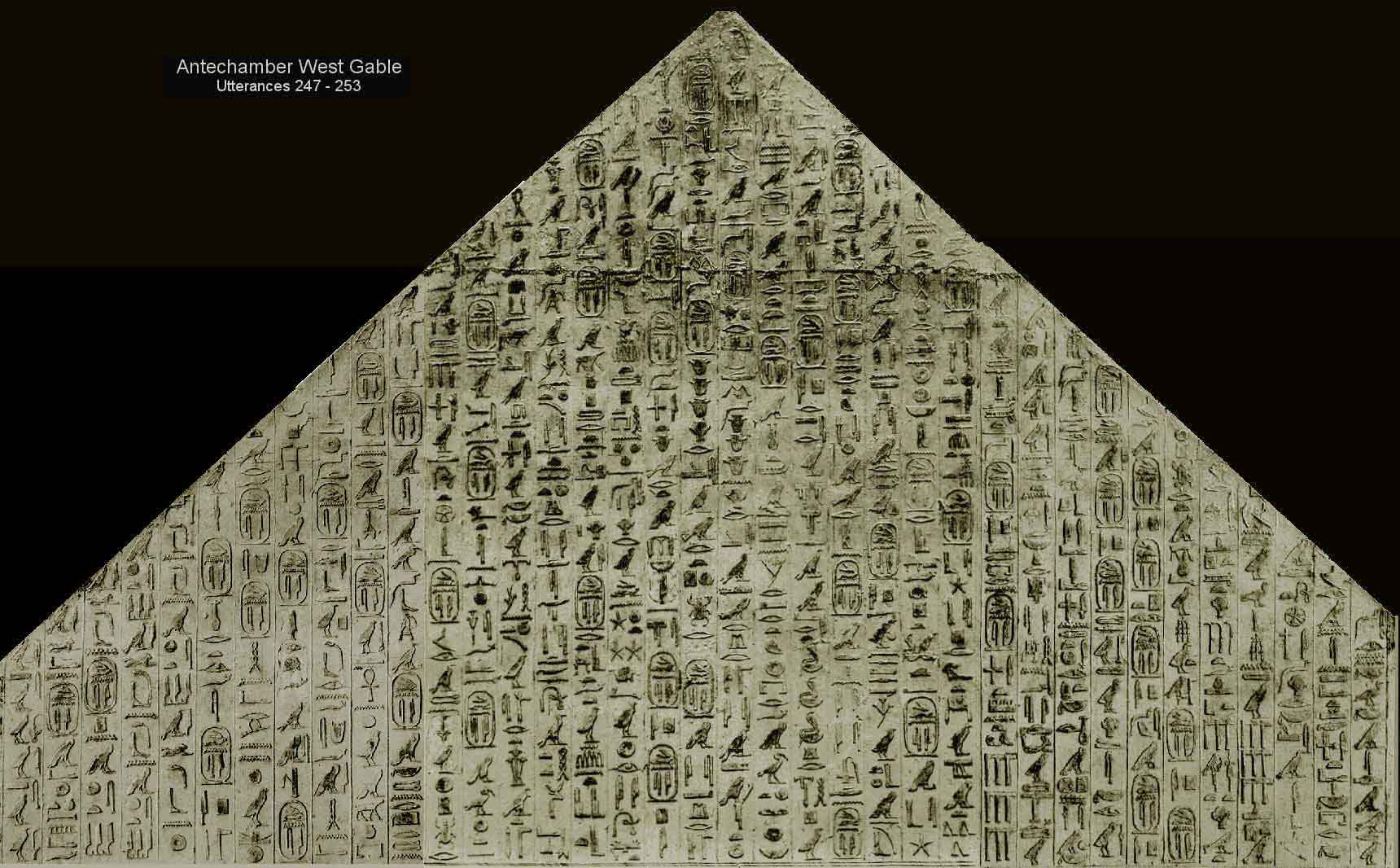
This entry is the west gable of the antechamber: 37 columns of hieroglyphs, Sethe's W 379-415, which follow each other from the right-hand (north) edge of the photograph. It holds the utterances 247, 248, 249, 250, 251, 252, 253.
Each section is one utterance. The Egyptian is the transliteration of the Thesaurus Linguae Aegyptiae (edition by Doris Topmann), with Sethe's Unas column number (W) before each column; a number ending in 'a' marks the offering label at the foot of a column. Signs restored by the editor are in square brackets, signs the scribe left out in angle brackets, damaged signs in half brackets. The English is Samuel A. B. Mercer's translation of 1952. Mercer translates Sethe's composite text made from all the pyramids that have an utterance, so his wording can include clauses that are not in the Unas copy, and his section numbers (134a, 134b ...) are Sethe's paragraph numbers, not column numbers; he writes 'N.' where the wall has the king's name. The photograph shows the whole wall; each section's note gives its columns counted from the edge where the text on that wall begins.
How was this verified? (Provenance)
Where on the image
Unas W 379-389: W 379-389 are columns 1-11 of the 37 columns on the photograph of the antechamber, west gable, counted from the right-hand (north) edge. Wall check (west gable): 37 columns under the gable, as many as W 379-415, from the right-hand (north) corner to the left-hand (south) corner. Checked on the image: the five columns at the right corner have no cartouche (W 379-383) and the sixth has two (W 384); the second and third columns from the left corner have one each (W 414, 413). Mercer's English renders Sethe's composite text of this utterance from all pyramids; it can contain words that are not in the Unas copy.
379ḏ〈d〉-mdw jri̯.n n =k zꜣ =k Ḥr,w sdꜣ wr.w
380mꜣ.n =sn šꜥ,t =k jm.t ꜥ =k pri̯ =k
381m dwꜣ,t j:nḏ ḥr =k sꜣj
382qmꜣ.n ṯw Gbb msi̯.n ṯw psḏ,t ḥtp Ḥr,w
383ḥr jt〈j〉 =f ḥtp 〈J〉tm〈,w〉 ḥr rnp,t.pl =f ḥtp nṯr.pl jꜣb,t〈j〉.w jmn,t〈j〉.w ḥr wr,t
384ḫpr.t m-ẖnw ꜥ.w msw,t nṯr Wnjs pj Wnjs
385mꜣ Wnjs pj Wnjs pt〈r〉 Wnjs pj sḏm Wnjs pj
386Wnjs wn jm Wnjs pj Wnjs ṯzi̯ ṯw ḥr gs =k jri̯ wḏ
387msḏḏ qdd sbꜣg.y ꜥḥꜥ jm〈,j〉 Ndj,t jri̯ tʾ =k nfr m P šzp sḫm =k
388m Jwn,w Ḥr,w pw wḏ n =f jr.t n jt〈j〉 =f nb qrj s〈ꜣ〉ḥ sn =f jsd wṯz =f ṯw
389swt wṯz =f 〈J〉tm〈,w〉
257aTo say: Thy son Horus has done (this) for thee.
257bThe great tremble when they have seen the sword which is in thy hand,
257cas thou comest forth from the Dwȝ-t.
258aGreetings to thee, wise one.
258bGeb has created thee; the Ennead have engendered thee.
258cHorus is satisfied with his father, (as) Atum is satisfied with his years.
258dThe gods of the East and West are satisfied with the great (thing) which is come to pass in the embrace of the divine mother (Nut).
259aN., O. N., (thou) who hast seen; N., O. N., (thou) who hast regarded;
259bN, O (thou) who hast heard; N., O N., (thou) who hast been there;
260aN., O N., lift thee up upon thy side, (thou) doer of command;
260b(thou) who hatest sleep, (thou) who art made tired, stand up, (thou) who art in Ndi.t.
260cThy fine bread is made (i.e. offered, cf. CT, I Spell 67, 286b) in Buto; take thy power in Heliopolis.
261aThis Horus commanded to do (this) for his father. The lord of tempest prevented the saliva of Set,
261bwhen he (Set) should carry thee. It is he who will carry the one who is (again) complete.
Where on the image
Unas W 389-391: W 389-391 are columns 11-13 of the 37 columns on the photograph of the antechamber, west gable, counted from the right-hand (north) edge. Wall check (west gable): 37 columns under the gable, as many as W 379-415, from the right-hand (north) corner to the left-hand (south) corner. Checked on the image: the five columns at the right corner have no cartouche (W 379-383) and the sixth has two (W 384); the second and third columns from the left corner have one each (W 414, 413). Mercer's English renders Sethe's composite text of this utterance from all pyramids; it can contain words that are not in the Unas copy.
389ḏ〈d〉-mdw Wnjs pj ꜥꜣ pri̯.n Wnjs jm,〈w〉tj mn,t.du psḏ,t
390jwr Wnjs jn Sḫm,t jn Šzm,tt msi̯.t Wnjs sbꜣ spd ḥꜣ,t ꜣwi̯ šm,t.pl
391jnn ḫr,t ḥr,t n Rꜥw rꜥw-nb jyi̯.n Wnjs r s,t =f tp.t nb,t.du ḫꜥi̯ Wnjs m sbꜣ
262aTo say; N. is great. N. has come forth from between the thighs of the Ennead.
262bN. was, conceived by Sekhmet, it is Šsmt.t who gave birth to N.,
263a(as) the star with piercing front (glance) and wide of stride, who brings provisions for (his) journey to Rē‘ every day.
263bN. has come to his throne, which is higher than (or, over, above) the two protective goddesses of Upper and Lower Egypt; N. appears (or, shines) as a star.
Where on the image
Unas W 392-396: W 392-396 are columns 14-18 of the 37 columns on the photograph of the antechamber, west gable, counted from the right-hand (north) edge. Wall check (west gable): 37 columns under the gable, as many as W 379-415, from the right-hand (north) corner to the left-hand (south) corner. Checked on the image: the five columns at the right corner have no cartouche (W 379-383) and the sixth has two (W 384); the second and third columns from the left corner have one each (W 414, 413). Mercer's English renders Sethe's composite text of this utterance from all pyramids; it can contain words that are not in the Unas copy.
392ḏ〈d〉-mdw j jꜣꜣ.wdu ḏd my n špsj m rn =f pw Wnjs pj nw n〈,j〉 zšzš wb〈n〉 m tꜣ wꜥb
393⸢šzp⸣ Wnjs jn jri̯ s,t =f Wnjs pj 〈j〉r〈,j〉 šr,t sḫm-wr jyi̯.n Wnjs m jw-nsjsj di̯.n Wnjs
394mꜣꜥ,t jm =f m s,t jzf,t Wnjs pj 〈j〉r〈,j〉 sšr.w zꜣꜣ jꜥr,t.pl grḥ pw
395n〈,j〉 ꜣgb,j wr pri̯ m wr,t ḫꜥi̯ Wnjs m Nfr-tm m zššn 〈j〉r〈,j〉 šr,t Rꜥw pri̯ =f m ꜣḫ,t rꜥw-nb
396wꜥb.w nṯr.pl n mꜣ =f
264aTo say: O ye two contestants, announce now to the honourable one in this his name:
264bN. is this sšsš-plant which springs from the earth.
264cThe hand of N. is cleansed by him who has prepared his throne.
265aN. it is who is at the nose of the powerful Great One.
265bN. comes out of the Isle of Flame,
265c(after) he, N., had set truth therein in the place of error.
265dN. it is who is the guardian of laundry, who protects the uraeus-serpents,
265ein the night of the great flood, which proceeds from the Great.
266aN. appears as Nefertem, as the flower of the lotus at the nose of Rē‘;
266bas he comes forth from the horizon every day, the gods purify themselves, when they see him.
Where on the image
Unas W 396-399: W 396-399 are columns 18-21 of the 37 columns on the photograph of the antechamber, west gable, counted from the right-hand (north) edge. Wall check (west gable): 37 columns under the gable, as many as W 379-415, from the right-hand (north) corner to the left-hand (south) corner. Checked on the image: the five columns at the right corner have no cartouche (W 379-383) and the sixth has two (W 384); the second and third columns from the left corner have one each (W 414, 413). Mercer's English renders Sethe's composite text of this utterance from all pyramids; it can contain words that are not in the Unas copy.
396ḏ〈d〉-mdw Wnjs p〈j〉 ḥr〈,j〉 kꜣ.pl dmḏ jb.pl n ḥr〈,j〉 sꜣ wr ẖr〈,j〉 mḏꜣ,t-nṯr Sjꜣ jmn,t Rꜥw
397jyi̯.n Wnjs r s,t =f ḥr.t kꜣ.pl dmḏ Wnjs jb.pl ḥr〈,j〉 sꜣ wr.t ḫpr Wnjs m Sjꜣ ẖr〈,j〉 mḏꜣ,t-nṯr
398jmn,t Rꜥw nḏḏ m-ꜥ Wnjs jn Wnjs ḏd jm.t jb wr,t m ḥ〈ꜣ〉b jns Wnjs pj Wnjs pj
399Sjꜣ jmn,t Rꜥw snk jb ḫnt〈,j〉 ṯpḥ,t Nw〈,w〉
267aTo say: "It is N. who is chief of the kas, who unites the hearts," so says be (or she) who is chief of the wise, the Great One,
267b"he who is in possession of the divine book, who knows, who is at the right of Rē‘."
267cN. comes to his throne, he is chief of the kas, N. unites the hearts, (so says she) who is chief of the wise, the Great One,
267dN. comes into being, he who knows, being in possession of the divine book, he who is at the right of Rē‘.
268aO thou who art vindicated by N.,
268bit is N. who says (is saying) what is in the heart of the Great One (Nut), at the Feast of Red Clothes,
268c(for) it is N., it is N., who knows, who is at the right of Rē‘;
268d(thus) the heart of the chief of the abyss of Nun is vexed.
Where on the image
Unas W 399-403: W 399-403 are columns 21-25 of the 37 columns on the photograph of the antechamber, west gable, counted from the right-hand (north) edge. Wall check (west gable): 37 columns under the gable, as many as W 379-415, from the right-hand (north) corner to the left-hand (south) corner. Checked on the image: the five columns at the right corner have no cartouche (W 379-383) and the sixth has two (W 384); the second and third columns from the left corner have one each (W 414, 413). Mercer's English renders Sethe's composite text of this utterance from all pyramids; it can contain words that are not in the Unas copy.
399ḏ〈d〉-mdw j ḥr〈,j〉.w wnw,t.pl tp〈,j〉.w-ꜥ Rꜥw jri̯.y wꜣ,t
400n Wnjs swꜣ Wnjs m-ẖnw pẖr,t n.t ꜥḥꜣ.w ḥr jw Wnjs r s,t{t} =f tw ḫnt〈.t〉 s,t.pl
401ḥꜣ〈.t〉 nṯr-⸢ꜥꜣ⸣ di̯ tp ḏbꜣ ḥnw,t spd.t nḫt ẖr〈,j〉 js ds spd zwꜣ ḥt,t wḏꜥ.t
402šn,w m-tp kꜣ sꜣhd.t jm〈,j〉.w kk,w ḥnw,t wsr.t ḥꜣ.t nṯr-ꜥꜣ
403jw dꜣ.n Wnjs zz.w sqr.n Wnjs ḥꜣ,t =sn n ḫsf ꜥ n〈,j〉 Wnjs m ꜣḫ,t
269aTo say: O ye, who are (set) over the hours, who are (go) before Rē‘, make (ready) the way for N.,
269bthat N. may pass through in the midst of the border guard of hostile mien.
270aN. is on the way to his throne, (like) one whose places are in front, who is behind the god, with bowed head,
270badorned with a sharp (and) strong antelope's horn,
270clike one in possession of a sharp knife, which cuts the throat.
270dThe driver-away (?) of suffering from the bull, the punisher of those in darkness,
270e(is) the strong antelope's horn, which is behind the Great God.
271aN. has reduced them to punishment; N. has crushed their head.
271bThe arm of N. will not be resisted in the horizon.
Where on the image
Unas W 404-410: W 404-410 are columns 26-32 of the 37 columns on the photograph of the antechamber, west gable, counted from the right-hand (north) edge. Wall check (west gable): 37 columns under the gable, as many as W 379-415, from the right-hand (north) corner to the left-hand (south) corner. Checked on the image: the five columns at the right corner have no cartouche (W 379-383) and the sixth has two (W 384); the second and third columns from the left corner have one each (W 414, 413). Mercer's English renders Sethe's composite text of this utterance from all pyramids; it can contain words that are not in the Unas copy.
404ḏ〈d〉-mdw fꜣi̯ ḥr =ṯn nṯr.pl jm〈,j〉.w dwꜣ,t jyi̯.n Wnjs mꜣ =ṯn sw ḫpr
405m nṯr-ꜥꜣ j:bz Wnjs m sdꜣ ḏbꜣ Wnjs m {k}〈nb〉 =ṯn r-ḏr =tn
406wḏ Wnjs mdw n rmṯ wḏꜥ Wnjs mdw n ꜥnḫ.w m-ẖnw
407jdb Rꜥw ḏd Wnjs r jdb pw wꜥb jri̯.n =f ḥms =f jm ḥnꜥ
408wpi̯ nṯr.du sḫm Wnjs jr tp =f ꜣms Wnjs
409twr =f Wnjs ḥmsi̯ Wnjs ḥnꜥ ẖnn.w Rꜥw
410wḏ Wnjs nfr,t jri̯ =f s〈j〉 Wnjs pj nṯr-ꜥꜣ
272aTo say: Lift up your head, ye gods, who are in the Dwȝ.t,
272bfor N. is come. Ye see him (how) he becomes as, a great god.
272cIntroduce N. with trembling; adorn N.,
273awho has honoured ye all, (as) he commanded mankind (also to do).
273bN. judges those who live in the midst of the land of Rē‘,
273cas N. speaks to this pure land, wherein he has established his residence, with the judge of the two gods,
274aN. is mighty in his presence; N. bears the ȝmś-sceptre, when he (Thot) would reject N.
274bN. sits with those who row Rē‘.
274cN. commands the good, and he (Thot) does it, (for) N. is the Great God.
Where on the image
Unas W 411-415: W 411-415 are columns 33-37 of the 37 columns on the photograph of the antechamber, west gable, counted from the right-hand (north) edge. Wall check (west gable): 37 columns under the gable, as many as W 379-415, from the right-hand (north) corner to the left-hand (south) corner. Checked on the image: the five columns at the right corner have no cartouche (W 379-383) and the sixth has two (W 384); the second and third columns from the left corner have one each (W 414, 413). Mercer's English renders Sethe's composite text of this utterance from all pyramids; it can contain words that are not in the Unas copy.
411ḏ〈d〉-mdw wꜥb.n wꜥb.n m sḫ,t-jꜣr,w wꜥb.n Rꜥw
412m sḫ,t-jꜣr,w wꜥb.n wꜥb.n m sḫ,t-jꜣr,w
413wꜥb.n Wnjs pn m sḫ,t-jꜣr,w
414ꜥ n〈,j〉 Wnjs m ꜥ Rꜥw Nw,t šzp ꜥ =f
415Šw sšwi̯ sw Šw sšwi̯ sw
275aTo say: He is pure, who was purified in the Marsh of Reeds.
275bRē‘ is purified in the Marsh of Reeds.
275cHe is pure, who was purified in the Marsh of Reeds.
275dThis N. is purified in the Marsh of Reeds.
275eThe hand of N. is in the hand of Rē‘; Nut takes his arm;
275fShu lifts him up; Shu lifts him up.
Notes
- Mercer's separate headings, postscripts and variants taken from other pyramids are left out.
- Letters follow the sacred-texts transcription of Mercer: ȝ stands for aleph and ‘ for ayin; letters underlined in the printed book are given as ḏ, ṯ, ẖ.
- Sethe's section numbers are kept as printed in that transcription, including a few misprints (for example '146.' for 141b in Utterance 215).
- The TLA has no hieroglyphic encoding for these texts, so only the transliteration is shown.
Cite
Sources
- Source: Pyramid of Unas, Saqqara, antechamber, west gable (photograph: L. F. Husson for A. Piankoff 1968, via Pyramid Texts Online) + TLA transliteration (ed. D. Topmann, CC BY-SA 4.0) + English of S. A. B. Mercer (1952, public domain in the US) (holding institution)
- Critical edition: Thesaurus Linguae Aegyptiae, ed. Doris Topmann (2018 data, AED-TEI)
← previous · → next · v cycle view · l back to library