Pyramid Texts of Unas: Utterances 244-246 (passage, south wall)
Introduction
The Pyramid Texts are the oldest large body of Egyptian religious writing: spells, called utterances, for the resurrection of the dead king, his protection, his meals and his ascent to the sky, cut in vertical columns of hieroglyphs on the walls of the burial apartments of late Old Kingdom pyramids. The pyramid of Unas at Saqqara, the last king of the 5th Dynasty (about 2375-2345 BCE), is the first to carry them. Its sarcophagus chamber, the passage to the antechamber, the antechamber and the corridor hold the columns of text that Sethe numbered W 1-649 (there is no W 129 or W 318). This library gives them wall by wall, in seventeen entries (227 different utterances, some of them inscribed more than once), with one gap: Utterance 271 (the end of W 492, all of W 493 and the top of W 494, on the south wall of the antechamber) is not in the Thesaurus Linguae Aegyptiae data used here, so it is not given. W 646 (corridor, east wall) has no column mark of its own in the TLA text; its words are given with W 645.
This entry is the south wall of the passage between sarcophagus chamber and antechamber: 19 columns of hieroglyphs, Sethe's W 360-378, which follow each other from the right-hand (west) edge of the photograph. It holds the utterances 244, 245, 246.
Each section is one utterance. The Egyptian is the transliteration of the Thesaurus Linguae Aegyptiae (edition by Doris Topmann), with Sethe's Unas column number (W) before each column; a number ending in 'a' marks the offering label at the foot of a column. Signs restored by the editor are in square brackets, signs the scribe left out in angle brackets, damaged signs in half brackets. The English is Samuel A. B. Mercer's translation of 1952. Mercer translates Sethe's composite text made from all the pyramids that have an utterance, so his wording can include clauses that are not in the Unas copy, and his section numbers (134a, 134b ...) are Sethe's paragraph numbers, not column numbers; he writes 'N.' where the wall has the king's name. The photograph shows the whole wall; each section's note gives its columns counted from the edge where the text on that wall begins.
How was this verified? (Provenance)
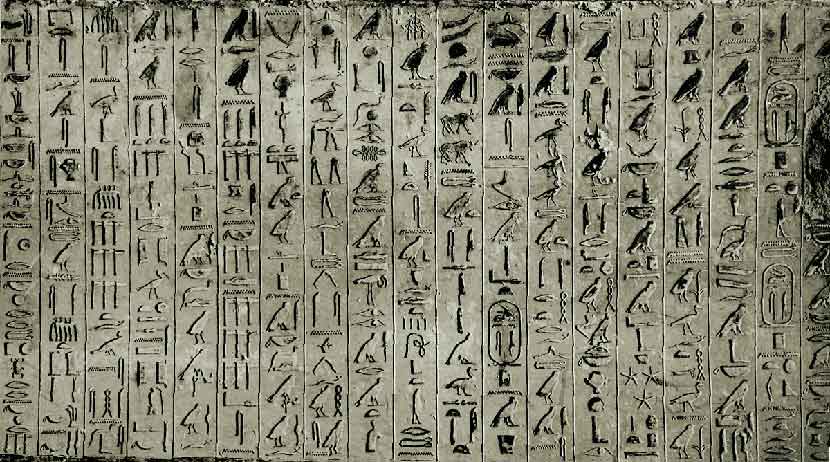
Where on the image
Unas W 360: W 360 is column 1 of the 19 columns on the photograph of the passage, south wall, counted from the right-hand (west) edge. Wall check (south wall): 19 columns (partial ones at both edges), W 360 at the right-hand (west) edge to W 378 at the left. Checked on the image: two cartouches in the second column from the right (W 361 'jyi̯ n=ṯ Wnjs pn Nw,t' twice), the three stars of sbꜣ.pl in the fifth (W 364) and a cartouche in mid-column in the eighth (W 367). Mercer's English renders Sethe's composite text of this utterance from all pyramids; it can contain words that are not in the Unas copy.
360jr〈,t〉 tw nn ⸢n⸣.[t] [Ḥr,w] [rwḏ.t] di̯ =〈j〉 n =k s〈j〉 〈j〉m〈j〉m =k nri̯ =f n =k
360asḏ dšr〈,t〉.pl
249aTo say: O Osiris N., this here is the [hard] eye of Horus.
249bTake it to thee that thou mayest be strong, (and) that he (Set) may fear thee.
Rubric. Breaking of two red jars.
Where on the image
Unas W 361-367: W 361-367 are columns 2-8 of the 19 columns on the photograph of the passage, south wall, counted from the right-hand (west) edge. Wall check (south wall): 19 columns (partial ones at both edges), W 360 at the right-hand (west) edge to W 378 at the left. Checked on the image: two cartouches in the second column from the right (W 361 'jyi̯ n=ṯ Wnjs pn Nw,t' twice), the three stars of sbꜣ.pl in the fifth (W 364) and a cartouche in mid-column in the eighth (W 367). Mercer's English renders Sethe's composite text of this utterance from all pyramids; it can contain words that are not in the Unas copy.
361jyi̯ n =ṯ Wnjs pn Nw,t jyi̯ n =ṯ Wnjs pn Nw,t qmꜣ.n =f jt〈j〉 =〈f〉 r tꜣ
362fḫ.n =f Ḥr,w m-ḫt =f rd ḏnḥ.du =f m b〈j〉k j〈w〉 šw,t.j =〈f〉
363m gmḥs,w jni̯.n sw bꜣ =f ḥtm.n sw
364ḥkꜣ.pl =f wpi̯ =k s,t =k m p,t m-ꜥb sbꜣ.pl n〈,j〉.w p,t
365n ṯwt js sbꜣ wꜥ,tj r rmn Nw,t ḥw ꜣ mꜣ =k ḥr-tp 〈W〉sjr
366wḏ =f mdw n ꜣḫ.pl ṯwt ꜥḥꜥ.tj ḥri̯.t〈j〉 r =f n ṯw jm =sn
367n wnn =k jm =sn
250aThis N. comes to thee Nut; this N. comes to thee Nut.
250bHe has thrown his father to the ground; he has left Horus behind him.
250cHis two wings are grown as (those of) a falcon; (his) two feathers as (those of) a gmḥśw-falcon.
250dHis ba has brought him (here); his magic power has equipped him.
251aThou openest thy place in heaven, among the stars of heaven;
251bthou art the only star, the companion of Ḥw; thou lookest down on Osiris,
251cas he commands the spirits. Thou standest there far from him.
251dThou are not of them; thou shalt not be of them.
Where on the image
Unas W 367-378: W 367-378 are columns 8-19 of the 19 columns on the photograph of the passage, south wall, counted from the right-hand (west) edge. Wall check (south wall): 19 columns (partial ones at both edges), W 360 at the right-hand (west) edge to W 378 at the left. Checked on the image: two cartouches in the second column from the right (W 361 'jyi̯ n=ṯ Wnjs pn Nw,t' twice), the three stars of sbꜣ.pl in the fifth (W 364) and a cartouche in mid-column in the eighth (W 367). Mercer's English renders Sethe's composite text of this utterance from all pyramids; it can contain words that are not in the Unas copy.
367mꜣ ꜥḥꜥ.t Wnjs pn m bꜣ
368ꜥb.du tp =f sm〈ꜣ〉.du n ṯwt js zj km zꜣ zj,t km.t
369msi̯.w zj,t bꜣq.t snq.w fd.t wꜣp,t jyi̯ r =ṯn
370Ḥr,w ḫsbḏ jr〈,t〉.du zꜣ ṯn Ḥr,w dš〈r〉 jr〈,t〉.du mr ꜣ,t
371n ḫsf bꜣ =f zj jn〈,w〉.pl =f bṯ sjn =f ḥww =sn
372n ḏsr rmn ḥr jꜣb,tt šm.t wꜥ pn jm〈,j〉 =k ḏd nṯr wḏ =f
373mdw n jt〈j〉.pl nṯr.pl j:gr n =k nṯr.pl di̯.n psḏ,t ꜥ =sn
374jr rʾ =sn tp-rd.du wꜥ pn jm〈,j〉 =k ḏd.w nṯr wḏ =f
375mdw n jt〈j〉.pl nṯr.pl ꜥḥꜥ r ꜥꜣ.du ꜣḫ,t j:zn ꜥꜣ.du qbḥ〈,w〉 ꜥḥꜥ =k
376ḫnt =sn Gbb js ḫnt〈,j〉 psḏ,t =f ꜥq =sn j:ḥ〈w〉 =sn sḏb
377pri̯ =sn fꜣi̯ =sn ḥr =sn mꜣ =sn ṯw Mnw js ḫnt〈,j〉 jtr〈,t〉.du ꜥḥꜥ ꜥḥꜥ ḥꜣ =k ꜥḥꜥ sn =k
378ḥꜣ =k ꜥḥꜥ n〈,j〉-s〈w〉 =k ḥꜣ =k n ski̯ =k n tm =k nḫj rn =k ḫr r〈m〉ṯ ḫpr rn =k ḫr nṯr.pl
252aSee, how N. stands there among (you), the two horns on him (like) two wild-bulls,
252bfor thou art the black ram, son of a black sheep.
252cborn of a white sheep, nursed by four sheep.
253aThe blue-eyed Horus comes against you; guard yourselves against the red-eyed Horus,
253bfurious in wrath, whose might no one withstands.
253cHis messengers go; his runner hastens.
253dThey announce to him who lifts up his arm in the East
254athat this One passes in thee of whom Dwn-‘n.wi said: "He shall command my (?) fathers, the gods."
254bThe gods are silent before thee; the Ennead lay their hands upon their mouth,
254cbefore this One in thee (of whom) Dwn-‘n.wi said: "He shall command my (?) fathers, the gods."
255aStand at the doorway of the horizon; open the double doors of ḳbḥ.w,
255bthat thou mayest stand at their (the gods') head, as Geb at the head of his Ennead--
255cthey (the gods) enter, they are smitten with fear; they depart, they lift up their head.
256aThey see thee like Min, chief of the two ’itr.t-palaces.
256bHe stands, he stands behind thee, thy brother stands behind thee, thy relative (nś) stands behind thee.
256cThou perishest not; thou art not destroyed.
256dThy name remains among men; thy name has its being among the gods.
Notes
- Mercer's separate headings, postscripts and variants taken from other pyramids are left out.
- Letters follow the sacred-texts transcription of Mercer: ȝ stands for aleph and ‘ for ayin; letters underlined in the printed book are given as ḏ, ṯ, ẖ.
- Sethe's section numbers are kept as printed in that transcription, including a few misprints (for example '146.' for 141b in Utterance 215).
- The TLA has no hieroglyphic encoding for these texts, so only the transliteration is shown.
Cite
Sources
- Source: Pyramid of Unas, Saqqara, passage between sarcophagus chamber and antechamber, south wall (photograph: L. F. Husson for A. Piankoff 1968, via Pyramid Texts Online) + TLA transliteration (ed. D. Topmann, CC BY-SA 4.0) + English of S. A. B. Mercer (1952, public domain in the US) (holding institution)
- Critical edition: Thesaurus Linguae Aegyptiae, ed. Doris Topmann (2018 data, AED-TEI)
← previous · → next · v cycle view · l back to library