Pyramid Texts of Unas: Utterances 220-224 (sarcophagus chamber, east wall)
Introduction
The Pyramid Texts are the oldest large body of Egyptian religious writing: spells, called utterances, for the resurrection of the dead king, his protection, his meals and his ascent to the sky, cut in vertical columns of hieroglyphs on the walls of the burial apartments of late Old Kingdom pyramids. The pyramid of Unas at Saqqara, the last king of the 5th Dynasty (about 2375-2345 BCE), is the first to carry them. Its sarcophagus chamber, the passage to the antechamber, the antechamber and the corridor hold the columns of text that Sethe numbered W 1-649 (there is no W 129 or W 318). This library gives them wall by wall, in seventeen entries (227 different utterances, some of them inscribed more than once), with one gap: Utterance 271 (the end of W 492, all of W 493 and the top of W 494, on the south wall of the antechamber) is not in the Thesaurus Linguae Aegyptiae data used here, so it is not given. W 646 (corridor, east wall) has no column mark of its own in the TLA text; its words are given with W 645.
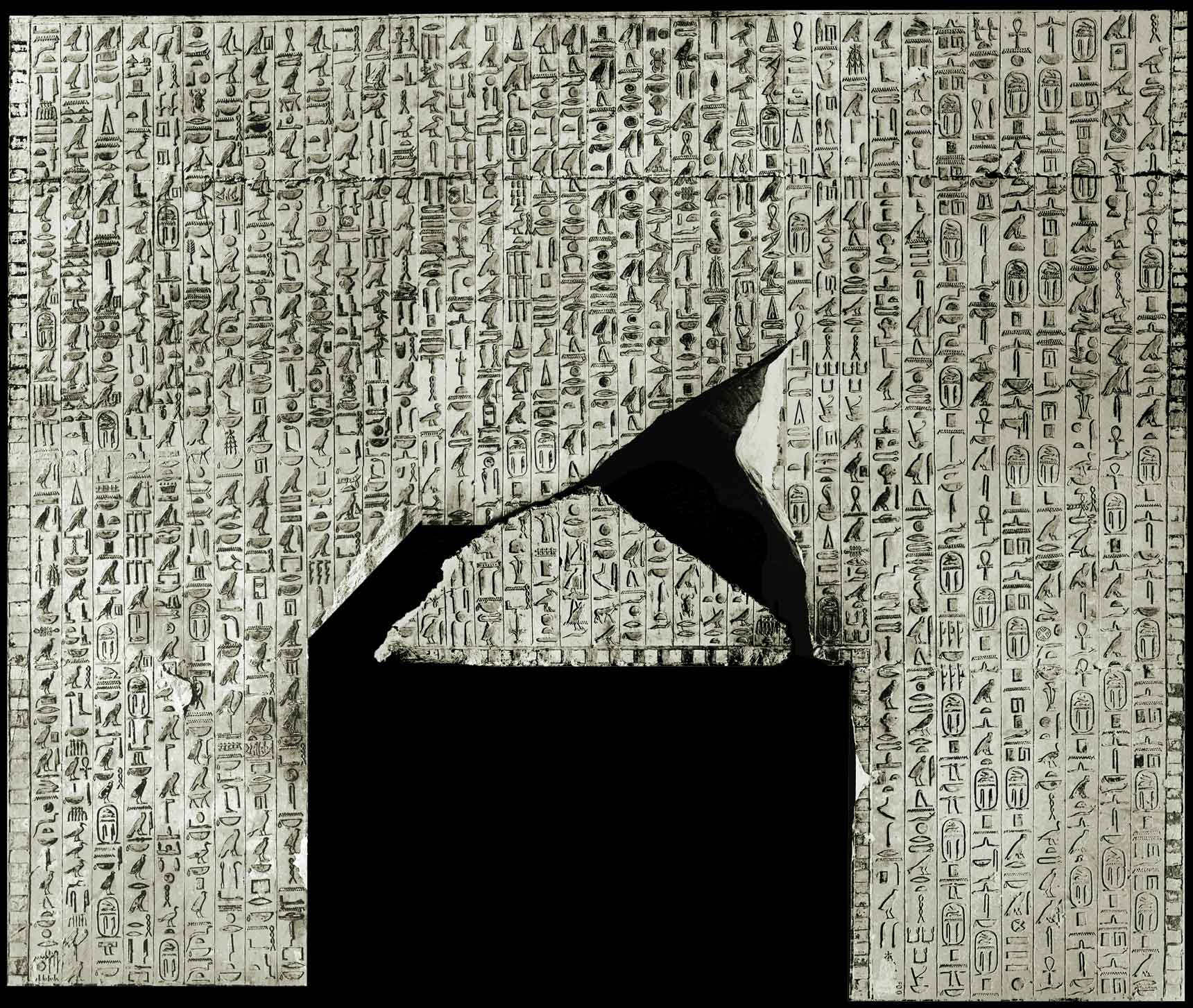
This entry is the east wall of the sarcophagus chamber: 38 columns of hieroglyphs, Sethe's W 262-299, which follow each other from the right-hand (south) edge of the photograph. It holds the utterances 220, 221, 222, 223, 224. The first seven columns at the right-hand end (W 262-268) carry the end of PT 219, which is given in full in the entry for the south wall.
Each section is one utterance. The Egyptian is the transliteration of the Thesaurus Linguae Aegyptiae (edition by Doris Topmann), with Sethe's Unas column number (W) before each column; a number ending in 'a' marks the offering label at the foot of a column. Signs restored by the editor are in square brackets, signs the scribe left out in angle brackets, damaged signs in half brackets. The English is Samuel A. B. Mercer's translation of 1952. Mercer translates Sethe's composite text made from all the pyramids that have an utterance, so his wording can include clauses that are not in the Unas copy, and his section numbers (134a, 134b ...) are Sethe's paragraph numbers, not column numbers; he writes 'N.' where the wall has the king's name. The photograph shows the whole wall; each section's note gives its columns counted from the edge where the text on that wall begins.
How was this verified? (Provenance)
Where on the image
Unas W 269-271: W 269-271 are columns 8-10 of the 38 columns on the photograph of the sarcophagus chamber, east wall, counted from the right-hand (south) edge. Wall check (east wall): 38 text columns between the palace-facade borders at both edges, W 262 at the right-hand (south) end to W 299 at the left-hand (north) end, around the doorway to the passage. Checked on the image: the second column from the left shows near its foot the three crested ibises of ꜣḫ.w in W 298, and 56 + 38 columns on the south and east walls equal W 206-299. Mercer's English renders Sethe's composite text of this utterance from all pyramids; it can contain words that are not in the Unas copy.
269wn ꜥꜣ.du ꜣḫ,t nḫbḫb qꜣ\n/,t.pl =s jwi̯.n =f ḫr =ṯ n,t jwi̯.n =f ḫr =t nzr,t jwi̯.n =f ḫr =ṯ wr,t jwi̯.n =f ḫr =ṯ wr,t-ḥkꜣ,w
270wꜥb n =ṯ snḏ n =ṯ ḥtp =ṯ ḥr =f ḥtp =ṯ ḥr ꜥb,w =f ḥtp =ṯ ḥr mdw =f j:ḏd =f n =ṯ nfr =w〈j〉 ḥr =ṯ ḥtp.tj mꜣ〈w〉i̯.tj rnpw.tj
271msi̯.n ṯm nṯr jt〈j〉 nṯr.pl jwi̯.n =f ḫr =ṯ wr,t-ḥkꜣ,w Ḥr,w pw šni̯ m zꜣ jr,t =f wr,t-ḥkꜣ,w
194aThe two doors of the horizon are open; its bolts slide.
I 94b. He has come to thee, N.t (Crown of Lower Egypt); he has come to thee, Nsr.t (Uraeus);
194che has, come to thee, Great One; he has come to thee, Great-in-magic (Crown of Lower Egypt).
194dHe is pure for thee; he is in awe of thee.
195aMayest thou be satisfied with him; mayest thou be satisfied with his purity;
195bmayest thou be satisfied with his word, which he speaks to thee:
195c"How beautiful is thy face, when it is peaceful, new, young, for a god, father of the gods, has begotten thee!"
195dHe has come to thee, Great-in-magic (Crown of Lower Egypt).
195eIt is Horus, who has fought in protection of his eye, Great-in-magic.
Where on the image
Unas W 272-277: W 272-277 are columns 11-16 of the 38 columns on the photograph of the sarcophagus chamber, east wall, counted from the right-hand (south) edge. Wall check (east wall): 38 text columns between the palace-facade borders at both edges, W 262 at the right-hand (south) end to W 299 at the left-hand (north) end, around the doorway to the passage. Checked on the image: the second column from the left shows near its foot the three crested ibises of ꜣḫ.w in W 298, and 56 + 38 columns on the south and east walls equal W 206-299. Mercer's English renders Sethe's composite text of this utterance from all pyramids; it can contain words that are not in the Unas copy.
272hj n,t hj jn hj wr,t hj wr,t-ḥkꜣ〈,w〉 hj nzr,t ḏi̯ =ṯ šꜥ,t Wnjs
273mr šꜥ,t =ṯ ḏi̯ =ṯ snḏ Wnjs pn mj snḏ =ṯ ḏi̯ =ṯ kj,t Wnjs pn mj kj,t =ṯ
274ḏi̯ =ṯ mrw,t Wnjs pn mj mrw,t =ṯ ḏi̯ =ṯ ꜥbꜣ =f ḫnt ꜥnḫ.w [ḏi̯] =[ṯ] [sḫm] =f ḫnt
275ꜣḫ.pl ḏi̯ =ṯ rwḏ ds =f r ḫft〈,j〉.w =f hj jn pri̯.n =[ṯ] [jm] =[f] [pri̯.n] =[f] [jm] =[ṯ] [msi̯.n] [ṯw] Jḫ,t-wr.t
276sškr.n ṯw Jḫ,t-wt,t msi̯.n ṯw Jḫ,t-w[t,t] [sškr.n] [ṯw] Jḫ,t-wr.t
277n ṯwt js Ḥr,w šni̯ m zꜣ jr,t =f
196aTo say: O N.t (Crown of Lower Egypt), O ’Inw (Crown of Lower Egypt), O Great One (Crown of Lower Egypt),
196bO Great-in-magic (Crown of Lower Egypt), O Nsr.t (Uraeus),
197amake thou the terror of N. to be like the terror of thee;
197bmake thou the awe of N. to be like the awe of thee;
197cmake thou the respect for N. to be like the respect for thee;
197dmake thou the love for N. to be like the love for thee;
197emake thou that his ‘bȝ-sceptre be at the head of the living; make thou that his śḫm-sceptre be at the head of the spirits;
197fmake thou that his blade be firm against his enemies.
198aO ’Inw-Crown, thou has come forth from him as he came forth from thee.
198bThe great ’Iḫ.t has given birth to thee, the ’Iḫ.t-wt.t has adorned thee;
198cthe ’Iḫ.t-wt.t has given birth to thee, the great ’Iḫ.t has adorned thee,
198dfor as for thee, thou art like Horus, who fought in protection of his eye.
Where on the image
Unas W 277-294: W 277-294 are columns 16-33 of the 38 columns on the photograph of the sarcophagus chamber, east wall, counted from the right-hand (south) edge. Wall check (east wall): 38 text columns between the palace-facade borders at both edges, W 262 at the right-hand (south) end to W 299 at the left-hand (north) end, around the doorway to the passage. Checked on the image: the second column from the left shows near its foot the three crested ibises of ꜣḫ.w in W 298, and 56 + 38 columns on the south and east walls equal W 206-299. Mercer's English renders Sethe's composite text of this utterance from all pyramids; it can contain words that are not in the Unas copy.
277ḏ〈d〉-mdw ꜥḥꜥ =k ḥr =f tꜣ pn [pri̯] [m] [〈J〉tm〈,w〉] [nšš] pri̯ m Ḫprr
278ḫpr =k ḥr =f qꜣi̯ =k ḥr =f mꜣ ṯw jt〈j〉 =k mꜣ ṯw [Rꜥw] [jwi̯].n =f ḫr =k jt〈j〉 =f
279jwi̯.n =f ḫr =k Rꜥw jwi̯.n =f ḫr =k jt〈j〉 =f jwi̯.n =f ḫr =k Ndj jwi̯.n =[f] [ḫr] =[k] [j]t〈j〉 =f jwi̯.n =f ḫr =k
280Pndn jwi̯.n =f ḫr =k jt〈j〉 =f jwi̯.n =f ḫr =k Dndn jwi̯.n =f ḫr =k jt〈j〉 =f [j]wi̯.n =f ḫr =k smꜣ-wr
281jwi̯.n =f ḫr =k jt〈j〉 =f jwi̯.n =f ḫr =k zḫn-wr jwi̯.n =f ḫr =k jt〈j〉 =f jwi̯.n =f ḫr =k Spd,w
282jwi̯.n =f ḫr =k jt〈j〉 =f jwi̯.n =f ḫr =k spd-jbḥ.pl ḏi̯ =k nḏri̯ Wnjs pn qbḥ〈,w〉 šzp =f ꜣḫ,t
283ḏi̯ =k jꜣq Wnjs pn 9,t ḥt〈m〉 =f psḏ,t ḏi̯ =k ꜥw,t m ꜥ Wnjs pn wꜣḥ.t tp mḥ,w ḥnꜥ šmꜥ,w
284hꜣi̯ =f ḫsf =f ꜥḥꜥ =f ḥr〈,j〉-tp wr,w m wr,w =f ḥzi̯.n sw Nb〈,t〉-ḥw〈,t〉 šdi̯.n =f ḫsf ḥtm.{tj}n =k ṯw
285m wr-ḥkꜣ〈,w〉 Stẖ jm〈,j〉 Nb〈w〉,t nb tꜣ-smꜥ〈,w〉 n fḫ.tj n =k n j〈ꜣ〉b.t n =k m ṯw jr =k bꜣ.tj sḫm.tj
286r nṯr.pl šmꜥ〈,w〉 ꜣḫ.pl =sn jsṯ nšnš.n jwr,t j:spš.n =k grḥ ḥtm.tj m Stẖ ⸢š⸣[bšb] ⸢wꜣ⸣ḏ =wj
287ḥzi̯.n 〈Ꜣ〉s,t ḥtm.n =k ṯw m Ḥr〈,w〉-ḥwn,tj n ḥm fḫ.tj n =k n ḥm [jꜣb.tj] n =k
288m ṯw jr =k bꜣ.tj sḫm.tj r nṯr.pl mḥ,t〈j〉.w ꜣḫ.pl =sn jsṯ j:fḫ =k ꜥb〈,w〉 =k n 〈J〉tm〈,w〉 m [Jwn,w] [hꜣi̯] =[k]
289ḥnꜥ =f wḏꜥ =k mꜣr.w nn,t ꜥḥꜥ =k ḥr s,t.pl nj,w ḫpr =k ḥnꜥ jt〈j〉 =k 〈J〉tm〈,w〉 qꜣi̯ =k ḥnꜥ j[t〈j〉] =[k] [〈J〉tm〈,w〉]
290wbn =k ḥnꜥ jt〈j〉 =k 〈J〉tm〈,w〉 j:fḫ n =k mꜣr.w tp =k n rpw,t jwn.t pri̯ =k wpi̯ =k wꜣ,t =k m qs.pl Šw
291šni̯ ṯw ẖnw-ꜥ.w mʾ〈w〉,t =k Nw,t wꜥb =k m ꜣḫ,t sfḫ =k ꜥb〈,w〉 =k m šj.pl Šw pri̯ =k hꜣi̯ =k hꜣi̯.w =k ḥnꜥ Rꜥw snk,w〈j〉 ḥnꜥ Ndj pri̯ =k
292hꜣi̯.w =k pri̯ =k ḥnꜥ Rꜥw wbn =k ḥnꜥ zḫn-wr pri̯ =k hꜣi̯ =k hꜣi̯.w =k ḥnꜥ Nb〈,t〉-ḥw〈,t〉 snk,w〈j〉 ḥnꜥ msk,tt pri̯ =k hꜣi̯.w =k pri̯ =k ḥnꜥ 〈Ꜣ〉s,t
293wbn =k ḥnꜥ mꜥnḏ,t sḫm =k m ḏ,t =k n jm〈,j〉-rd =k msi̯ =k n Ḥr〈,w〉 jwr =k n Stẖ wꜥb.n =k m Jmn,tt šzp.n =k ꜥb〈,w〉 =k m ḥqꜣ-ꜥnḏ ḫr jt〈j〉 =k
294ḫr 〈J〉tm〈,w〉 ḫpr.n =k qꜣi̯.n =k ꜣḫ.n =k qbb.n{n} =k m-ẖnw ꜥ.du jt〈j〉 =k m-ẖnw ꜥ.du 〈J〉tm〈,w〉 〈J〉tm〈,w〉 sjꜥ n =k Wnjs pn šni̯ n =k sw m-ẖnw ꜥ.du =k zꜣ =k pw n〈,j〉 ḏ,t =k n ḏ,t
199aTo say: Stand thou upon it, this earth, which comes forth from Atum, the saliva which comes forth from Ḫprr;
199bbe thou above it; he thou high above it,
199cthat thou mayest see thy father; that thou mayest see Rē‘.
200aHe has come to thee, his father; he has come to thee, Rē‘.
200bHe has come to thee, his father; he has come to thee, Ndi.
200cHe has come to thee, his father; he has come to thee, Pndn.
200dHe has come to thee, his father; he has come to thee, Dndn.
201aHe has come to thee, his father; he has come to thee, Śmȝ-wr.
201bHe has, come to thee, his father; he has come to thee, Sḫn-wr.
201cHe has come to thee, his father; he has come to thee, Sopdu.
201dHe has come to thee, his father; he has come to thee, Sharp of Teeth.
202aCause thou that N. seize ḳbḥ.w, that he take the horizon;
202bcause thou that N. govern the Nine Bows, that he equip the Ennead;
202ccause thou that the shepherd's crook be in the hand of N., so that Lower Egypt and Upper Egypt may bow (before him).
203aHe accepts ("takes on") his opponent and stands up, the great chief, in his great kingdom;
203bNephthys praised him when he seized his opponent:
204a"Thou hast equipped thyself as the Great-in-magic, Set, who is in Ombos, lord of the land of the South;
204bnothing is lacking in thee; nothing ceases with thee,
204cfor behold thou art more glorious, more powerful than the gods of Upper Egypt and their spirits.
205aThou whom the pregnant brought forth, as thou didst cleave the night,
205bthou art equipped like Set, who mightily broke forth". Fortunate is he whom Isis has praised:
206a"Thou hast equipped thyself like Horus, the youthful,
206bnor is there anything lacking in thee, nor anything ceases with thee,
206cfor behold thou art more glorious, more powerful than the northern gods and their spirits.
207aThou puttest away thine uncleanness for Atum in Heliopolis, thou ascendest with him;
207bthou judgest distress in the underworld,. thou standest above the places of the abyss;
207cthou art (king) with thy father Atum, thou art high with thy father Atum;
207dthou appearest with thy father Atum, distress disappears.
207eThe midwife of Heliopolis (holds) thy head.
208aThou ascendest, thou openest thy way through the bones of Shu;
208bthou envelopest thyself in the embrace of thy mother Nut;
208cthou purifiest thyself in the horizon, thou puttest away thine impurity in the lakes of Shu.
209aThou risest, thou settest, thou settest with Rē‘, in obscurity with Ndi;
209bthou risest, thou settest, thou risest with Rē‘,
209cthou appearest with Sḫn-wr;
210athou risest, thou settest, thou settest with Nephthys, in obscurity with the mśkt.t-boat;
210bthou risest, thou settest, thou risest with Isis;
210cthou appearest with the m‘nḏ.t-boat.
211aThou art master of thyself; there is no one in thy way.
211bThou art born because of (like) Horus; thou art conceived because of (like) Set;
211cThou didst purify thyself in the Falcon-nome; thou didst receive thy purification in the Nome of the Integral Ruler, from thy father, from Atum.
212aThou hast come into being, thou hast become high, thou hast become content;
212bthou hast become well in the embrace of thy father, in the embrace of Atum.
213aAtum, let N. ascend to thee, enfold him in thine embrace,
213bfor he is thy bodily son for ever".
Where on the image
Unas W 295-297: W 295-297 are columns 34-36 of the 38 columns on the photograph of the sarcophagus chamber, east wall, counted from the right-hand (south) edge. Wall check (east wall): 38 text columns between the palace-facade borders at both edges, W 262 at the right-hand (south) end to W 299 at the left-hand (north) end, around the doorway to the passage. Checked on the image: the second column from the left shows near its foot the three crested ibises of ꜣḫ.w in W 298, and 56 + 38 columns on the south and east walls equal W 206-299. Mercer's English renders Sethe's composite text of this utterance from all pyramids; it can contain words that are not in the Unas copy.
295ḏ〈d〉-mdw wḥ j:nn jh jh hꜣ Wnjs ꜥḥꜥ ḥmsi̯ r ḫꜣ m tʾ ḫꜣ m ḥ〈n〉q,t ꜣšr,t šb,t〈j〉w =k m pr nm,t tʾ-jtḥ m wsḫ〈,t〉 ḥtm nṯr m ḥtp-nṯr ḥtm Wnjs
296m tʾ =f pn jyi̯.t〈j〉 n bꜣ =k 〈W〉sjr bꜣ jm〈,j〉 ꜣḫ.pl sḫ〈m〉 jm〈,j〉 s,t.pl =f nḏ.w psḏ〈,t〉 m ḥw〈,t〉-sr hꜣ Wnjs sjꜥ kw n =〈j〉 j:mz kw r =〈j〉 m ḥri̯ r jz
297j:mḏr =k jr =〈j〉 ḏi̯.n =〈j〉 n =k jr,t-Ḥr〈,w〉 jp.n =〈j〉 n =k s〈j〉 hꜣ nḫḫ n =k ḫr =k hꜣ Wnjs ꜥḥꜥ šzp n =k tʾ =k pn m ꜥ =〈j〉 hꜣ Wnjs wn〈n〉 =〈j〉 n =k m ꜥꜣ
214aTo say: Awake. Turn around. O! O!
214bO N., up, be seated before a thousand. loaves, a thousand mugs of beer;
214cthe roast, thy double-rib piece (comes) from the slaughtering-bench, the rtḥ-bread from the broad-hall (wśḫ.t).
25aAs a god is provided with divine offerings, so N. is provided with his bread.
215bThou art come to thy ba, Osiris, a ba among the spirits, mighty in his domains,
215cprotected by the Ennead in the house of the prince.
216aO N., betake thyself to me, approach thyself to me,
216bbe not far from the tomb, be not separated from me.
216cI have given thee the eye of Horus; I have reckoned it to thee. O may it be pleasing to thee, with thee.
217aO N., up, receive thy bread from (my) hand.
217bTo say four times: O N., I will be to thee a door-keeper.
Where on the image
Unas W 297-299: W 297-299 are columns 36-38 of the 38 columns on the photograph of the sarcophagus chamber, east wall, counted from the right-hand (south) edge. Wall check (east wall): 38 text columns between the palace-facade borders at both edges, W 262 at the right-hand (south) end to W 299 at the left-hand (north) end, around the doorway to the passage. Checked on the image: the second column from the left shows near its foot the three crested ibises of ꜣḫ.w in W 298, and 56 + 38 columns on the south and east walls equal W 206-299. Mercer's English renders Sethe's composite text of this utterance from all pyramids; it can contain words that are not in the Unas copy.
297ḏ〈d〉-mdw wḥ kw Wnjs j:nn kw Wnjs šmi̯ n =k
298wḏ =k mdw n jꜣ,t.pl Ḥr〈,w〉 šmi̯ n =k wḏ =k mdw n jꜣ,t.pl Stẖ šmi̯ n =k wḏ =k mdw n jꜣ,t.pl 〈W〉sjr ḥtp-ḏi̯-nzw m sꜥḥ =k nb m s,t.pl =k nb〈.t〉 nḥb,t =k ḫnt ꜥnḫ.w mdw =k ḫnt ꜣḫ.pl Jnp〈,w〉 js ḫnt〈,j〉 jmn,t〈j〉w
299Ꜥnḏ,t〈j〉 js ḫnt〈,j〉 zpꜣ,t.pl jꜣb,t.t ḥtp =w ḫr,t =k ꜣḫ =k hꜣ Wnjs m-ꜥb sn.pl =k nṯr.pl nš =w s〈j〉 nš =w s〈j〉 j:nḏ ms.w ={nb}〈k〉 zꜣu̯ ṯw ḏr =k pw jm〈,j〉 tꜣ wnḫ ḏ,t ={nb}〈k〉 jwt =k ḫr =sn 〈ḏ〈d〉-mdw〉 zp 4
218cTo say: Awake, N. Turn around, N.
218dThou hast come that thou mayest command in the regions of Horus;
218ethou hast come that thou mayest command in the regions of Set;
218fthou hast come that thou mayest command in the regions of Osiris.
219aMay the king make an offering: "in all thy dignities".
219bThy garment is a bȝ-loin-cloth; thy garment is a hśdd-loincloth;
219cthou goest in sandals; thou slaughterest an ox;
220athou goest in the wȝḏ-'n-boat, in all thy dignities, in all thy places.
220bThy nḥb.t-sceptre is at the head of the living, thy staff is at the head of the spirits,
220clike Anubis, First of the Westerners; like ‘nḏ.ti, First of the Eastern nomes.
221aHow fortunate is thy condition! Thou art a spirit, O N., among thy brothers, the gods.
221bHow changed it is! How changed it is! (So) protect thy children; beware of
221cthy border (limitation) which is in the earth. To say four times: Clothe thy body (and) come into their presence.
Notes
- Mercer's separate headings, postscripts and variants taken from other pyramids are left out.
- Letters follow the sacred-texts transcription of Mercer: ȝ stands for aleph and ‘ for ayin; letters underlined in the printed book are given as ḏ, ṯ, ẖ.
- Sethe's section numbers are kept as printed in that transcription, including a few misprints (for example '146.' for 141b in Utterance 215).
- The TLA has no hieroglyphic encoding for these texts, so only the transliteration is shown.
Cite
Sources
- Source: Pyramid of Unas, Saqqara, sarcophagus chamber, east wall (photograph: L. F. Husson for A. Piankoff 1968, via Pyramid Texts Online) + TLA transliteration (ed. D. Topmann, CC BY-SA 4.0) + English of S. A. B. Mercer (1952, public domain in the US) (holding institution)
- Critical edition: Thesaurus Linguae Aegyptiae, ed. Doris Topmann (2018 data, AED-TEI)
← previous · → next · v cycle view · l back to library