Pyramid Texts of Unas: Utterances 213-219 (sarcophagus chamber, south wall)
Introduction
The Pyramid Texts are the oldest large body of Egyptian religious writing: spells, called utterances, for the resurrection of the dead king, his protection, his meals and his ascent to the sky, cut in vertical columns of hieroglyphs on the walls of the burial apartments of late Old Kingdom pyramids. The pyramid of Unas at Saqqara, the last king of the 5th Dynasty (about 2375-2345 BCE), is the first to carry them. Its sarcophagus chamber, the passage to the antechamber, the antechamber and the corridor hold the columns of text that Sethe numbered W 1-649 (there is no W 129 or W 318). This library gives them wall by wall, in seventeen entries (227 different utterances, some of them inscribed more than once), with one gap: Utterance 271 (the end of W 492, all of W 493 and the top of W 494, on the south wall of the antechamber) is not in the Thesaurus Linguae Aegyptiae data used here, so it is not given. W 646 (corridor, east wall) has no column mark of its own in the TLA text; its words are given with W 645.
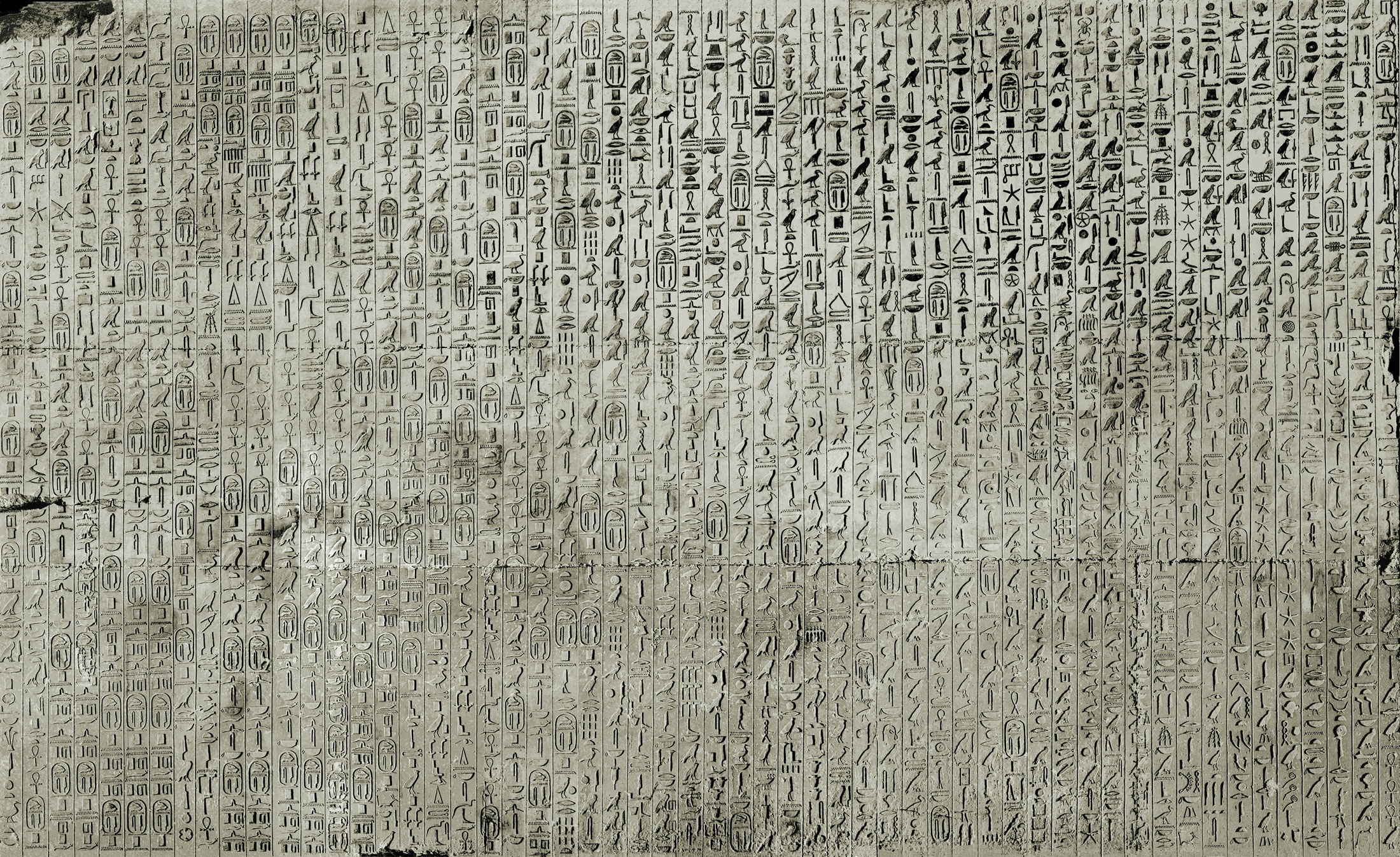
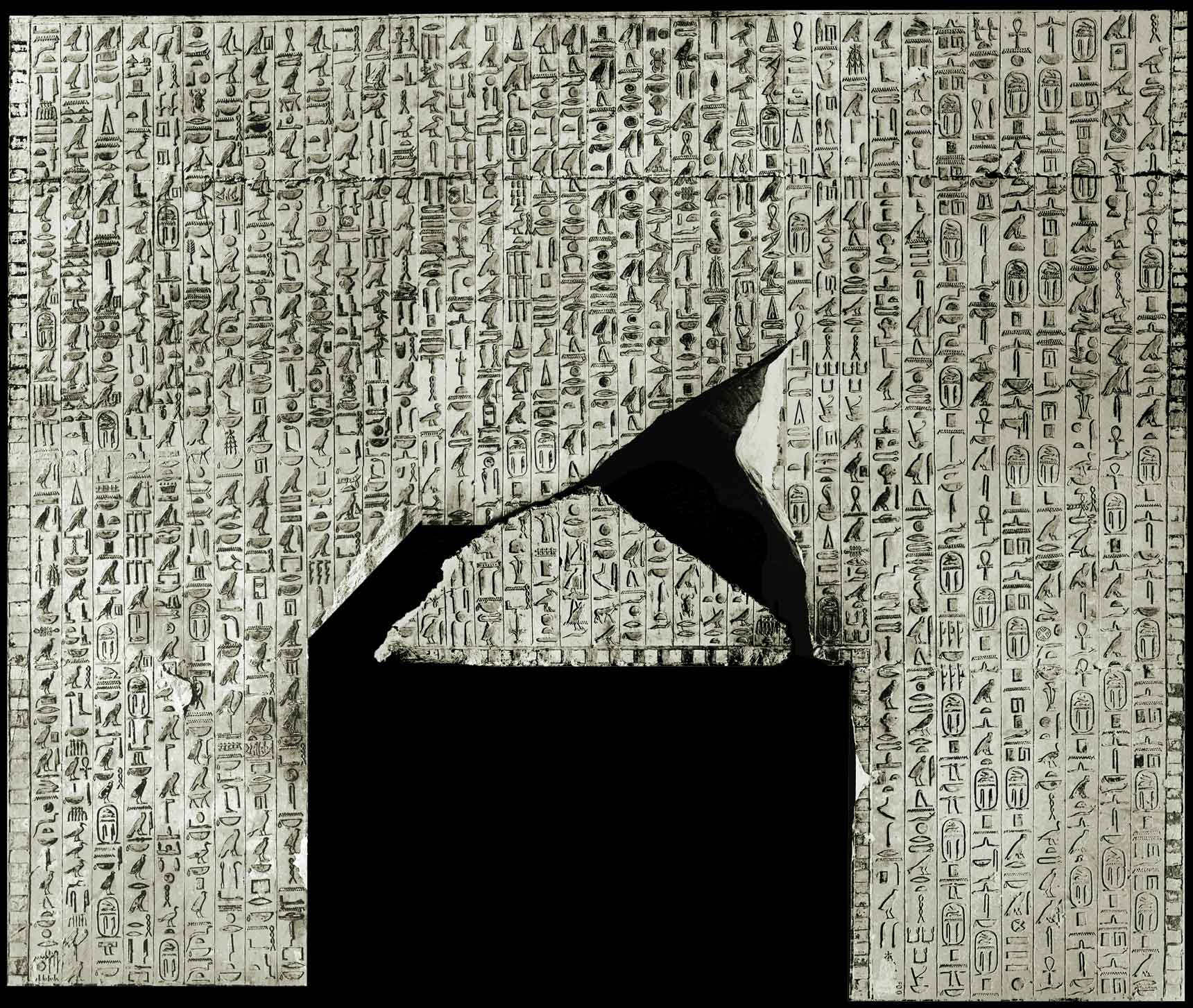
This entry is the south wall of the sarcophagus chamber: 56 columns of hieroglyphs, Sethe's W 206-261, which follow each other from the right-hand (west) edge of the photograph. It holds the utterances 213, 214, 215, 216, 217, 218, 219. PT 219, the long litany of Osiris, continues round the corner onto the east wall (W 262-268); it is given here in full, with both photographs.
Each section is one utterance. The Egyptian is the transliteration of the Thesaurus Linguae Aegyptiae (edition by Doris Topmann), with Sethe's Unas column number (W) before each column; a number ending in 'a' marks the offering label at the foot of a column. Signs restored by the editor are in square brackets, signs the scribe left out in angle brackets, damaged signs in half brackets. The English is Samuel A. B. Mercer's translation of 1952. Mercer translates Sethe's composite text made from all the pyramids that have an utterance, so his wording can include clauses that are not in the Unas copy, and his section numbers (134a, 134b ...) are Sethe's paragraph numbers, not column numbers; he writes 'N.' where the wall has the king's name. The photograph shows the whole wall; each section's note gives its columns counted from the edge where the text on that wall begins.
How was this verified? (Provenance)
Where on the image
Unas W 206-208: W 206-208 are columns 1-3 of the 56 columns on the photograph of the sarcophagus chamber, south wall, counted from the right-hand (west) edge. Wall check (south wall): 56 columns on the photograph (the leftmost partly cut by the edge), W 206 at the right-hand (west) end to W 261 at the left-hand (east) end; with the 38 columns of the east wall this gives exactly W 206-299. Checked on the image: the rightmost column opens with hꜣ and the Unas cartouche and ends with three ankh signs (ꜥnḫ.w, end of W 206); the next column repeats the owl and sledge of 'm Jtm' (W 207). Mercer's English renders Sethe's composite text of this utterance from all pyramids; it can contain words that are not in the Unas copy.
206hꜣ Wnjs n šmi̯.n =k js m〈w〉t.tj šmi̯.n =k ꜥnḫ.t ḥmsi̯ ḥr ḫnd 〈W〉sjr ꜥbꜣ =k m ꜥ =k wḏ =k mdw n ꜥnḫ.w
207mks nḥb,t =k m ꜥ =k wḏ =〈k〉 mdw n štꜣ.w-s,t.pl ꜥ =k m 〈J〉tm〈,w〉 rmn.du =k m 〈J〉tm〈,w〉 ẖ,t =k m 〈J〉tm〈,w〉 sꜣ =k m 〈J〉tm〈,w〉 pḥ =k m 〈J〉tm〈,w〉 rd.du =k m 〈J〉tm〈,w〉 ḥr =k m Jnp〈,w〉
208pẖr n =k jꜣ,t.pl Ḥr〈,w〉 pẖr n =k jꜣ,t.pl Stẖ
134aO N., thou didst not depart dead; thou didst depart living,
134b(so) thou sittest upon the throne of Osiris, thy ‘bȝ-sceptre in thy hand, thou commandest the living;
134c(thy) mkś-sceptre and thy nḥb.t-sceptre in thy hand, commanding those of secret places.
135aThine arm is like that of Atum; thy shoulders are like those of Atum; thy body is like that of Atum; thy back is like that of Atum;
135bthy seat is like that of Atum; thy legs are like those of Atum; thy face is like that of Anubis.
135cThou travelest over the regions of Horus; thou travelest over the regions of Set (or, the regions of Horus serve thee; the regions of Set serve thee).
Where on the image
Unas W 208-212: W 208-212 are columns 3-7 of the 56 columns on the photograph of the sarcophagus chamber, south wall, counted from the right-hand (west) edge. Wall check (south wall): 56 columns on the photograph (the leftmost partly cut by the edge), W 206 at the right-hand (west) end to W 261 at the left-hand (east) end; with the 38 columns of the east wall this gives exactly W 206-299. Checked on the image: the rightmost column opens with hꜣ and the Unas cartouche and ends with three ankh signs (ꜥnḫ.w, end of W 206); the next column repeats the owl and sledge of 'm Jtm' (W 207). Mercer's English renders Sethe's composite text of this utterance from all pyramids; it can contain words that are not in the Unas copy.
208hꜣ Wnjs zꜣu̯ k〈w〉 šj ḏ〈d〉-mdw zp 4 jy wp〈w〉,t.pl kꜣ =k jr =k jy wp〈w〉,t.pl jt =k jr =k jy wp〈w〉,t.pl Rꜥw jr =k j:zj
209m-ḫt rꜥw =k wꜥb =k jr =k qs.pl =k b〈j〉k,t.pl nṯr.tpl jm.t p,t wn =k jr gs nṯr j:fḫ =k pr =k n zꜣ =k n tṯ,t =k mdwi̯.t =f nb
210m rn n Wnjs ḏwi̯ pri̯ ={k}〈f〉 wḏ.n sw Gbb m twꜣ m nʾ.t jr.t ḥmi̯ =f nn =f wꜥb =k jr =k m qbḥ sbꜣ.pl hꜣi̯ =k ḥr nwḥ.wpl bjꜣ
211ḥr rmn.du Ḥr〈,w〉 m rn =f jm〈,j〉 ḥnw kj.w n =k ḥnmm,t wṯz.n kw j:ḫm.pl-sk jꜣq jr =k jr bw ẖr〈,j〉 jt =k jr bw ẖr〈,j〉
212Gbb ḏi̯ =f n =k jm.t ḥꜣ,t Ḥr〈,w〉 bꜣ =k jm =s sḫm =k jm =s wn =k jm =s ḫnt jmn,t〈j〉w
136aO N., beware of the ocean (sea?). To say four times.
136bThe messengers of thy ka are come for thee; the messengers of thy father are come for thee; the messengers of Rē‘ are come for thee.
137aGo after (pursue) thy sun (days); purify thyself,
137b(for) thy bones are (those of) female-falcons, goddesses, who are in heaven,
137cthat thou mayest be at the side of the god; that thou mayest leave thy house to thy son
137dwho is thine heir. Everyone who speaks, evil against the name of N.,
138awhen he ascends, Geb reckons him as an evil-doer in his own city,
138bso that he weakens, he falters. Thou purifiest thyself in the dew of the stars;
138cthou descendest on firm (copper?) cables, on the shoulders of Horus in his name of "He who is in the Ḥnw-boat."
139aThe blessed dead (?) lament for thee (after) the imperishable stars bore thee (away).
139bEnter the abode of thy father, to the abode of Geb,
139cthat he may give to thee that which is on the brow of Horus, that thou mayest be a ba thereby, that thou mayest be a śḫm thereby,
139dthat thou mayest be a Ḫnti-’imntiw thereby.
Where on the image
Unas W 212-220: W 212-220 are columns 7-15 of the 56 columns on the photograph of the sarcophagus chamber, south wall, counted from the right-hand (west) edge. Wall check (south wall): 56 columns on the photograph (the leftmost partly cut by the edge), W 206 at the right-hand (west) end to W 261 at the left-hand (east) end; with the 38 columns of the east wall this gives exactly W 206-299. Checked on the image: the rightmost column opens with hꜣ and the Unas cartouche and ends with three ankh signs (ꜥnḫ.w, end of W 206); the next column repeats the owl and sledge of 'm Jtm' (W 207). Mercer's English renders Sethe's composite text of this utterance from all pyramids; it can contain words that are not in the Unas copy.
212hꜣ Wnjs zj jn.pl =k bṯ ḥw〈w〉,t〈j〉.pl =k ḫr jt〈j〉 =k
213ḫr 〈J〉tm〈,w〉 〈J〉tm〈,w〉 sjꜥ n =k sw šni̯ n =k sw m-ẖn,w ꜥ =k n sbꜣ jw,tj rmn,wtj =f jnk rmn,wtj =k mꜣꜣ w mꜣ.n =k jr,w ms,wt jt〈j〉.pl =sn
214j:rḫ.w rʾ =sn j:ḫm-sk mꜣ =k jm〈,j〉.w〈j〉 ꜥḥ Ḥr,w pw ḥnꜥ Stẖ psg =k ḥr n Ḥr,w n =f j:dr =k nkn jr〈,j〉 =f jꜥḥ =k ẖr〈,wj〉 n Stẖ
215j:dr =k jy =f msi̯ n =k pf jwr n =k pn msi̯ =k Ḥr,w m rn =f nwr.w n =f tꜣ sdꜣ.w n =f p,t n jj pn n nkn pn ṯꜣz-pẖr n nkn =k n jj =k msi̯ =k Ḥr,w n 〈W〉sjr bꜣ.n =k r =f
216sḫm.n =k jr =f jwr =k Stẖ n Gbb bꜣ.n =k jr =f sḫm.n =k jr =f n mtw,t nṯr zj.t〈j〉 n j =f n zj =k n j =f n ḏi̯ kw 〈J〉tm〈,w〉 n 〈W〉sjr n jp =f jb =k n sḫm =f m ḥꜣ,t〈j〉 =k n ḏi̯ kw 〈J〉tm〈,w〉 n Ḥr,w n jp =f jb =k n sḫm =f
217m ḥꜣ,t〈j〉 =k 〈W〉sjr n sḫm.n =k jm =f n sḫm.n zꜣ =k jm =f Ḥr,w n sḫm.n =k jm =f n sḫm.n jt〈j〉 =k jm =f n〈,j〉 kw mn nṯr pw ḏd.n zꜣ,t.du 〈J〉tm〈,w〉 ṯni̯ kw j.n =sn m rn =k n nṯr
218ḫpr =k j:tm.t〈j〉 〈m〉 nṯr nb tp =k m Ḥr,w-dwꜣ,t〈j〉 j:ḫm-sk mḫnt =k m Ḫnt〈,j〉-jr,t.du j:ḫm-sk msḏr.du =k zꜣ,t.du 〈J〉tm〈,w〉 j:ḫm-sk jr,t.du =k zꜣ,t.du 〈J〉tm〈,w〉 j:ḫm-sk
219fnḏ =k m zꜣb j:ḫm-sk jbḥ.pl =k Spd〈,w〉 j:ḫm-sk ꜥ.du =k Ḥ〈j〉p〈,w〉 Dwꜣ-mʾw,t≡f dbḥ =k pri̯ =k r p,t prr =k rd.du =k 〈J〉ms,t〈j〉 Qbḥ-sn〈,w〉≡f dbḥ =k hꜣi̯ =k jr nn,t hꜣꜣ =k ꜥ,t.pl =k zꜣ,t.du 〈J〉tm〈,w〉
220j:ḫm-sk n ski̯ =k n ski̯ kꜣ =k ṯwt kꜣ
140aO N.,
140blet thy messengers go; let thine envoys hasten to thy father, to Atum.
140cAtum, let him ascend to thee; enfold him in thine embrace,
141a(for) there is no god, (who has become) a star, who has not his companion. Shall I be thy companion?
146Look (at me); thou hast regarded the form of the children of their fathers,
141cwho know their speech. (They are now) imperishable stars.
141d(So) shalt thou see those who are in the palace, (that is) Horus and Set.
142aMayest thou spit in the face of Horus; mayest thou drive away the injury from him.
142bMayest thou catch the testicles of Set; mayest thou drive away his mutilation.
142cThat one was born to thee; this one was conceived by thee.
143aThou art born, O Horus, as one whose name is "Him at whom the earth quakes." [Thou art conceived, O Set, as one whose name is] "Him at whom heaven trembles."
143bThat one (Horus) has not a mutilation; this one (Set) has not an injury; this one (Set) has not an injury; that one (Horus) has not a mutilation.
144aThou art born, Horus, of Osiris; thou art more ba than he, thou art more śḫm than he.
144bThou art conceived, Set by Geb; thou art more ba than he, thou art more śḫm than he.
145aNo seed of a god, which belongs to him, goes to ruin; so thou who belongest to him wilt not go to ruin.
145bRē‘-Atum does not surrender thee to Osiris. He judges (lit. numbers) not thy heart; he gains not power over thy heart.
145cRē‘-Atum does not surrender thee to Horus. He judges (lit. numbers) not thy heart; he gains not power over thy heart.
146aOsiris, thou dost not gain power over him (Set); thy son gains not power over him.
146bHorus, thou dost not gain power over him (Set); thy father gains not power over him.
147aThou belongest, O mn, to that god, of whom the twin-children of Atum said (to him):
147b"Arise," said they, "in thy name of god"--and so thou becomest an Atum to (of) every god:
148aThy head is (that of) Horus of the Dȝ.t, O Imperishable.
148bThy face is that of Mḫnti-’irti, O Imperishable.
148cThine ears are the twin-children of Atum, O Imperishable. Thine eyes are the twin-children of Atum, O Imperishable.
148dThy nose is (that of) Anubis, O Imperishable. Thy teeth are (those of) Sopdu, O Imperishable.
149aThine arms are Hp and Dwȝ-mw.t.f, which thou needest to ascend to heaven, when thou ascendest;
149bthy legs are ’Imś.ti and Ḳbḥ-śn.w.f, which thou needest to descend to the lower heaven (underworld) when thou descendest.
149cThy (other) members are the twin-children of Atum, O Imperishable.
149dThou perishest not, thy ka perishes not, (for) thou art a ka.
Where on the image
Unas W 220-222: W 220-222 are columns 15-17 of the 56 columns on the photograph of the sarcophagus chamber, south wall, counted from the right-hand (west) edge. Wall check (south wall): 56 columns on the photograph (the leftmost partly cut by the edge), W 206 at the right-hand (west) end to W 261 at the left-hand (east) end; with the 38 columns of the east wall this gives exactly W 206-299. Checked on the image: the rightmost column opens with hꜣ and the Unas cartouche and ends with three ankh signs (ꜥnḫ.w, end of W 206); the next column repeats the owl and sledge of 'm Jtm' (W 207). Mercer's English renders Sethe's composite text of this utterance from all pyramids; it can contain words that are not in the Unas copy.
220ḏ〈d〉-mdw jwi̯.n =〈j〉 ḫr =ṯ Nb〈,t〉-ḥw〈,t〉 jwi̯.n =〈j〉 ḫr =ṯ msk,tt jwi̯.n =〈j〉 ḫr ={ṯ} =〈k〉 Mꜣꜥ ḥr〈,j〉-ṯr,wt jwi̯.n =〈j〉 ḫr =ṯ Msḫꜣ.t-kꜣ.pl
221sḫꜣ =ṯn sw Wnjs pn šni̯ Sꜣḥ jn d〈w〉ꜣ,t wꜥb ꜥnḫ m ꜣḫ,t šni̯ Spd,t jn d〈w〉ꜣ,t wꜥb ꜥnḫ m ꜣḫ,t šni̯ Wnjs pn jn d〈w〉ꜣ,t
222wꜥb ꜥnḫ m ꜣḫ,t ꜣḫ.n =f n =sn qbb.n =f n =sn m-ẖn,w ꜥ.du jt〈j〉 =f m-ẖn,w ꜥ.du 〈J〉tm〈,w〉
150aTo say: I had come to thee Nephthys; I am come to thee Boat of the Evening (mśkt.t-boat);
150bI am come to thee Mȝ‘-ḥri-ṯr.wt;
150cI am come to thee Mśḫȝ.t-kȝ.w; remember him--N.
151aŚȝḥ is enveloped by the Dȝ.t, pure and living, in the horizon;
151bSo this is enveloped by the Dȝ.t, pure and living, in the horizon;
151cN. is enveloped by the Dȝ.t, pure and living, in the horizon.
151dHe is content because of them; he is cool because of them,
151ein the arms of his father, in the arms of Atum.
Where on the image
Unas W 222-233: W 222-233 are columns 17-28 of the 56 columns on the photograph of the sarcophagus chamber, south wall, counted from the right-hand (west) edge. Wall check (south wall): 56 columns on the photograph (the leftmost partly cut by the edge), W 206 at the right-hand (west) end to W 261 at the left-hand (east) end; with the 38 columns of the east wall this gives exactly W 206-299. Checked on the image: the rightmost column opens with hꜣ and the Unas cartouche and ends with three ankh signs (ꜥnḫ.w, end of W 206); the next column repeats the owl and sledge of 'm Jtm' (W 207). Mercer's English renders Sethe's composite text of this utterance from all pyramids; it can contain words that are not in the Unas copy.
222ḏ〈d〉-mdw 〈J〉tm〈,w〉 jyi̯ n =k Wnjs pn ꜣḫ〈,j〉 j:ḫm sk nb ḫr.w,t s,t wꜣḏ 4
223jyi̯ n =k zꜣ =k jyi̯ n =k Wnjs pn šꜣs =ṯn〈j〉 ḥr,t jꜥb.twn m snk,w wbn =ṯn〈j〉 m ꜣḫ,t m bw ꜣḫ.n =ṯn〈j〉 jm Stẖ Nb〈,t〉-ḥw〈,t〉 j:zy
224ḥw n nṯr.pl Šmꜥ〈,w〉 ꜣḫ.pl =sn jsṯ jyi̯ r =f Wnjs pn ꜣḫ〈,j〉 j:ḫm sk mri̯.w =f m〈w〉t =ṯn m〈w〉t =ṯn mri̯.w =f ꜥnḫ =ṯn ꜥnḫ =ṯn 〈J〉tm〈,w〉 jyi̯ n =k Wnjs
225ꜣḫ〈,j〉 j:ḫm sk nb ḫr.w,t s,t wꜣḏ 4 jyi̯ n =k zꜣ =k jyi̯ n =k Wnjs pn šꜣs =ṯn〈j〉 ḥr,t jꜥb.twn m snk,w wbn =ṯn〈j〉 m ꜣḫ,t
226m bw ꜣḫ.n =ṯn〈j〉 jm 〈W〉sjr 〈Ꜣ〉s.t j:zy ḥw.w n nṯr.pl Mḥ〈,w〉 ꜣḫ.pl =sn jsṯ jyi̯ r =f Wnjs pn ꜣḫ〈,j〉 j:ḫm sk dwꜣ js ḥr〈,j〉 ḥ〈ꜥ〉p
227dwꜣ sw ꜣḫ.pl jm.w mw mri̯.w =f ꜥnḫ =f swt ꜥnḫ =f mri̯.w =f m〈w〉t =f swt m〈w〉t =f 〈J〉tm〈,w〉 jyi̯ n =k Wnjs pn ꜣḫ〈,j〉 j:ḫm sk nb ḫr.wt
228s,t wꜣḏ 4 jyi̯ n =k zꜣ =k jyi̯ n =k Wnjs pn šꜣs =ṯn〈j〉 ḥr,t jꜥb.twn m snk,w wbn =ṯn〈j〉 m ꜣḫ,t m bw ꜣḫ.n =ṯn〈j〉 jm Ḏḥw,tj
229j:zj ḥw n nṯr.pl jmn,t〈j〉.w ꜣḫ.pl =sn jsṯ jyi̯ r =f Wnjs pn ꜣḫ〈,j〉 j:ḫm sk ḏbꜣ〈.w〉 m Jnp,w ḥr wsr,t ḫnt〈,j〉 qꜣ,t jmn,t.t jp =f jb.pl sḫm =f
230m ḥꜣ,t〈j〉.pl mri̯.w =f ꜥnḫ =f swt ꜥnḫ =f mri̯.w =f m〈w〉t =f swt m〈w〉t =f 〈J〉tm〈,w〉 jyi̯ n =k Wnjs pn ꜣḫ〈,j〉 j:ḫm sk nb ḫr,w.t s,t wꜣḏ 4 jyi̯ n =k zꜣ =k
231jyi̯ n =k Wnjs pn šꜣs =ṯn〈j〉 ḥr,t jꜥb.twn m snk,w wbn =ṯn〈j〉 m ꜣḫ,t m bw ꜣḫ.n =ṯn〈j〉 jm Ḥr,w j:zj ḥw n bꜣ.pl jꜣb,t〈j〉.w
232ꜣḫ.pl =sn jsṯ jyi̯ r =f Wnjs pn ꜣḫ〈,j〉 j:ḫm sk mri̯.w =f ꜥnḫ =f swt ꜥnḫ =f mri̯.w =f m〈w〉t =f swt m〈w〉t =f 〈J〉tm〈,w〉 jyi̯ n =k zꜣ =k jyi̯ n =k Wnjs
233sjꜥ n =k sw šni̯ n =k sw m-ẖnw ꜥ.du =k zꜣ =k pw n〈.j〉 ḏ,t =k n ḏ,t
152aTo say: Rē‘-Atum, N. comes to thee, an imperishable spirit, lord (by) decree of the places of the four papyrus-pillars.
152bThy son comes to thee; N. comes to thee,
152cthat ye may stride over the sky (way), reunited in obscurity;
152dthat ye may arise in the horizon, in a place which is pleasing to you.
153aSet and Nephthys, hasten, announce to the gods of Upper Egypt and their spirits:
153b"N. comes, an imperishable spirit;
153cif he wills that ye die, you will die; if he wills that ye live, you will live."
154a-d == 1152a-d.
155aOsiris and Isis, hasten, announce to the gods of Lower Egypt and their spirits:
155b"N. comes, an imperishable spirit, like the morning star over the Nile;
155cthe spirits in the waters adore him;
155dwhom he wills that he live, be lives; whom he wills that be die, he dies."
156a-d = 152a-d.
157aThot, hasten, announce to the gods of the West and their spirits:
157b"N. comes, an imperishable spirit, masked to the neck like an Anubis, chief of the western highland,
157cthat he may count hearts, that he may be powerful over the best of the hearts;
157dwhom he wills that he live, he lives; whom he wills that he die, he dies."
1158a-d = 152a-d.
159aHorus, hasten, announce to the Souls of the East and their spirits:
159b"N. comes, an imperishable spirit;
159cwhom he wills that he live, he lives; whom he wills that he die, he dies,."
160aRē‘-Atum, thy son comes to thee; N. comes to thee;
160blet him ascend to thee, enfold him in thy embrace;
160che is thy bodily son for ever.
Where on the image
Unas W 233-240: W 233-240 are columns 28-35 of the 56 columns on the photograph of the sarcophagus chamber, south wall, counted from the right-hand (west) edge. Wall check (south wall): 56 columns on the photograph (the leftmost partly cut by the edge), W 206 at the right-hand (west) end to W 261 at the left-hand (east) end; with the 38 columns of the east wall this gives exactly W 206-299. Checked on the image: the rightmost column opens with hꜣ and the Unas cartouche and ends with three ankh signs (ꜥnḫ.w, end of W 206); the next column repeats the owl and sledge of 'm Jtm' (W 207). Mercer's English renders Sethe's composite text of this utterance from all pyramids; it can contain words that are not in the Unas copy.
233ḏ〈d〉-mdw 〈W〉sjr jyi̯ r =f Wnjs pn ḫwrr psḏ,t ꜣḫ〈,j〉 j:ḫm ski̯ jp =f jb.pl nḥm =f kꜣ.pl
234nḥb =f kꜣ.pl m ṯni̯.t =f nb.t šni̯.t rmni̯ =f n =f spr n =f n ḥmi̯.wt〈j〉 =f nb n tʾ =f n tʾ kꜣ =f ḏr tʾ =f r =f ḏd.n Gbb pri̯ m rʾ n〈,j〉 psḏ,t b〈j〉k m-ḫt jṯi̯ =f j.n =sn
235m kw bꜣ.tj sḫm.tj jyi̯ r =f Wnjs pn ḫwrr psḏ,t ꜣḫ〈,j〉 j:ḫm ski̯ zni̯ jr =k znn jr =k nni̯ jr =k wrr jr =k wꜣḏ jr =k nhmhm jr =k
236n tr =k j:gr jm m =k jri̯.t.n Stẖ ḥnꜥ Ḏḥw,tj sn.du =k j:ḫm.w rmi̯ ṯw Ꜣs,t ḥnꜥ Nb〈,t〉-ḥw〈,t〉 jnq jr =ṯn jnq jr =ṯn jꜥb jr =ṯn jꜥb jr =ṯn
237jyi̯ r =f Wnjs pn ḫwrr psḏ,t ꜣḫ〈,j〉 j:ḫm ski̯ jmn,t〈j〉.w jm〈,j〉.w tꜣ n Wnjs pn jyi̯ r =f Wnjs pn ḫwrr psḏ,t ꜣḫ〈,j〉 j:ḫm ski̯ jꜣb,t〈j〉.w jm〈,j〉.w tꜣ
238n Wnjs pn jyi̯ r =f Wnjs pn ḫwrr psḏ,t ꜣḫ〈,j〉 j:ḫm ski̯ rs〈,j〉.w jm〈,j〉.w tꜣ n Wnjs pn jyi̯ r =f Wnjs pn ḫwrr psḏ,t ꜣḫ〈,j〉 j:ḫm ski̯
239mḥ,t〈j〉.w jm〈,j〉.w tꜣ n Wnjs pn jyi̯ r =f Wnjs pn ḫwrr psḏ,t ꜣḫ〈,j〉 j:ḫm ski̯ jm〈,j〉.w nn,t n Wnjs pn jyi̯ r =f Wnjs pn ḫwrr psḏ,t
240ꜣḫ〈,j〉 j:ḫm ski̯
161aTo say: Osiris, N. comes; he is displeased (?) with the Nine (Bows?), an imperishable spirit,
161bto count hearts, to seize kas, to subdue kas. Each of his functions
161cobliges him whom he (himself) protected, (as well as him who) asked him (to help him). There is no one who withdraws-
162a(such) would have no bread, his ka would have no bread, his bread would be withheld from him.
162bGeb has said, and it comes out of the mouth of the Ennead:
162c"Falcon, m-ḫt-’iṯi.f," said they, "behold, thou art ba, thou art śḫm."
163aN. comes, he is displeased (?) with the Nine (Bows?), an imperishable spirit,
163bwho surpasses thee, who is more like thee, who is more weary than thou, who is greater than thou, who is fresher than thou,
163cwho is more praised than thou. Thy time of silence about it is no more.
163dBehold what Set and Thot have done, thy two brothers, who knew not how to weep for thee.
164aIsis and Nephthys embrace ye, embrace ye;
164bunite ye, unite ye.
164cN. comes, he is displeased (?) with the Nine (Bows?), an imperishable spirit.
164dThe Westerners, who are on the earth belong to N.
164eN. comes, he is displeased (?) with the Nine (Bows?) an imperishable spirit.
165aThe Easterners who are on the earth belong to N.
165bN. comes, he is displeased (?) with the Nine (Bows?) an imperishable spirit.
165cThe Southerners who are on the earth belong to N.
165dN. comes, he is displeased (?) with the Nine (Bows?), an imperishable spirit.
166aThe Northerners who are on the earth belong to N.
166bN. comes, he is displeased (?) with the Nine (Bows?), an imperishable spirit.
166cThose who are in the underworld belong to N.
166dN. comes, he is displeased (?) with the Nine (Bows?), an imperishable spirit.
Where on the image
Unas W 240-268: W 240-261 are columns 35-56 of the 56 columns on the photograph of the sarcophagus chamber, south wall, counted from the right-hand (west) edge. W 262-268 are columns 1-7 of the 38 columns on the photograph of the sarcophagus chamber, east wall, counted from the right-hand (south) edge. PT 219 runs from the south wall round the corner onto the east wall: W 240-261 are on the south wall, W 262-268 are the first seven columns at the right-hand (south) end of the east wall photograph. Wall check (south wall): 56 columns on the photograph (the leftmost partly cut by the edge), W 206 at the right-hand (west) end to W 261 at the left-hand (east) end; with the 38 columns of the east wall this gives exactly W 206-299. Checked on the image: the rightmost column opens with hꜣ and the Unas cartouche and ends with three ankh signs (ꜥnḫ.w, end of W 206); the next column repeats the owl and sledge of 'm Jtm' (W 207). Wall check (east wall): 38 text columns between the palace-facade borders at both edges, W 262 at the right-hand (south) end to W 299 at the left-hand (north) end, around the doorway to the passage. Checked on the image: the second column from the left shows near its foot the three crested ibises of ꜣḫ.w in W 298, and 56 + 38 columns on the south and east walls equal W 206-299. Mercer's English renders Sethe's composite text of this utterance from all pyramids; it can contain words that are not in the Unas copy.
240ḏ〈d〉-mdw 〈J〉tm〈,w〉 zꜣ =k pw p〈w〉-nn 〈W〉sjr ḏi̯.n =k sḏb =f ꜥnḫ =f ꜥnḫ =f ꜥnḫ Wnjs pn n m〈w〉t =f n m〈w〉t Wnjs pn n ski̯ =f n ski̯ Wnjs pn n nhp =f
241n nhp Wnjs pn nhp =f nhp Wnjs pn Šw zꜣ =k pw p〈w〉-nn 〈W〉sjr ḏi̯.n =k sḏb =f ꜥnḫ =f ꜥnḫ =f ꜥnḫ Wnjs pn n m〈w〉t =f n m〈w〉t Wnjs pn n ski̯ =f n ski̯
242Wnjs pn n nhp =f n nhp Wnjs pn nhp =f nhp Wnjs pn Tfn,wt zꜣ =ṯ pw p〈w〉-nn 〈W〉sjr ḏi̯.n =ṯ sḏb =f ꜥnḫ =f ꜥnḫ =f ꜥnḫ Wnjs pn
243n m〈w〉t =f n m〈w〉t Wnjs pn n ski̯ =f n ski̯ Wnjs pn nhp =f n nhp Wnjs pn nhp =f nhp Wnjs pn Gbb zꜣ =k pw p〈w〉-nn 〈W〉sjr ḏi̯.n =k sḏb =f ꜥnḫ =f
244ꜥnḫ =f ꜥnḫ Wnjs pn n m〈w〉t =f n m〈w〉t Wnjs pn n ski̯ =f n ski̯ Wnjs pn n nhp =f n nhp Wnjs pn nhp =f nhp Wnjs pn Nw,t zꜣ =ṯ pw p〈w〉-nn 〈W〉sjr ḏi̯.n =ṯ{n} sḏb =f
245ꜥnḫ =f ꜥnḫ =f ꜥnḫ Wnjs pn n m〈w〉t =f n m〈w〉t Wnjs pn n ski̯ =f n ski̯ Wnjs pn n nhp =f n nhp Wnjs pn nhp =f nhp Wnjs pn 〈Ꜣ〉s,t sn =ṯ pw p〈w〉-nn 〈W〉sjr
246ḏi̯.n =ṯ sḏb =f ꜥnḫ =f ꜥnḫ =f ꜥnḫ Wnjs pn n m〈w〉t =f n m〈w〉t Wnjs pn n ski̯ =f n ski̯ Wnjs pn n nhp =f n nhp Wnjs pn nhp =f nhp Wnjs pn Stẖ sn =k pw
247p〈w〉-nn 〈W〉sjr ḏi̯.y sḏb =f ꜥnḫ =f zzi̯ =f ṯw ꜥnḫ =f ꜥnḫ Wnjs pn n m〈w〉t =f n m〈w〉t Wnjs pn n ski̯ =f n ski̯ Wnjs pn n nhp =f n nhp Wnjs pn nhp =f nhp
248Wnjs pn Nb〈,t〉-ḥw〈,t〉 sn =ṯ pw p〈w〉-nn 〈W〉sjr ḏi̯.n =ṯ sḏb =f ꜥnḫ =f ꜥnḫ =f ꜥnḫ Wnjs pn n m〈w〉t =f n m〈w〉t Wnjs pn n ski̯ =f n ski̯ Wnjs pn n nhp =f n nhp Wnjs pn nhp =f nhp
249Wnjs pn Ḏḥw,tj sn =k pw p〈w〉-nn 〈W〉sjr ḏi̯.y sḏb =f ꜥnḫ =f zzi̯ =f ṯw ꜥnḫ =f ꜥnḫ Wnjs pn n m〈w〉t =f n m〈w〉t Wnjs pn n ski̯ =f n ski̯ Wnjs pn n nhp =f n nhp
250Wnjs pn nhp =f nhp Wnjs pn Ḥr〈,w〉 jt〈j〉 =k pw p〈w〉-nn 〈W〉sjr ḏi̯.n =k sḏb =f ꜥnḫ =f ꜥnḫ =f ꜥnḫ Wnjs pn n m〈w〉t =f n m〈w〉t Wnjs pn n ski̯ =f n ski̯ Wnjs pn n nhp =f n nhp
251Wnjs pn nhp =f nhp Wnjs pn Psḏ〈,t〉-ꜥꜣ,t 〈W〉sjr pw p〈w〉-nn ḏi̯.n =ṯn sḏb =f ꜥnḫ =f ꜥnḫ =f ꜥnḫ Wnjs pn n m〈w〉t =f n m〈w〉t Wnjs n ski̯ =f n ski̯ Wnjs n nhp =f n nhp
252Wnjs pn nhp =f nhp Wnjs pn Psḏ〈,t〉-nḏs,t 〈W〉sjr pw p〈w〉-nn ḏi̯.n =ṯn sḏb =f ꜥnḫ =f ꜥnḫ =f ꜥnḫ Wnjs pn n m〈w〉t =f n m〈w〉t Wnjs n ski̯ =f n ski̯ Wnjs n nhp =f n nhp
253Wnjs pn nhp =f nhp Wnjs pn {⸢nʾ〈,t〉⸣}〈Nw〉,t zꜣ =ṯ pw p〈w〉-nn 〈W〉sjr ḏd.n =ṯ jr =f msi̯.nt〈j〉 n =〈j〉 j.t〈j〉 ṯn sk.n =ṯ n =f rʾ =f wpi̯ rʾ =f jn zꜣ =f Ḥr〈,w〉 mr,y =f ṯnw ꜥ,t.pl{t} =f jn nṯr.pl ꜥnḫ =f
254ꜥnḫ Wnjs pn n m〈w〉t =f n m〈w〉t Wnjs pn n ski̯ =f n ski̯ Wnjs pn n nhp =f n nhp Wnjs pn nhp =f nhp Wnjs pn m rn =k jm〈,j〉-Jwn〈,w〉
255nḏdnḏd =f m Ḏd〈j〉,t =f ꜥnḫ =f ꜥnḫ Wnjs pn n m〈w〉t =f n m〈w〉t Wnjs pn n ski̯ =f n ski̯ Wnjs pn n nhp =f n nhp Wnjs pn nhp =f nhp Wnjs pn
256m rn =k jm〈,j〉-Ꜥnḏ,t ḥr〈,j〉-tp-spꜣ,〈w〉t≡f ꜥnḫ =f ꜥnḫ Wnjs pn n m〈w〉t =f n m〈w〉t Wnjs pn n ski̯ =f n ski̯ Wnjs pn n nhp =f n nhp Wnjs pn nhp =f nhp Wnjs pn
257m rn =k jm〈,j〉-ḥw〈,t〉-Srq〈,t〉 kꜣ-ḥtp ꜥnḫ =f ꜥnḫ Wnjs pn n m〈w〉t =f n m〈w〉t Wnjs pn n ski̯ =f n ski̯ Wnjs pn n nhp =f n nhp Wnjs pn nhp =f nhp Wnjs pn
258m rn =k jm〈,j〉-zḥ-nṯr jm〈,j〉-kꜣp dbn〈,j〉 ṯz,tj jnq,tj ꜥnḫ =f ꜥnḫ Wnjs pn n m〈w〉t =f n m〈w〉t Wnjs pn n ski̯ =f n ski̯ Wnjs pn n nhp =f n nhp Wnjs pn nhp =f
259[nh]p Wnjs pn m rn =k jm〈,j〉-ḥḏ-pꜣꜥr ꜥnḫ =f ꜥnḫ Wnjs pn n m〈w〉t =f n m〈w〉t Wnjs pn n ski̯ =f n ski̯ Wnjs pn n nhp =f n nhp Wnjs pn nhp =f
260[nh]p Wnjs pn m rn =k jm〈,j〉-Sꜣḥ tr =k r p,t tr =k r tꜣ 〈W〉sjr pšr ḥr =k mꜣ =k n Wnjs pn mtw,t =k pri̯.t jm =k spd.t〈j〉 ꜥnḫ =f ꜥnḫ Wnjs pn
261[n] m〈w〉t =f n m〈w〉t Wnjs pn n ski̯ =f n ski̯ Wnjs pn n nhp =f n nhp Wnjs pn nhp =f nhp Wnjs pn m rn =k jm〈,j〉-Dp ꜥ.du =k ḥꜣ jḫ,t zꜣ,t =k
262ḥt〈m〉 ṯw jm =s ꜥnḫ =f ꜥnḫ Wnjs pn n m〈w〉t =f n m〈w〉t Wnjs pn n ski̯ =f n ski̯ Wnjs pn n nhp =f n nhp Wnjs pn nhp =f nhp Wnjs pn m rn =k
263jm〈,j〉-ḥw,t-wr-kꜣ〈,w〉 ꜥ.du =k ḥꜣ jḫ,t zꜣ,t =k ḥtm ṯw jm =s ꜥnḫ =f ꜥnḫ Wnjs pn n m〈w〉t =f n m〈w〉t Wnjs pn n ski̯ =f n ski̯ Wnjs pn n nhp =f n nhp
264Wnjs pn 〈n〉hp =f nhp Wnjs pn m rn =k jm〈,j〉-Wnw-rs〈,j〉 ꜥ.du =k ḥꜣ jḫ,t zꜣ,t =k ḥtm ṯw jm =s ꜥnḫ =f ꜥnḫ Wnjs pn n m〈w〉t =f n m〈w〉t Wnjs pn n ski̯ =f
265n ski̯ Wnjs pn n nhp =f n nhp Wnjs pn nhp =f 〈n〉hp Wnjs pn m rn =k jm〈,j〉-Wnw-mḥ,t〈j〉 ꜥ.du =k ḥꜣ jḫ,t zꜣ,t =k ḥt〈m〉 ṯw jm =s ꜥnḫ =f
266ꜥnḫ Wnjs pn n m〈w〉t =f n m〈w〉t Wnjs pn n ski̯ =f n ski̯ Wnjs pn n nhp =f n nhp Wnjs pn 〈n〉hp =f nhp Wnjs pn m rn =k jm〈,j〉-nʾ,t-š,pl
267wnm.t.n =k jr〈,t〉 j:šn ẖ,t =k ẖr =s j:fḫ n =k s〈j〉 zꜣ =k Ḥr〈,w〉 ꜥnḫ =k jm =s ꜥnḫ =f ꜥnḫ Wnjs pn n m〈w〉t =〈f〉 n m〈w〉t Wnjs pn n ski̯ =f n ski̯ Wnjs pn
268n nhp =f n nhp Wnjs pn nhp =f nhp Wnjs pn ḏ,t =k ḏ,t n.t Wnjs pn j〈w〉f =k j〈w〉f n〈,j〉 Wnjs pn qs.pl =k qs.pl Wnjs pn zj =k zj Wnjs pn zj Wnjs pn zj =k
167aTo say: Atum, this thy son is this one here, Osiris, whom thou hast made to endure and to live.
167bHe lives, N. (also) lives; he dies not, N. (also) dies not;
167che perishes not, N. (also) perishes not, he is not judged, N. (also) is not judged;
167dhe judges, N. (also) judges.
168aShu, this thy son is this one here, Osiris, whom thou hast made to endure and to live.
168b-168d = 167b-167d.
169aTefnut, this thy son is this one here, Osiris, whom thou hast made to endure and to live.
169b-169d = 167b-167d.
170aGeb, this thy son is this one here, Osiris, whom thou hast made to endure and to live.
170b-170d = 167b-167d.
171aNut, this thy son is this one here, Osiris, whom thou hast made to endure and to live.
171b-171d = 07b-167d.
172aIsis, this thy brother is this one here, Osiris, whom thou hast made to endure and to live.
172b-172d = 167b-07d.
173aSet, this thy brother is this one here, Osiris, who is made to endure and to live, that he may punish thee.
173b-173d = 167b-167d.
174aNephthys, this thy brother is this one here, Osiris, whom thou hast made to endure and to live.
174b-174d = 167b-167d.
175aThot, this thy brother is this one here, Osiris, who is made to endure and to live, that he may punish thee.
175b-175d = 167b-167d.
176aHorus, this thy father is this one here, Osiris., whom thou hast made to endure and to live.
176b-176d = 167b-167d.
177aGreat Ennead, this one here is Osiris, whom ye have made to endure and to live.
177b-177d = 167b-167d.
178aLittle Ennead, this one here is Osiris, whom ye have made to endure and to live.
178b-178d = 167b-167d.
179aNut, this thy son is this one here, Osiris, of whom thou hast said: "One born to your father."
179bThou hast wiped for him his mouth; his mouth was opened by his son, Horus, whom he loves;
179chis limbs are counted by the gods.
180a-180c = 167b-167d.
181aIn thy name, "He who is in Heliopolis, while he remains everlastingly in his necropolis":
181b-181d = 167b-167d.
182aIn thy name, "He who is in Busiris, chief of his nomes":
182b-182d = 167b-167d.
183aIn thy name, "He who is in the House of Śerḳet, the satisfied ka":
183b-183d = 167b-167d.
184aIn thy name, "He who is in the Divine Hall, who is in fumigation,
184b(who is in the) chest, (who is in the) portable chest, (who is in the) sack":
184c-184e = 167b-167d.
185aIn thy name, "He who is in the White Chapel of pȝ‘r-wood":
185b-185d = 167b-167d.
186aIn thy name, "He who is in Śȝḥ": Thou sojournest in heaven; thou sojournest on earth.
186bOsiris, turn thy face around, that thou mayest see N.,
186cthy seed which came forth from thee, the pointed (śpd.t).
187a-187c = 167b-167d.
188aIn thy name, "He who is in Buto":
188bLet thine arms be about "provisions", thy daughter; equip thyself with her.
188c-188e = 167b-167d.
189aIn thy name, "He who is in the House of the Great Ox":
189bLet thine arms be about "provisions", thy daughter; equip thyself with her.
189c-189e = 167b-167d.
190aIn thy name, "He who is in Hermopolis of the South":
190bLet thine arms be about "provisions", thy daughter; equip thyself with her.
190c-190e = 167b-167d.
191aIn thy name, "He who is in Hermopolis of the North":
191bLet thine arms be about "provisions", thy daughter, equip thyself with her.
191c-191d = 167b-167d.
192aIn thy name, "He who is in the City of Waters":
192bThat which thou hast eaten is an eye; thy body is full of it; thy son, Horus, parts with it for thee, that thou mayest live by it.
192c-192d = 167b-167d.
193aThy body is the body of N.; thy flesh is the flesh of N.;
193bthy bones are the bones of N.
193cThou goest, N. goes; N. goes, thou goest.
Notes
- Mercer's separate headings, postscripts and variants taken from other pyramids are left out.
- Letters follow the sacred-texts transcription of Mercer: ȝ stands for aleph and ‘ for ayin; letters underlined in the printed book are given as ḏ, ṯ, ẖ.
- Sethe's section numbers are kept as printed in that transcription, including a few misprints (for example '146.' for 141b in Utterance 215).
- The TLA has no hieroglyphic encoding for these texts, so only the transliteration is shown.
Cite
Sources
- Source: Pyramid of Unas, Saqqara, sarcophagus chamber, south wall (photograph: L. F. Husson for A. Piankoff 1968, via Pyramid Texts Online) + TLA transliteration (ed. D. Topmann, CC BY-SA 4.0) + English of S. A. B. Mercer (1952, public domain in the US) (holding institution)
- Critical edition: Thesaurus Linguae Aegyptiae, ed. Doris Topmann (2018 data, AED-TEI)
← previous · → next · v cycle view · l back to library