Rigveda 1.10: To Indra
Introduction
Rigveda 1.10 is a hymn of 12 verses addressed to Indra. It stands in book (maṇḍala) 1, a collection of hymns by many families of poets. The Rigveda is the oldest collection of Sanskrit hymns, composed in the second half of the second millennium BCE and handed down orally for many centuries before it was written down.
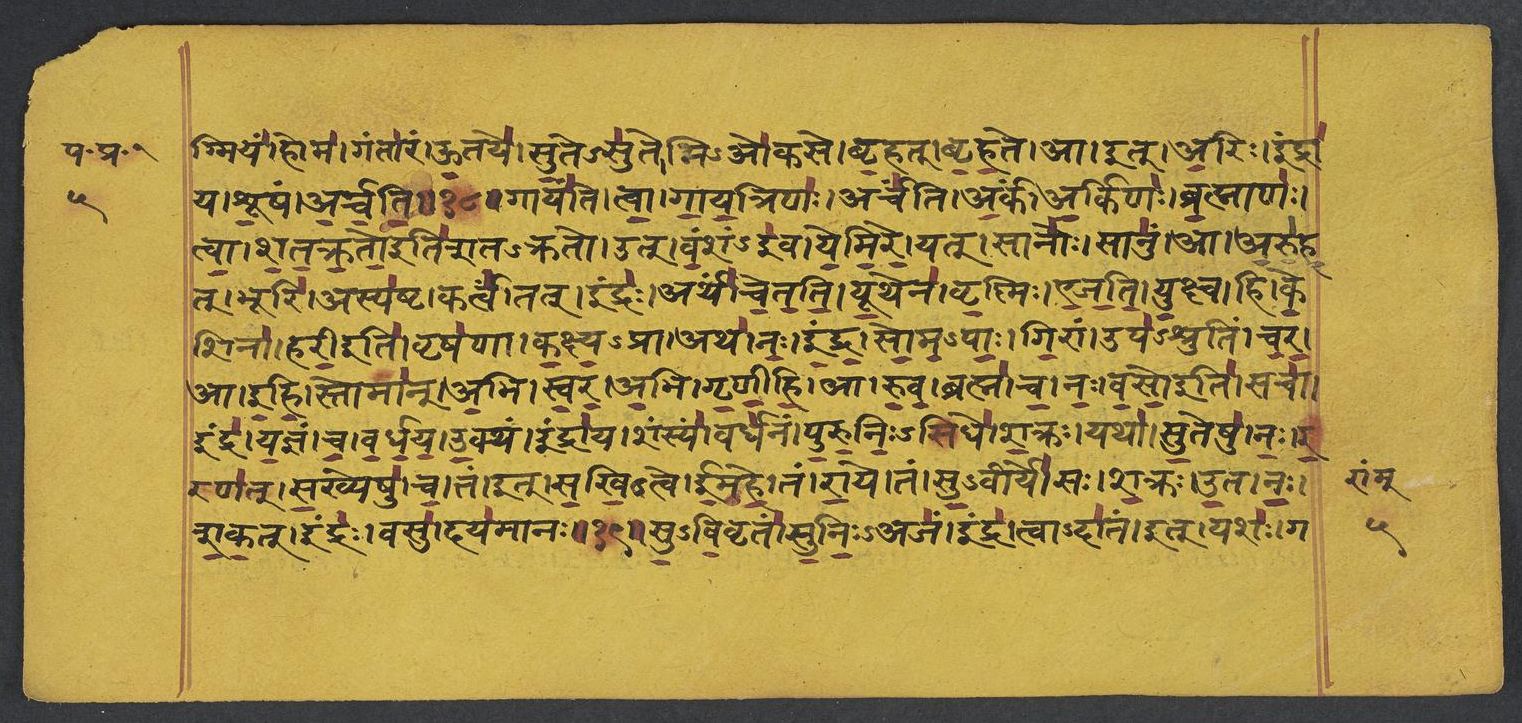
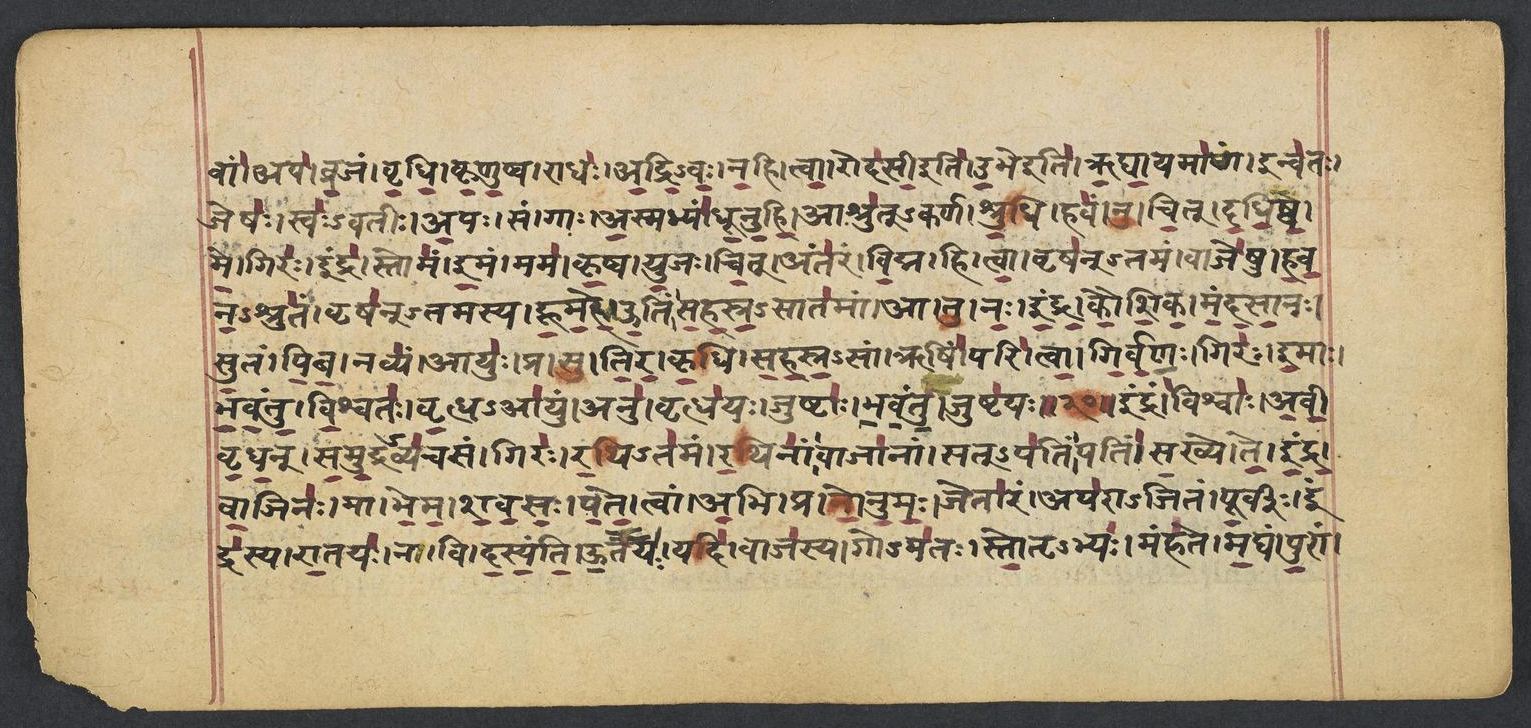
The manuscript shown is Penn Ms. Coll. 390 Item 41 (University of Pennsylvania), an undated paper manuscript of the padapāṭha (the word-by-word recitation text, in which every word is written separately and compounds are split) of the whole Ṛgveda in Devanāgarī, 884 leaves in fascicles, 7-9 lines to the page, accents in red; this hymn stands on fol. 5v-6r. Each section below gives the verses that end on one page; the page boundaries were read on the images (the opening words of every page), not counted out. Where the manuscript is a padapāṭha (the word-by-word recitation text), the section shows Aufrecht's continuous (saṃhitā) text first and, as the edition text, the padapāṭha of the same verses, which is the form written on the page.
How was this verified? (Provenance)
Where on the image
Penn Ms. Coll. 390 Item 41, fol. 5v (OPenn image 7, upper leaf). Checked on the image: the Rigveda text on this page begins in RV 1.9.9 ‹-ṛgmiyam homa gantāram ūtaye›. The next page with Rigveda text, fol. 6r, begins in RV 1.10.7 ‹-gavām apa vrajam vṛdhi›. Verses 1.10.1-6 end on this page.
1gāya̍nti tvā gāya̱triṇo 'rca̍nty a̱rkam a̱rkiṇa̍ḥ | bra̱hmāṇa̍s tvā śatakrata̱ ud va̱ṁśam i̍va yemire ||
2yat sāno̱ḥ sānu̱m āru̍ha̱d bhūry aspa̍ṣṭa̱ kartva̍m | tad indro̱ artha̍ṁ cetati yū̱thena̍ vṛ̱ṣṇir e̍jati ||
3yu̱kṣvā hi ke̱śinā̱ harī̱ vṛṣa̍ṇā kakṣya̱prā | athā̍ na indra somapā gi̱rām upa̍śrutiṁ cara ||
4ehi̱ stomā̍m̐ a̱bhi sva̍rā̱bhi gṛ̍ṇī̱hy ā ru̍va | brahma̍ ca no vaso̱ sacendra̍ ya̱jñaṁ ca̍ vardhaya ||
5u̱ktham indrā̍ya̱ śaṁsya̱ṁ vardha̍nam puruni̱ṣṣidhe̍ | śa̱kro yathā̍ su̱teṣu̍ ṇo rā̱raṇa̍t sa̱khyeṣu̍ ca ||
6tam it sa̍khi̱tva ī̍mahe̱ taṁ rā̱ye taṁ su̱vīrye̍ | sa śa̱kra u̱ta na̍ḥ śaka̱d indro̱ vasu̱ daya̍mānaḥ ||
Compare: Padapāṭha (word-by-word text written in the manuscript; Sansknet e-text via GRETIL)
1gāyanti | tvā | gāyatriṇaḥ | arcanti | arkam | arkiṇaḥ | brahmāṇaḥ | tvā | śatakrato itiśata-krato | ut | vaṃśam-iva | yemire
2yat | sānoḥ | sānum | ā | aruhat | bhūri | aspaṣṭa | kartvam | tat | indraḥ | artham | cetati | yūthena | vṛṣṇiḥ | ejati
3yukṣva | hi | keśinā | harī iti | vṛṣaṇā | kakṣya-prā | atha | naḥ | indra | soma-pāḥ | girām | upa-śrutim | cara
4ā | ihi | stomān | abhi | svara | abhi | gṛṇīhi | ā | ruva | brahma | ca | naḥ | vaso iti | sacā | indra | yajñam | ca | vardhaya
5uktham | indrāya | śaṃsyam | vardhanam | puruniḥ-sidhe | śakraḥ | yathā | suteṣu | naḥ | raraṇat | sakhyeṣu | ca
6tam | it | sakhi-tve | īmahe | tam | rāye | tam | su-vīrye | saḥ | śakraḥ | uta | naḥ | śakat | indraḥ | vasu | dayamānaḥ
1THE chanters hymn thee, they who say the word of praise magnify thee. The priests have raised thee up on high, O Ṣatakratu, like a pole.
2As up he clomb from ridge to ridge and looked upon the toilsome task, Indra observes this wish of his, and the Rain hastens with his troop.
3Harness thy pair of strong bay steeds, long-maned, whose bodies fill the girths, And, Indra, Soma-drinker, come to listen to our songs of praise.
4Come hither, answer thou the song, sing in approval, cry aloud. Good Indra, make our prayer succeed, and prosper this our sacrifice.
5To Indra must a laud be said, to strengthen him who freely gives, That Ṣakra may take pleasure in our friendship and drink-offerings.
6Him, him we seek for friendship, him for riches and heroic might. For Indra, he is Ṣakra, he shall aid us while he gives us wealth.
Where on the image
Penn Ms. Coll. 390 Item 41, fol. 6r (OPenn image 7, lower leaf). Checked on the image: the Rigveda text on this page begins in RV 1.10.7 ‹-gavām apa vrajam vṛdhi›. The next page with Rigveda text, fol. 6v, begins in RV 1.11.4 ‹bhinduḥ yuvā kaviḥ amita-ojāḥ›. Verses 1.10.7-12 end on this page; 1.10.7 begins on fol. 5v.
7su̱vi̱vṛta̍ṁ suni̱raja̱m indra̱ tvādā̍ta̱m id yaśa̍ḥ | gavā̱m apa̍ vra̱jaṁ vṛ̍dhi kṛṇu̱ṣva rādho̍ adrivaḥ ||
8na̱hi tvā̱ roda̍sī u̱bhe ṛ̍ghā̱yamā̍ṇa̱m inva̍taḥ | jeṣa̱ḥ sva̍rvatīr a̱paḥ saṁ gā a̱smabhya̍ṁ dhūnuhi ||
9āśru̍tkarṇa śru̱dhī hava̱ṁ nū ci̍d dadhiṣva me̱ gira̍ḥ | indra̱ stoma̍m i̱mam mama̍ kṛ̱ṣvā yu̱jaś ci̱d anta̍ram ||
10vi̱dmā hi tvā̱ vṛṣa̍ntama̱ṁ vāje̍ṣu havana̱śruta̍m | vṛṣa̍ntamasya hūmaha ū̱tiṁ sa̍hasra̱sāta̍mām ||
11ā tū na̍ indra kauśika mandasā̱naḥ su̱tam pi̍ba | navya̱m āyu̱ḥ pra sū ti̍ra kṛ̱dhī sa̍hasra̱sām ṛṣi̍m ||
12pari̍ tvā girvaṇo̱ gira̍ i̱mā bha̍vantu vi̱śvata̍ḥ | vṛ̱ddhāyu̱m anu̱ vṛddha̍yo̱ juṣṭā̍ bhavantu̱ juṣṭa̍yaḥ ||
Compare: Padapāṭha (word-by-word text written in the manuscript; Sansknet e-text via GRETIL)
7su-vivṛtam | suniḥ-ajam | indra | tvādātam | it | yaśaḥ | gavām | apa | vrajam | vṛdhi | kṛṇuṣva | rādhaḥ | adri-vaḥ
8nahi | tvā | rodasī iti | ubhe iti | ṛghāyamāṇam | invataḥ | jeṣaḥ | svaḥ-vatīḥ | apaḥ | sam | gāḥ | asmabhyam | dhūnuhi
9āśrut-karṇa | śrudhi | havam | nū | cit | dadhiṣva | me | giraḥ | indra | stomam | imam | mama | kṛṣva | yujaḥ | cit | antaram
10vidma | hi | tvā | vṛṣan-tamam | vājeṣu | havana-śrutam | vṛṣan-tamasya | hūmahe | ūtim | sahasra-sātamām
11ā | tu | naḥ | indra | kauśika | mandasānaḥ | sutam | piba | navyam | āyuḥ | pra | su | tira | kṛdhi | sahasra-sām | ṛṣim
12pari | tvā | girvaṇaḥ | giraḥ | imāḥ | bhavantu | viśvataḥ | vṛddha-āyum | anu | vṛddhayaḥ | juṣṭāḥ | bhavantu | juṣṭayaḥ
7Easy to turn and drive away, Indra, is spoil bestowed by thee. Unclose the stable of the kine, and give us wealth O Thunder-armed
8The heaven and earth contain thee not, together, in thy wrathful mood. Win us the waters of the sky, and send us kine abundantly.
9Hear, thou whose ear is quick, my call; take to thee readily my songs O Indra, let this laud of mine come nearer even than thy friend.
10We know thee mightiest of all, in battles hearer of our cry. Of thee most mighty we invoke the aid that giveth thousandfold.
11O Indra, Son of Kuṣika, drink our libation with delight. Prolong our life anew, and cause the seer to win a thousand gifts.
12Lover of song, may these our songs on every side encompass thee: Strengthening thee of lengthened life, may they be dear delights to thee.
Notes
- Sanskrit: Aufrecht's edition (1877) with the Vedic accents, as entered by van Nooten and Holland (GRETIL).
- English: Ralph T. H. Griffith, The Hymns of the Rigveda (1889-1892; 2nd ed. 1896-1897), from the VedaWeb digital text; OCR slips in that text were corrected against the printed 2nd edition (data/sources/rigveda/griffith_errata.json).
- Padapāṭha (edition text): Sansknet e-text via GRETIL (CC BY-NC-SA 4.0).
Cite
Sources
- Source: Penn Ms. Coll. 390 Item 41 (undated (catalogued with Penn's 18th-19th c. Vedic manuscripts)), OPenn, Public Domain Mark + Aufrecht's accented text (GRETIL) + Griffith's English (VedaWeb) (holding institution)
- Critical edition: Aufrecht (1877), accented e-text via GRETIL
← previous · → next · v cycle view · l back to library