Rigveda 1.9: To Indra
Introduction
Rigveda 1.9 is a hymn of 10 verses addressed to Indra. It stands in book (maṇḍala) 1, a collection of hymns by many families of poets. The Rigveda is the oldest collection of Sanskrit hymns, composed in the second half of the second millennium BCE and handed down orally for many centuries before it was written down.
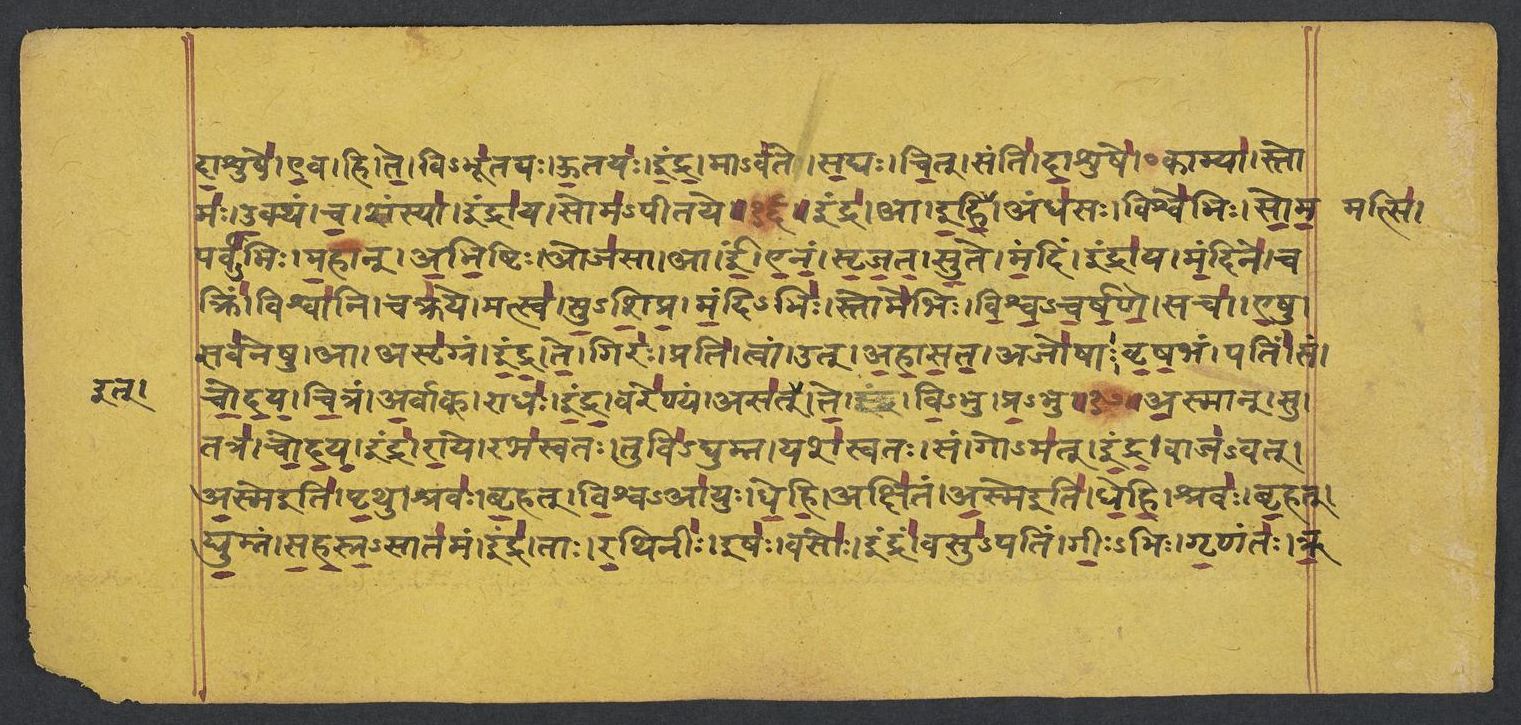
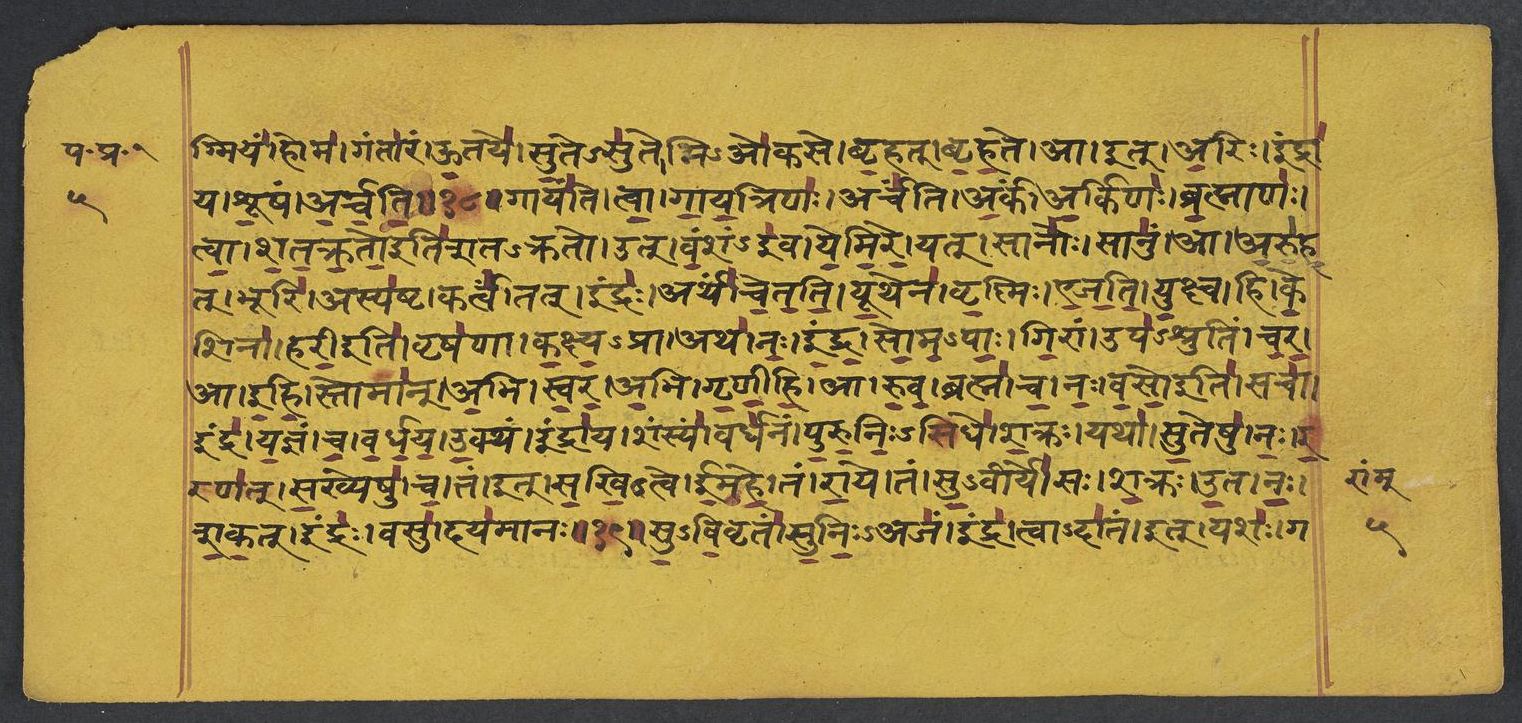
The manuscript shown is Penn Ms. Coll. 390 Item 41 (University of Pennsylvania), an undated paper manuscript of the padapāṭha (the word-by-word recitation text, in which every word is written separately and compounds are split) of the whole Ṛgveda in Devanāgarī, 884 leaves in fascicles, 7-9 lines to the page, accents in red; this hymn stands on fol. 5r-5v. Each section below gives the verses that end on one page; the page boundaries were read on the images (the opening words of every page), not counted out. Where the manuscript is a padapāṭha (the word-by-word recitation text), the section shows Aufrecht's continuous (saṃhitā) text first and, as the edition text, the padapāṭha of the same verses, which is the form written on the page.
How was this verified? (Provenance)
Where on the image
Penn Ms. Coll. 390 Item 41, fol. 5r (OPenn image 6, lower leaf). Checked on the image: the Rigveda text on this page begins in RV 1.8.8 ‹dāśuṣe›. The next page with Rigveda text, fol. 5v, begins in RV 1.9.9 ‹-ṛgmiyam homa gantāram ūtaye›. Verses 1.9.1-8 end on this page.
1indrehi̱ matsy andha̍so̱ viśve̍bhiḥ soma̱parva̍bhiḥ | ma̱hām̐ a̍bhi̱ṣṭir oja̍sā ||
2em e̍naṁ sṛjatā su̱te ma̱ndim indrā̍ya ma̱ndine̍ | cakri̱ṁ viśvā̍ni̱ cakra̍ye ||
3matsvā̍ suśipra ma̱ndibhi̱ḥ stome̍bhir viśvacarṣaṇe | sacai̱ṣu sava̍ne̱ṣv ā ||
4asṛ̍gram indra te̱ gira̱ḥ prati̱ tvām ud a̍hāsata | ajo̍ṣā vṛṣa̱bham pati̍m ||
5saṁ co̍daya ci̱tram a̱rvāg rādha̍ indra̱ vare̍ṇyam | asa̱d it te̍ vi̱bhu pra̱bhu ||
6a̱smān su tatra̍ coda̱yendra̍ rā̱ye rabha̍svataḥ | tuvi̍dyumna̱ yaśa̍svataḥ ||
7saṁ goma̍d indra̱ vāja̍vad a̱sme pṛ̱thu śravo̍ bṛ̱hat | vi̱śvāyu̍r dhe̱hy akṣi̍tam ||
8a̱sme dhe̍hi̱ śravo̍ bṛ̱had dyu̱mnaṁ sa̍hasra̱sāta̍mam | indra̱ tā ra̱thinī̱r iṣa̍ḥ ||
Compare: Padapāṭha (word-by-word text written in the manuscript; Sansknet e-text via GRETIL)
1indra | ā | ihi | matsi | andhasaḥ | viśvebhiḥ | somaparva-bhiḥ | mahān | abhiṣṭiḥ | ojasā
2ā | īm | enam | sṛjata | sute | mandim | indrāya | mandine | cakrim | viśvāni | cakraye
3matsva | su-śipra | mandi-bhiḥ | stomebhiḥ | viśva-carṣaṇe | sacā | eṣu | savaneṣu | ā
4asṛgram | indra | te | giraḥ | prati | tvām | ud | ahāsata | ajoṣāḥ | vṛṣabham | patim
5sam | codaya | citram | arvāk | rādhaḥ | indra | vareṇyam | asat | it | te | vi-bhu | pra-bhu
6asmān | su | tatra | codaya | indra | rāye | rabhasvataḥ | tuvi-dyumna | yaśasvataḥ
7sam | go--mat | indra | vāja-vat | asme iti | pṛthu | śravaḥ | bṛhat | viśva-āyuḥ | dhehi | akṣitam
8asme iti | dhehi | śravaḥ | bṛhat | dyumnam | sahasra-sātamam | indra | tāḥ | rathiniḥ | iṣaḥ
1COME, Indra, and delight thee with the juice at all the Soma feasts, Protector, mighty in thy strength.
2To Indra pour ye forth thejuice, the active gladdening juice to him Ile gladdening, omnific God.
3O Lord of all men, fair of cheek, rejoice thee in the gladdening lauds, Present at these drink-offerings.
4Songs have outpoured themselves to thee, Indra, the strong, the guardian Lord, And raised themselves unsatisfied.
5Send to us bounty manifold, O Indra, worthy of' our wish, For power supreme is only thine.
6O Indra, stimulate thereto us emulously fain for wealth, And glorious, O most splendid One.
7Give, Indra, wide and lofty fame, wealthy in cattle and in strength, Lasting our life-time, failing not.
8Grant us high fame, O Indra, grant riches bestowing thousands, those Fair fruits of earth borne home in wains.
Where on the image
Penn Ms. Coll. 390 Item 41, fol. 5v (OPenn image 7, upper leaf). Checked on the image: the Rigveda text on this page begins in RV 1.9.9 ‹-ṛgmiyam homa gantāram ūtaye›. The next page with Rigveda text, fol. 6r, begins in RV 1.10.7 ‹-gavām apa vrajam vṛdhi›. Verses 1.9.9-10 end on this page; 1.9.9 begins on fol. 5r.
9vaso̱r indra̱ṁ vasu̍patiṁ gī̱rbhir gṛ̱ṇanta̍ ṛ̱gmiya̍m | homa̱ gantā̍ram ū̱taye̍ ||
10su̱te-su̍te̱ nyo̍kase bṛ̱had bṛ̍ha̱ta ed a̱riḥ | indrā̍ya śū̱ṣam a̍rcati ||
Compare: Padapāṭha (word-by-word text written in the manuscript; Sansknet e-text via GRETIL)
9vasoḥ | indram | vasu-patim | gīḥ-bhiḥ | gṛṇantaḥ | ṛgmiyam | homa | gantāram | ūtaye
10sute--sute | ni-okase | bṛhat | bṛhate | ā | it | ariḥ | indrāya | śūṣam | arcati
9Praising with songs the praise-worthy who cometh to our aid, we call Indra, the Treasure-Lord of wealth.
10To lofty Indra, dweller by each libation, the pious man Sings forth aloud a strengthening hymn.
Notes
- Sanskrit: Aufrecht's edition (1877) with the Vedic accents, as entered by van Nooten and Holland (GRETIL).
- English: Ralph T. H. Griffith, The Hymns of the Rigveda (1889-1892; 2nd ed. 1896-1897), from the VedaWeb digital text; OCR slips in that text were corrected against the printed 2nd edition (data/sources/rigveda/griffith_errata.json).
- Padapāṭha (edition text): Sansknet e-text via GRETIL (CC BY-NC-SA 4.0).
Cite
Sources
- Source: Penn Ms. Coll. 390 Item 41 (undated (catalogued with Penn's 18th-19th c. Vedic manuscripts)), OPenn, Public Domain Mark + Aufrecht's accented text (GRETIL) + Griffith's English (VedaWeb) (holding institution)
- Critical edition: Aufrecht (1877), accented e-text via GRETIL
← previous · → next · v cycle view · l back to library