Rigveda 1.125: Praise of the generous sacrificer
Introduction
Rigveda 1.125 is a hymn of 7 verses addressed to praise of the generous sacrificer. It stands in book (maṇḍala) 1, a collection of hymns by many families of poets. The Rigveda is the oldest collection of Sanskrit hymns, composed in the second half of the second millennium BCE and handed down orally for many centuries before it was written down.
The manuscript shown is Penn Ms. Coll. 390 Item 41 (University of Pennsylvania), an undated paper manuscript of the padapāṭha (the word-by-word recitation text, in which every word is written separately and compounds are split) of the whole Ṛgveda in Devanāgarī, 884 leaves in fascicles, 7-9 lines to the page, accents in red; this hymn stands on fol. 95v-96v. Each section below gives the verses that end on one page; the page boundaries were read on the images (the opening words of every page), not counted out. Where the manuscript is a padapāṭha (the word-by-word recitation text), the section shows Aufrecht's continuous (saṃhitā) text first and, as the edition text, the padapāṭha of the same verses, which is the form written on the page.
How was this verified? (Provenance)
Where on the image
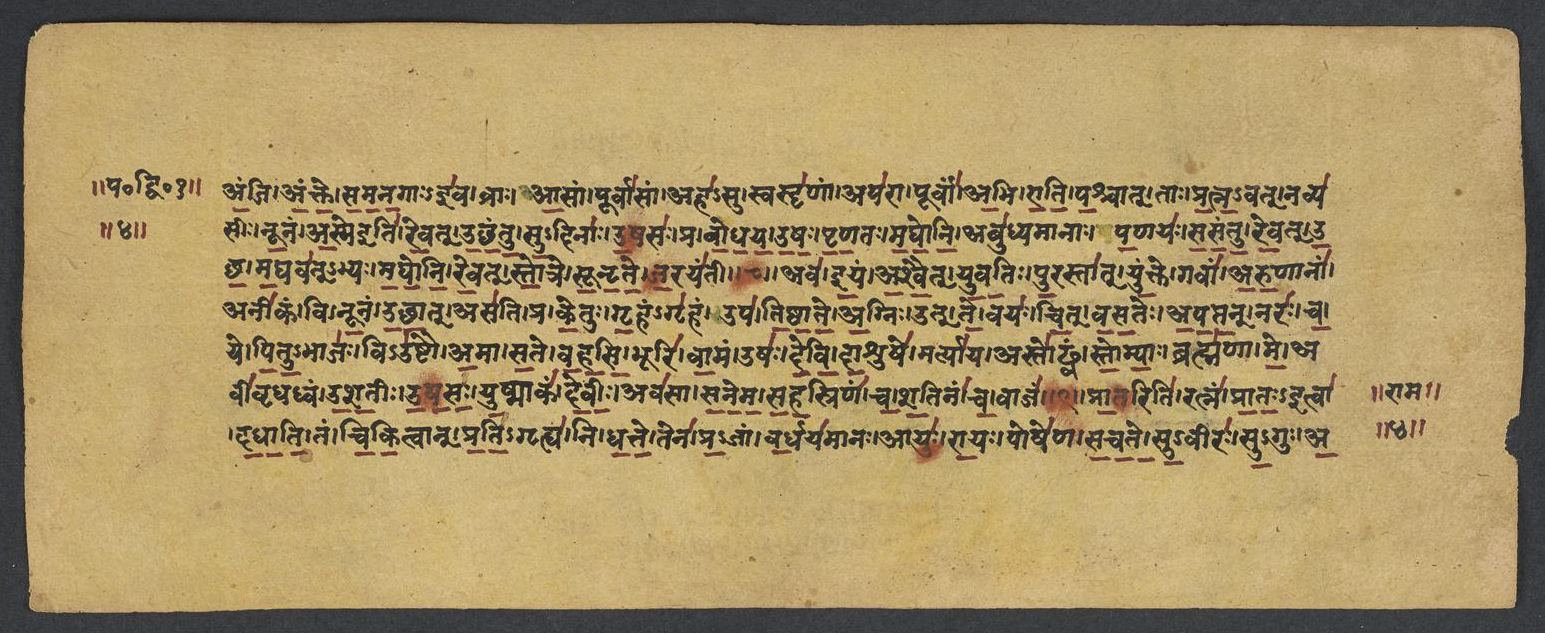
Penn Ms. Coll. 390 Item 41, fol. 95v (numbered 4v by the scribe) (OPenn image 97, upper leaf). Checked on the image: the Rigveda text on this page begins in RV 1.124.8 ‹añji aṅkte samanagāḥ-iva vrāḥ›. The next page with Rigveda text, fol. 96r (numbered 5r by the scribe), begins in RV 1.125.2 ‹-asat su-hiraṇyaḥ su-aśvaḥ bṛhat›. Verse 1.125.1 ends on this page.
1prā̱tā ratna̍m prāta̱ritvā̍ dadhāti̱ taṁ ci̍ki̱tvān pra̍ti̱gṛhyā̱ ni dha̍tte | tena̍ pra̱jāṁ va̱rdhaya̍māna̱ āyū̍ rā̱yas poṣe̍ṇa sacate su̱vīra̍ḥ ||
Compare: Padapāṭha (word-by-word text written in the manuscript; Sansknet e-text via GRETIL)
1prātriti | ratnam | prātaḥ-itvā | dadhāti | tam | cikitvān | prati-gṛhya | ni | dhatte | tena | prajām | vardhayamānaḥ | āyuḥ | rāyaḥ | poṣeṇa | sacate | su-vīraḥ
1COMING at early morn he gives his treasure; the prudent one receives and entertains him. Thereby increasing still his life and offspring, he comes with brave sons to abundant riches.
Where on the image
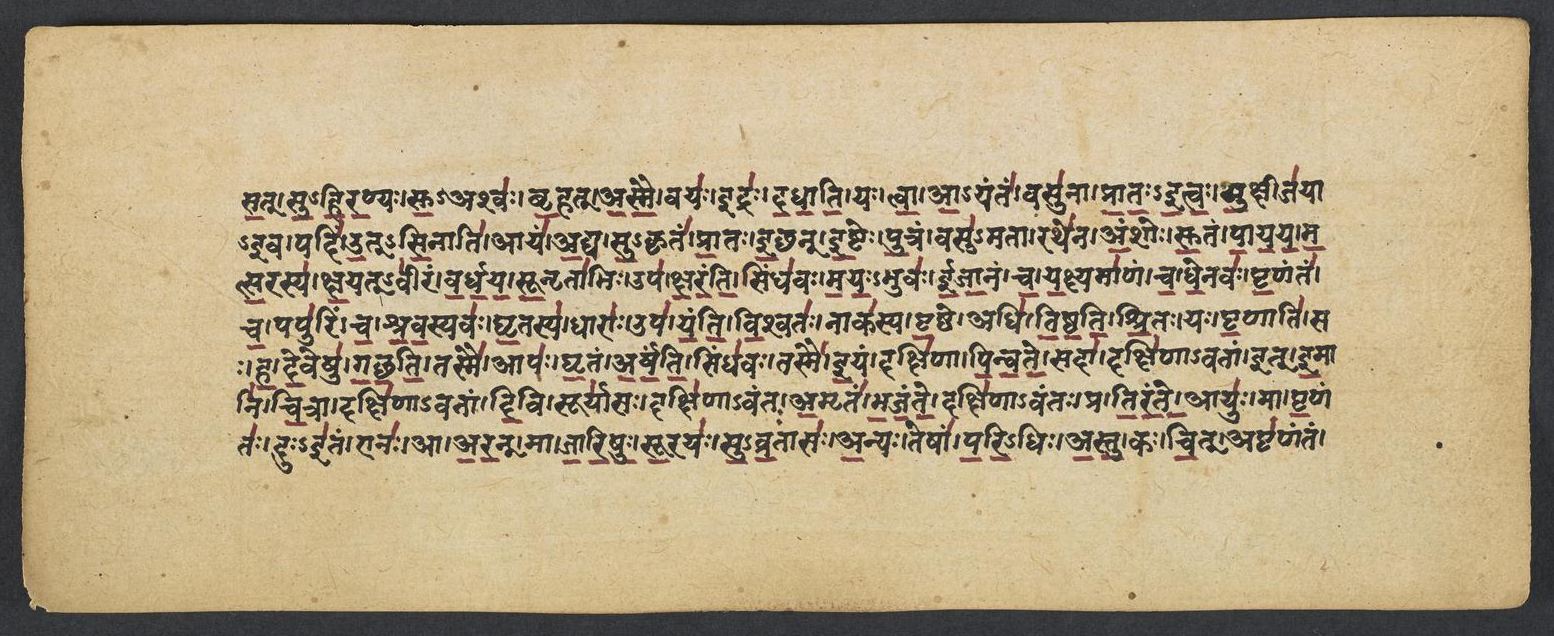
Penn Ms. Coll. 390 Item 41, fol. 96r (numbered 5r by the scribe) (OPenn image 97, lower leaf). Checked on the image: the Rigveda text on this page begins in RV 1.125.2 ‹-asat su-hiraṇyaḥ su-aśvaḥ bṛhat›. The next page with Rigveda text, fol. 96v (numbered 5v by the scribe), begins in RV 1.125.7 ‹abhi sam yantu śokāḥ›. Verses 1.125.2-6 end on this page; 1.125.2 begins on fol. 95v (numbered 4v by the scribe).
2su̱gur a̍sat suhira̱ṇyaḥ svaśvo̍ bṛ̱had a̍smai̱ vaya̱ indro̍ dadhāti | yas tvā̱yanta̱ṁ vasu̍nā prātaritvo mu̱kṣīja̍yeva̱ padi̍m utsi̱nāti̍ ||
3āya̍m a̱dya su̱kṛta̍m prā̱tar i̱cchann i̱ṣṭeḥ pu̱traṁ vasu̍matā̱ rathe̍na | a̱ṁśoḥ su̱tam pā̍yaya matsa̱rasya̍ kṣa̱yadvī̍raṁ vardhaya sū̱nṛtā̍bhiḥ ||
4upa̍ kṣaranti̱ sindha̍vo mayo̱bhuva̍ ījā̱naṁ ca̍ ya̱kṣyamā̍ṇaṁ ca dhe̱nava̍ḥ | pṛ̱ṇanta̍ṁ ca̱ papu̍riṁ ca śrava̱syavo̍ ghṛ̱tasya̱ dhārā̱ upa̍ yanti vi̱śvata̍ḥ ||
5nāka̍sya pṛ̱ṣṭhe adhi̍ tiṣṭhati śri̱to yaḥ pṛ̱ṇāti̱ sa ha̍ de̱veṣu̍ gacchati | tasmā̱ āpo̍ ghṛ̱tam a̍rṣanti̱ sindha̍va̱s tasmā̍ i̱yaṁ dakṣi̍ṇā pinvate̱ sadā̍ ||
6dakṣi̍ṇāvatā̱m id i̱māni̍ ci̱trā dakṣi̍ṇāvatāṁ di̱vi sūryā̍saḥ | dakṣi̍ṇāvanto a̱mṛta̍m bhajante̱ dakṣi̍ṇāvanta̱ḥ pra ti̍ranta̱ āyu̍ḥ ||
Compare: Padapāṭha (word-by-word text written in the manuscript; Sansknet e-text via GRETIL)
2su-guḥ | asat | su-hiraṇyaḥ | su-aśvaḥ | bṛhat | asmai | vayaḥ | indraḥ | dadhāti | yaḥ | tvā | āyantam | vasunā | prātaḥ-itvaḥ | mukṣījayāiva | padim | ut-sināti
3āyam | adya | su-kṛtam | prātaḥ | icchan | iṣṭeḥ | putram | vasumatā | rathena | aṃśoḥ | sutam | pāyaya | matsarasya | kṣayat-vīram | vardhaya | sūnṛtābhiḥ
4upa | kṣaranti | sindhavaḥ | mayaḥ-bhuvaḥ | ījānam | ca | yakṣyamāṇam | ca | dhenavaḥ | pṛṇantam | ca | papurim | ca | śravasyavaḥ | ghṛtasya | dhārāḥ | upa | yanti | viśvataḥ
5nākasya | pṛṣṭhe | adhi | tiṣṭhati | śritaḥ | yaḥ | pṛṇāti | saḥ | ha | deveṣu | gacchati | tasmai | āpaḥ | ghṛtam | arṣanti | sindhavaḥ | tasmai | iyam | dakṣiṇā | pinvate | sadā
6dakṣiṇāvatām | it | imāni | citrā | dakṣiṇāvatām | divi | sūryāsaḥ | dakṣiṇāvantaḥ | amṛtam | bhajante | dakṣiṇāvantaḥ | pra | tirante | āyuḥ
2Rich shall he be in gold and kine and horses. Indra bestows on him great vital power, Who stays thee, as thou comest, with his treasure, like game caught in the net, O early comer.
3Longing, I came this morning to the pious, the son of sacrifice, with car wealth. laden. Give him to drink juice of the stalk that gladdens; prosper with pleasant hymns the Lord of Heroes.
4Health-bringing streams, as milch-cows, flow to profit him who hath worshipped, him who now will worship. To him who freely gives and fills on all sides full streams of fatness flow and make him famous.
5On the high ridge of heaven he stands exalted, yea, to the Gods he goes, the liberal giver. The streams, the waters flow for him with fatness: to him this guerdon ever yields abundance.
6For those who give rich meeds are all these splendours, for those who give rich meeds suns shine in heaven. The givers of rich meeds are made immortal; the givers of rich fees prolong their lifetime.
Where on the image
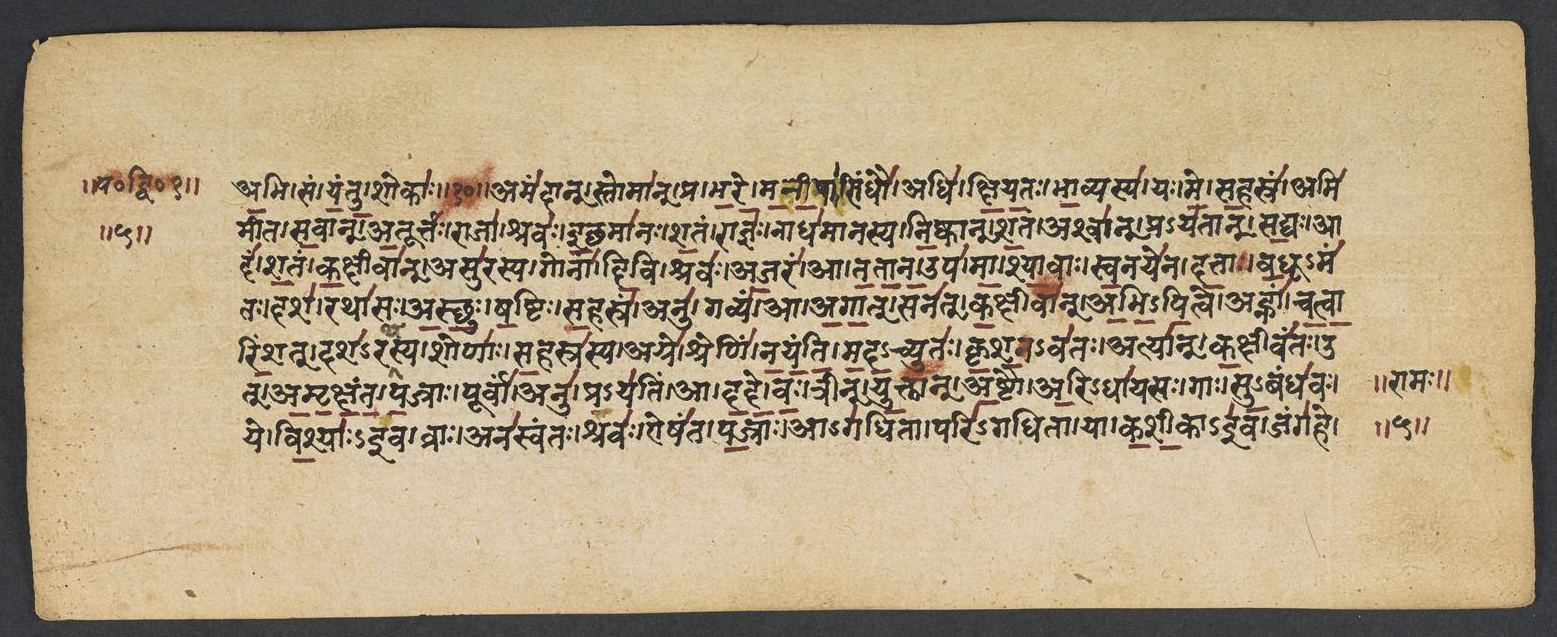
Penn Ms. Coll. 390 Item 41, fol. 96v (numbered 5v by the scribe) (OPenn image 98, upper leaf). Checked on the image: the Rigveda text on this page begins in RV 1.125.7 ‹abhi sam yantu śokāḥ›. The next page with Rigveda text, fol. 97r (numbered 6r by the scribe), begins in RV 1.126.6 ‹dadāti mahyam yādurī yāśūnām›. Verse 1.125.7 ends on this page; 1.125.7 begins on fol. 96r (numbered 5r by the scribe).
7mā pṛ̱ṇanto̱ duri̍ta̱m ena̱ āra̱n mā jā̍riṣuḥ sū̱raya̍ḥ suvra̱tāsa̍ḥ | a̱nyas teṣā̍m pari̱dhir a̍stu̱ kaś ci̱d apṛ̍ṇantam a̱bhi saṁ ya̍ntu̱ śokā̍ḥ ||
Compare: Padapāṭha (word-by-word text written in the manuscript; Sansknet e-text via GRETIL)
7mā | pṛṇantaḥ | duḥ-itam | enaḥ | ā | aran | mā | jāriṣuḥ | sūrayaḥ | su-vratāsaḥ | anyaḥ | teṣām | pari-dhiḥ | astu | kaḥ | cit | apṛṇantam | abhi | sam | yantu | śokāḥ
7Let not the liberal sink to sin and sorrow, never decay the pious -chiefs who worship! Let every man besides be their protection, and let affliction fall upon the niggard.
Notes
- Sanskrit: Aufrecht's edition (1877) with the Vedic accents, as entered by van Nooten and Holland (GRETIL).
- English: Ralph T. H. Griffith, The Hymns of the Rigveda (1889-1892; 2nd ed. 1896-1897), from the VedaWeb digital text; OCR slips in that text were corrected against the printed 2nd edition (data/sources/rigveda/griffith_errata.json).
- Padapāṭha (edition text): Sansknet e-text via GRETIL (CC BY-NC-SA 4.0).
Cite
Sources
- Source: Penn Ms. Coll. 390 Item 41 (undated (catalogued with Penn's 18th-19th c. Vedic manuscripts)), OPenn, Public Domain Mark + Aufrecht's accented text (GRETIL) + Griffith's English (VedaWeb) (holding institution)
- Critical edition: Aufrecht (1877), accented e-text via GRETIL
← previous · → next · v cycle view · l back to library