Rigveda 1.132: To Indra
Introduction
Rigveda 1.132 is a hymn of 6 verses addressed to Indra. It stands in book (maṇḍala) 1, a collection of hymns by many families of poets. The Rigveda is the oldest collection of Sanskrit hymns, composed in the second half of the second millennium BCE and handed down orally for many centuries before it was written down.
The manuscript shown is Penn Ms. Coll. 390 Item 41 (University of Pennsylvania), an undated paper manuscript of the padapāṭha (the word-by-word recitation text, in which every word is written separately and compounds are split) of the whole Ṛgveda in Devanāgarī, 884 leaves in fascicles, 7-9 lines to the page, accents in red; this hymn stands on fol. 103r-103v. Each section below gives the verses that end on one page; the page boundaries were read on the images (the opening words of every page), not counted out. Where the manuscript is a padapāṭha (the word-by-word recitation text), the section shows Aufrecht's continuous (saṃhitā) text first and, as the edition text, the padapāṭha of the same verses, which is the form written on the page.
How was this verified? (Provenance)
Where on the image
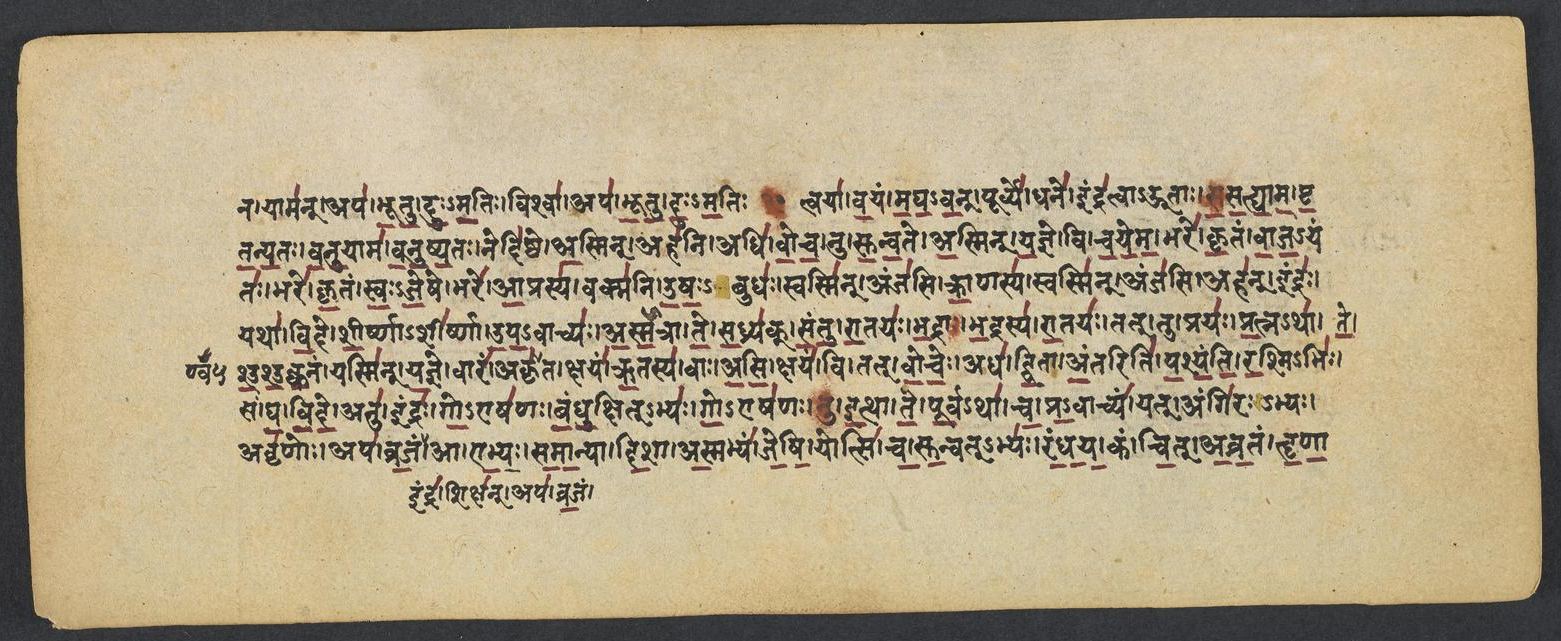
Penn Ms. Coll. 390 Item 41, fol. 103r (numbered 12r by the scribe) (OPenn image 104, lower leaf). Checked on the image: the Rigveda text on this page begins in RV 1.131.7 ‹na yāman apa bhūtu›. The next page with Rigveda text, fol. 103v (numbered 12v by the scribe), begins in RV 1.132.4 ‹-hṛṇāyantam cit avratam›. Verses 1.132.1-3 end on this page.
1tvayā̍ va̱yam ma̍ghava̱n pūrvye̱ dhana̱ indra̍tvotāḥ sāsahyāma pṛtanya̱to va̍nu̱yāma̍ vanuṣya̱taḥ | nedi̍ṣṭhe a̱sminn aha̱ny adhi̍ vocā̱ nu su̍nva̱te | a̱smin ya̱jñe vi ca̍yemā̱ bhare̍ kṛ̱taṁ vā̍ja̱yanto̱ bhare̍ kṛ̱tam ||
2sva̱rje̱ṣe bhara̍ ā̱prasya̱ vakma̍ny uṣa̱rbudha̱ḥ svasmi̱nn añja̍si krā̱ṇasya̱ svasmi̱nn añja̍si | aha̱nn indro̱ yathā̍ vi̱de śī̱rṣṇā-śī̍rṣṇopa̱vācya̍ḥ | a̱sma̱trā te̍ sa̱dhrya̍k santu rā̱tayo̍ bha̱drā bha̱drasya̍ rā̱taya̍ḥ ||
3tat tu praya̍ḥ pra̱tnathā̍ te śuśukva̱naṁ yasmi̍n ya̱jñe vāra̱m akṛ̍ṇvata̱ kṣaya̍m ṛ̱tasya̱ vār a̍si̱ kṣaya̍m | vi tad vo̍ce̱r adha̍ dvi̱tāntaḥ pa̍śyanti ra̱śmibhi̍ḥ | sa ghā̍ vide̱ anv indro̍ ga̱veṣa̍ṇo bandhu̱kṣidbhyo̍ ga̱veṣa̍ṇaḥ ||
Compare: Padapāṭha (word-by-word text written in the manuscript; Sansknet e-text via GRETIL)
1tvayā | vayam | magha-van | pūrvye | dhane | indratvāūtāḥ | sasahyāma | pṛtanyataḥ | vanuyāma | vanuṣyataḥ | nediṣṭhe | asmin | ahani | adhi | voca | nu | sunvate | asmin | yajñe | vi | cayema | bhare | kṛtam | vāja-yantaḥ | bhare | kṛtam
2svaḥ-jeṣe | bhare | āprasya | vakmani | uṣaḥ-budhaḥ | svasmin | añjasi | krāṇasya | svasmin | añjasi | ahan | indraḥ | yathā | vide | śīrṣṇāśīrṣṇā | upa-vācyaḥ | asma-trā | te | sadhryak | santu | rātayaḥ | bhadrāḥ | bhadrasy | rātayaḥ
3tat | tu | prayaḥ | pratna-thā | te | śuśukvanam | yasmin | yajñe | vāram | akṛṇvata | kṣayam | ṛtasya | vāḥ | asi | kṣayam | vi | tat | voceḥ | adha | dvitā | antariti | paśyanti | raśmi-bhiḥ | saḥ | gha | vide | anu | indraḥ | go--eṣaṇaḥ | bandhukṣit-bhyaḥ | go--eṣaṇaḥ
1HELPED, Indra Maghavan, by thee in war of old, may we subdue in fight the men who strive with us, conquer the men who war with us. This day that now is close at hand bless him who pours the Soma juice. In this our sacrifice may we divide the spoil, showing our strength, the spoil of war.
2In war which wins the light, at the freegiver's call, at due oblation of the early-rising one, oblation of the active one, Indra slew, even as we know-whom each bowed head must reverence. May all thy bounteous gifts be gathered up for us, yea, the good gifts of thee the Good.
3This food glows for thee as of old at sacrifice, wherein they made thee chooser of the place , for thou choosest the place of sacrifice. Speak thou and make it known to us they see within with beams of light. Indra, indeed, is found a seeker after spoil, spoil-seeker for his own allies.
Where on the image
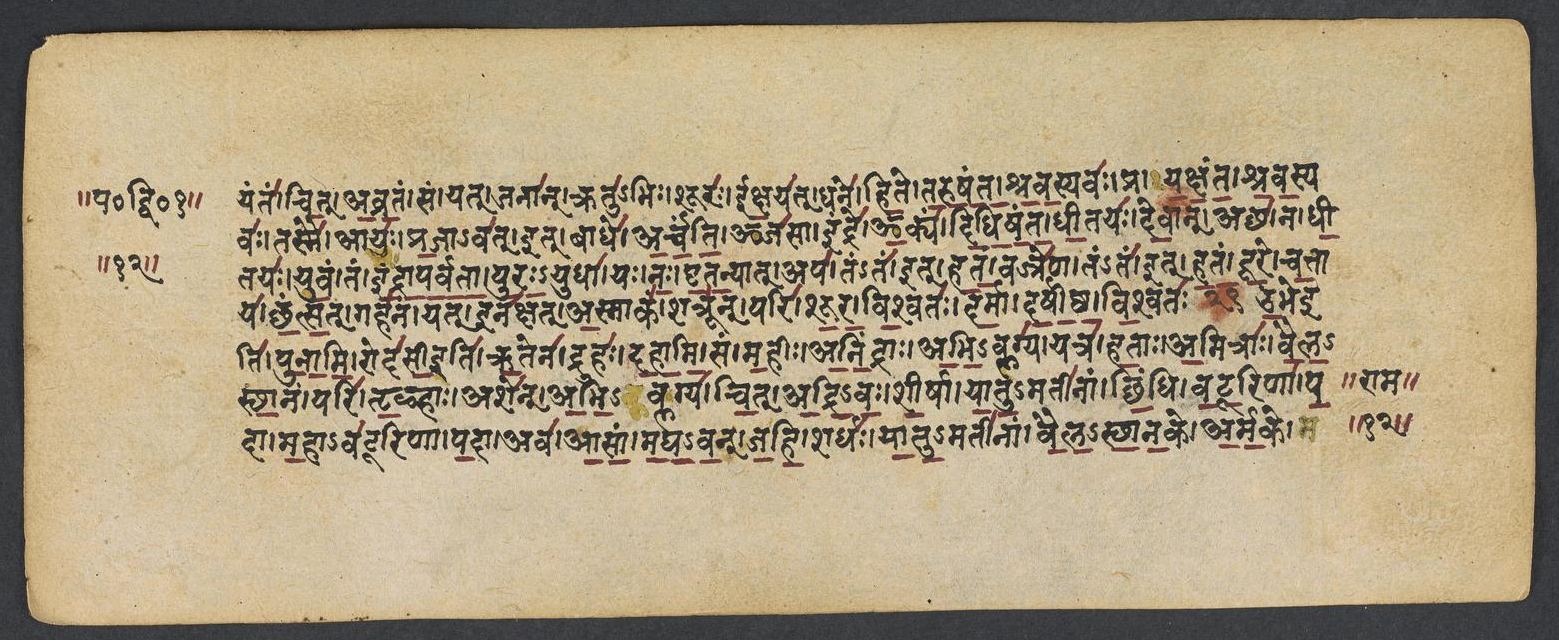
Penn Ms. Coll. 390 Item 41, fol. 103v (numbered 12v by the scribe) (OPenn image 105, upper leaf). Checked on the image: the Rigveda text on this page begins in RV 1.132.4 ‹-hṛṇāyantam cit avratam›. The next page with Rigveda text, fol. 104r (numbered 13r by the scribe), begins in RV 1.133.3 ‹mahāvailasthe arbhake›. Verses 1.132.4-6 end on this page; 1.132.4 begins on fol. 103r (numbered 12r by the scribe).
4nū i̱tthā te̍ pū̱rvathā̍ ca pra̱vācya̱ṁ yad aṅgi̍ro̱bhyo 'vṛ̍ṇo̱r apa̍ vra̱jam indra̱ śikṣa̱nn apa̍ vra̱jam | aibhya̍ḥ samā̱nyā di̱śāsmabhya̍ṁ jeṣi̱ yotsi̍ ca | su̱nvadbhyo̍ randhayā̱ kaṁ ci̍d avra̱taṁ hṛ̍ṇā̱yanta̍ṁ cid avra̱tam ||
5saṁ yaj janā̱n kratu̍bhi̱ḥ śūra̍ ī̱kṣaya̱d dhane̍ hi̱te ta̍ruṣanta śrava̱syava̱ḥ pra ya̍kṣanta śrava̱syava̍ḥ | tasmā̱ āyu̍ḥ pra̱jāva̱d id bādhe̍ arca̱nty oja̍sā | indra̍ o̱kya̍ṁ didhiṣanta dhī̱tayo̍ de̱vām̐ acchā̱ na dhī̱taya̍ḥ ||
6yu̱vaṁ tam i̍ndrāparvatā puro̱yudhā̱ yo na̍ḥ pṛta̱nyād apa̱ taṁ-ta̱m id dha̍ta̱ṁ vajre̍ṇa̱ taṁ-ta̱m id dha̍tam | dū̱re ca̱ttāya̍ cchantsa̱d gaha̍na̱ṁ yad ina̍kṣat | a̱smāka̱ṁ śatrū̱n pari̍ śūra vi̱śvato̍ da̱rmā da̍rṣīṣṭa vi̱śvata̍ḥ ||
Compare: Padapāṭha (word-by-word text written in the manuscript; Sansknet e-text via GRETIL)
4nu | itthā | te | pūrvathā | ca | pra-vācyam | yat | aṅgiraḥ-bhyaḥ | avṛṇoḥ | apa | vrajam | indra | śikṣan | apa | vrajam | ebhyaḥ | samānyā | diśā | asmabhyam | jeṣi | yotsi | ca | sunvat-bhyaḥ | randhaya | kam | cit | avratam | hṛṇāyantam | cit | avratam
5sam | yat | janān | kratu-bhiḥ | śūraḥ | īkṣayat | dhane | hite | taruṣanta | śravasyavaḥ | pra | yakṣanta | śravasyavaḥ | tasmai | āyuḥ | prajāvat | it | bādhe | arcanti | ojasā | indra | okyam | didhiṣanta | dhītayaḥ | devān | accha | na | dhītayaḥ
6yuvam | tam | indrāparvatā | puraḥ-yudhā | yaḥ | naḥ | pṛtanyāt | apa | tam-tam | it | hatam | vajreṇa | tam-tam | it | hatam | dūre | cattāya | chantsat | gahanam | yat | inakṣat | asmākam | śatrūn | pari | śūra | viśvataḥ | darmā | darṣīṣṭa | vi śvataḥ
4So now must thy great deed be lauded as of old, when for the Angirases thou openedst the stall, openedst, giving aid, the stall. In the same manner for us here fight thou and be victorious: To him who pours the juice give up the lawless man, the lawless who is wroth with us.
5When with wise plan the Hero leads the people forth, they conquer in the ordered battle, seeking fame, press, eager, onward seeking fame. To him in time of need they sing for life with offspring and with strength. Their hymns with Indra find a welcome place of rest: the hymns go forward to the Gods.
6Indra and Parvata, our champions in the fight, drive ye away each man who fain would war with us, drive him far from us with the bolt. Welcome to him concealed afar shall he the lair that he hath found. So may the Render rend our foes on every side, rend them, O Hero, everywhere.
Notes
- Sanskrit: Aufrecht's edition (1877) with the Vedic accents, as entered by van Nooten and Holland (GRETIL).
- English: Ralph T. H. Griffith, The Hymns of the Rigveda (1889-1892; 2nd ed. 1896-1897), from the VedaWeb digital text; OCR slips in that text were corrected against the printed 2nd edition (data/sources/rigveda/griffith_errata.json).
- Padapāṭha (edition text): Sansknet e-text via GRETIL (CC BY-NC-SA 4.0).
Cite
Sources
- Source: Penn Ms. Coll. 390 Item 41 (undated (catalogued with Penn's 18th-19th c. Vedic manuscripts)), OPenn, Public Domain Mark + Aufrecht's accented text (GRETIL) + Griffith's English (VedaWeb) (holding institution)
- Critical edition: Aufrecht (1877), accented e-text via GRETIL
← previous · → next · v cycle view · l back to library