Rigveda 1.145: To Agni
Introduction
Rigveda 1.145 is a hymn of 5 verses addressed to Agni. It stands in book (maṇḍala) 1, a collection of hymns by many families of poets. The Rigveda is the oldest collection of Sanskrit hymns, composed in the second half of the second millennium BCE and handed down orally for many centuries before it was written down.
The manuscript shown is Penn Ms. Coll. 390 Item 41 (University of Pennsylvania), an undated paper manuscript of the padapāṭha (the word-by-word recitation text, in which every word is written separately and compounds are split) of the whole Ṛgveda in Devanāgarī, 884 leaves in fascicles, 7-9 lines to the page, accents in red; this hymn stands on fol. 113v-114r. Each section below gives the verses that end on one page; the page boundaries were read on the images (the opening words of every page), not counted out. Where the manuscript is a padapāṭha (the word-by-word recitation text), the section shows Aufrecht's continuous (saṃhitā) text first and, as the edition text, the padapāṭha of the same verses, which is the form written on the page.
How was this verified? (Provenance)
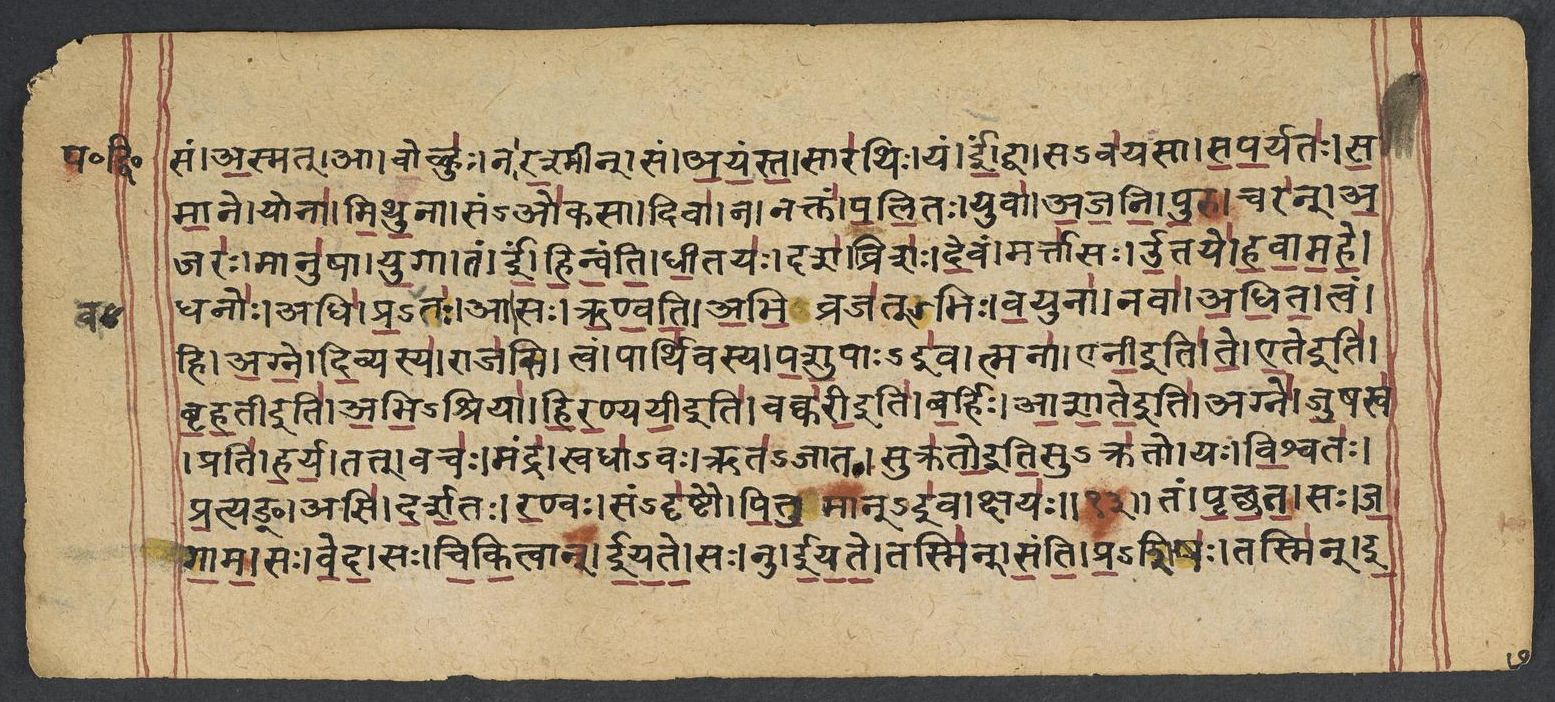
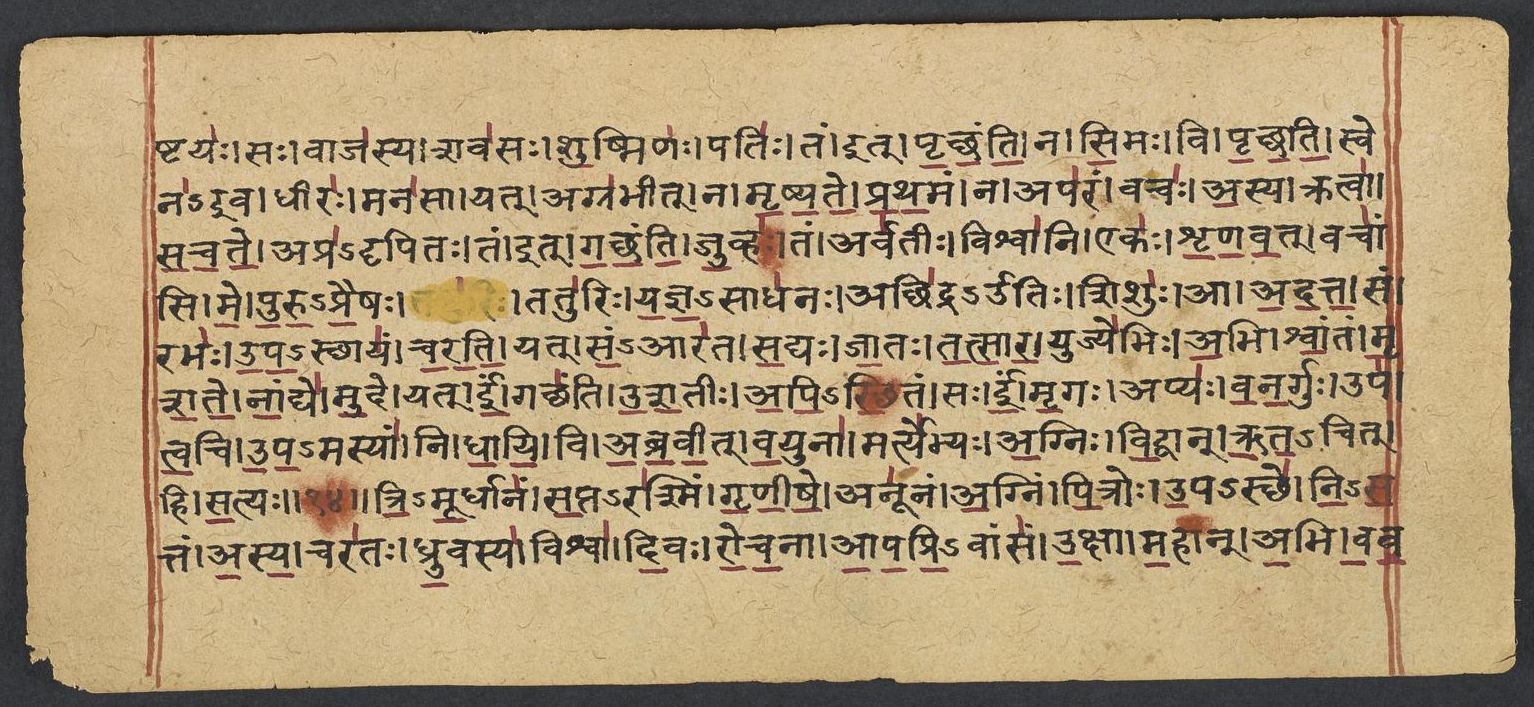
Where on the image
Penn Ms. Coll. 390 Item 41, fol. 114r (numbered 8r by the scribe) (OPenn image 115, lower leaf). Checked on the image: the Rigveda text on this page begins in RV 1.145.1 ‹-iṣṭayaḥ saḥ vājasya śavasaḥ›. Read on the full page image (Penn's label for this page lacks its '=' sign). The next page with Rigveda text, fol. 114v (numbered 8v by the scribe), begins in RV 1.146.2 ‹-vavakṣe eneiti ajaraḥ tasthau›. Verses 1.145.1-5 end on this page; 1.145.1 begins on fol. 113v (numbered 7v by the scribe).
1tam pṛ̍cchatā̱ sa ja̍gāmā̱ sa ve̍da̱ sa ci̍ki̱tvām̐ ī̍yate̱ sā nv ī̍yate | tasmi̍n santi pra̱śiṣa̱s tasmi̍nn i̱ṣṭaya̱ḥ sa vāja̍sya̱ śava̍saḥ śu̱ṣmiṇa̱s pati̍ḥ ||
2tam it pṛ̍cchanti̱ na si̱mo vi pṛ̍cchati̱ svene̍va̱ dhīro̱ mana̍sā̱ yad agra̍bhīt | na mṛ̍ṣyate pratha̱maṁ nāpa̍ra̱ṁ vaco̱ 'sya kratvā̍ sacate̱ apra̍dṛpitaḥ ||
3tam id ga̍cchanti ju̱hva1̱̍s tam arva̍tī̱r viśvā̱ny eka̍ḥ śṛṇava̱d vacā̍ṁsi me | pu̱ru̱prai̱ṣas tatu̍rir yajña̱sādha̱no 'cchi̍droti̱ḥ śiśu̱r āda̍tta̱ saṁ rabha̍ḥ ||
4u̱pa̱sthāya̍ṁ carati̱ yat sa̱māra̍ta sa̱dyo jā̱tas ta̍tsāra̱ yujye̍bhiḥ | a̱bhi śvā̱ntam mṛ̍śate nā̱ndye̍ mu̱de yad ī̱ṁ gaccha̍nty uśa̱tīr a̍piṣṭhi̱tam ||
5sa ī̍m mṛ̱go apyo̍ vana̱rgur upa̍ tva̱cy u̍pa̱masyā̱ṁ ni dhā̍yi | vy a̍bravīd va̱yunā̱ martye̍bhyo̱ 'gnir vi̱dvām̐ ṛ̍ta̱cid dhi sa̱tyaḥ ||
Compare: Padapāṭha (word-by-word text written in the manuscript; Sansknet e-text via GRETIL)
1tam | pṛcchata | saḥ | jagāma | saḥ | veda | saḥ | cikitvān | īyate | saḥ | nu | īyate | tasmin | santi | pra-śiṣaḥ | tasmin | iṣṭayaḥ | saḥ | vājasya | śavasaḥ | śuṣmiṇaḥ | patiḥ
2tam | it | pṛcchanti | na | simaḥ | vi | pṛcchati | svena-va | dhīraḥ | manasā | yat | agrabhīt | na | mṛṣyate | prathamam | na | aparam | vacaḥ | asya | kratvā | sacate | apra-dṛpitaḥ
3tam | it | gacchanti | juhvaḥ | tam | arvatīḥ | viśvāni | ekaḥ | śṛṇavat | vacāṃsi | me | puru-praiṣaḥ | taturiḥ | yajña-sādhanaḥ | acchidra-ūtiḥ | śiśuḥ | ā | adatta | sam | rabhaḥ
4upa-sthāyam | carati | yat | sam-ārata | sadyaḥ | jātaḥ | tatsāra | yujyebhiḥ | abh i | śvāntam | mṛśate | nāndye | mude | yat | īm | gacchanti | uśatīḥ | api-sthitam
5saḥ | īm | mṛgaḥ | apyaḥ | vanarguḥ | upa | tvaci | upa-masyām | ni | dhāyi | vi | abravīt | vayunā | martyebhyaḥ | agniḥ | vidvān | ṛta-cit | hi | satyaḥ
1Ask ye of him for he is come, he knoweth it; he, full of wisdom, is implored, is now implored. With him are admonitions and with him commands: he is the Lord of Strength, the Lord of Power and Might.
2They ask of him: not all learn by their questioning what he, the Sage, hath grasped, as 'twere, with his own mind. Forgetting not the former nor the later word, he goeth on, not careless, in his mental power.
3To him these ladles go, to him these racing mares: he only will give ear to all the words I speak. All-speeding, victor, perfecter of sacrifice, the Babe with flawless help hath mustered vigorous might.
4Whate'er he meets he grasps and then runs farther on, and straightway, newly born,creeps forward with his kin. He stirs the wearied man to pleasure and great joy what time the longing gifts approach him as he comes.
5He is a wild thing of the flood and forest: he hath been laid upon the highest surface. He hath declared the lore of works to mortals, Agni the Wise, for he knows Law, the Truthful.
Notes
- Sanskrit: Aufrecht's edition (1877) with the Vedic accents, as entered by van Nooten and Holland (GRETIL).
- English: Ralph T. H. Griffith, The Hymns of the Rigveda (1889-1892; 2nd ed. 1896-1897), from the VedaWeb digital text; OCR slips in that text were corrected against the printed 2nd edition (data/sources/rigveda/griffith_errata.json).
- Padapāṭha (edition text): Sansknet e-text via GRETIL (CC BY-NC-SA 4.0).
Cite
Sources
- Source: Penn Ms. Coll. 390 Item 41 (undated (catalogued with Penn's 18th-19th c. Vedic manuscripts)), OPenn, Public Domain Mark + Aufrecht's accented text (GRETIL) + Griffith's English (VedaWeb) (holding institution)
- Critical edition: Aufrecht (1877), accented e-text via GRETIL
← previous · → next · v cycle view · l back to library