Rigveda 1.147: To Agni
Introduction
Rigveda 1.147 is a hymn of 5 verses addressed to Agni. It stands in book (maṇḍala) 1, a collection of hymns by many families of poets. The Rigveda is the oldest collection of Sanskrit hymns, composed in the second half of the second millennium BCE and handed down orally for many centuries before it was written down.
The manuscript shown is Penn Ms. Coll. 390 Item 41 (University of Pennsylvania), an undated paper manuscript of the padapāṭha (the word-by-word recitation text, in which every word is written separately and compounds are split) of the whole Ṛgveda in Devanāgarī, 884 leaves in fascicles, 7-9 lines to the page, accents in red; this hymn stands on fol. 114v-115r. Each section below gives the verses that end on one page; the page boundaries were read on the images (the opening words of every page), not counted out. Where the manuscript is a padapāṭha (the word-by-word recitation text), the section shows Aufrecht's continuous (saṃhitā) text first and, as the edition text, the padapāṭha of the same verses, which is the form written on the page.
How was this verified? (Provenance)
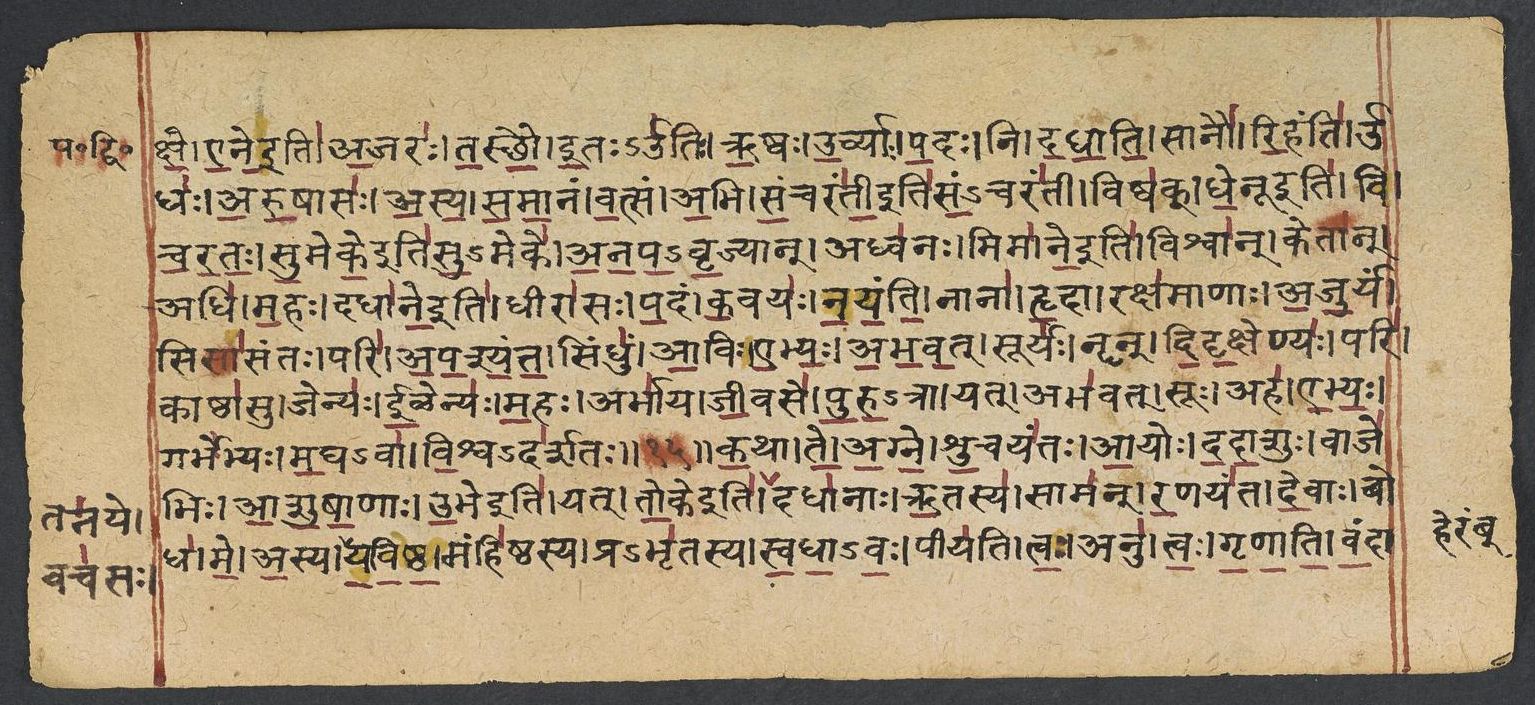
Where on the image
Penn Ms. Coll. 390 Item 41, fol. 114v (numbered 8v by the scribe) (OPenn image 116, upper leaf). Checked on the image: the Rigveda text on this page begins in RV 1.146.2 ‹-vavakṣe eneiti ajaraḥ tasthau›. The next page with Rigveda text, fol. 115r (numbered 9r by the scribe), begins in RV 1.147.2 ‹-vandāruḥ te tanvam vande›. Verse 1.147.1 ends on this page.
1ka̱thā te̍ agne śu̱caya̍nta ā̱yor da̍dā̱śur vāje̍bhir āśuṣā̱ṇāḥ | u̱bhe yat to̱ke tana̍ye̱ dadhā̍nā ṛ̱tasya̱ sāma̍n ra̱ṇaya̍nta de̱vāḥ ||
Compare: Padapāṭha (word-by-word text written in the manuscript; Sansknet e-text via GRETIL)
1kathā | te | agne | śucayantaḥ | āyoḥ | dadāśuḥ | vājebhiḥ | āśuṣāṇāḥ | ubhe iti | yat | toke iti | tanaye | dadhānāḥ | ṛtasya | sāman | raṇayanta | devāḥ
1How, Agni, have the radiant ones, aspiring, endued thee with the vigour of the living, So that on both sides fostering seed and offspring, the Gods may joy in Holy Law's fulfilment?
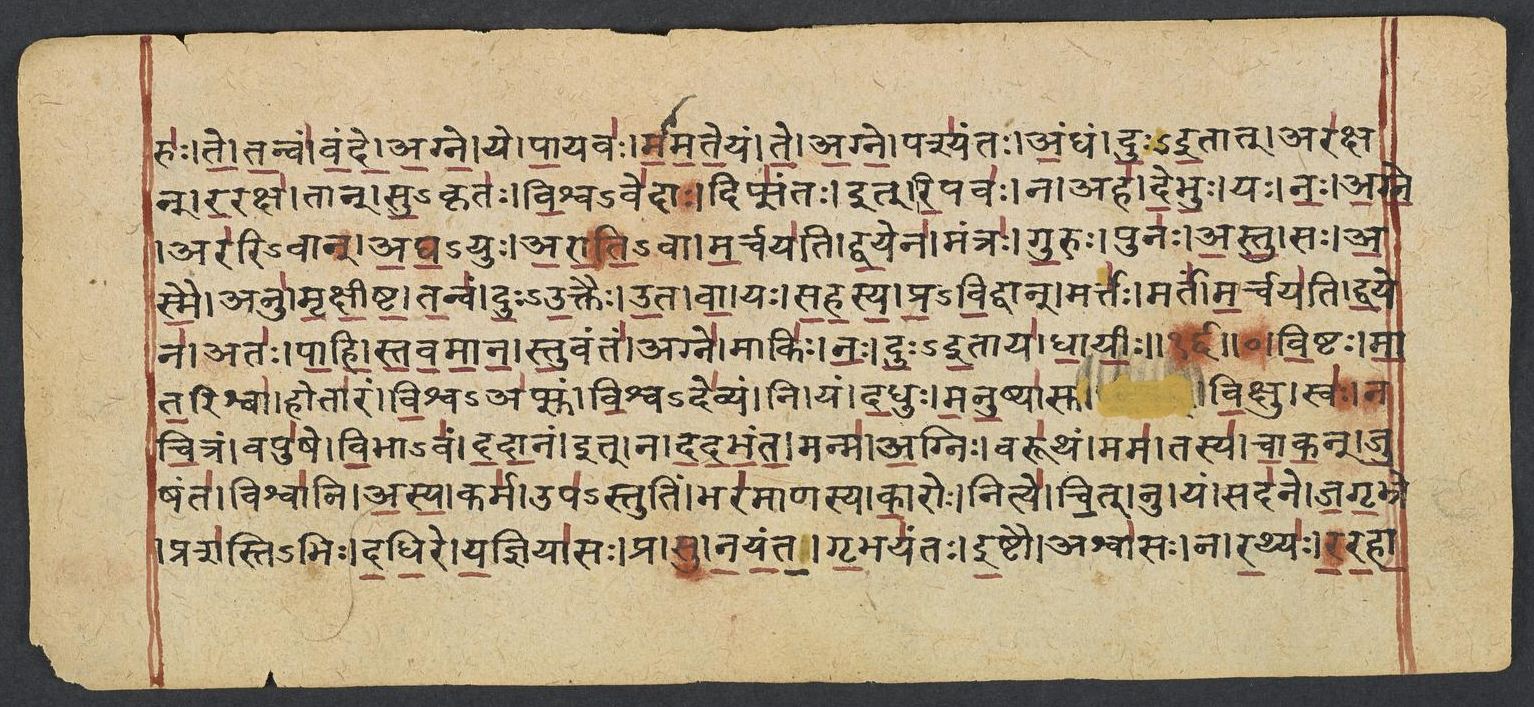
Where on the image
Penn Ms. Coll. 390 Item 41, fol. 115r (numbered 9r by the scribe) (OPenn image 116, lower leaf). Checked on the image: the Rigveda text on this page begins in RV 1.147.2 ‹-vandāruḥ te tanvam vande›. The next page with Rigveda text, fol. 115v (numbered 9v by the scribe), begins in RV 1.148.3 ‹-rarahāṇāḥ›. Verses 1.147.2-5 end on this page; 1.147.2 begins on fol. 114v (numbered 8v by the scribe).
2bodhā̍ me a̱sya vaca̍so yaviṣṭha̱ maṁhi̍ṣṭhasya̱ prabhṛ̍tasya svadhāvaḥ | pīya̍ti tvo̱ anu̍ tvo gṛṇāti va̱ndāru̍s te ta̱nva̍ṁ vande agne ||
3ye pā̱yavo̍ māmate̱yaṁ te̍ agne̱ paśya̍nto a̱ndhaṁ du̍ri̱tād ara̍kṣan | ra̱rakṣa̱ tān su̱kṛto̍ vi̱śvave̍dā̱ dipsa̍nta̱ id ri̱pavo̱ nāha̍ debhuḥ ||
4yo no̍ agne̱ ara̍rivām̐ aghā̱yur a̍rātī̱vā ma̱rcaya̍ti dva̱yena̍ | mantro̍ gu̱ruḥ puna̍r astu̱ so a̍smā̱ anu̍ mṛkṣīṣṭa ta̱nva̍ṁ duru̱ktaiḥ ||
5u̱ta vā̱ yaḥ sa̍hasya pravi̱dvān marto̱ marta̍m ma̱rcaya̍ti dva̱yena̍ | ata̍ḥ pāhi stavamāna stu̱vanta̱m agne̱ māki̍r no duri̱tāya̍ dhāyīḥ ||
Compare: Padapāṭha (word-by-word text written in the manuscript; Sansknet e-text via GRETIL)
2bodha | me | asya | vacasaḥ | yaviṣṭha | maṃhiṣṭhasya | pra-bhṛtasya | svadhāvaḥ | pīyati | tvaḥ | anu | tvaḥ | gṛṇāti | vandāruḥ | te | tanvam | vande | agne
3ye | pāyavaḥ | māmateyam | te | agne | paśyantaḥ | andham | duḥ-itāt | arakṣan | rarakṣa | tān | su-kṛtaḥ | viśva-vedāḥ | dipsantaḥ | it | ripavaḥ | na | aha | debhuḥ
4yaḥ | naḥ | agne | arari-vān | agha-yuḥ | arāti-vā | marcayati | dvayena | mantraḥ | guruḥ | punaḥ | astu | saḥ | asmai | anu | mṛkṣīṣṭa | tanvam | duḥ-uktaiḥ
5uta | vā | yaḥ | sahasya | pra-vidvān | martaḥ | martam | marcayati | dvayena | ataḥ | pāhi | stavamāna | stuvantam | agne | mākiḥ | naḥ | duḥ-itāya | dhāyīḥ
2Mark this my speech, Divine One, thou, Most Youthful! offered to thee by him who gives most freely. One hates thee, and another sings thy praises: I thine adorer laud thy form, O Agni.
3Thy guardian rays, O Agni, when they saw him, preserved blind Mâmateya from affliction. Lord of all riches, he preserved the pious the foes who fain would harm them did no mischief.
4The sinful man who worships not, O Agni, who, offering not, harms us with double-dealing,– Be this in turn to him a heavy sentence may he distress himself by his revilings.
5Yea, when a mortal knowingly, O Victor, injures with double tongue a fellow-mortal, From him, praised Agni! save thou him that lauds thee: bring us not into trouble and affliction.
Notes
- Sanskrit: Aufrecht's edition (1877) with the Vedic accents, as entered by van Nooten and Holland (GRETIL).
- English: Ralph T. H. Griffith, The Hymns of the Rigveda (1889-1892; 2nd ed. 1896-1897), from the VedaWeb digital text; OCR slips in that text were corrected against the printed 2nd edition (data/sources/rigveda/griffith_errata.json).
- Padapāṭha (edition text): Sansknet e-text via GRETIL (CC BY-NC-SA 4.0).
Cite
Sources
- Source: Penn Ms. Coll. 390 Item 41 (undated (catalogued with Penn's 18th-19th c. Vedic manuscripts)), OPenn, Public Domain Mark + Aufrecht's accented text (GRETIL) + Griffith's English (VedaWeb) (holding institution)
- Critical edition: Aufrecht (1877), accented e-text via GRETIL
← previous · → next · v cycle view · l back to library