Rigveda 1.148: To Agni
Introduction
Rigveda 1.148 is a hymn of 5 verses addressed to Agni. It stands in book (maṇḍala) 1, a collection of hymns by many families of poets. The Rigveda is the oldest collection of Sanskrit hymns, composed in the second half of the second millennium BCE and handed down orally for many centuries before it was written down.
The manuscript shown is Penn Ms. Coll. 390 Item 41 (University of Pennsylvania), an undated paper manuscript of the padapāṭha (the word-by-word recitation text, in which every word is written separately and compounds are split) of the whole Ṛgveda in Devanāgarī, 884 leaves in fascicles, 7-9 lines to the page, accents in red; this hymn stands on fol. 115r-115v. Each section below gives the verses that end on one page; the page boundaries were read on the images (the opening words of every page), not counted out. Where the manuscript is a padapāṭha (the word-by-word recitation text), the section shows Aufrecht's continuous (saṃhitā) text first and, as the edition text, the padapāṭha of the same verses, which is the form written on the page.
How was this verified? (Provenance)
Where on the image
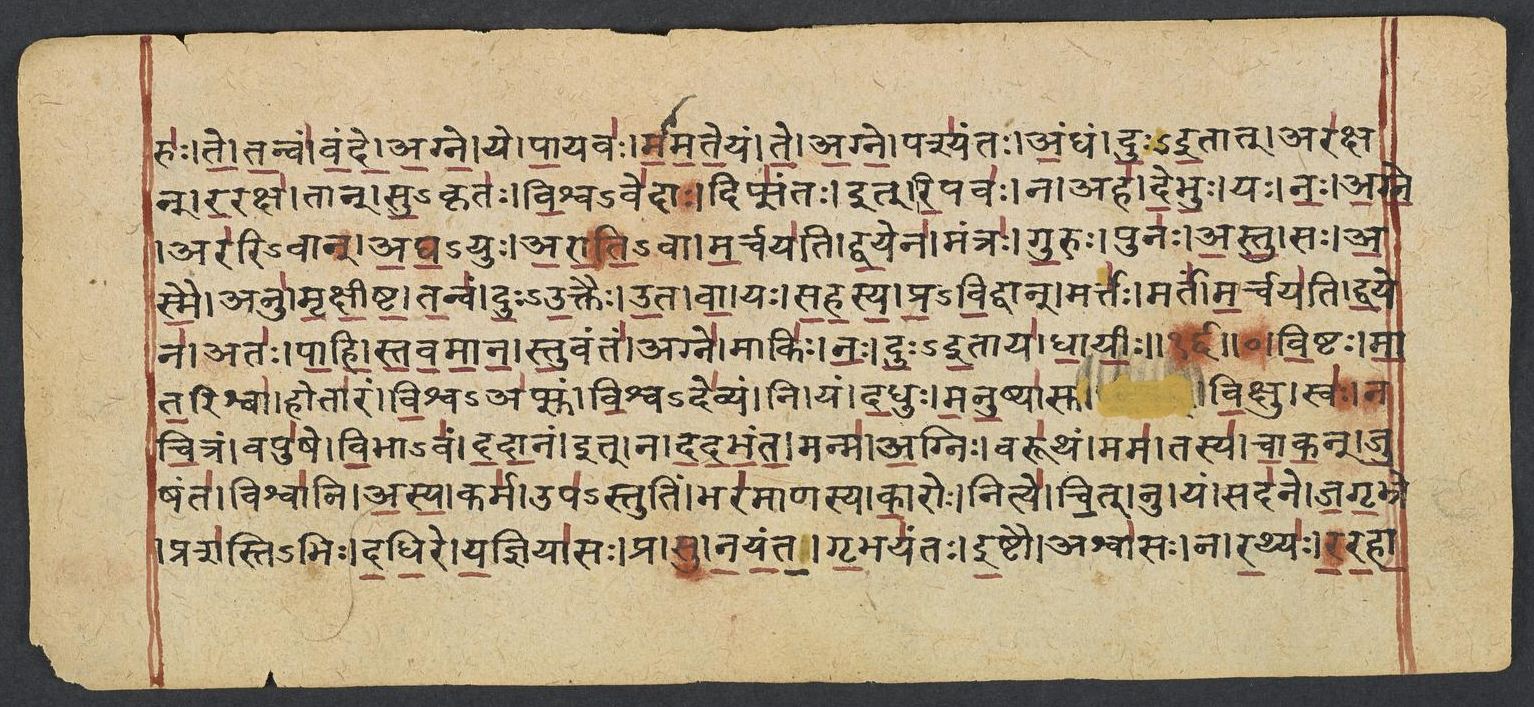
Penn Ms. Coll. 390 Item 41, fol. 115r (numbered 9r by the scribe) (OPenn image 116, lower leaf). Checked on the image: the Rigveda text on this page begins in RV 1.147.2 ‹-vandāruḥ te tanvam vande›. The next page with Rigveda text, fol. 115v (numbered 9v by the scribe), begins in RV 1.148.3 ‹-rarahāṇāḥ›. Verses 1.148.1-2 end on this page.
1mathī̱d yad ī̍ṁ vi̱ṣṭo mā̍ta̱riśvā̱ hotā̍raṁ vi̱śvāpsu̍ṁ vi̱śvade̍vyam | ni yaṁ da̱dhur ma̍nu̱ṣyā̍su vi̱kṣu sva1̱̍r ṇa ci̱traṁ vapu̍ṣe vi̱bhāva̍m ||
2da̱dā̱nam in na da̍dabhanta̱ manmā̱gnir varū̍tha̱m mama̱ tasya̍ cākan | ju̱ṣanta̱ viśvā̍ny asya̱ karmopa̍stuti̱m bhara̍māṇasya kā̱roḥ ||
Compare: Padapāṭha (word-by-word text written in the manuscript; Sansknet e-text via GRETIL)
1mathīt | yat | īm | viṣṭaḥ | mātariśvā | hotāram | viśva-apsum | viśva-devyam | ni | yam | dadhuḥ | manuṣyāsu | vikṣu | svaḥ | na | citram | vapuṣe | vibhāvam
2dadānam | it | na | dadabhanta | manma | agniḥ | varūtham | mama | tasyacākan | juṣanta | viśvāni | asya | karma | upa-stutim | bharamāṇasya | kāroḥ
1WHAT Mâtariṣvan, piercing, formed by friction, Herald of all the Gods. in varied figure, Is he whom they have set mid human houses, gay-hued as light and shining forth for beauty.
2They shall not harm the man who brings thee praises: such as I am, Agni my help approves me. All acts of mine shall they accept with pleasure, laudation from the singer who presents it.
Where on the image
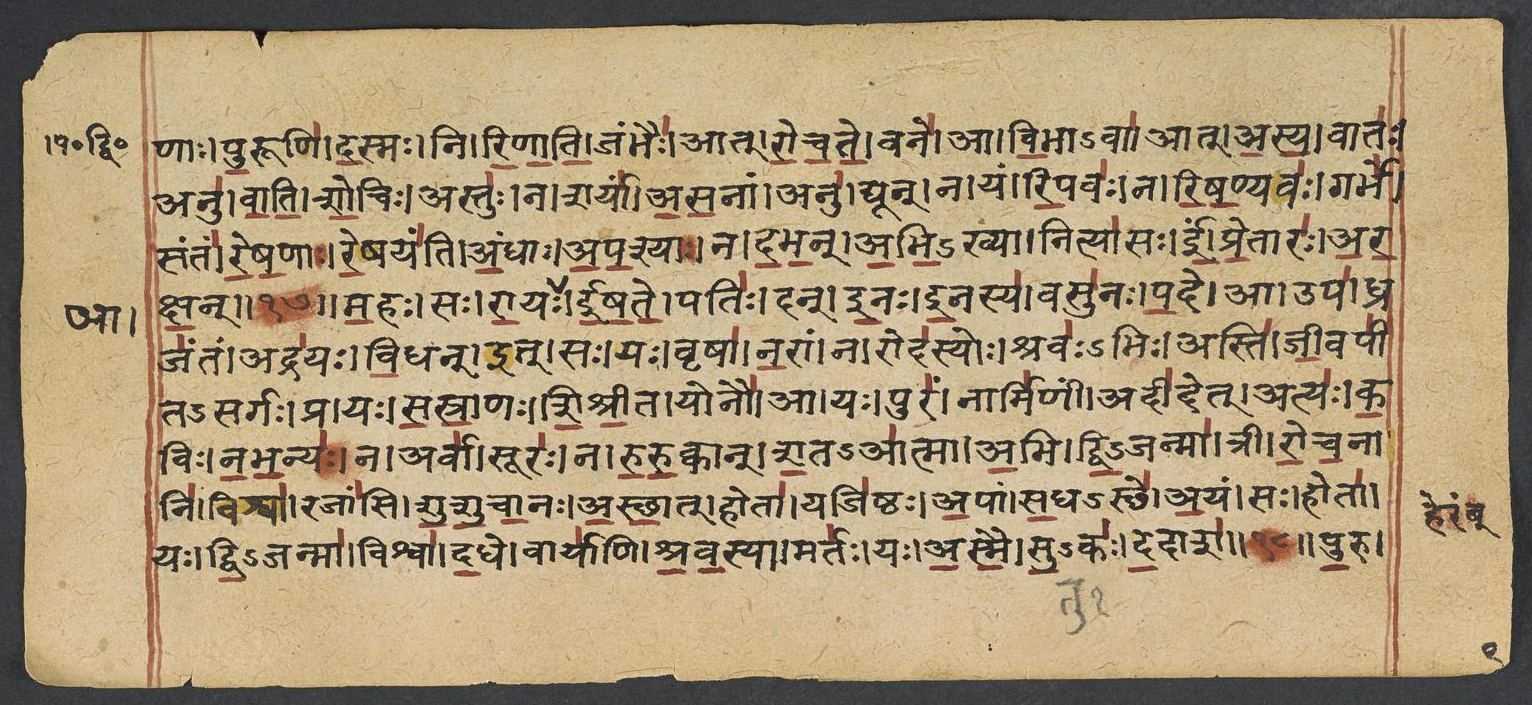
Penn Ms. Coll. 390 Item 41, fol. 115v (numbered 9v by the scribe) (OPenn image 117, upper leaf). Checked on the image: the Rigveda text on this page begins in RV 1.148.3 ‹-rarahāṇāḥ›. The next page with Rigveda text, fol. 116r (numbered 10r by the scribe), begins in RV 1.150.1 ‹tvā dāsvān voce ariḥ›. Verses 1.148.3-5 end on this page; 1.148.3 begins on fol. 115r (numbered 9r by the scribe).
3nitye̍ ci̱n nu yaṁ sada̍ne jagṛ̱bhre praśa̍stibhir dadhi̱re ya̱jñiyā̍saḥ | pra sū na̍yanta gṛ̱bhaya̍nta i̱ṣṭāv aśvā̍so̱ na ra̱thyo̍ rārahā̱ṇāḥ ||
4pu̱rūṇi̍ da̱smo ni ri̍ṇāti̱ jambhai̱r ād ro̍cate̱ vana̱ ā vi̱bhāvā̍ | ād a̍sya̱ vāto̱ anu̍ vāti śo̱cir astu̱r na śaryā̍m asa̱nām anu̱ dyūn ||
5na yaṁ ri̱pavo̱ na ri̍ṣa̱ṇyavo̱ garbhe̱ santa̍ṁ reṣa̱ṇā re̱ṣaya̍nti | a̱ndhā a̍pa̱śyā na da̍bhann abhi̱khyā nityā̍sa īm pre̱tāro̍ arakṣan ||
Compare: Padapāṭha (word-by-word text written in the manuscript; Sansknet e-text via GRETIL)
3nitye | cit | nu | yam | sadane | jagṛbhre | praśasti-bhiḥ | dadhire | yajñiyāsaḥ | pra | su | nayanta | gṛbhayantaḥ | iṣṭau | aśvāsaḥ | na | rathyaḥ | rarahāṇāḥ
4purūṇi | dasmaḥ | ni | riṇāti | jambhaiḥ | āt | rocate | vane | ā | vibhāvā | āt | asya | vātaḥ | anu | vāti | śociḥ | astuḥ | na | śaryām | asanām | anu | dyūn
5na | yam | ripavaḥ | na | riṣaṇyavaḥ | garbhe | santam | reṣaṇāḥ | reṣayanti | andhāḥ | apaśyāḥ | na | dabhan | abhi-khyā | nityāsaḥ | īm | pretāraḥ | arakṣan
3Him in his constant seat men skilled in worship have taken and with praises have established. As, harnessed to a chariot fleet-foot horses, at his command let bearers lead him forward.
4Wondrous, full many a thing he chews and crunches: he shines amid the wood with spreading brightness. Upon his glowing flames the wind blows daily, driving them like the keen shaft of an archer.
5Him, whom while yet in embryo the hostile, both skilled and fain to harm, may never injure, Men blind and sightless through his splendour hurt not: his never-failing lovers have preserved him.
Notes
- Sanskrit: Aufrecht's edition (1877) with the Vedic accents, as entered by van Nooten and Holland (GRETIL).
- English: Ralph T. H. Griffith, The Hymns of the Rigveda (1889-1892; 2nd ed. 1896-1897), from the VedaWeb digital text; OCR slips in that text were corrected against the printed 2nd edition (data/sources/rigveda/griffith_errata.json).
- Padapāṭha (edition text): Sansknet e-text via GRETIL (CC BY-NC-SA 4.0).
Cite
Sources
- Source: Penn Ms. Coll. 390 Item 41 (undated (catalogued with Penn's 18th-19th c. Vedic manuscripts)), OPenn, Public Domain Mark + Aufrecht's accented text (GRETIL) + Griffith's English (VedaWeb) (holding institution)
- Critical edition: Aufrecht (1877), accented e-text via GRETIL
← previous · → next · v cycle view · l back to library