Rigveda 1.149: To Agni
Introduction
Rigveda 1.149 is a hymn of 5 verses addressed to Agni. It stands in book (maṇḍala) 1, a collection of hymns by many families of poets. The Rigveda is the oldest collection of Sanskrit hymns, composed in the second half of the second millennium BCE and handed down orally for many centuries before it was written down.
The manuscript shown is Penn Ms. Coll. 390 Item 41 (University of Pennsylvania), an undated paper manuscript of the padapāṭha (the word-by-word recitation text, in which every word is written separately and compounds are split) of the whole Ṛgveda in Devanāgarī, 884 leaves in fascicles, 7-9 lines to the page, accents in red; this hymn stands on fol. 115v. Each section below gives the verses that end on one page; the page boundaries were read on the images (the opening words of every page), not counted out. Where the manuscript is a padapāṭha (the word-by-word recitation text), the section shows Aufrecht's continuous (saṃhitā) text first and, as the edition text, the padapāṭha of the same verses, which is the form written on the page.
How was this verified? (Provenance)
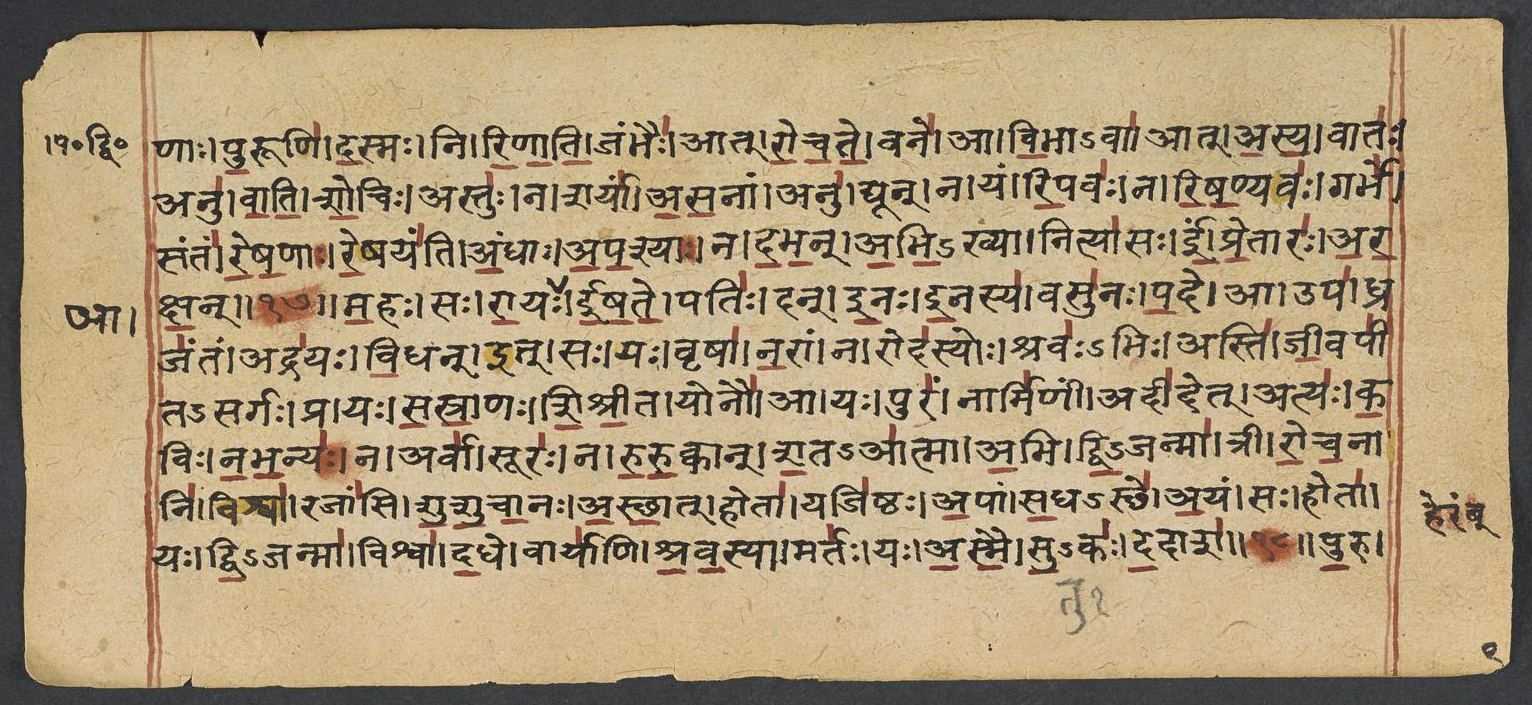
Where on the image
Penn Ms. Coll. 390 Item 41, fol. 115v (numbered 9v by the scribe) (OPenn image 117, upper leaf). Checked on the image: the Rigveda text on this page begins in RV 1.148.3 ‹-rarahāṇāḥ›. The next page with Rigveda text, fol. 116r (numbered 10r by the scribe), begins in RV 1.150.1 ‹tvā dāsvān voce ariḥ›. Verses 1.149.1-5 end on this page.
1ma̱haḥ sa rā̱ya eṣa̍te̱ pati̱r dann i̱na i̱nasya̱ vasu̍naḥ pa̱da ā | upa̱ dhraja̍nta̱m adra̍yo vi̱dhann it ||
2sa yo vṛṣā̍ na̱rāṁ na roda̍syo̱ḥ śravo̍bhi̱r asti̍ jī̱vapī̍tasargaḥ | pra yaḥ sa̍srā̱ṇaḥ śi̍śrī̱ta yonau̍ ||
3ā yaḥ pura̱ṁ nārmi̍ṇī̱m adī̍de̱d atya̍ḥ ka̱vir na̍bha̱nyo̱3̱̍ nārvā̍ | sūro̱ na ru̍ru̱kvāñ cha̱tātmā̍ ||
4a̱bhi dvi̱janmā̱ trī ro̍ca̱nāni̱ viśvā̱ rajā̍ṁsi śuśucā̱no a̍sthāt | hotā̱ yaji̍ṣṭho a̱pāṁ sa̱dhasthe̍ ||
5a̱yaṁ sa hotā̱ yo dvi̱janmā̱ viśvā̍ da̱dhe vāryā̍ṇi śrava̱syā | marto̱ yo a̍smai su̱tuko̍ da̱dāśa̍ ||
Compare: Padapāṭha (word-by-word text written in the manuscript; Sansknet e-text via GRETIL)
1mahaḥ | saḥ | rāyaḥ | ā | īṣate | patiḥ | dan | inaḥ | inasya | vasunaḥ | pade | ā | upa | dhrajantam | adrayaḥ | vidhan | it
2saḥ | yaḥ | vṛṣā | narān | na | rodasyoḥ | śravaḥ-bhiḥ | asti | jīvapīta-sagarḥ | pra | yaḥ | sasrāṇaḥ | śiśrīta | yonau
3ā | yaḥ | puram | nārmiṇīm | adīdet | atyaḥ | kaviḥ | nabhanyaḥ | nārvā | sūraḥ | na | rurukvān | śata-ātmā
4abhi | dvi-janmā | trī | rocanāni | viśvā | rajāṃsi | śuśucānaḥ | asthāt | hotā | yajiṣṭhaḥ | apām | sadha-sthe
5ayam | saḥ | hotā | yaḥ | dvi-janmā | viśvā | dadhe | vāryāṇi | śravasyā | martaḥ | yaḥ | asmai | su-tukaḥ | dadāśa
1HITHER he hastens to give, Lord of great riches, King of the mighty, to the place of treasure. lie pressing-stones shall serve him speeding near us.
2As Steer of men so Steer of earth and heaven by glory, he whose streams all life hath drunken, Who hasting forward rests upon the altar.
3He who hath lighted up the joyous castle, wise Courser like the Steed of cloudy heaven, Bright like the Sun, with hundredfold existence.
4He, doubly born, hath spread in his effulgence through the three luminous realms, through all the regions, Best sacrificing Priest where waters gather.
5Priest doubly born, he through his love of glory hath in his keeping all things worth the choosing, The man who brings him gifts hath noble offspring.
Notes
- Sanskrit: Aufrecht's edition (1877) with the Vedic accents, as entered by van Nooten and Holland (GRETIL).
- English: Ralph T. H. Griffith, The Hymns of the Rigveda (1889-1892; 2nd ed. 1896-1897), from the VedaWeb digital text; OCR slips in that text were corrected against the printed 2nd edition (data/sources/rigveda/griffith_errata.json).
- Padapāṭha (edition text): Sansknet e-text via GRETIL (CC BY-NC-SA 4.0).
Cite
Sources
- Source: Penn Ms. Coll. 390 Item 41 (undated (catalogued with Penn's 18th-19th c. Vedic manuscripts)), OPenn, Public Domain Mark + Aufrecht's accented text (GRETIL) + Griffith's English (VedaWeb) (holding institution)
- Critical edition: Aufrecht (1877), accented e-text via GRETIL
← previous · → next · v cycle view · l back to library