Rigveda 1.150: To Agni
Introduction
Rigveda 1.150 is a hymn of 3 verses addressed to Agni. It stands in book (maṇḍala) 1, a collection of hymns by many families of poets. The Rigveda is the oldest collection of Sanskrit hymns, composed in the second half of the second millennium BCE and handed down orally for many centuries before it was written down.
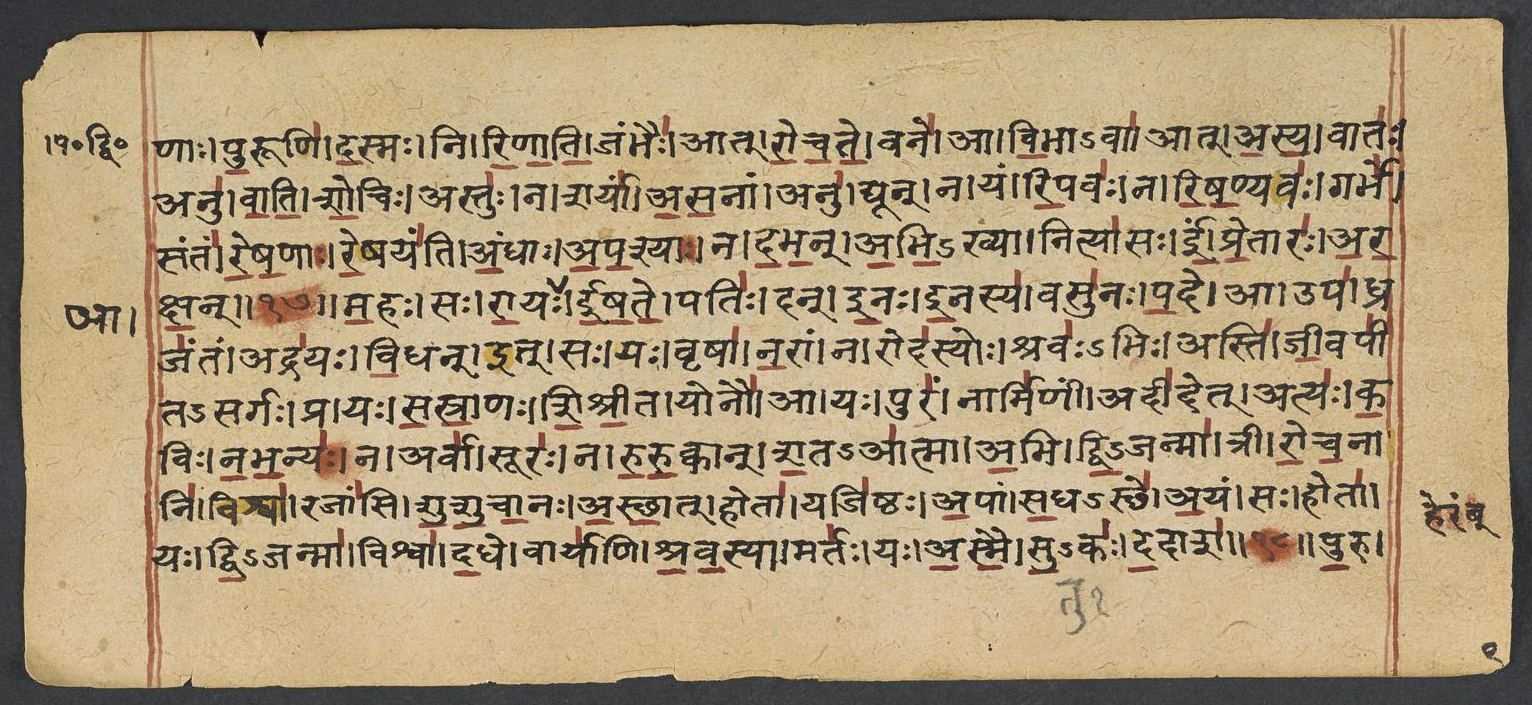
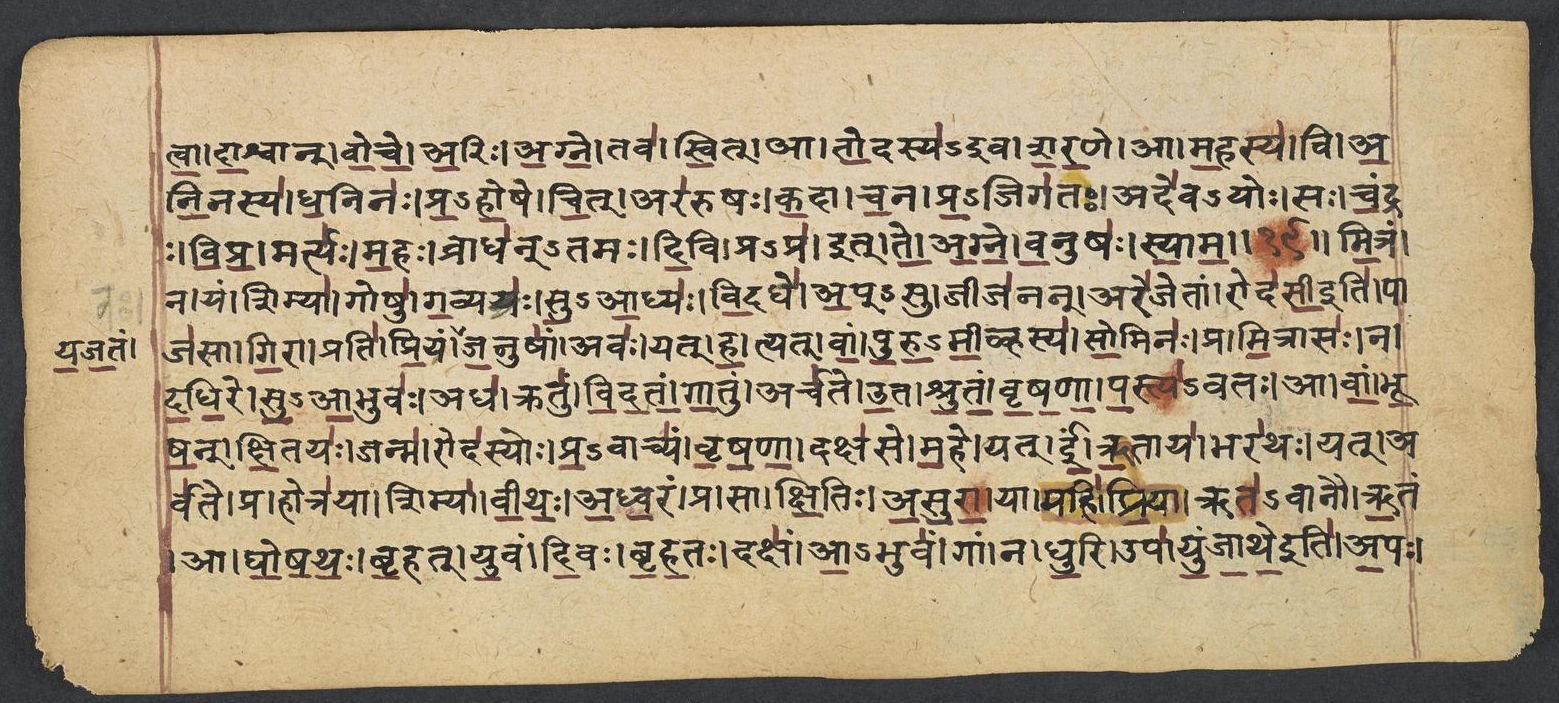
The manuscript shown is Penn Ms. Coll. 390 Item 41 (University of Pennsylvania), an undated paper manuscript of the padapāṭha (the word-by-word recitation text, in which every word is written separately and compounds are split) of the whole Ṛgveda in Devanāgarī, 884 leaves in fascicles, 7-9 lines to the page, accents in red; this hymn stands on fol. 115v-116r. Each section below gives the verses that end on one page; the page boundaries were read on the images (the opening words of every page), not counted out. Where the manuscript is a padapāṭha (the word-by-word recitation text), the section shows Aufrecht's continuous (saṃhitā) text first and, as the edition text, the padapāṭha of the same verses, which is the form written on the page.
How was this verified? (Provenance)
Where on the image
Penn Ms. Coll. 390 Item 41, fol. 116r (numbered 10r by the scribe) (OPenn image 117, lower leaf). Checked on the image: the Rigveda text on this page begins in RV 1.150.1 ‹tvā dāsvān voce ariḥ›. The next page with Rigveda text, fol. 116v (numbered 10v by the scribe), begins in RV 1.151.4 ‹-apaḥ›. Verses 1.150.1-3 end on this page; 1.150.1 begins on fol. 115v (numbered 9v by the scribe).
1pu̱ru tvā̍ dā̱śvān vo̍ce̱ 'rir a̍gne̱ tava̍ svi̱d ā | to̱dasye̍va śara̱ṇa ā ma̱hasya̍ ||
2vy a̍ni̱nasya̍ dha̱nina̍ḥ praho̱ṣe ci̱d ara̍ruṣaḥ | ka̱dā ca̱na pra̱jiga̍to̱ ade̍vayoḥ ||
3sa ca̱ndro vi̍pra̱ martyo̍ ma̱ho vrādha̍ntamo di̱vi | pra-pret te̍ agne va̱nuṣa̍ḥ syāma ||
Compare: Padapāṭha (word-by-word text written in the manuscript; Sansknet e-text via GRETIL)
1puru | tvā | dāsvān | voce | ariḥ | agne | tava | svit | ā | todasya-iva | śaraṇe | ā | mahasya
2vi | aninasya | dhaninaḥ | pra-hoṣe | cit | araruṣaḥ | kadā | cana | pra-jigataḥ | adeva-yoḥ
3saḥ | candraḥ | vipra | martyaḥ | mahaḥ | vrādhan-tamaḥ | divi | pra-pra | it | te | agne | vanuṣaḥ | syāma
1AGNI, thy faithful servant I call upon thee with many a gift, As in the keeping of the great inciting God;
2Thou who ne'er movest thee to aid the indolent, the godless man, Him who though wealthy never brings an offering.
3Splendid, O Singer, is that man, mightiest of the great in heaven. Agni, may we be foremost, we thy worshippers.
Notes
- Sanskrit: Aufrecht's edition (1877) with the Vedic accents, as entered by van Nooten and Holland (GRETIL).
- English: Ralph T. H. Griffith, The Hymns of the Rigveda (1889-1892; 2nd ed. 1896-1897), from the VedaWeb digital text; OCR slips in that text were corrected against the printed 2nd edition (data/sources/rigveda/griffith_errata.json).
- Padapāṭha (edition text): Sansknet e-text via GRETIL (CC BY-NC-SA 4.0).
Cite
Sources
- Source: Penn Ms. Coll. 390 Item 41 (undated (catalogued with Penn's 18th-19th c. Vedic manuscripts)), OPenn, Public Domain Mark + Aufrecht's accented text (GRETIL) + Griffith's English (VedaWeb) (holding institution)
- Critical edition: Aufrecht (1877), accented e-text via GRETIL
← previous · → next · v cycle view · l back to library