Rigveda 1.175: To Indra
Introduction
Rigveda 1.175 is a hymn of 6 verses addressed to Indra. It stands in book (maṇḍala) 1, a collection of hymns by many families of poets. The Rigveda is the oldest collection of Sanskrit hymns, composed in the second half of the second millennium BCE and handed down orally for many centuries before it was written down.
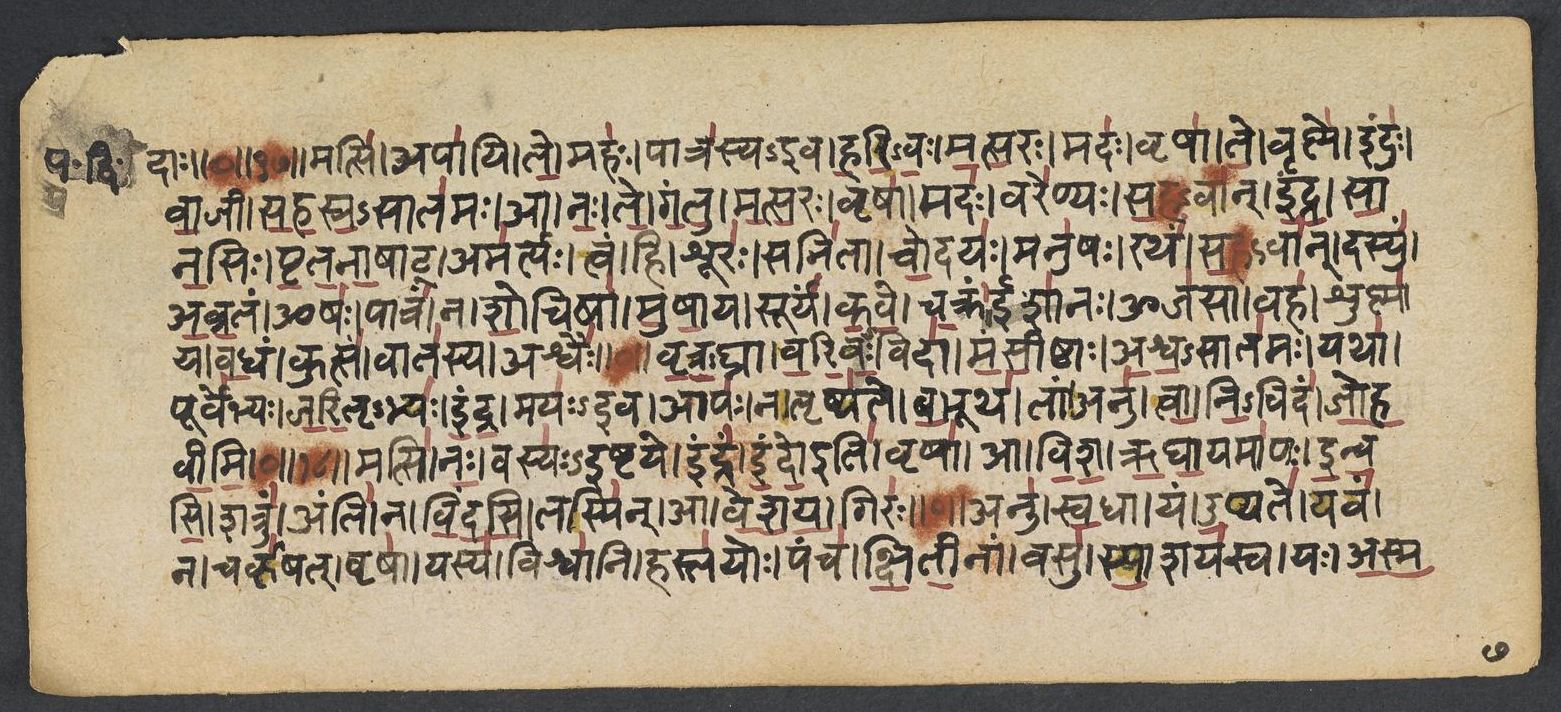
The manuscript shown is Penn Ms. Coll. 390 Item 41 (University of Pennsylvania), an undated paper manuscript of the padapāṭha (the word-by-word recitation text, in which every word is written separately and compounds are split) of the whole Ṛgveda in Devanāgarī, 884 leaves in fascicles, 7-9 lines to the page, accents in red; this hymn stands on fol. 138v. Each section below gives the verses that end on one page; the page boundaries were read on the images (the opening words of every page), not counted out. Where the manuscript is a padapāṭha (the word-by-word recitation text), the section shows Aufrecht's continuous (saṃhitā) text first and, as the edition text, the padapāṭha of the same verses, which is the form written on the page.
How was this verified? (Provenance)
Where on the image
Penn Ms. Coll. 390 Item 41, fol. 138v (numbered 7v by the scribe) (OPenn image 140, upper leaf). Checked on the image: the Rigveda text on this page begins in RV 1.174.10 ‹-jīra-dānum›. The next page with Rigveda text, fol. 139r (numbered 8r by the scribe), begins in RV 1.176.3 ‹-asma-dhruk divyāiva aśaniḥ jahi›. Verses 1.175.1-6 end on this page.
1matsy apā̍yi te̱ maha̱ḥ pātra̍syeva harivo matsa̱ro mada̍ḥ | vṛṣā̍ te̱ vṛṣṇa̱ indu̍r vā̱jī sa̍hasra̱sāta̍maḥ ||
2ā na̍s te gantu matsa̱ro vṛṣā̱ mado̱ vare̍ṇyaḥ | sa̱hāvā̍m̐ indra sāna̱siḥ pṛ̍tanā̱ṣāḻ ama̍rtyaḥ ||
3tvaṁ hi śūra̱ḥ sani̍tā co̱dayo̱ manu̍ṣo̱ ratha̍m | sa̱hāvā̱n dasyu̍m avra̱tam oṣa̱ḥ pātra̱ṁ na śo̱ciṣā̍ ||
4mu̱ṣā̱ya sūrya̍ṁ kave ca̱kram īśā̍na̱ oja̍sā | vaha̱ śuṣṇā̍ya va̱dhaṁ kutsa̱ṁ vāta̱syāśvai̍ḥ ||
5śu̱ṣminta̍mo̱ hi te̱ mado̍ dyu̱mninta̍ma u̱ta kratu̍ḥ | vṛ̱tra̱ghnā va̍rivo̱vidā̍ maṁsī̱ṣṭhā a̍śva̱sāta̍maḥ ||
6yathā̱ pūrve̍bhyo jari̱tṛbhya̍ indra̱ maya̍ i̱vāpo̱ na tṛṣya̍te ba̱bhūtha̍ | tām anu̍ tvā ni̱vida̍ṁ johavīmi vi̱dyāme̱ṣaṁ vṛ̱jana̍ṁ jī̱radā̍num ||
Compare: Padapāṭha (word-by-word text written in the manuscript; Sansknet e-text via GRETIL)
1matsi | apāyi | te | mahaḥ | pātrasya-iva | hari-vaḥ | matsaraḥ | madaḥ | vṛṣā | te | vṛṣṇe | induḥ | vājī | sahasra-sātamaḥ
2ā | naḥ | te | gantu | matsaraḥ | vṛṣā | madaḥ | vareṇyaḥ | saha-vān | indra | sānasiḥ | pṛtanāṣāṭ | amartyaḥ
3tvam | hi | śūraḥ | sanitā | codayaḥ | manuṣaḥ | ratham | saha-vān | dasyum | avratam | oṣaḥ | pātram | na | śociṣā
4muṣāya | sūrya | kave | cakram | īśānaḥ | ojasā | vaha | śuṣṇāya | vadham | kutsam | vātasya | aśvaiḥ
5śuṣmin-tamaḥ | hi | te | madaḥ | dyumnin-tamaḥ | uta | kratuḥ | vṛtra-ghnā | var ivaḥ-vidā | maṃsīṣṭhāḥ | aśva-sātamaḥ
6yathā | pūrvebhyaḥ | jaritṛ-bhyaḥ | indra | mayaḥ-iva | āpaḥ | na | tṛṣyate | babhūtha | tām | anu | tvā | ni-vidam | johavīmi | vidyāma | iṣam | vṛjanam | jīra-dānum
1GLAD thee: thy glory hath been quaffed, Lord of Bay Steeds, as 'twere the bowl's enlivening mead. For thee the Strong there is strong drink, mighty, omnipotent to win.
2Let our strong drink, most excellent, exhilarating, come to thee, Victorious, Indra! bringing gain, immortal conquering in fight,
3Thou, Hero, winner of the spoil, urgest to speed the car of man. Burn, like a vessel with the flame, the lawless Dasyu, Conqueror!
4Empowered by thine own might, O Sage, thou stolest Sarya's chariot wheel. Thou barest Kutsa with the steeds of Wind to Ṣushṇa as his death.
5Most mighty is thy rapturous joy, most splendid is thine active power, Wherewith, foe-slaying, sending bliss, thou art supreme in gaining steeds.
6As thou, O Indra, to the ancient singers wast ever joy, as water to the thirsty, So unto thee I sing this invocation. May we find strengthening food in full abundance.
Notes
- Sanskrit: Aufrecht's edition (1877) with the Vedic accents, as entered by van Nooten and Holland (GRETIL).
- English: Ralph T. H. Griffith, The Hymns of the Rigveda (1889-1892; 2nd ed. 1896-1897), from the VedaWeb digital text; OCR slips in that text were corrected against the printed 2nd edition (data/sources/rigveda/griffith_errata.json).
- Padapāṭha (edition text): Sansknet e-text via GRETIL (CC BY-NC-SA 4.0).
Cite
Sources
- Source: Penn Ms. Coll. 390 Item 41 (undated (catalogued with Penn's 18th-19th c. Vedic manuscripts)), OPenn, Public Domain Mark + Aufrecht's accented text (GRETIL) + Griffith's English (VedaWeb) (holding institution)
- Critical edition: Aufrecht (1877), accented e-text via GRETIL
← previous · → next · v cycle view · l back to library