Rigveda 1.28: The simplified pressing of Soma
Introduction
Rigveda 1.28 is a hymn of 9 verses addressed to the simplified pressing of Soma. It stands in book (maṇḍala) 1, a collection of hymns by many families of poets. The Rigveda is the oldest collection of Sanskrit hymns, composed in the second half of the second millennium BCE and handed down orally for many centuries before it was written down.
The manuscript shown is Penn Ms. Coll. 390 Item 41 (University of Pennsylvania), an undated paper manuscript of the padapāṭha (the word-by-word recitation text, in which every word is written separately and compounds are split) of the whole Ṛgveda in Devanāgarī, 884 leaves in fascicles, 7-9 lines to the page, accents in red; this hymn stands on fol. 16v-17r. Each section below gives the verses that end on one page; the page boundaries were read on the images (the opening words of every page), not counted out. Where the manuscript is a padapāṭha (the word-by-word recitation text), the section shows Aufrecht's continuous (saṃhitā) text first and, as the edition text, the padapāṭha of the same verses, which is the form written on the page.
How was this verified? (Provenance)
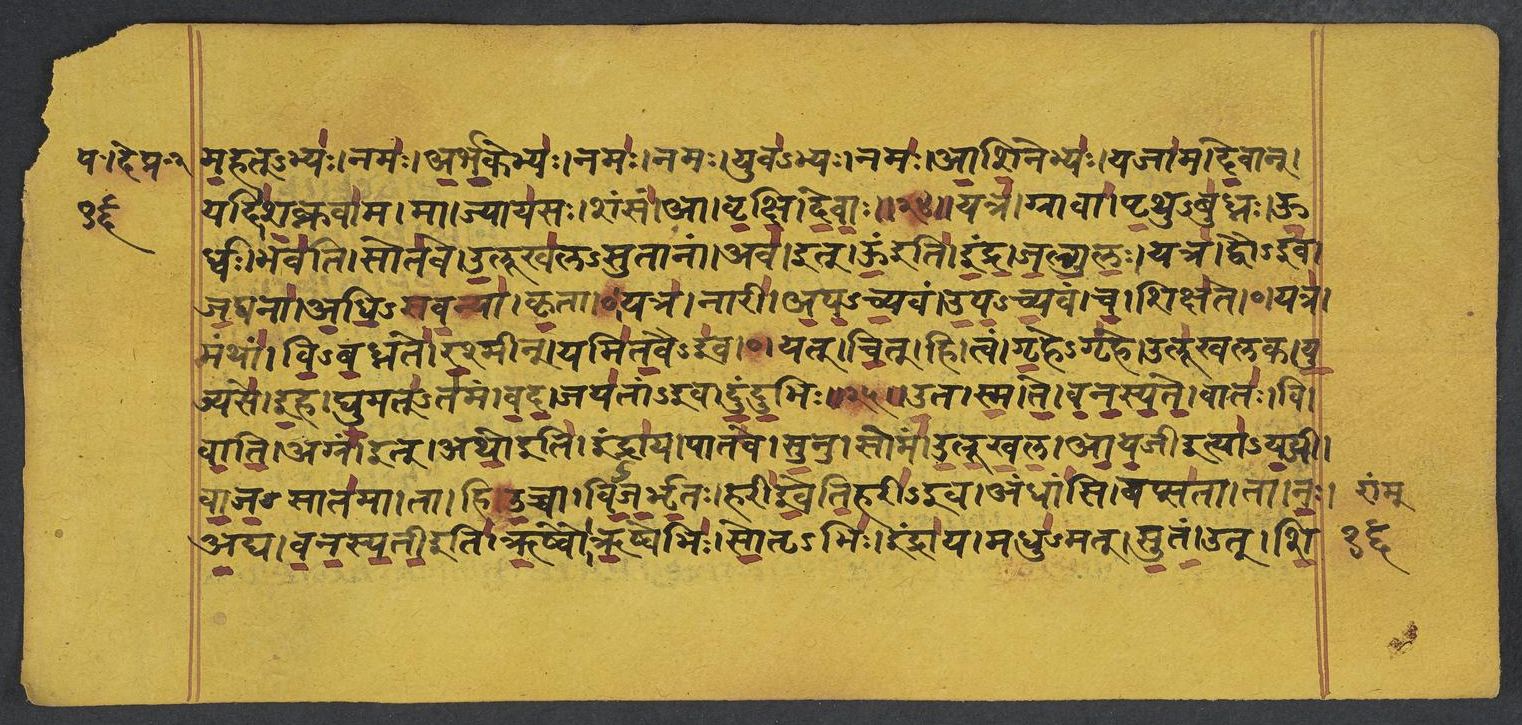
Where on the image
Penn Ms. Coll. 390 Item 41, fol. 16v (OPenn image 18, upper leaf). Checked on the image: the Rigveda text on this page begins in RV 1.27.13 ‹mahat-bhyaḥ namaḥ arbhakebhyaḥ namaḥ›. The next page with Rigveda text, fol. 17r, begins in RV 1.28.9 ‹-śiṣṭam camvoḥ bhara somam›. Verses 1.28.1-8 end on this page.
1yatra̱ grāvā̍ pṛ̱thubu̍dhna ū̱rdhvo bhava̍ti̱ sota̍ve | u̱lūkha̍lasutānā̱m aved v i̍ndra jalgulaḥ ||
2yatra̱ dvāv i̍va ja̱ghanā̍dhiṣava̱ṇyā̍ kṛ̱tā | u̱lūkha̍lasutānā̱m aved v i̍ndra jalgulaḥ ||
3yatra̱ nāry a̍pacya̱vam u̍pacya̱vaṁ ca̱ śikṣa̍te | u̱lūkha̍lasutānā̱m aved v i̍ndra jalgulaḥ ||
4yatra̱ manthā̍ṁ viba̱dhnate̍ ra̱śmīn yami̍ta̱vā i̍va | u̱lūkha̍lasutānā̱m aved v i̍ndra jalgulaḥ ||
5yac ci̱d dhi tvaṁ gṛ̱he-gṛ̍ha̱ ulū̍khalaka yu̱jyase̍ | i̱ha dyu̱matta̍maṁ vada̱ jaya̍tām iva dundu̱bhiḥ ||
6u̱ta sma̍ te vanaspate̱ vāto̱ vi vā̱ty agra̱m it | atho̱ indrā̍ya̱ pāta̍ve su̱nu soma̍m ulūkhala ||
7ā̱ya̱jī vā̍ja̱sāta̍mā̱ tā hy u1̱̍ccā vi̍jarbhṛ̱taḥ | harī̍ i̱vāndhā̍ṁsi̱ bapsa̍tā ||
8tā no̍ a̱dya va̍naspatī ṛ̱ṣvāv ṛ̱ṣvebhi̍ḥ so̱tṛbhi̍ḥ | indrā̍ya̱ madhu̍mat sutam ||
Compare: Padapāṭha (word-by-word text written in the manuscript; Sansknet e-text via GRETIL)
1yatra | grāvā | pṛthu-budhnaḥ | ūrdhvaḥ | bhavati | sotave | ulūkhala-sutānām | ava | it | oṃ iti | indra | jalgulaḥ
2yatra | dvau-iva | jaghanā | adhi-savanyā | kṛtā | ulūkhala-sutānām | ava | it | oṃ iti | indra | jalgulaḥ
3yatra | nārī | apa-cyavam | upa-cyavam | ca | śikṣate | ulūkhala-sutānām | ava | it | oṃ iti | indra | jalgulaḥ
4yatra | manthām | vi-badhnate | raśmīn | yamitavai-iva | ulūkhala-sutānām | ava | it | oṃ iti | indra | jalgulaḥ
5yat | cit | hi | tvam | gṛhe--gṛhe | ulūkhalaka | yujyase | iha | dyumat-tamam | vada | jayatām-iva | dundubhiḥ
6uta | sma | te | vanaspate | vātaḥ | vi | vāti | agram | it | atho iti | indrāya | pātave | sunu | somam | ulūkhala
7āyajī ity āyajī | vāja-sātamā | tā | hi | uccā | vi-jarbhṛtaḥ | harīivetiharī-iva | andhāṃsi | bapsatā
8tā | naḥ | adya | vanaspatī iti | ṛṣvau | ṛṣvebhiḥ | sotṛ-bhiḥ | indrāya | madhu-mat | sutam
1THERE where the broad-based stone raised on high to press the juices out, O Indra, drink with eager thirst the droppings which the mortar sheds.
2Where, like broad hips, to hold the juice the platters of the press are laid, O Indra, drink with eager thirst the droppings which the mortar sheds.
3There where the woman marks and leans the pestle's constant rise and fall, O Indra, drink with eager thirst the droppings which the mortar sheds.
4Where, as with reins to guide a horse, they bind the churning-staff with cords, O Indra, drink with eager thirst the droppings which the mortar sheds.
5If of a truth in every house, O Mortar thou art set for work, Here give thou forth thy clearest sound, loud as the drum of conquerors.
6O Sovran of the Forest, as the wind blows soft in front of thee, Mortar, for Indra press thou forth the Soma juice that he may drink.
7Best strength-givers, ye stretch wide jaws, O Sacrificial Implements, Like two bay horses champing herbs.
8Ye Sovrans of the Forest, both swift, with swift pressers press to-day Sweet Soma juice for Indra's drink.
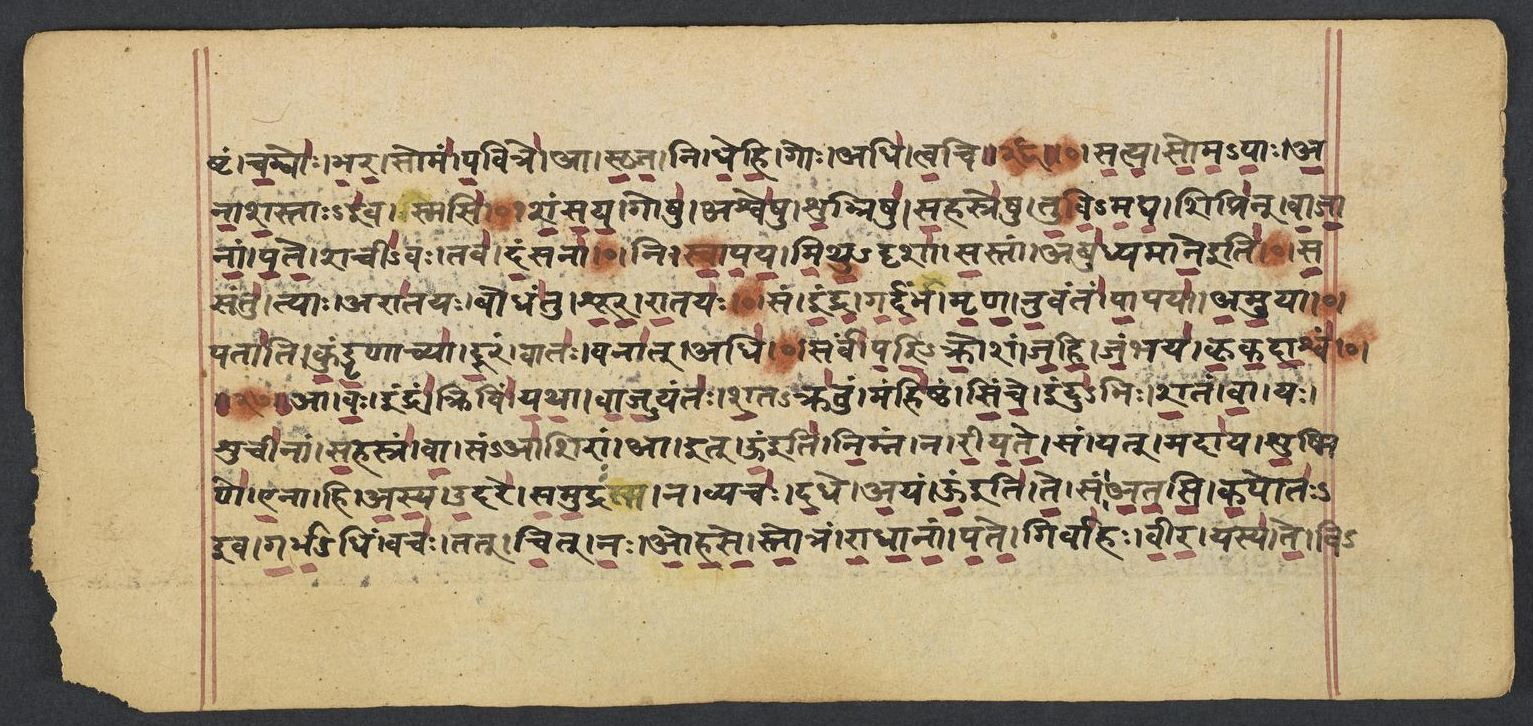
Where on the image
Penn Ms. Coll. 390 Item 41, fol. 17r (OPenn image 18, lower leaf). Checked on the image: the Rigveda text on this page begins in RV 1.28.9 ‹-śiṣṭam camvoḥ bhara somam›. The next page with Rigveda text, fol. 17v, begins in RV 1.30.5 ‹-vi-bhūtiḥ astu sunṛtā›. Verse 1.28.9 ends on this page; 1.28.9 begins on fol. 16v.
9uc chi̱ṣṭaṁ ca̱mvo̍r bhara̱ soma̍m pa̱vitra̱ ā sṛ̍ja | ni dhe̍hi̱ gor adhi̍ tva̱ci ||
Compare: Padapāṭha (word-by-word text written in the manuscript; Sansknet e-text via GRETIL)
9ut | śiṣṭam | camvoḥ | bhara | somam | pavitre | ā | sṛja | ni | dhehi | goḥ | adhi | tvaci
9Take up in beakers what remains: the Soma on the filter pour, and on the ox-hide set the dregs.
Notes
- Sanskrit: Aufrecht's edition (1877) with the Vedic accents, as entered by van Nooten and Holland (GRETIL).
- English: Ralph T. H. Griffith, The Hymns of the Rigveda (1889-1892; 2nd ed. 1896-1897), from the VedaWeb digital text; OCR slips in that text were corrected against the printed 2nd edition (data/sources/rigveda/griffith_errata.json).
- Padapāṭha (edition text): Sansknet e-text via GRETIL (CC BY-NC-SA 4.0).
Cite
Sources
- Source: Penn Ms. Coll. 390 Item 41 (undated (catalogued with Penn's 18th-19th c. Vedic manuscripts)), OPenn, Public Domain Mark + Aufrecht's accented text (GRETIL) + Griffith's English (VedaWeb) (holding institution)
- Critical edition: Aufrecht (1877), accented e-text via GRETIL
← previous · → next · v cycle view · l back to library