Rigveda 1.29: To Indra
Introduction
Rigveda 1.29 is a hymn of 7 verses addressed to Indra. It stands in book (maṇḍala) 1, a collection of hymns by many families of poets. The Rigveda is the oldest collection of Sanskrit hymns, composed in the second half of the second millennium BCE and handed down orally for many centuries before it was written down.
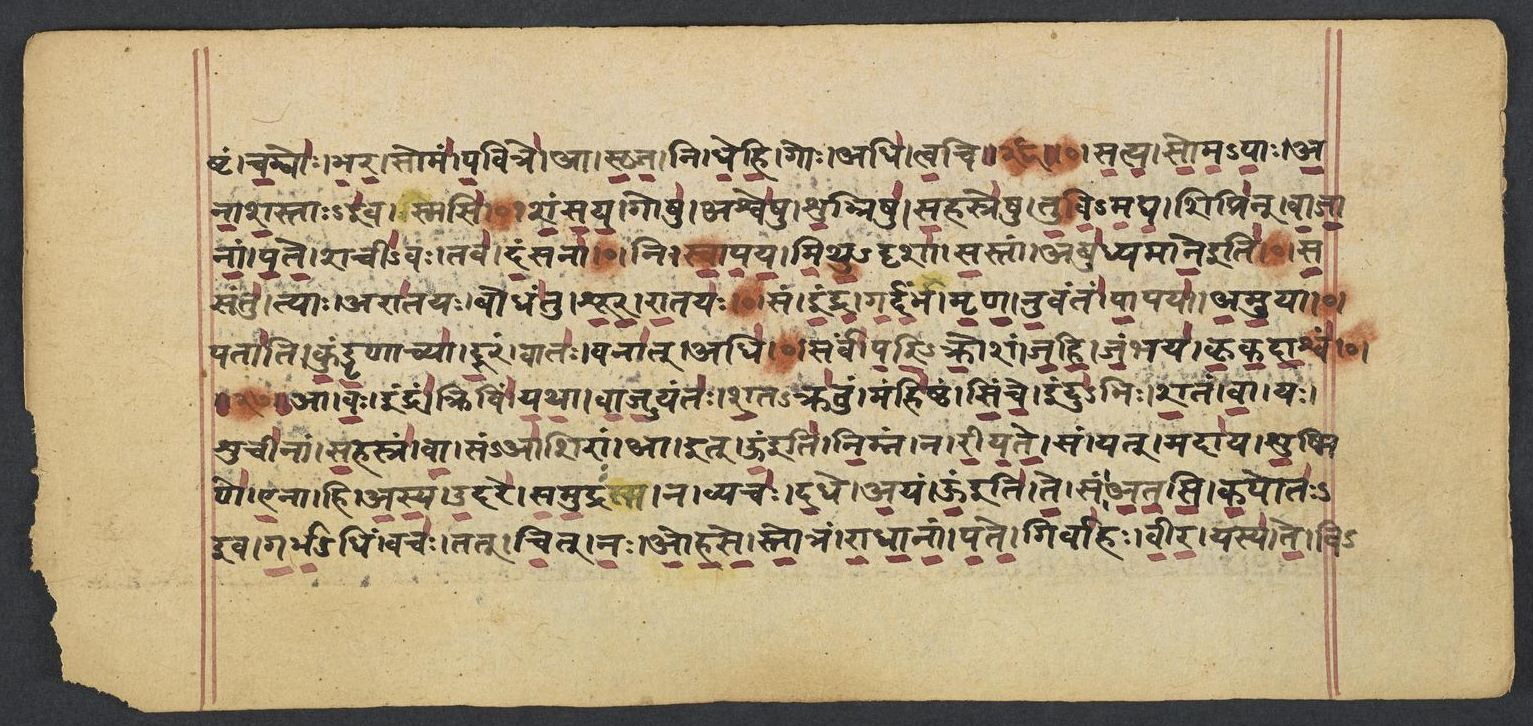
The manuscript shown is Penn Ms. Coll. 390 Item 41 (University of Pennsylvania), an undated paper manuscript of the padapāṭha (the word-by-word recitation text, in which every word is written separately and compounds are split) of the whole Ṛgveda in Devanāgarī, 884 leaves in fascicles, 7-9 lines to the page, accents in red; this hymn stands on fol. 17r. Each section below gives the verses that end on one page; the page boundaries were read on the images (the opening words of every page), not counted out. Where the manuscript is a padapāṭha (the word-by-word recitation text), the section shows Aufrecht's continuous (saṃhitā) text first and, as the edition text, the padapāṭha of the same verses, which is the form written on the page.
How was this verified? (Provenance)
Where on the image
Penn Ms. Coll. 390 Item 41, fol. 17r (OPenn image 18, lower leaf). Checked on the image: the Rigveda text on this page begins in RV 1.28.9 ‹-śiṣṭam camvoḥ bhara somam›. The next page with Rigveda text, fol. 17v, begins in RV 1.30.5 ‹-vi-bhūtiḥ astu sunṛtā›. Verses 1.29.1-7 end on this page.
1yac ci̱d dhi sa̍tya somapā anāśa̱stā i̍va̱ smasi̍ | ā tū na̍ indra śaṁsaya̱ goṣv aśve̍ṣu śu̱bhriṣu̍ sa̱hasre̍ṣu tuvīmagha ||
2śipri̍n vājānām pate̱ śacī̍va̱s tava̍ da̱ṁsanā̍ | ā tū na̍ indra śaṁsaya̱ goṣv aśve̍ṣu śu̱bhriṣu̍ sa̱hasre̍ṣu tuvīmagha ||
3ni ṣvā̍payā mithū̱dṛśā̍ sa̱stām abu̍dhyamāne | ā tū na̍ indra śaṁsaya̱ goṣv aśve̍ṣu śu̱bhriṣu̍ sa̱hasre̍ṣu tuvīmagha ||
4sa̱santu̱ tyā arā̍tayo̱ bodha̍ntu śūra rā̱taya̍ḥ | ā tū na̍ indra śaṁsaya̱ goṣv aśve̍ṣu śu̱bhriṣu̍ sa̱hasre̍ṣu tuvīmagha ||
5sam i̍ndra garda̱bham mṛ̍ṇa nu̱vanta̍m pā̱payā̍mu̱yā | ā tū na̍ indra śaṁsaya̱ goṣv aśve̍ṣu śu̱bhriṣu̍ sa̱hasre̍ṣu tuvīmagha ||
6patā̍ti kuṇḍṛ̱ṇācyā̍ dū̱raṁ vāto̱ vanā̱d adhi̍ | ā tū na̍ indra śaṁsaya̱ goṣv aśve̍ṣu śu̱bhriṣu̍ sa̱hasre̍ṣu tuvīmagha ||
7sarva̍m parikro̱śaṁ ja̍hi ja̱mbhayā̍ kṛkadā̱śva̍m | ā tū na̍ indra śaṁsaya̱ goṣv aśve̍ṣu śu̱bhriṣu̍ sa̱hasre̍ṣu tuvīmagha ||
Compare: Padapāṭha (word-by-word text written in the manuscript; Sansknet e-text via GRETIL)
1yat | cit | hi | satya | soma-pā | anāśastāḥ-iva | smasi | ā | tu | naḥ | indra | śaṃsaya | goṣu | aśveṣu | śubhriṣu | sahasreṣu | tuvī-magha
2śiprin | vājānām | pate | śacī-vaḥ | tava | daṃsanā | ā | tu | naḥ | indra | śaṃsaya | goṣu | aśveṣu | śubhriṣu | sahasreṣu | tuvī-magha
3ni | svāpaya | mithu-dṛśā | sastām | abudhyamāneiti | ā | tu | naḥ | indra | śaṃsaya | goṣu | aśveṣu | śubhriṣu | sahasreṣu | tuvī-magha
4sasantu | tyāḥ | arātayaḥ | bodhantu | śūra | rātayaḥ | ā | tu | naḥ | indra | śaṃsaya | goṣu | aśveṣu | śubhriṣu | sahasreṣu | tuvī-magha
5sam | indra | gardabham | mṛṇa | nuvantam | pāpayā | amuyā | ā | tu | naḥ | indra | śaṃsaya | goṣu | aśveṣu | śubhriṣu | sahasreṣu | tuvī-magha
6patāti | kuṇḍṛṇācyā | dūram | vātaḥ | vanāt | adhi | ā | tu | naḥ | indra | śaṃsaya | goṣu | aśveṣu | śubhriṣu | sahasreṣu | tuvī-magha
7sarvam | pari-krośam | jahi | jambhaya | kṛkadāśvam | ā | tu | naḥ | indra | śaṃsaya | goṣu | aśveṣu | śubhriṣu | sahasreṣu | tuvī-magha
1O SOMA DRINKER, ever true, utterly hopeless though we be, Do thou, O Indra, give us hope of beauteous horses and of kine, In thousands, O most wealthy One.
2O Lord of Strength, whose jaws are strong, great deeds are thine, the powerful: Do thou, O Indra, give us hope of beauteous horses and of kine, In thousands, O most wealthy One.
3Lull thou asleep, to wake no more, the pair who on each other look Do thou, O Indra, give us, help of beauteous horses and of kine, In thousands, O most wealthy One.
4Hero, let hostile spirits sleep, and every gentler genius wake: Do thou, O Indra,. give us hope of beauteous horses and of kine, In thousands, O most wealthy One.
5Destroy this ass, O Indra, who in tones discordant brays to thee: Do thou, O Indra, give us hope of beauteous horses and of kine, In thousands, O most wealthy One.
6Far distant on the forest fall the tempest in a circling course! Do thou, O Indra, give us hope of beauteous horses and of kine, In thousands, O most wealthy One.
7Slay each reviler, and destroy him who in secret injures us: Do thou, O Indra, give us hope of beauteous horses and of kine In thousands, O most wealthy One.
Notes
- Sanskrit: Aufrecht's edition (1877) with the Vedic accents, as entered by van Nooten and Holland (GRETIL).
- English: Ralph T. H. Griffith, The Hymns of the Rigveda (1889-1892; 2nd ed. 1896-1897), from the VedaWeb digital text; OCR slips in that text were corrected against the printed 2nd edition (data/sources/rigveda/griffith_errata.json).
- Padapāṭha (edition text): Sansknet e-text via GRETIL (CC BY-NC-SA 4.0).
Cite
Sources
- Source: Penn Ms. Coll. 390 Item 41 (undated (catalogued with Penn's 18th-19th c. Vedic manuscripts)), OPenn, Public Domain Mark + Aufrecht's accented text (GRETIL) + Griffith's English (VedaWeb) (holding institution)
- Critical edition: Aufrecht (1877), accented e-text via GRETIL
← previous · → next · v cycle view · l back to library