Rigveda 1.4: To Indra
Introduction
Rigveda 1.4 is a hymn of 10 verses addressed to Indra. It stands in book (maṇḍala) 1, a collection of hymns by many families of poets. The Rigveda is the oldest collection of Sanskrit hymns, composed in the second half of the second millennium BCE and handed down orally for many centuries before it was written down.
The manuscript shown is Penn Ms. Coll. 390 Item 41 (University of Pennsylvania), an undated paper manuscript of the padapāṭha (the word-by-word recitation text, in which every word is written separately and compounds are split) of the whole Ṛgveda in Devanāgarī, 884 leaves in fascicles, 7-9 lines to the page, accents in red; this hymn stands on fol. 2v-3r. Each section below gives the verses that end on one page; the page boundaries were read on the images (the opening words of every page), not counted out. Where the manuscript is a padapāṭha (the word-by-word recitation text), the section shows Aufrecht's continuous (saṃhitā) text first and, as the edition text, the padapāṭha of the same verses, which is the form written on the page.
How was this verified? (Provenance)
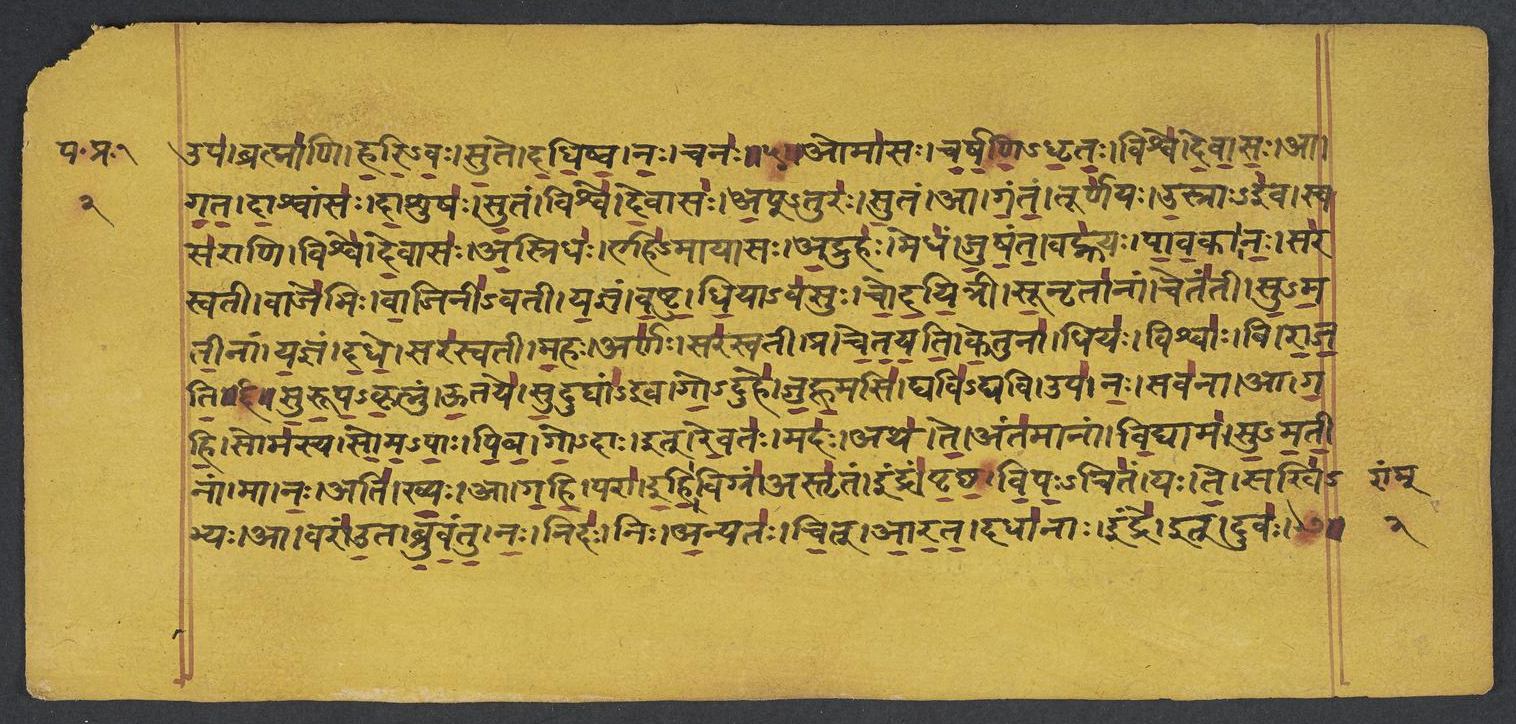
Where on the image
Penn Ms. Coll. 390 Item 41, fol. 2v (OPenn image 4, upper leaf). Checked on the image: the Rigveda text on this page begins in RV 1.3.6 ‹upa brahmāṇi hari-vaḥ sute›. The next page with Rigveda text, fol. 3r, begins in RV 1.4.6 ‹uta naḥ subhagān ariḥ›. Verses 1.4.1-5 end on this page.
1su̱rū̱pa̱kṛ̱tnum ū̱taye̍ su̱dughā̍m iva go̱duhe̍ | ju̱hū̱masi̱ dyavi̍-dyavi ||
2upa̍ na̱ḥ sava̱nā ga̍hi̱ soma̍sya somapāḥ piba | go̱dā id re̱vato̱ mada̍ḥ ||
3athā̍ te̱ anta̍mānāṁ vi̱dyāma̍ sumatī̱nām | mā no̱ ati̍ khya̱ ā ga̍hi ||
4pare̍hi̱ vigra̱m astṛ̍ta̱m indra̍m pṛcchā vipa̱ścita̍m | yas te̱ sakhi̍bhya̱ ā vara̍m ||
5u̱ta bru̍vantu no̱ nido̱ nir a̱nyata̍ś cid ārata | dadhā̍nā̱ indra̱ id duva̍ḥ ||
Compare: Padapāṭha (word-by-word text written in the manuscript; Sansknet e-text via GRETIL)
1surūpa-kṛtnum | ūtaye | sudughām-iva | go--duhe | juhūmasi | dyavi-dyavi
2upa | naḥ | savanā | ā | gahi | somasya | soma-pāḥ | piba | go--dāḥ | it | revataḥ | madaḥ
3atha | te | antamānām | vidyāma | su-matīnām | mā | naḥ | ati | khyaḥ | ā | gahi
4parā | ihi | vigram | astṛtam | indram | pṛccha | vipaḥ-citam | yaḥ | te | sakhi-bhyaḥ | ā | varam
5uta | bruvantu | naḥ | nidaḥ | niḥ | anyataḥ | cit | ārata | dadhānāḥ | indre | it | duvaḥ
1As a good cow to him who milks, we call the doer of fair deeds, To our assistance day by day.
2Come thou to our libations, drink of Soma; Soma-drinker thou! The rich One's rapture giveth kine.
3So may we be acquainted with thine innermost benevolence: Neglect us not, come hitherward.
4Go to the wise unconquered One, ask thou of Indra, skilled in song, Him who is better than thy friends.
5Whether the men who mock us say, Depart unto another place, Ye who serve Indra and none else;
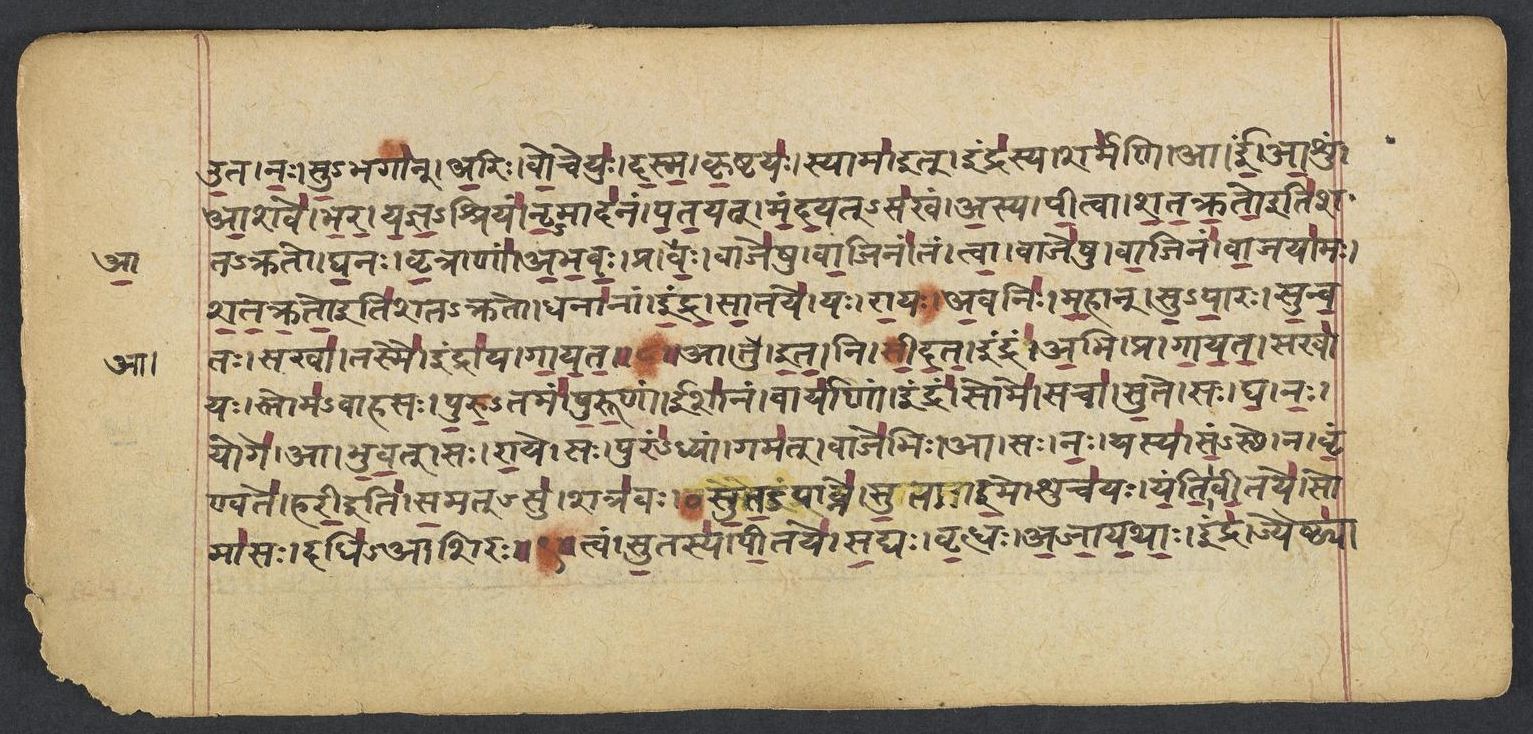
Where on the image
Penn Ms. Coll. 390 Item 41, fol. 3r (OPenn image 4, lower leaf). Checked on the image: the Rigveda text on this page begins in RV 1.4.6 ‹uta naḥ subhagān ariḥ›. The next page with Rigveda text, fol. 3v, begins in RV 1.5.6 ‹-jyaiṣṭhyāya sukrato itisu-krato›. Verses 1.4.6-10 end on this page.
6u̱ta na̍ḥ su̱bhagā̍m̐ a̱rir vo̱ceyu̍r dasma kṛ̱ṣṭaya̍ḥ | syāmed indra̍sya̱ śarma̍ṇi ||
7em ā̱śum ā̱śave̍ bhara yajña̱śriya̍ṁ nṛ̱māda̍nam | pa̱ta̱yan ma̍nda̱yatsa̍kham ||
8a̱sya pī̱tvā śa̍takrato gha̱no vṛ̱trāṇā̍m abhavaḥ | prāvo̱ vāje̍ṣu vā̱jina̍m ||
9taṁ tvā̱ vāje̍ṣu vā̱jina̍ṁ vā̱jayā̍maḥ śatakrato | dhanā̍nām indra sā̱taye̍ ||
10yo rā̱yo̱3̱̍ 'vani̍r ma̱hān su̍pā̱raḥ su̍nva̱taḥ sakhā̍ | tasmā̱ indrā̍ya gāyata ||
Compare: Padapāṭha (word-by-word text written in the manuscript; Sansknet e-text via GRETIL)
6uta | naḥ | subhagān | ariḥ | voceyuḥ | dasma | kṛṣṭayaḥ | syāma | it | indrasya | śarmaṇi
7ā | īm | āśum | āśave | bhara | yajña-śriyam | nṛ-mādanam | patayat | mandayat-sakham
8asya | pītvā | śatakrato itiśata-krato | ghanaḥ | vṛtrāṇām | abhavaḥ | pra | āvaḥ | vājeṣu | vājinam
9tam | tvā | vājeṣu | vājinam | vājayāmaḥ | śatakrato itiśata-krato | dhanānām | indra | sātaye
10yaḥ | rāyaḥ | avaniḥ | mahān | su-pāraḥ | sunvataḥ | sakhā | tasmai | indrāya | gāyata
6Or whether, God of wondrous deeds, all our true people call us blest, Still may we dwell in Indra's care.
7Unto the swift One bring the swift, man-cheering, grace of sacrifice, That to the Friend gives wings and joy.
8Thou, Ṣatakratu, drankest this and wast the Vr̥itras' slayer; thou Helpest the warrior in the fray.
9We strengthen, Ṣatakratu, thee, yea, thee the powerful in fight, That, Indra, we may win us wealth.
10To him the mighty stream of wealth, prompt friend ot'him who pours the juice, yea, to this Indra sing your song.
Notes
- Sanskrit: Aufrecht's edition (1877) with the Vedic accents, as entered by van Nooten and Holland (GRETIL).
- English: Ralph T. H. Griffith, The Hymns of the Rigveda (1889-1892; 2nd ed. 1896-1897), from the VedaWeb digital text; OCR slips in that text were corrected against the printed 2nd edition (data/sources/rigveda/griffith_errata.json).
- Padapāṭha (edition text): Sansknet e-text via GRETIL (CC BY-NC-SA 4.0).
Cite
Sources
- Source: Penn Ms. Coll. 390 Item 41 (undated (catalogued with Penn's 18th-19th c. Vedic manuscripts)), OPenn, Public Domain Mark + Aufrecht's accented text (GRETIL) + Griffith's English (VedaWeb) (holding institution)
- Critical edition: Aufrecht (1877), accented e-text via GRETIL
← previous · → next · v cycle view · l back to library