Rigveda 1.5: To Indra
Introduction
Rigveda 1.5 is a hymn of 10 verses addressed to Indra. It stands in book (maṇḍala) 1, a collection of hymns by many families of poets. The Rigveda is the oldest collection of Sanskrit hymns, composed in the second half of the second millennium BCE and handed down orally for many centuries before it was written down.
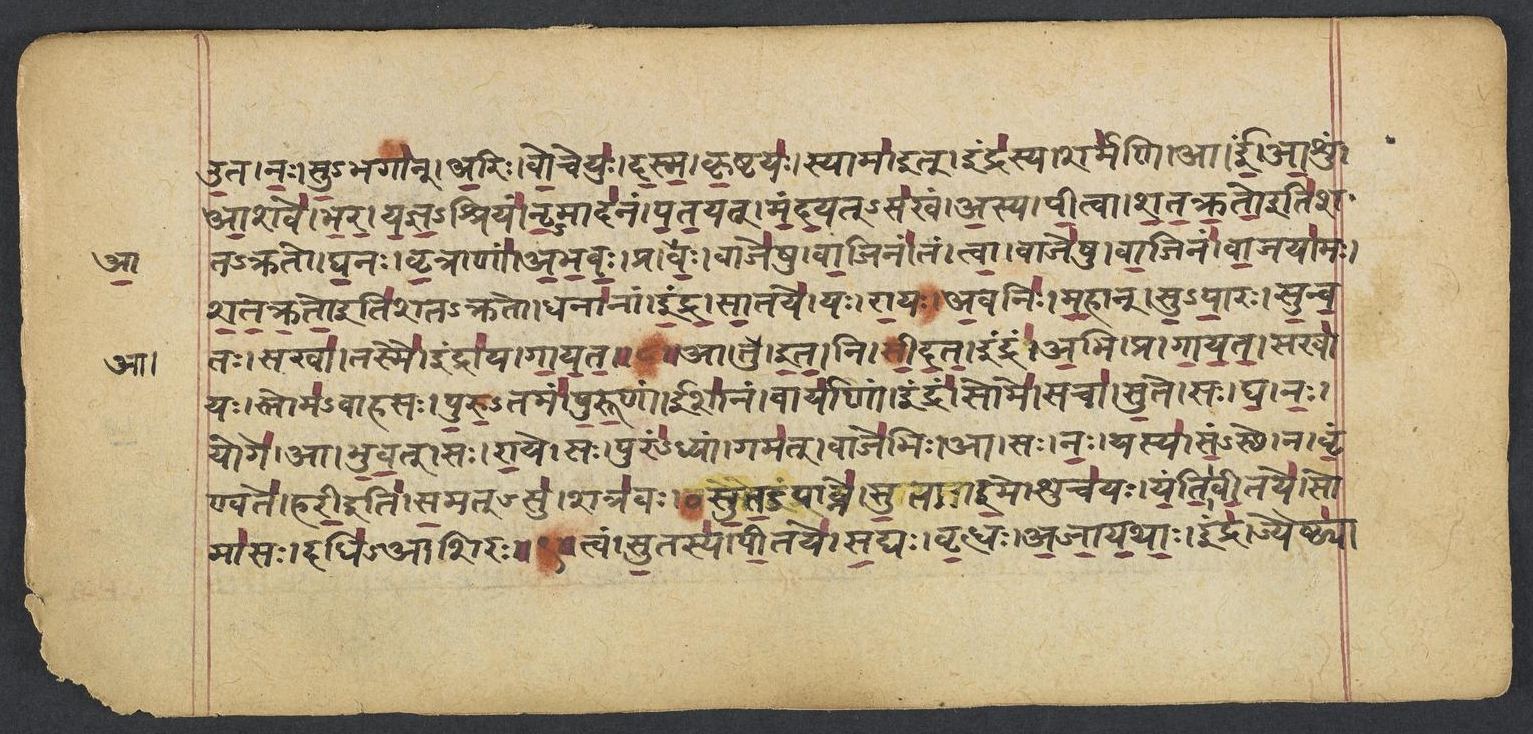
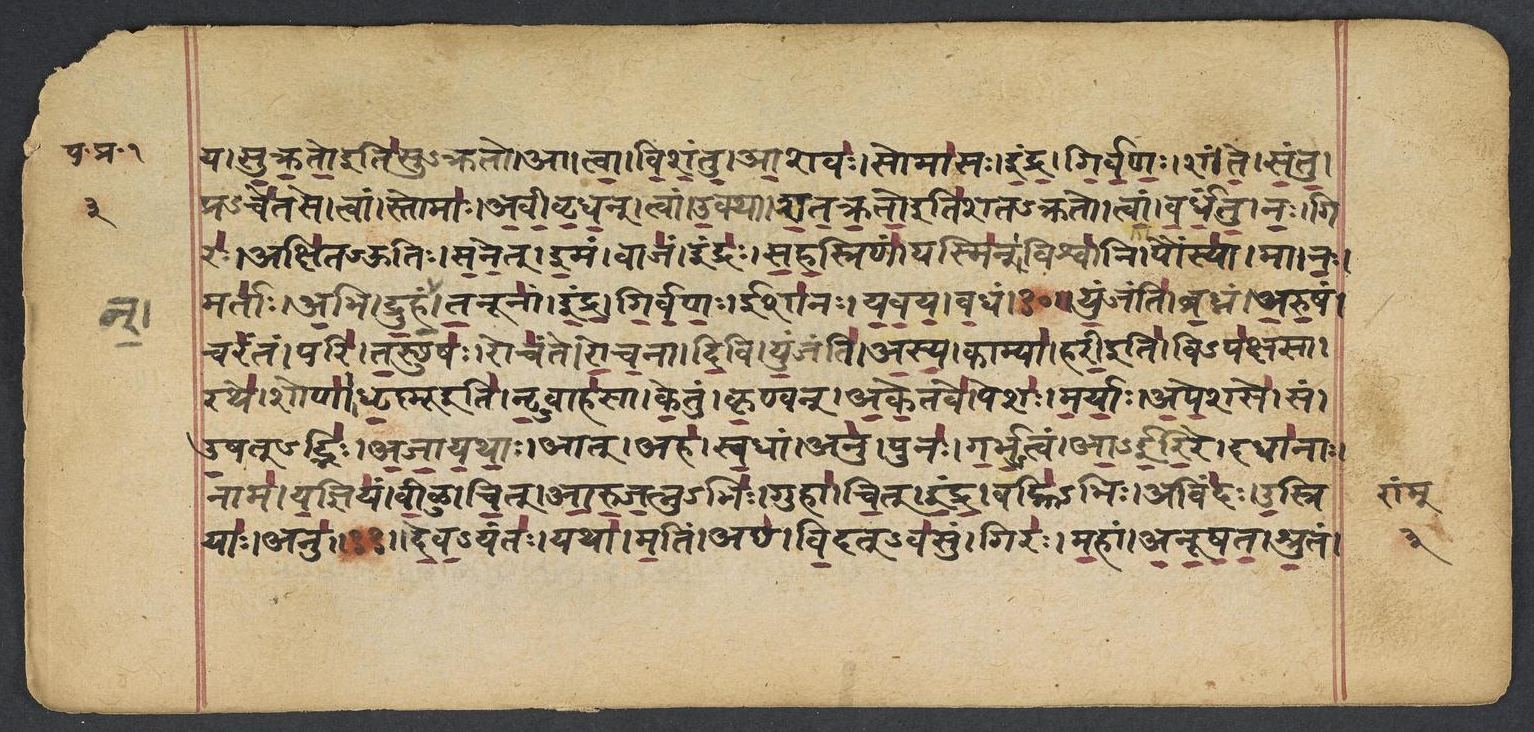
The manuscript shown is Penn Ms. Coll. 390 Item 41 (University of Pennsylvania), an undated paper manuscript of the padapāṭha (the word-by-word recitation text, in which every word is written separately and compounds are split) of the whole Ṛgveda in Devanāgarī, 884 leaves in fascicles, 7-9 lines to the page, accents in red; this hymn stands on fol. 3r-3v. Each section below gives the verses that end on one page; the page boundaries were read on the images (the opening words of every page), not counted out. Where the manuscript is a padapāṭha (the word-by-word recitation text), the section shows Aufrecht's continuous (saṃhitā) text first and, as the edition text, the padapāṭha of the same verses, which is the form written on the page.
How was this verified? (Provenance)
Where on the image
Penn Ms. Coll. 390 Item 41, fol. 3r (OPenn image 4, lower leaf). Checked on the image: the Rigveda text on this page begins in RV 1.4.6 ‹uta naḥ subhagān ariḥ›. The next page with Rigveda text, fol. 3v, begins in RV 1.5.6 ‹-jyaiṣṭhyāya sukrato itisu-krato›. Verses 1.5.1-5 end on this page.
1ā tv etā̱ ni ṣī̍da̱tendra̍m a̱bhi pra gā̍yata | sakhā̍ya̱ḥ stoma̍vāhasaḥ ||
2pu̱rū̱tama̍m purū̱ṇām īśā̍na̱ṁ vāryā̍ṇām | indra̱ṁ some̱ sacā̍ su̱te ||
3sa ghā̍ no̱ yoga̱ ā bhu̍va̱t sa rā̱ye sa pura̍ṁdhyām | gama̱d vāje̍bhi̱r ā sa na̍ḥ ||
4yasya̍ sa̱ṁsthe na vṛ̱ṇvate̱ harī̍ sa̱matsu̱ śatra̍vaḥ | tasmā̱ indrā̍ya gāyata ||
5su̱ta̱pāvne̍ su̱tā i̱me śuca̍yo yanti vī̱taye̍ | somā̍so̱ dadhyā̍śiraḥ ||
Compare: Padapāṭha (word-by-word text written in the manuscript; Sansknet e-text via GRETIL)
1ā | tu | ā | ita | ni | sīdata | indram | abhi | pra | gāyata | sakhāyaḥ | stoma-vāhasaḥ
2puru-tamam | purūṇām | īśānam | vāryāṇam | indram | some | sacā | sute
3saḥ | gha | naḥ | yoge | ā | bhuvat | saḥ | rāye | saḥ | puram-dhyām | gamat | vājebhiḥ | ā | saḥ | naḥ
4yasya | sam-sthe | na | vṛṇvate | harī iti | samat-su | śatravaḥ | tasmai | indrāya | gāyata
5suta-pāvne | sutāḥ | ime | śucayaḥ | yanti | vītaye | somāsaḥ | dadhi-āśiraḥ
1O COME ye hither, sit ye down: to Indra sing ye forth, your song, companions, bringing hymns of praise.
2To him the richest of the rich, the Lord of treasures excellent, Indra, wi th Soma juice outpoured.
3May he stand by us in our need and in abundance for our wealth: May he come nigh us with his strength.
4Whose pair of tawny horses yoked in battles foemen challenge not: To him, to Indra sing your song.
5Nigh to the Soma-drinker come, for his enjoyment, these pure drops, The Somas mingled with the curd.
Where on the image
Penn Ms. Coll. 390 Item 41, fol. 3v (OPenn image 5, upper leaf). Checked on the image: the Rigveda text on this page begins in RV 1.5.6 ‹-jyaiṣṭhyāya sukrato itisu-krato›. The next page with Rigveda text, fol. 4r, begins in RV 1.6.7 ‹indreṇa sam hi dṛkṣase›. Verses 1.5.6-10 end on this page; 1.5.6 begins on fol. 3r.
6tvaṁ su̱tasya̍ pī̱taye̍ sa̱dyo vṛ̱ddho a̍jāyathāḥ | indra̱ jyaiṣṭhyā̍ya sukrato ||
7ā tvā̍ viśantv ā̱śava̱ḥ somā̍sa indra girvaṇaḥ | śaṁ te̍ santu̱ prace̍tase ||
8tvāṁ stomā̍ avīvṛdha̱n tvām u̱kthā śa̍takrato | tvāṁ va̍rdhantu no̱ gira̍ḥ ||
9akṣi̍totiḥ saned i̱maṁ vāja̱m indra̍ḥ saha̱sriṇa̍m | yasmi̱n viśvā̍ni̱ pauṁsyā̍ ||
10mā no̱ martā̍ a̱bhi dru̍han ta̱nūnā̍m indra girvaṇaḥ | īśā̍no yavayā va̱dham ||
Compare: Padapāṭha (word-by-word text written in the manuscript; Sansknet e-text via GRETIL)
6tvam | sutasya | pītaye | sadyaḥ | vṛddhaḥ | ajāyathāḥ | indra | jyaiṣṭhyāya | sukrato itisu-krato
7ā | tvā | viśantu | āśavaḥ | somāsaḥ | indra | girvaṇaḥ | śam | te | santu | pra-cetase
8tvām | stomāḥ | avīvṛdhan | tvām | ukthā | śatakrato itiśata-krato | tvām | vardhantu | naḥ | giraḥ
9akṣita-ūtiḥ | sanet | imam | vājam | indraḥ | sahasriṇam | yasmin | viśvāni | paiṃsyā
10mā | naḥ | martāḥ | abhi | druhan | tanūnām | indra | girvaṇaḥ | īśānaḥ | yavaya | vadham
6Thou, grown at once to perfect strength, wast born to drink the Soma juice, Strong Indra, for preeminence.
7O Indra, lover of the song, may these quick Somas enter thee: May they bring bliss to thee the Sage.
8Our chants of praise have strengthened thee, O Ṣatakratu, and our lauds So strengthen thee the songs we sing.
9Indra, whose succour never fails, accept these viands thousandfold, Wherein all manly powers abide.
10O Indra, thou who lovest song, let no man hurt our bodies, keep Slaughter far from us, for thou canst.
Notes
- Sanskrit: Aufrecht's edition (1877) with the Vedic accents, as entered by van Nooten and Holland (GRETIL).
- English: Ralph T. H. Griffith, The Hymns of the Rigveda (1889-1892; 2nd ed. 1896-1897), from the VedaWeb digital text; OCR slips in that text were corrected against the printed 2nd edition (data/sources/rigveda/griffith_errata.json).
- Padapāṭha (edition text): Sansknet e-text via GRETIL (CC BY-NC-SA 4.0).
Cite
Sources
- Source: Penn Ms. Coll. 390 Item 41 (undated (catalogued with Penn's 18th-19th c. Vedic manuscripts)), OPenn, Public Domain Mark + Aufrecht's accented text (GRETIL) + Griffith's English (VedaWeb) (holding institution)
- Critical edition: Aufrecht (1877), accented e-text via GRETIL
← previous · → next · v cycle view · l back to library