Rigveda 1.49: To Usas
Introduction
Rigveda 1.49 is a hymn of 4 verses addressed to Usas. It stands in book (maṇḍala) 1, a collection of hymns by many families of poets. The Rigveda is the oldest collection of Sanskrit hymns, composed in the second half of the second millennium BCE and handed down orally for many centuries before it was written down.
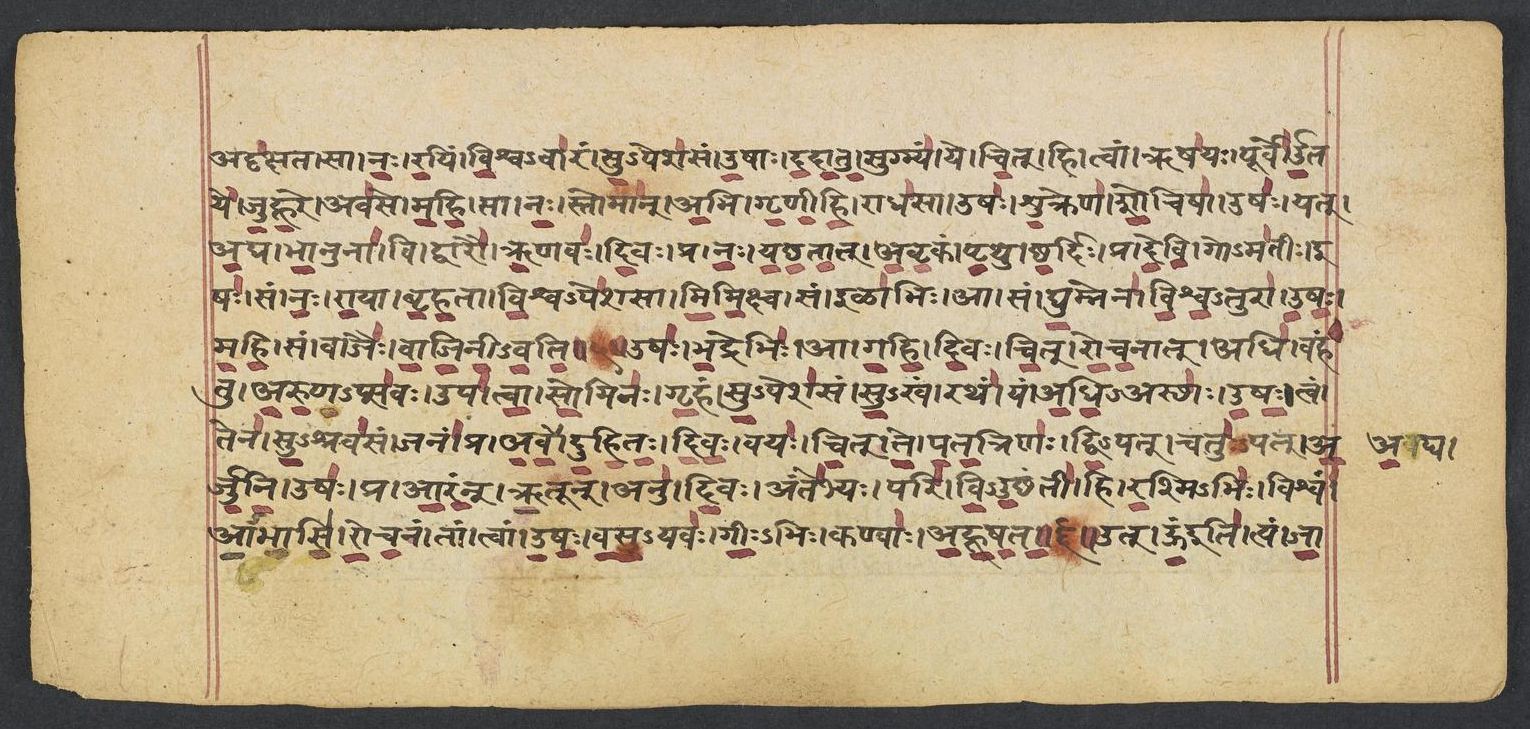
The manuscript shown is Penn Ms. Coll. 390 Item 41 (University of Pennsylvania), an undated paper manuscript of the padapāṭha (the word-by-word recitation text, in which every word is written separately and compounds are split) of the whole Ṛgveda in Devanāgarī, 884 leaves in fascicles, 7-9 lines to the page, accents in red; this hymn stands on fol. 34r. Each section below gives the verses that end on one page; the page boundaries were read on the images (the opening words of every page), not counted out. Where the manuscript is a padapāṭha (the word-by-word recitation text), the section shows Aufrecht's continuous (saṃhitā) text first and, as the edition text, the padapāṭha of the same verses, which is the form written on the page.
How was this verified? (Provenance)
Where on the image
Penn Ms. Coll. 390 Item 41, fol. 34r (OPenn image 35, lower leaf). Checked on the image: the Rigveda text on this page begins in RV 1.48.13 ‹adṛkṣata sā naḥ rayim›. The next page with Rigveda text, fol. 34v, begins in RV 1.50.1 ‹jāta-vedasam devam vahanti ketavaḥ›. Verses 1.49.1-4 end on this page.
1uṣo̍ bha̱drebhi̱r ā ga̍hi di̱vaś ci̍d roca̱nād adhi̍ | vaha̍ntv aru̱ṇapsa̍va̱ upa̍ tvā so̱mino̍ gṛ̱ham ||
2su̱peśa̍saṁ su̱khaṁ ratha̱ṁ yam a̱dhyasthā̍ uṣa̱s tvam | tenā̍ su̱śrava̍sa̱ṁ jana̱m prāvā̱dya du̍hitar divaḥ ||
3vaya̍ś cit te pata̱triṇo̍ dvi̱pac catu̍ṣpad arjuni | uṣa̱ḥ prāra̍nn ṛ̱tūm̐r anu̍ di̱vo ante̍bhya̱s pari̍ ||
4vyu̱cchantī̱ hi ra̱śmibhi̱r viśva̍m ā̱bhāsi̍ roca̱nam | tāṁ tvām u̍ṣar vasū̱yavo̍ gī̱rbhiḥ kaṇvā̍ ahūṣata ||
Compare: Padapāṭha (word-by-word text written in the manuscript; Sansknet e-text via GRETIL)
1uṣaḥ | bhadrebhiḥ | ā | gahi | divaḥ | cit | rocanāt | adhi | vahantu | aruṇa-psavaḥ | upa | tvā | sominaḥ | gṛham
2su-peśasam | sukham | ratham | yam | adhi-asthāḥ | uṣaḥ | tvam | tena | su-śravasam | janam | pra | ava | adya | duhitaḥ | divaḥ
3vayaḥ | cit | te | patatriṇaḥ | dvipat | catuḥ-pat | arjuni | uṣaḥ | pra | āran ṛtūn | anu | divaḥ | antebhyaḥ | pari
4vyi-ucchantī | hi | raśmi-bhiḥ | viśvam | ābhāsi | rocanam | tām | tvām | uṣaḥ | vasu-yavaḥ | gīḥ-bhiḥ | kaṇvāḥ | ahūṣata
1E'EN from above the sky's bright realm come, Ushas, by auspicious ways: Let red steeds bear thee to the house of him who pours the Soma, juice.
2The chariot which thou mountest, fair of shape, O Ushas light to move,– Therewith, O Daughter of the Sky, aid men of noble fame today.
3Bright Ushas, when thy times return, all quadrupeds and bipeds stir, And round about flock winged birds from all theboundaries of heaven.
4Thou dawning with thy beams of light illumest all the radiant realm. Thee, as thou art, the Kaṇvas, fain for wealth, have called with sacred songs.
Notes
- Sanskrit: Aufrecht's edition (1877) with the Vedic accents, as entered by van Nooten and Holland (GRETIL).
- English: Ralph T. H. Griffith, The Hymns of the Rigveda (1889-1892; 2nd ed. 1896-1897), from the VedaWeb digital text; OCR slips in that text were corrected against the printed 2nd edition (data/sources/rigveda/griffith_errata.json).
- Padapāṭha (edition text): Sansknet e-text via GRETIL (CC BY-NC-SA 4.0).
Cite
Sources
- Source: Penn Ms. Coll. 390 Item 41 (undated (catalogued with Penn's 18th-19th c. Vedic manuscripts)), OPenn, Public Domain Mark + Aufrecht's accented text (GRETIL) + Griffith's English (VedaWeb) (holding institution)
- Critical edition: Aufrecht (1877), accented e-text via GRETIL
← previous · → next · v cycle view · l back to library