Rigveda 1.50: To Surya
Introduction
Rigveda 1.50 is a hymn of 13 verses addressed to Surya. It stands in book (maṇḍala) 1, a collection of hymns by many families of poets. The Rigveda is the oldest collection of Sanskrit hymns, composed in the second half of the second millennium BCE and handed down orally for many centuries before it was written down.
The manuscript shown is Penn Ms. Coll. 390 Item 41 (University of Pennsylvania), an undated paper manuscript of the padapāṭha (the word-by-word recitation text, in which every word is written separately and compounds are split) of the whole Ṛgveda in Devanāgarī, 884 leaves in fascicles, 7-9 lines to the page, accents in red; this hymn stands on fol. 34r-35r. Each section below gives the verses that end on one page; the page boundaries were read on the images (the opening words of every page), not counted out. Where the manuscript is a padapāṭha (the word-by-word recitation text), the section shows Aufrecht's continuous (saṃhitā) text first and, as the edition text, the padapāṭha of the same verses, which is the form written on the page.
How was this verified? (Provenance)
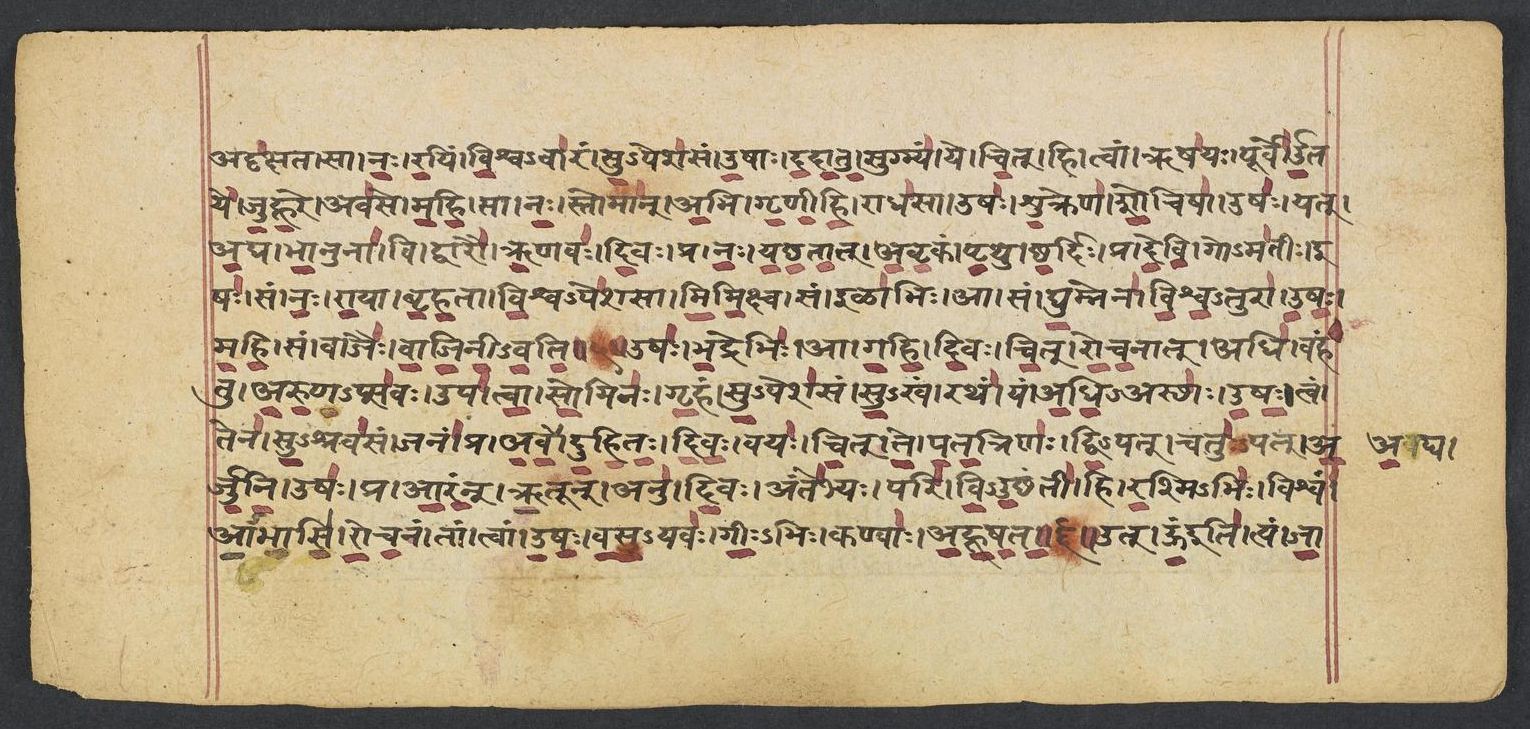
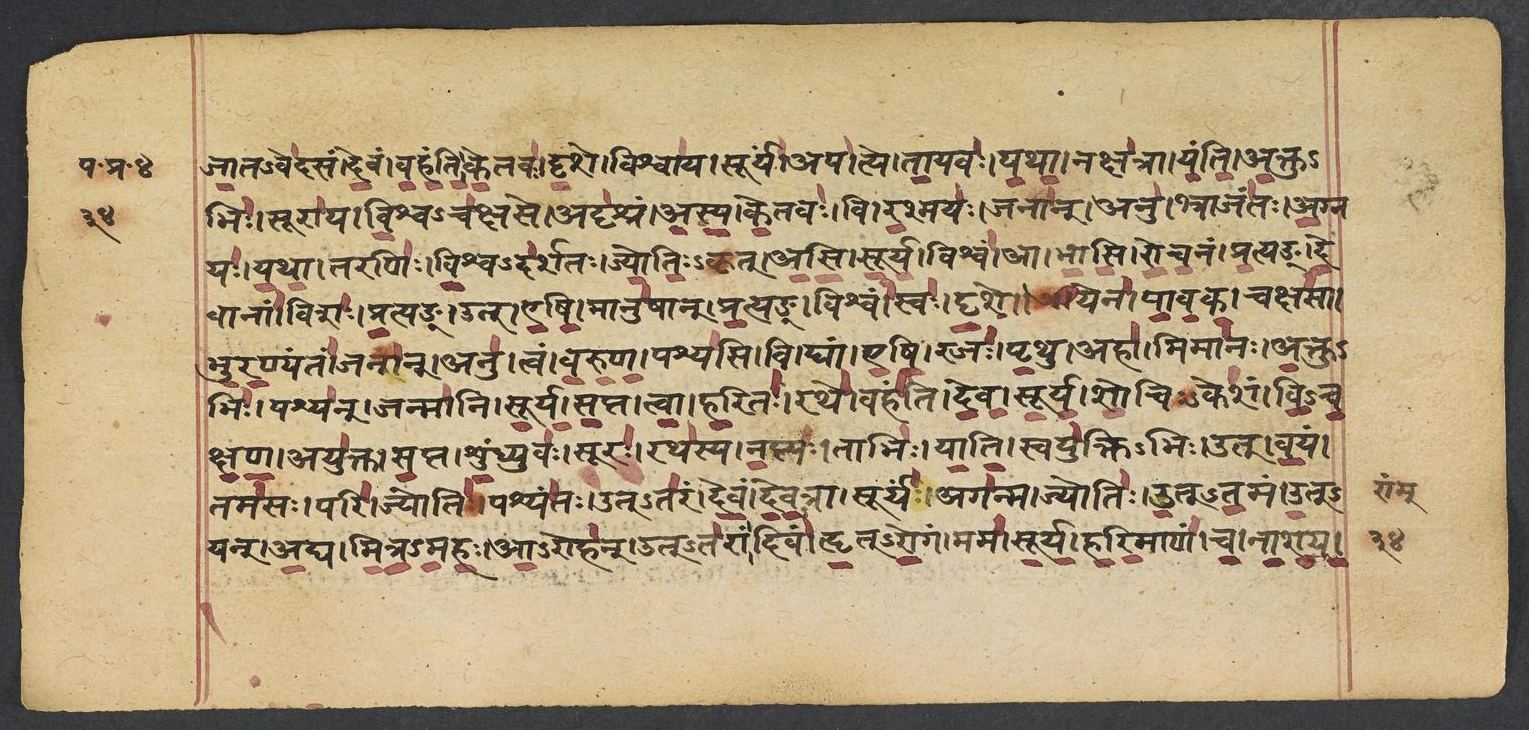
Where on the image
Penn Ms. Coll. 390 Item 41, fol. 34v (OPenn image 36, upper leaf). Checked on the image: the Rigveda text on this page begins in RV 1.50.1 ‹jāta-vedasam devam vahanti ketavaḥ›. The next page with Rigveda text, fol. 35r, begins in RV 1.50.12 ‹śukeṣu me harimāṇam ropaṇākāsu›. Verses 1.50.1-11 end on this page; 1.50.1 begins on fol. 34r.
1ud u̱ tyaṁ jā̱tave̍dasaṁ de̱vaṁ va̍hanti ke̱tava̍ḥ | dṛ̱śe viśvā̍ya̱ sūrya̍m ||
2apa̱ tye tā̱yavo̍ yathā̱ nakṣa̍trā yanty a̱ktubhi̍ḥ | sūrā̍ya vi̱śvaca̍kṣase ||
3adṛ̍śram asya ke̱tavo̱ vi ra̱śmayo̱ janā̱m̐ anu̍ | bhrāja̍nto a̱gnayo̍ yathā ||
4ta̱raṇi̍r vi̱śvada̍rśato jyoti̱ṣkṛd a̍si sūrya | viśva̱m ā bhā̍si roca̱nam ||
5pra̱tyaṅ de̱vānā̱ṁ viśa̍ḥ pra̱tyaṅṅ ud e̍ṣi̱ mānu̍ṣān | pra̱tyaṅ viśva̱ṁ sva̍r dṛ̱śe ||
6yenā̍ pāvaka̱ cakṣa̍sā bhura̱ṇyanta̱ṁ janā̱m̐ anu̍ | tvaṁ va̍ruṇa̱ paśya̍si ||
7vi dyām e̍ṣi̱ raja̍s pṛ̱thv ahā̱ mimā̍no a̱ktubhi̍ḥ | paśya̱ñ janmā̍ni sūrya ||
8sa̱pta tvā̍ ha̱rito̱ rathe̱ vaha̍nti deva sūrya | śo̱ciṣke̍śaṁ vicakṣaṇa ||
9ayu̍kta sa̱pta śu̱ndhyuva̱ḥ sūro̱ ratha̍sya na̱ptya̍ḥ | tābhi̍r yāti̱ svayu̍ktibhiḥ ||
10ud va̱yaṁ tama̍sa̱s pari̱ jyoti̱ṣ paśya̍nta̱ utta̍ram | de̱vaṁ de̍va̱trā sūrya̱m aga̍nma̱ jyoti̍r utta̱mam ||
11u̱dyann a̱dya mi̍tramaha ā̱roha̱nn utta̍rā̱ṁ diva̍m | hṛ̱dro̱gam mama̍ sūrya hari̱māṇa̍ṁ ca nāśaya ||
Compare: Padapāṭha (word-by-word text written in the manuscript; Sansknet e-text via GRETIL)
1ut | oṃ iti | tyam | jāta-vedasam | devam | vahanti | ketavaḥ | dṛśe | viśvāya | sūryam
2apa | tye | tāyavaḥ | yathā | nakṣatrā | yanti | aktu-bhiḥ | sūrāya | viśva-cakṣase
3adṛśram | asya | ketavaḥ | vi | raśmayaḥ | janān | anu | bhrājantaḥ | agnayaḥ | yathā
4taraṇiḥ | viśva-darśataḥ | jyotiḥ-kṛt | asi | sūrya | viśvam | ā | bhāsi | rocanam
5pratyaṅ | devānām | viśaḥ | pratyaṅ | ut | eṣi | mānuṣān | pratyaṅ | viśvam | svaḥ | dṛśe
6yena | pāvaka | cakṣasā | bhuraṇyantam | janān | anu | tvam | varuṇa | paśyasi
7vi | dyām | eṣi | rajaḥ | pṛthu | ahā | mimānaḥ | aktu-bhiḥ | paśyan | janmāni | sūyar
8sapta | tvā | haritaḥ | rathe | vahanti | deva | sūrya | śociḥ-keśam | vi-cakṣaṇa
9ayukta | sapta | śundhyuvaḥ | sūraḥ | rathasya | naptyaḥ | tābhiḥ | yāti | svayukti-bhiḥ
10ut | vayam | tamasaḥ | pari | jyotiḥ | paśyantaḥ | ut-taram | devam | deva-trā | sūryam | aganma | jyotiḥ | ut-tamam
11ut-yan | adya | mitra-mahaḥ | ārohan | ut-tarām | divam | hṛt-rogam | mama | sūrya | harimāṇam | ca | nāśaya
1HIS bright rays bear him up aloft, the God who knoweth all that lives, Sûrya, that all may look on him.
2The constellations pass away, like thieves, together with their beams, Before the all-beholding Sun'
3His herald rays are seen afar refulgent o'er the world of men, Like flames of fire that burn and blaze.
4Swift and all beautiful art thou, O Sûrya, maker of the light, Illuming all the radiant realm.
5Thou goest to the hosts of Gods, thou comest hither to mankind, Hither all light to be belield.
6With that same eye of thine wherewith thou lookest brilliant Varuṇa, Upon the busy race of men,
7traversing sky and wide mid-air, thou metest with thy beams our days, Sun, seeing all things that have birth.
8Seven Bay Steeds harnessed to thy car bear thee, O thou farseeing One, God, Sûrya, with the radiant hair.
9Sûrya hath yoked the pure bright Seven, the daughters of the car; with these, His own dear team, he goeth forth.
10Looking upon the loftier light above the darkness we have come To Sûrya, God among the Gods, the light that is most excellent.
11Rising this day, O rich in friends, ascending to the loftier heaven, Sûrya remove my heart's disease, take from me this my yellow hue.
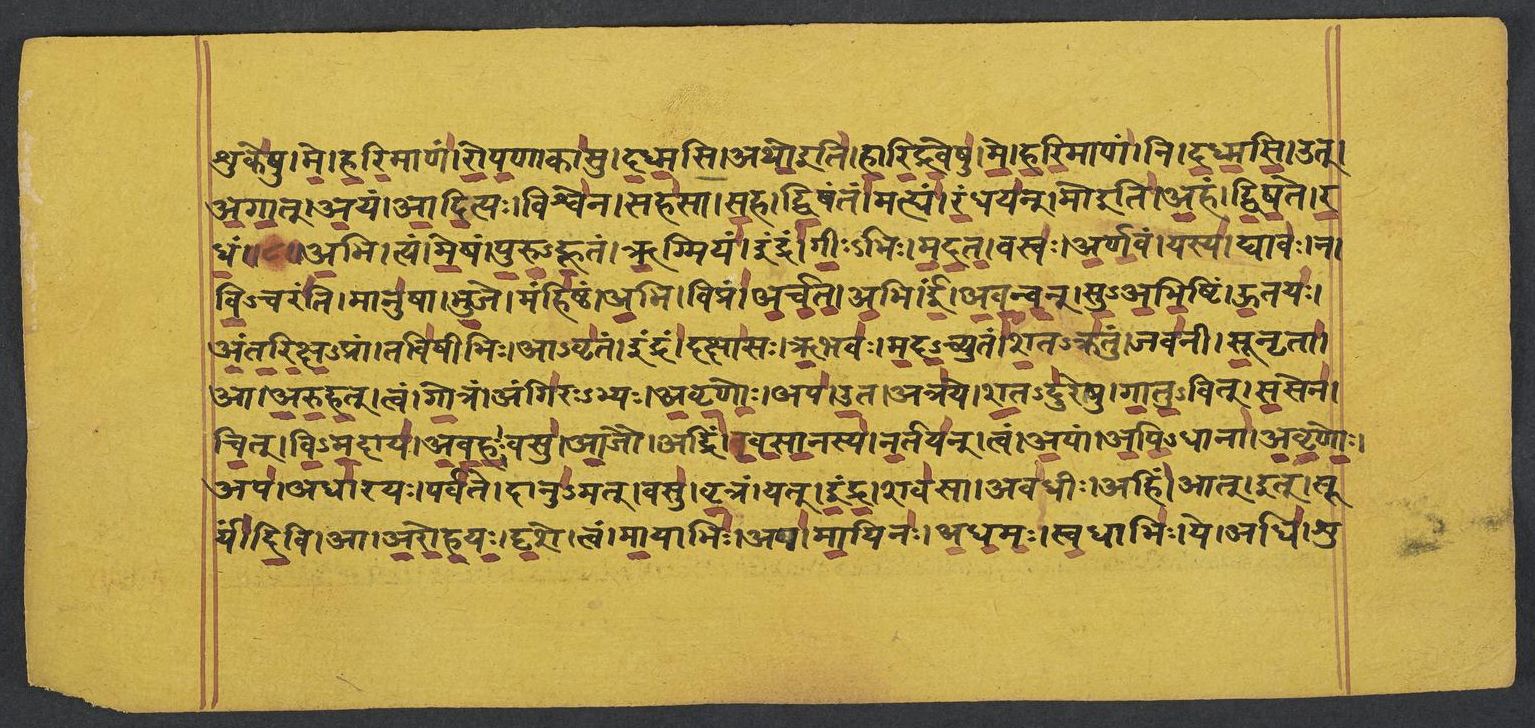
Where on the image
Penn Ms. Coll. 390 Item 41, fol. 35r (OPenn image 36, lower leaf). Checked on the image: the Rigveda text on this page begins in RV 1.50.12 ‹śukeṣu me harimāṇam ropaṇākāsu›. The next page with Rigveda text, fol. 35v, begins in RV 1.51.5 ‹-śuptau ajuhvata tvam piproḥ›. Verses 1.50.12-13 end on this page.
12śuke̍ṣu me hari̱māṇa̍ṁ ropa̱ṇākā̍su dadhmasi | atho̍ hāridra̱veṣu̍ me hari̱māṇa̱ṁ ni da̍dhmasi ||
13ud a̍gād a̱yam ā̍di̱tyo viśve̍na̱ saha̍sā sa̱ha | dvi̱ṣanta̱m mahya̍ṁ ra̱ndhaya̱n mo a̱haṁ dvi̍ṣa̱te ra̍dham ||
Compare: Padapāṭha (word-by-word text written in the manuscript; Sansknet e-text via GRETIL)
12śukeṣu | me | harimāṇam | ropaṇākāsu | dadhmasi | atho iti | hāridraveṣu | me | harimāṇam | ni | dadhmasi
13ut | agāt | ayam | ādityaḥ | viśvena | sahasā | saha | dviṣantam | mahyam | randhayan | mo iti | aham | dviṣate | radham
12To parrots and to starlings let us give away my yellowness, Or this my yellowness let us transfer to Haritâla trees.
13With all his conquering vigour this Âditya hath gone up on high, Giving my foe into mine hand: let me not be my foeman's prey.
Notes
- Sanskrit: Aufrecht's edition (1877) with the Vedic accents, as entered by van Nooten and Holland (GRETIL).
- English: Ralph T. H. Griffith, The Hymns of the Rigveda (1889-1892; 2nd ed. 1896-1897), from the VedaWeb digital text; OCR slips in that text were corrected against the printed 2nd edition (data/sources/rigveda/griffith_errata.json).
- Padapāṭha (edition text): Sansknet e-text via GRETIL (CC BY-NC-SA 4.0).
Cite
Sources
- Source: Penn Ms. Coll. 390 Item 41 (undated (catalogued with Penn's 18th-19th c. Vedic manuscripts)), OPenn, Public Domain Mark + Aufrecht's accented text (GRETIL) + Griffith's English (VedaWeb) (holding institution)
- Critical edition: Aufrecht (1877), accented e-text via GRETIL
← previous · → next · v cycle view · l back to library