Rigveda 1.6: To Indra
Introduction
Rigveda 1.6 is a hymn of 10 verses addressed to Indra. It stands in book (maṇḍala) 1, a collection of hymns by many families of poets. The Rigveda is the oldest collection of Sanskrit hymns, composed in the second half of the second millennium BCE and handed down orally for many centuries before it was written down.
The manuscript shown is Penn Ms. Coll. 390 Item 41 (University of Pennsylvania), an undated paper manuscript of the padapāṭha (the word-by-word recitation text, in which every word is written separately and compounds are split) of the whole Ṛgveda in Devanāgarī, 884 leaves in fascicles, 7-9 lines to the page, accents in red; this hymn stands on fol. 3v-4r. Each section below gives the verses that end on one page; the page boundaries were read on the images (the opening words of every page), not counted out. Where the manuscript is a padapāṭha (the word-by-word recitation text), the section shows Aufrecht's continuous (saṃhitā) text first and, as the edition text, the padapāṭha of the same verses, which is the form written on the page.
How was this verified? (Provenance)
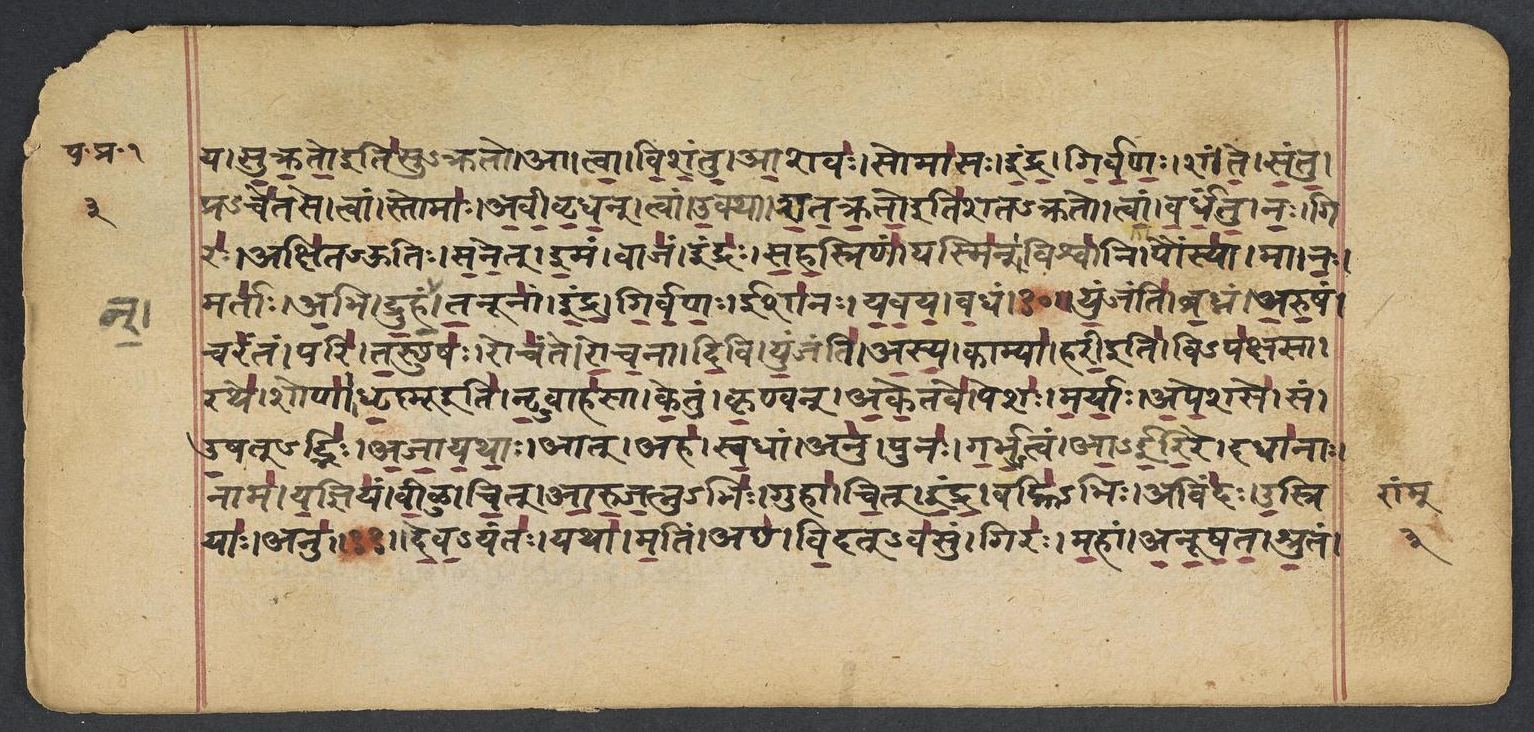
Where on the image
Penn Ms. Coll. 390 Item 41, fol. 3v (OPenn image 5, upper leaf). Checked on the image: the Rigveda text on this page begins in RV 1.5.6 ‹-jyaiṣṭhyāya sukrato itisu-krato›. The next page with Rigveda text, fol. 4r, begins in RV 1.6.7 ‹indreṇa sam hi dṛkṣase›. Verses 1.6.1-6 end on this page.
1yu̱ñjanti̍ bra̱dhnam a̍ru̱ṣaṁ cara̍nta̱m pari̍ ta̱sthuṣa̍ḥ | roca̍nte roca̱nā di̱vi ||
2yu̱ñjanty a̍sya̱ kāmyā̱ harī̱ vipa̍kṣasā̱ rathe̍ | śoṇā̍ dhṛ̱ṣṇū nṛ̱vāha̍sā ||
3ke̱tuṁ kṛ̱ṇvann a̍ke̱tave̱ peśo̍ maryā ape̱śase̍ | sam u̱ṣadbhi̍r ajāyathāḥ ||
4ād aha̍ sva̱dhām anu̱ puna̍r garbha̱tvam e̍ri̱re | dadhā̍nā̱ nāma̍ ya̱jñiya̍m ||
5vī̱ḻu ci̍d āruja̱tnubhi̱r guhā̍ cid indra̱ vahni̍bhiḥ | avi̍nda u̱sriyā̱ anu̍ ||
6de̱va̱yanto̱ yathā̍ ma̱tim acchā̍ vi̱dadva̍su̱ṁ gira̍ḥ | ma̱hām a̍nūṣata śru̱tam ||
Compare: Padapāṭha (word-by-word text written in the manuscript; Sansknet e-text via GRETIL)
1yuñjanti | bradhnam | aruṣam | carantam | pari | tasthuṣaḥ | rocante | rocanā | divi
2yuñjanti | asya | kāmyā | harī iti | vipakṣasā | rathe | śoṇā | dhṛṣṇū iti | nṛ-vāhasā
3ketum | kṛṇvan | aketave | peśaḥ | maryāḥ | apeśase | sam | uṣat-bhiḥ | ajāyathāḥ
4āt | aha | svadhām | anu | punaḥ | garbha-tvam āīrire | dadhānāḥ | nāma | yajñiyam
5vīḷu | cit | ārujatnu-bhiḥ | guhā | cit | indra | vahni-bhiḥ | avindaḥ | usriyāḥ | anu
6deva-yantaḥ | yathā | matim | accha | vidat-vasum | giraḥ | mahām | anūṣata | śrutam
1They who stand round him as he moves harness the bright, the ruddy Steed The lights are shining in the sky.
2On both sides to the car they yoke the two bay coursers dear to him, Bold, tawny, bearers of the Chief.
3Thou, making light where no light was, and form, O men: where form was not, Wast born together with the Dawns.
4Thereafter they, as is their wont, threw off the state of' babes unborn, Assuming sacrificial names.
5Thou, Indra, with the Tempest-Gods, the breakers down of what is firm ' Foundest the kine even in the cave.
6Worshipping even as they list, singers laud him who findeth wealth, The far-renowned, the mighty One.
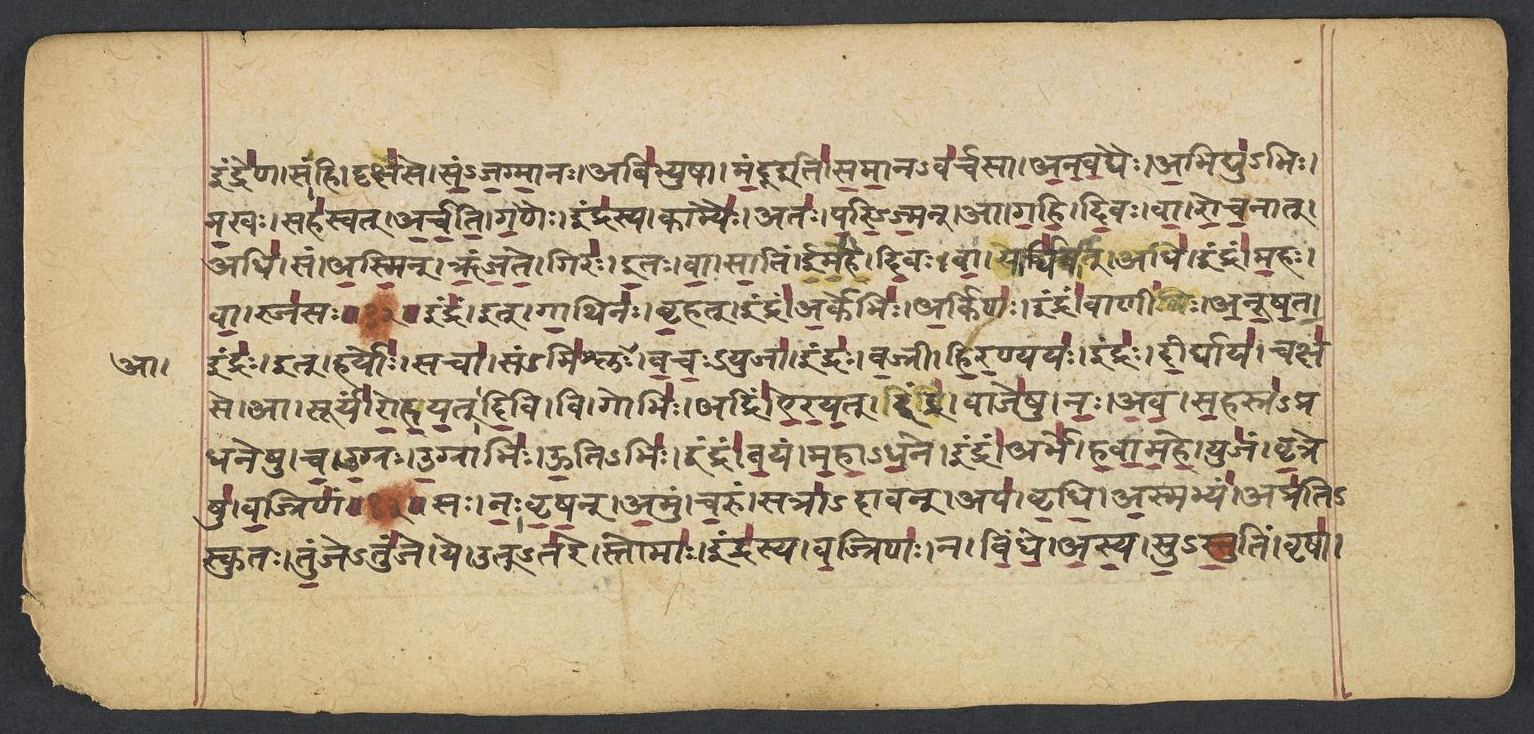
Where on the image
Penn Ms. Coll. 390 Item 41, fol. 4r (OPenn image 5, lower leaf). Checked on the image: the Rigveda text on this page begins in RV 1.6.7 ‹indreṇa sam hi dṛkṣase›. The next page with Rigveda text, fol. 4v, begins in RV 1.7.8 ‹yūthāiva vaṃsagaḥ kṛṣṭīḥ iyarti›. Verses 1.6.7-10 end on this page.
7indre̍ṇa̱ saṁ hi dṛkṣa̍se saṁjagmā̱no abi̍bhyuṣā | ma̱ndū sa̍mā̱nava̍rcasā ||
8a̱na̱va̱dyair a̱bhidyu̍bhir ma̱khaḥ saha̍svad arcati | ga̱ṇair indra̍sya̱ kāmyai̍ḥ ||
9ata̍ḥ parijma̱nn ā ga̍hi di̱vo vā̍ roca̱nād adhi̍ | sam a̍sminn ṛñjate̱ gira̍ḥ ||
10i̱to vā̍ sā̱tim īma̍he di̱vo vā̱ pārthi̍vā̱d adhi̍ | indra̍m ma̱ho vā̱ raja̍saḥ ||
Compare: Padapāṭha (word-by-word text written in the manuscript; Sansknet e-text via GRETIL)
7indreṇa | sam | hi | dṛkṣase | sam-jagmānaḥ | abibhyuṣā | mandū iti | samāna-varcasā
8anavadyaiḥ | abhidyu-bhiḥ | makhaḥ | sahasvat | arcati | gaṇaiḥ | indrasya | kāmyaiḥ
9ataḥ | parijman | ā | gahi | divaḥ | vā | rocanāt | adhi | sam | asmin | ṛñjate | giraḥ
10itaḥ | vā | sātim | īmahe | diva | vā | pārthivāt | adhi | indram | mahaḥ | vā | rajasaḥ
7Mayest thou verily be seen coming by fearless Indra's side: Both joyous, equal in your sheen.
8With Indra's well beloved hosts, the blameless, hastening to heaven, The sacrificer cries aloud.
9Come from this place, O Wanderer, or downward from the light of heaven: Our songs of praise all yearn for this.
10Indra we seek to give us help, from here, from heaven above the earth, Or from the spacious firmament.
Notes
- Sanskrit: Aufrecht's edition (1877) with the Vedic accents, as entered by van Nooten and Holland (GRETIL).
- English: Ralph T. H. Griffith, The Hymns of the Rigveda (1889-1892; 2nd ed. 1896-1897), from the VedaWeb digital text; OCR slips in that text were corrected against the printed 2nd edition (data/sources/rigveda/griffith_errata.json).
- Padapāṭha (edition text): Sansknet e-text via GRETIL (CC BY-NC-SA 4.0).
Cite
Sources
- Source: Penn Ms. Coll. 390 Item 41 (undated (catalogued with Penn's 18th-19th c. Vedic manuscripts)), OPenn, Public Domain Mark + Aufrecht's accented text (GRETIL) + Griffith's English (VedaWeb) (holding institution)
- Critical edition: Aufrecht (1877), accented e-text via GRETIL
← previous · → next · v cycle view · l back to library