Rigveda 1.57: To Indra
Introduction
Rigveda 1.57 is a hymn of 6 verses addressed to Indra. It stands in book (maṇḍala) 1, a collection of hymns by many families of poets. The Rigveda is the oldest collection of Sanskrit hymns, composed in the second half of the second millennium BCE and handed down orally for many centuries before it was written down.
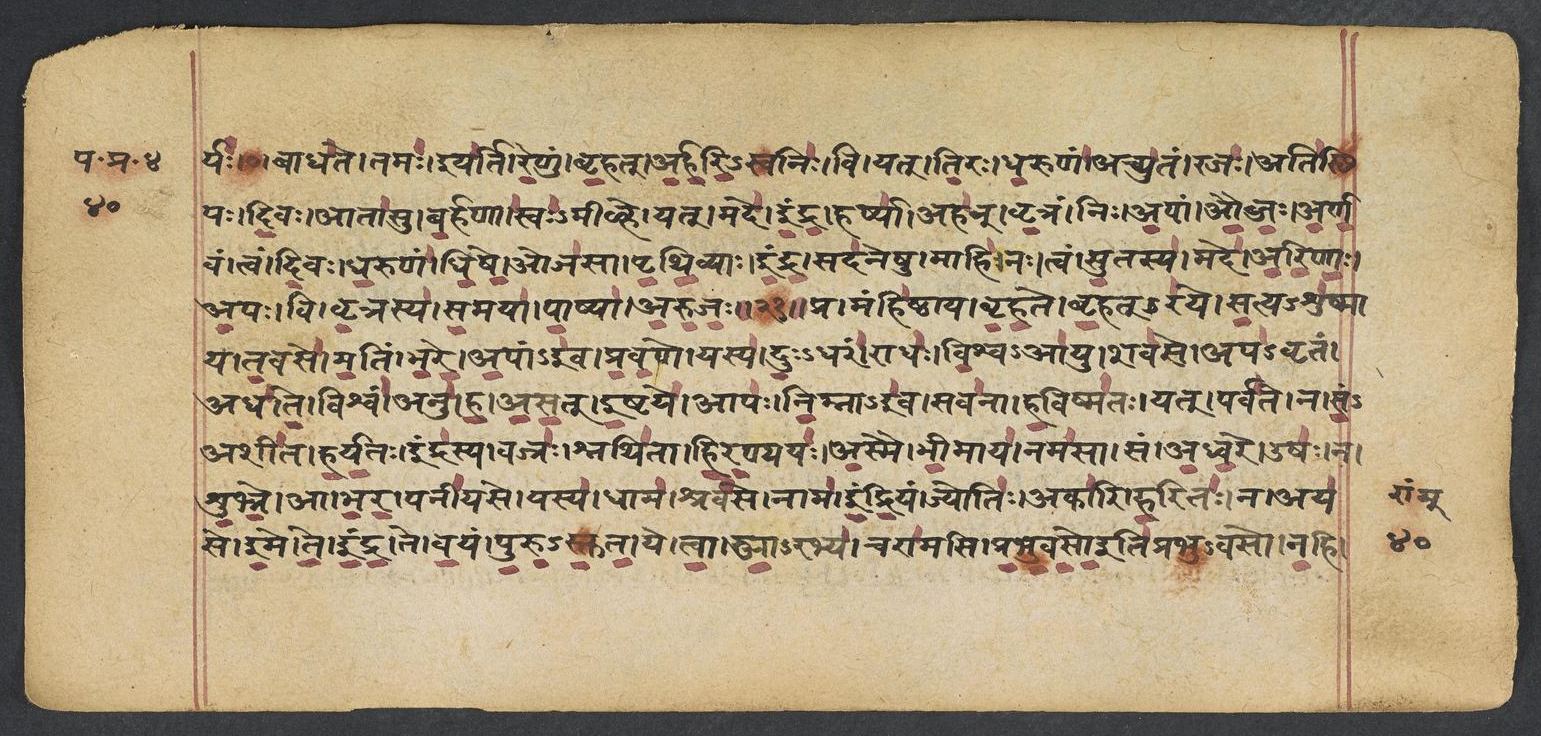
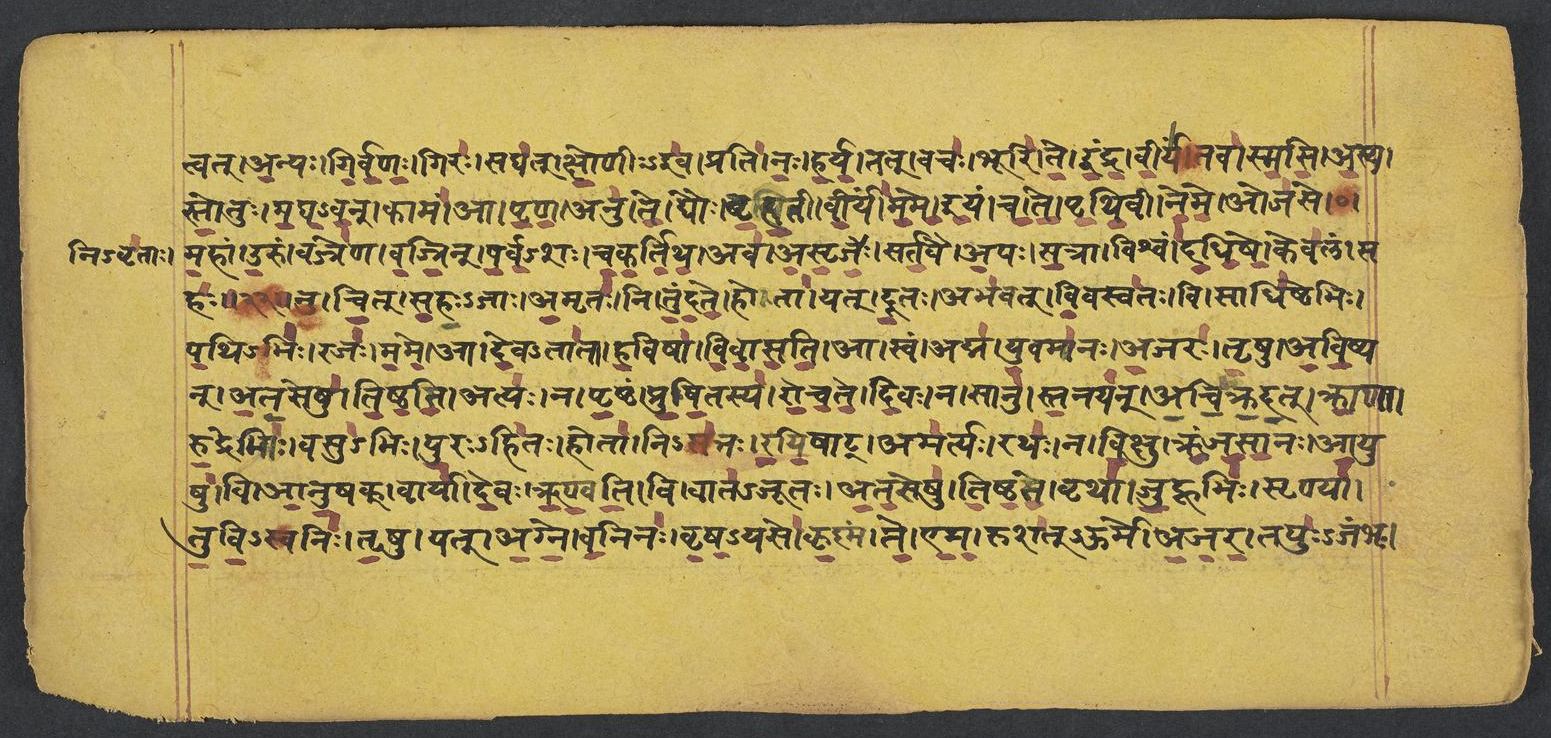
The manuscript shown is Penn Ms. Coll. 390 Item 41 (University of Pennsylvania), an undated paper manuscript of the padapāṭha (the word-by-word recitation text, in which every word is written separately and compounds are split) of the whole Ṛgveda in Devanāgarī, 884 leaves in fascicles, 7-9 lines to the page, accents in red; this hymn stands on fol. 40v-41r. Each section below gives the verses that end on one page; the page boundaries were read on the images (the opening words of every page), not counted out. Where the manuscript is a padapāṭha (the word-by-word recitation text), the section shows Aufrecht's continuous (saṃhitā) text first and, as the edition text, the padapāṭha of the same verses, which is the form written on the page.
How was this verified? (Provenance)
Where on the image
Penn Ms. Coll. 390 Item 41, fol. 40v (OPenn image 42, upper leaf). Checked on the image: the Rigveda text on this page begins in RV 1.56.4 ‹-śavasā bādhate tamaḥ iyarti›. The next page with Rigveda text, fol. 41r, begins in RV 1.57.4 ‹tvat anyaḥ girvaṇaḥ giraḥ›. Verses 1.57.1-3 end on this page.
1pra maṁhi̍ṣṭhāya bṛha̱te bṛ̱hadra̍ye sa̱tyaśu̍ṣmāya ta̱vase̍ ma̱tim bha̍re | a̱pām i̍va prava̱ṇe yasya̍ du̱rdhara̱ṁ rādho̍ vi̱śvāyu̱ śava̍se̱ apā̍vṛtam ||
2adha̍ te̱ viśva̱m anu̍ hāsad i̱ṣṭaya̱ āpo̍ ni̱mneva̱ sava̍nā ha̱viṣma̍taḥ | yat parva̍te̱ na sa̱maśī̍ta harya̱ta indra̍sya̱ vajra̱ḥ śnathi̍tā hira̱ṇyaya̍ḥ ||
3a̱smai bhī̱māya̱ nama̍sā̱ sam a̍dhva̱ra uṣo̱ na śu̍bhra̱ ā bha̍rā̱ panī̍yase | yasya̱ dhāma̱ śrava̍se̱ nāme̍ndri̱yaṁ jyoti̱r akā̍ri ha̱rito̱ nāya̍se ||
Compare: Padapāṭha (word-by-word text written in the manuscript; Sansknet e-text via GRETIL)
1pra | maṃhiṣṭhāya | bṛhate | bṛhat-raye | satya-śuṣmāya | tavase | matim | bhare | apām-iva | pravaṇe | yasya | duḥ-dharam | rādhaḥ | viśva-āyu | śavase | apa-vṛtam
2agha | te | viśvam | anu | ha | asat | iṣṭaye | āpaḥ | nimnāiva | savanā | haviṣmataḥ | yat | parvate | na | sam-aśīta | haryataḥ | indrasya | vajraḥ | śnathitā | hiraṇyayaḥ
3asmai | bhīmāya | namasā | sam | adhvare | uṣaḥ | na | śubhre | ā | bhara | panīyase | yasya | dhāma | śravase | nāma | indriyam | jyotiḥ | akāri | haritaḥ | na | ayase
1To him most liberal, lofty Lord of lofty wealth, verily powerful and strong, I bring my hymn,– Whose checkless bounty, as of waters down a slope, is spread abroad for all that live, to give them strength.
2Now all this world, for worship, shall come after thee-the offerer's libations like floods to the depth, When the well-loved one seems to rest upon the hill, the thunderbolt of Indra, shatterer wrought of gold.
3To him the terrible, most meet for lofty praise, like bright Dawn, now bring gifts with reverence in this rite, Whose being, for renown, yea, Indra-power and light, have been created, like bay steeds, to move with speed.
Where on the image
Penn Ms. Coll. 390 Item 41, fol. 41r (OPenn image 42, lower leaf). Checked on the image: the Rigveda text on this page begins in RV 1.57.4 ‹tvat anyaḥ girvaṇaḥ giraḥ›. The next page with Rigveda text, fol. 41v, begins in RV 1.58.5 ‹vane ā vāta-coditaḥ yūthe›. Verses 1.57.4-6 end on this page; 1.57.4 begins on fol. 40v.
4i̱me ta̍ indra̱ te va̱yam pu̍ruṣṭuta̱ ye tvā̱rabhya̱ carā̍masi prabhūvaso | na̱hi tvad a̱nyo gi̍rvaṇo̱ gira̱ḥ sagha̍t kṣo̱ṇīr i̍va̱ prati̍ no harya̱ tad vaca̍ḥ ||
5bhūri̍ ta indra vī̱rya1̱̍ṁ tava̍ smasy a̱sya sto̱tur ma̍ghava̱n kāma̱m ā pṛ̍ṇa | anu̍ te̱ dyaur bṛ̍ha̱tī vī̱rya̍m mama i̱yaṁ ca̍ te pṛthi̱vī ne̍ma̱ oja̍se ||
6tvaṁ tam i̍ndra̱ parva̍tam ma̱hām u̱ruṁ vajre̍ṇa vajrin parva̱śaś ca̍kartitha | avā̍sṛjo̱ nivṛ̍tā̱ḥ sarta̱vā a̱paḥ sa̱trā viśva̍ṁ dadhiṣe̱ keva̍la̱ṁ saha̍ḥ ||
Compare: Padapāṭha (word-by-word text written in the manuscript; Sansknet e-text via GRETIL)
4ime | te | indra | te | vayam | puru-stuta | ye | tvā | ārabhya | carāmasi | prabhuvaso itiprabhu-vaso | nahi | tvat | anyaḥ | girvaṇaḥ | giraḥ | saghat | kṣoṇīḥ-iva | prati | naḥ | harya | tat | vacaḥ
5bhūri | te | indra | vīryam | tava | smasi | asya | stotuḥ | magha-van | kāmam | ā | pṛṇa | anu | te | dyauḥ | bṛhatī | vīryam | mame | iyam | ca | te | pṛthivī | neme | ojase
6tvam | tam | indra | parvatam | mahām | urum | vajreṇa | vajrin | parva-śaḥ | cakartitha | ava | asṛjaḥ | ni-vṛtāḥ | sartavai | apaḥ | satrā | viśvam | dadhiṣe | kevalam | sahaḥ
4Thine, Indra, praised by many, excellently rich! are we who trusting in thy help draw near to thee. Lover of praise, none else but thou receives our laud: as earth loves all her creatures, love thou this our hymn.
5Great is thy power, O Indra, we are thine. Fulfil, O Maghavan, the wish of this thy worshipper. After thee lofty heaven hath measured out its strength: to thee and to thy power this earth hath bowed itself.
6Thou, who hast thunder for thy weapon, with thy bolt hast shattered into pieces this broad massive cloud. Thou hast sent down the obstructed floods that they may flow: thou hast, thine own for ever, all victorious might.
Notes
- Sanskrit: Aufrecht's edition (1877) with the Vedic accents, as entered by van Nooten and Holland (GRETIL).
- English: Ralph T. H. Griffith, The Hymns of the Rigveda (1889-1892; 2nd ed. 1896-1897), from the VedaWeb digital text; OCR slips in that text were corrected against the printed 2nd edition (data/sources/rigveda/griffith_errata.json).
- Padapāṭha (edition text): Sansknet e-text via GRETIL (CC BY-NC-SA 4.0).
Cite
Sources
- Source: Penn Ms. Coll. 390 Item 41 (undated (catalogued with Penn's 18th-19th c. Vedic manuscripts)), OPenn, Public Domain Mark + Aufrecht's accented text (GRETIL) + Griffith's English (VedaWeb) (holding institution)
- Critical edition: Aufrecht (1877), accented e-text via GRETIL
← previous · → next · v cycle view · l back to library