Rigveda 1.7: To Indra
Introduction
Rigveda 1.7 is a hymn of 10 verses addressed to Indra. It stands in book (maṇḍala) 1, a collection of hymns by many families of poets. The Rigveda is the oldest collection of Sanskrit hymns, composed in the second half of the second millennium BCE and handed down orally for many centuries before it was written down.
The manuscript shown is Penn Ms. Coll. 390 Item 41 (University of Pennsylvania), an undated paper manuscript of the padapāṭha (the word-by-word recitation text, in which every word is written separately and compounds are split) of the whole Ṛgveda in Devanāgarī, 884 leaves in fascicles, 7-9 lines to the page, accents in red; this hymn stands on fol. 4r-4v. Each section below gives the verses that end on one page; the page boundaries were read on the images (the opening words of every page), not counted out. Where the manuscript is a padapāṭha (the word-by-word recitation text), the section shows Aufrecht's continuous (saṃhitā) text first and, as the edition text, the padapāṭha of the same verses, which is the form written on the page.
How was this verified? (Provenance)
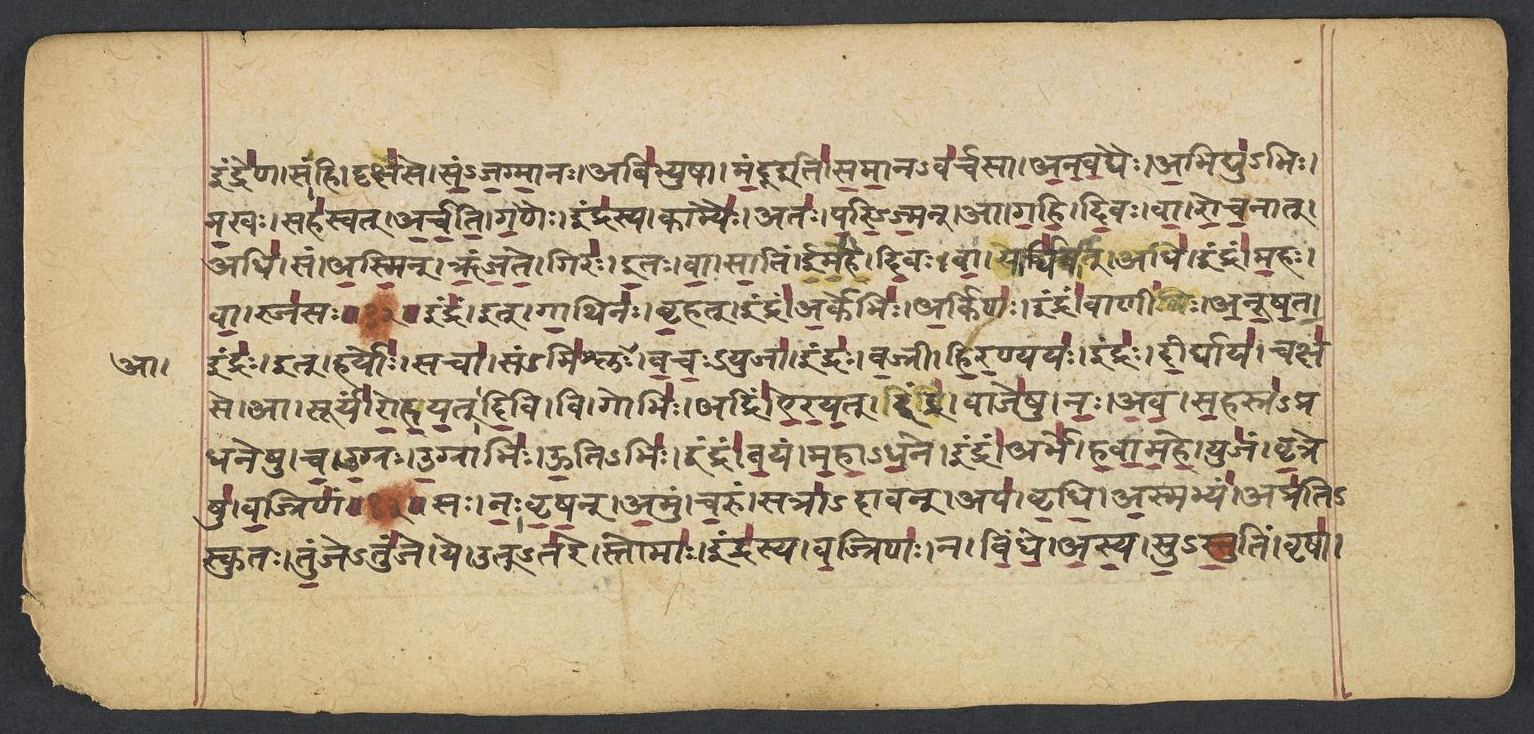
Where on the image
Penn Ms. Coll. 390 Item 41, fol. 4r (OPenn image 5, lower leaf). Checked on the image: the Rigveda text on this page begins in RV 1.6.7 ‹indreṇa sam hi dṛkṣase›. The next page with Rigveda text, fol. 4v, begins in RV 1.7.8 ‹yūthāiva vaṃsagaḥ kṛṣṭīḥ iyarti›. Verses 1.7.1-7 end on this page.
1indra̱m id gā̱thino̍ bṛ̱had indra̍m a̱rkebhi̍r a̱rkiṇa̍ḥ | indra̱ṁ vāṇī̍r anūṣata ||
2indra̱ id dharyo̱ḥ sacā̱ sammi̍śla̱ ā va̍co̱yujā̍ | indro̍ va̱jrī hi̍ra̱ṇyaya̍ḥ ||
3indro̍ dī̱rghāya̱ cakṣa̍sa̱ ā sūrya̍ṁ rohayad di̱vi | vi gobhi̱r adri̍m airayat ||
4indra̱ vāje̍ṣu no 'va sa̱hasra̍pradhaneṣu ca | u̱gra u̱grābhi̍r ū̱tibhi̍ḥ ||
5indra̍ṁ va̱yam ma̍hādha̱na indra̱m arbhe̍ havāmahe | yuja̍ṁ vṛ̱treṣu̍ va̱jriṇa̍m ||
6sa no̍ vṛṣann a̱muṁ ca̱ruṁ satrā̍dāva̱nn apā̍ vṛdhi | a̱smabhya̱m apra̍tiṣkutaḥ ||
7tu̱ñje-tu̍ñje̱ ya utta̍re̱ stomā̱ indra̍sya va̱jriṇa̍ḥ | na vi̍ndhe asya suṣṭu̱tim ||
Compare: Padapāṭha (word-by-word text written in the manuscript; Sansknet e-text via GRETIL)
1indram | it | gāthinaḥ | bṛhat | indram | arkebhiḥ | arkiṇaḥ | indram | vāṇīḥ | anūṣata
2indraḥ | it | haryoḥ | sacā | sam-miślaḥ | ā | vacaḥ-yujā | indraḥ | vajrī | hiraṇyayaḥ
3indraḥ | dīrghāya | cakṣase | ā | sūryam | rohayat | divi | vi | gobhiḥ | adrim | airayat
4indraḥ | vājeṣu | naḥ | ava | sahasra-pradhaneṣu | ca | ugraḥ | ugrābhiḥ | ūti-bhiḥ
5indram | vayam | mahādhane | indram | arbhe | havāmahe | yujam | vṛtreṣu | vajriṇam
6saḥ | naḥ | vṛṣan amum | carum | satrādāvan | apa | vṛdhi | asmabhyam | aprati-skutaḥ
7tuñje--tuñje | ye | ut-tare | stomāḥ | indrasya | vajriṇaḥ | na | vindhe | asya | su-stutim
1INDRA the singers with high praise, Indra reciters with their lauds, Indra the choirs have glorified.
2Indra hath ever close to him his two bay steeds and word-yoked car, Indra the golden, thunder-armed.
3Indra hath raised the Sun on high in heaven, that he may see afar: He burst the mountain for the kine.
4Help us, O Indra, in the frays, yea, frays, where thousand spoils are gained, With awful aids, O awful One.
5In mighty battle we invoke Indra, Indra in lesser fight, The Friend who bends his bolt at fiends.
6Unclose, our manly Hero, thou for ever bounteous, yonder cloud, For us, thou irresistible.
7Still higher, at each strain of mine, thunder-armed Indra's praises rise: I find no laud worthy of him.
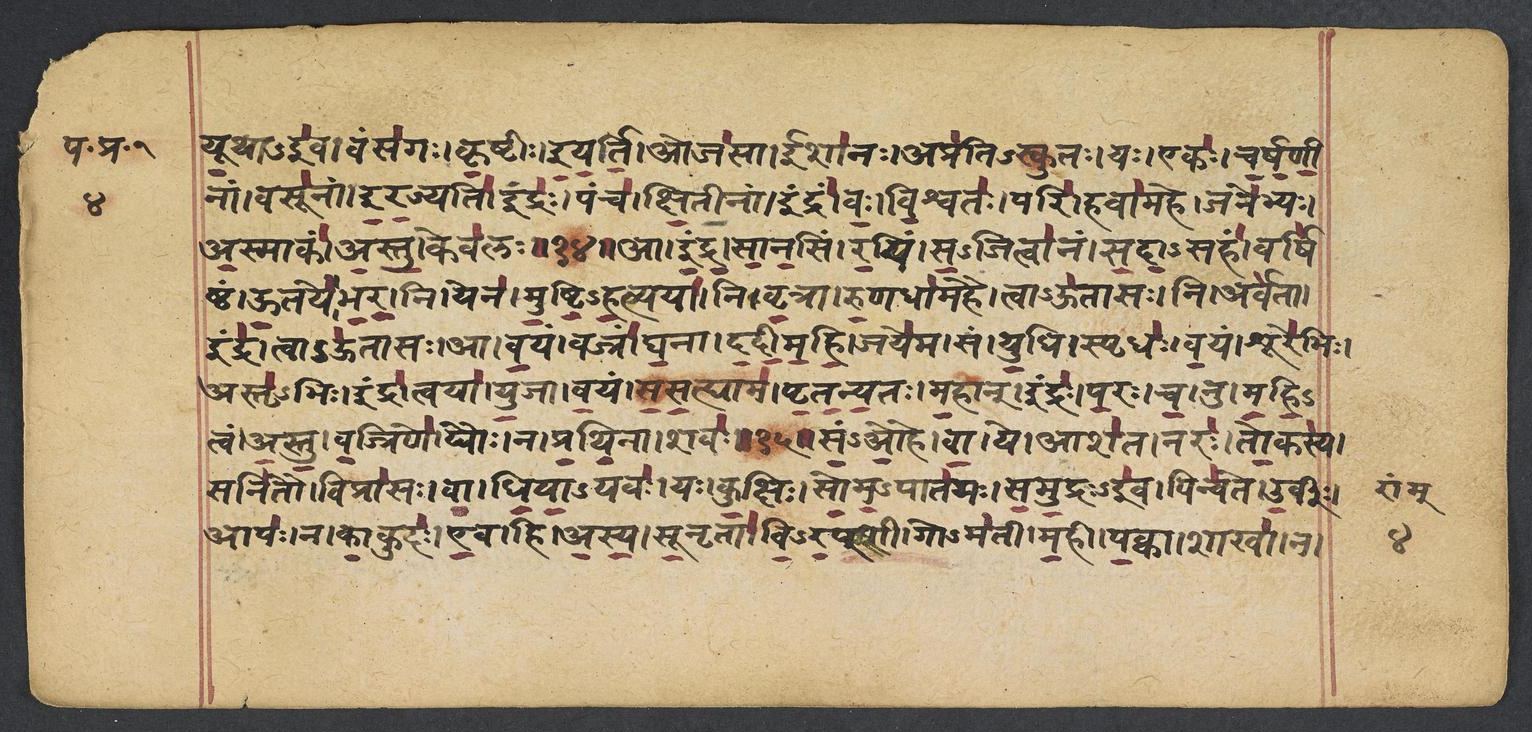
Where on the image
Penn Ms. Coll. 390 Item 41, fol. 4v (OPenn image 6, upper leaf). Checked on the image: the Rigveda text on this page begins in RV 1.7.8 ‹yūthāiva vaṃsagaḥ kṛṣṭīḥ iyarti›. The next page with Rigveda text, fol. 5r, begins in RV 1.8.8 ‹dāśuṣe›. Verses 1.7.8-10 end on this page; 1.7.8 begins on fol. 4r.
8vṛṣā̍ yū̱theva̱ vaṁsa̍gaḥ kṛ̱ṣṭīr i̍ya̱rty oja̍sā | īśā̍no̱ apra̍tiṣkutaḥ ||
9ya eka̍ś carṣaṇī̱nāṁ vasū̍nām ira̱jyati̍ | indra̱ḥ pañca̍ kṣitī̱nām ||
10indra̍ṁ vo vi̱śvata̱s pari̱ havā̍mahe̱ jane̍bhyaḥ | a̱smāka̍m astu̱ keva̍laḥ ||
Compare: Padapāṭha (word-by-word text written in the manuscript; Sansknet e-text via GRETIL)
8vṛṣā | yūthāiva | vaṃsagaḥ | kṛṣṭīḥ iyarti | ojasā | īśānaḥ | aprati-skutaḥ
9yaḥ | ekaḥ | carṣaṇīnām | vasūnām | irajyati | indraḥ | pañca | kṣitīnām
10indram | vaḥ | viśvataḥ | pari | havāmahe | janebhyaḥ | asmākam | astu | kevalaḥ
8Even as the bull drives on the herds, he drives the people with his might, The Ruler irresistible:
9Indra who rules with single sway men, riches, and the fivefold race Of those who dwell upon the earth.
10For your sake from each side we call Indra away from other men: Ours, and none others', may he be.
Notes
- Sanskrit: Aufrecht's edition (1877) with the Vedic accents, as entered by van Nooten and Holland (GRETIL).
- English: Ralph T. H. Griffith, The Hymns of the Rigveda (1889-1892; 2nd ed. 1896-1897), from the VedaWeb digital text; OCR slips in that text were corrected against the printed 2nd edition (data/sources/rigveda/griffith_errata.json).
- Padapāṭha (edition text): Sansknet e-text via GRETIL (CC BY-NC-SA 4.0).
Cite
Sources
- Source: Penn Ms. Coll. 390 Item 41 (undated (catalogued with Penn's 18th-19th c. Vedic manuscripts)), OPenn, Public Domain Mark + Aufrecht's accented text (GRETIL) + Griffith's English (VedaWeb) (holding institution)
- Critical edition: Aufrecht (1877), accented e-text via GRETIL
← previous · → next · v cycle view · l back to library