Rigveda 1.65: To Agni
Introduction
Rigveda 1.65 is a hymn of 10 verses addressed to Agni. It stands in book (maṇḍala) 1, a collection of hymns by many families of poets. The Rigveda is the oldest collection of Sanskrit hymns, composed in the second half of the second millennium BCE and handed down orally for many centuries before it was written down.
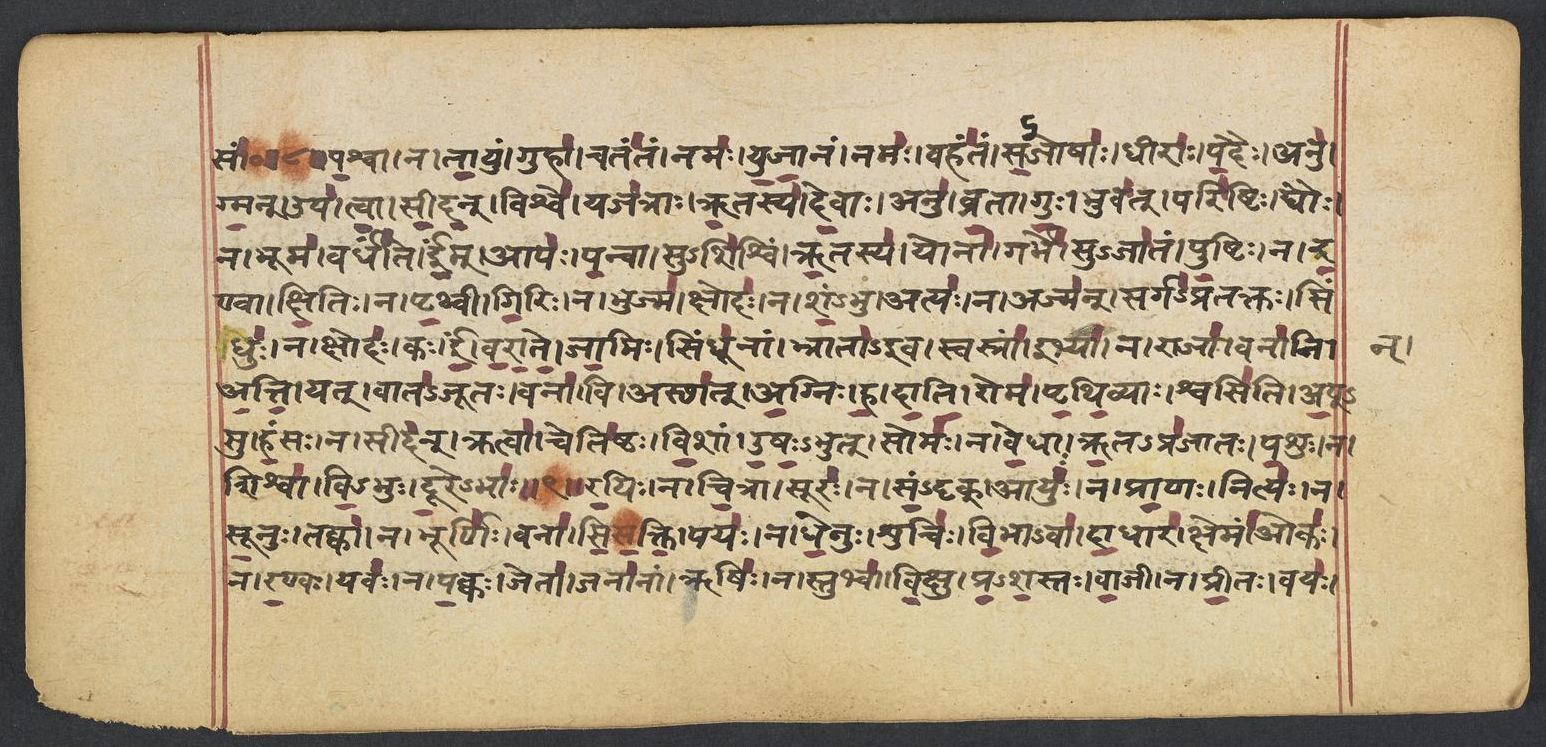
The manuscript shown is Penn Ms. Coll. 390 Item 41 (University of Pennsylvania), an undated paper manuscript of the padapāṭha (the word-by-word recitation text, in which every word is written separately and compounds are split) of the whole Ṛgveda in Devanāgarī, 884 leaves in fascicles, 7-9 lines to the page, accents in red; this hymn stands on fol. 47r. Each section below gives the verses that end on one page; the page boundaries were read on the images (the opening words of every page), not counted out. Where the manuscript is a padapāṭha (the word-by-word recitation text), the section shows Aufrecht's continuous (saṃhitā) text first and, as the edition text, the padapāṭha of the same verses, which is the form written on the page.
How was this verified? (Provenance)
Where on the image
Penn Ms. Coll. 390 Item 41, fol. 47r (OPenn image 48, lower leaf). Checked on the image: the Rigveda text on this page begins in RV 1.64.15 ‹-jagamyāt›. The next page with Rigveda text, fol. 47v, begins in RV 1.66.4 ‹dadhāti›. Verses 1.65.1-10 end on this page.
1pa̱śvā na tā̱yuṁ guhā̱ cata̍nta̱ṁ namo̍ yujā̱naṁ namo̱ vaha̍ntam ||
2sa̱joṣā̱ dhīrā̍ḥ pa̱dair anu̍ gma̱nn upa̍ tvā sīda̱n viśve̱ yaja̍trāḥ ||
3ṛ̱tasya̍ de̱vā anu̍ vra̱tā gu̱r bhuva̱t pari̍ṣṭi̱r dyaur na bhūma̍ ||
4vardha̍ntī̱m āpa̍ḥ pa̱nvā suśi̍śvim ṛ̱tasya̱ yonā̱ garbhe̱ sujā̍tam ||
5pu̱ṣṭir na ra̱ṇvā kṣi̱tir na pṛ̱thvī gi̱rir na bhujma̱ kṣodo̱ na śa̱mbhu ||
6atyo̱ nājma̱n sarga̍pratakta̱ḥ sindhu̱r na kṣoda̱ḥ ka ī̍ṁ varāte ||
7jā̱miḥ sindhū̍nā̱m bhrāte̍va̱ svasrā̱m ibhyā̱n na rājā̱ vanā̍ny atti ||
8yad vāta̍jūto̱ vanā̱ vy asthā̍d a̱gnir ha̍ dāti̱ romā̍ pṛthi̱vyāḥ ||
9śvasi̍ty a̱psu ha̱ṁso na sīda̱n kratvā̱ ceti̍ṣṭho vi̱śām u̍ṣa̱rbhut ||
10somo̱ na ve̱dhā ṛ̱tapra̍jātaḥ pa̱śur na śiśvā̍ vi̱bhur dū̱rebhā̍ḥ ||
Compare: Padapāṭha (word-by-word text written in the manuscript; Sansknet e-text via GRETIL)
1paśvā | na | tāyum | guhā | catantam | namaḥ | yujānam | namaḥ | vahantam
2sajoṣāḥ | dhīrāḥ | padaiḥ | anu | gman | upa | tvā | sīdan | viśve | yajatrāḥ
3ṛtasya | devāḥ | anu | vratā | guḥ | bhuvat | pariṣṭiḥ | dyauḥ | na | bhūma
4vardhanti | īm | āpaḥ | panvā | su-śiśvim | ṛtasya | yonā | garbhe | su-jātam
5puṣṭiḥ | na | raṇvā | kṣitiḥ | na | pṛthvī | giriḥ | na | bhujma | kṣodaḥ | na | śam-bhu
6atyaḥ | na | ajman | sarga-prataktaḥ | sindhuḥ | na | kṣodaḥ | kaḥ | im | varāte
7jāmiḥ | sindhūnām | bhrātāiva | svasrām | ibhyān | na | rājā | vanāni | atti
8yat | vāta-jūtaḥ | vanā | vi | asthāt | agniḥ | ha | dāti | roma | pṛthivyāḥ
9śvasiti | ap-su | haṃsaḥ | na | sīdan | kratvā | cetiṣṭhaḥ | viśām | uṣaḥ-bhut
10somaḥ | na | vedhāḥ | ṛta-prajātaḥ | paśuḥ | na | śiśvā | vi-bhuḥ | dūre--bhāḥ
1ONE-MINDED, wise, they tracked thee like a thief lurking in dark cave with a stolen cow; Thee claiming worship, bearing it to Gods : there nigh to thee sate all the Holy Ones.
2ONE-MINDED, wise, they tracked thee like a thief lurking in dark cave with a stolen cow; Thee claiming worship, bearing it to Gods : there nigh to thee sate all the Holy Ones.
3The Gods approached the ways of holy Law; there was a gathering vast as heaven itself.
4The waters feed with praise the growing Babe, born nobly in the womb, the seat of Law.
5Like grateful food, like some wide dwelling place, like a fruit-bearing hill, a wholesome stream.
6Like a steed urged to run in swift career, rushing like Sindhu, who may check his course?
7Kin as a brother to his sister floods, he eats the woods as a King eats the rich.
8When through the forest, urged by wind, he spreads, verily Agni shears the hair of earth.
9Like a swan sitting in the floods he pants wisest in mind mid men he wakes at morn.
10A Sage like Soma, sprung from Law, he grew like some young creature, mighty, shining far.
Notes
- Sanskrit: Aufrecht's edition (1877) with the Vedic accents, as entered by van Nooten and Holland (GRETIL).
- English: Ralph T. H. Griffith, The Hymns of the Rigveda (1889-1892; 2nd ed. 1896-1897), from the VedaWeb digital text; OCR slips in that text were corrected against the printed 2nd edition (data/sources/rigveda/griffith_errata.json).
- Padapāṭha (edition text): Sansknet e-text via GRETIL (CC BY-NC-SA 4.0).
Cite
Sources
- Source: Penn Ms. Coll. 390 Item 41 (undated (catalogued with Penn's 18th-19th c. Vedic manuscripts)), OPenn, Public Domain Mark + Aufrecht's accented text (GRETIL) + Griffith's English (VedaWeb) (holding institution)
- Critical edition: Aufrecht (1877), accented e-text via GRETIL
← previous · → next · v cycle view · l back to library